 Add to Chrome
 Add to Firefox
 Add to Edge
Generative Table Pre-training Empowers Models for Tabular Prediction
May 16, 2023

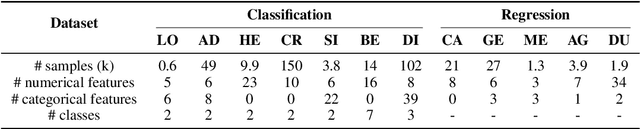

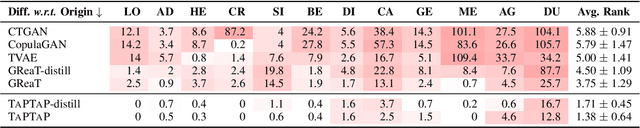
Recently, the topic of table pre-training has attracted considerable research interest. However, how to employ table pre-training to boost the performance of tabular prediction remains an open challenge. In this paper, we propose TapTap, the first attempt that leverages table pre-training to empower models for tabular prediction. After pre-training on a large corpus of real-world tabular data, TapTap can generate high-quality synthetic tables to support various applications on tabular data, including privacy protection, low resource regime, missing value imputation, and imbalanced classification. Extensive experiments on 12 datasets demonstrate that TapTap outperforms a total of 16 baselines in different scenarios. Meanwhile, it can be easily combined with various backbone models, including LightGBM, Multilayer Perceptron (MLP) and Transformer. Moreover, with the aid of table pre-training, models trained using synthetic data generated by TapTap can even compete with models using the original dataset on half of the experimental datasets, marking a milestone in the development of synthetic tabular data generation. The codes are available at https://github.com/ZhangTP1996/TapTap.

Nonparametric Generative Modeling with Conditional and Locally-Connected Sliced-Wasserstein Flows
May 03, 2023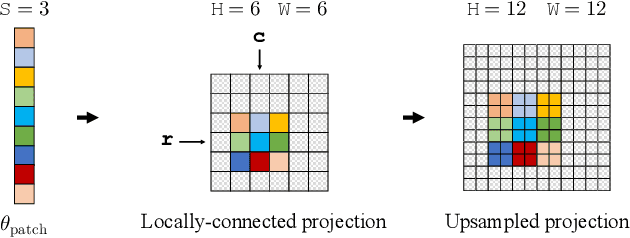
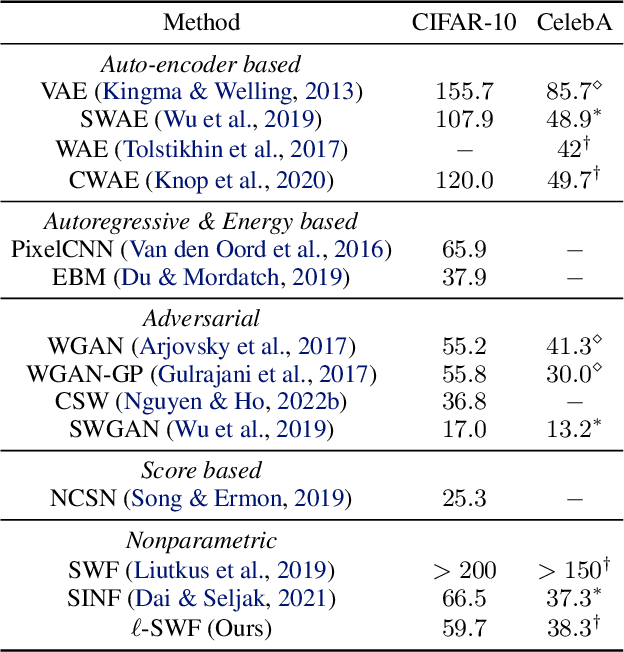
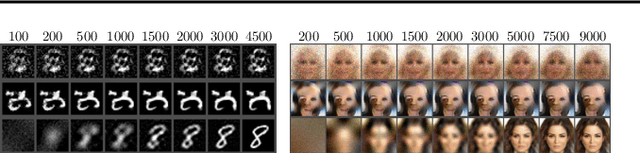

Sliced-Wasserstein Flow (SWF) is a promising approach to nonparametric generative modeling but has not been widely adopted due to its suboptimal generative quality and lack of conditional modeling capabilities. In this work, we make two major contributions to bridging this gap. First, based on a pleasant observation that (under certain conditions) the SWF of joint distributions coincides with those of conditional distributions, we propose Conditional Sliced-Wasserstein Flow (CSWF), a simple yet effective extension of SWF that enables nonparametric conditional modeling. Second, we introduce appropriate inductive biases of images into SWF with two techniques inspired by local connectivity and multiscale representation in vision research, which greatly improve the efficiency and quality of modeling images. With all the improvements, we achieve generative performance comparable with many deep parametric generative models on both conditional and unconditional tasks in a purely nonparametric fashion, demonstrating its great potential.
A Review of Deep Learning for Video Captioning
Apr 22, 2023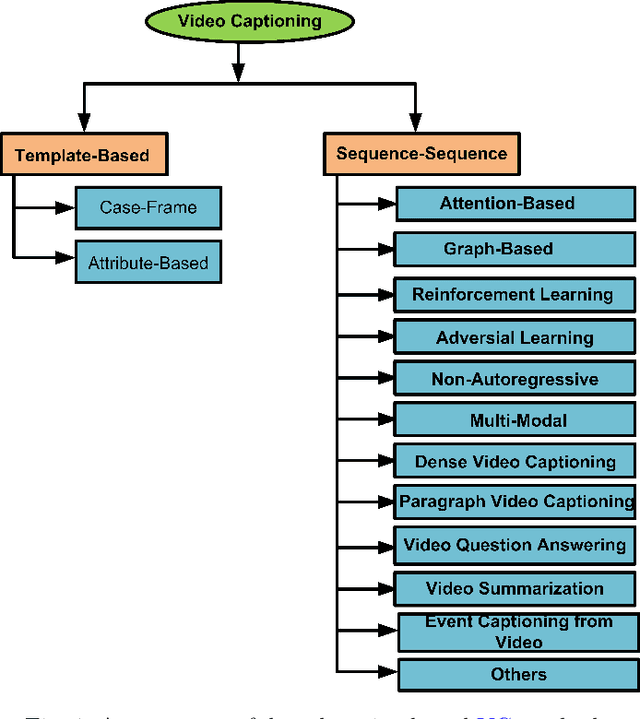
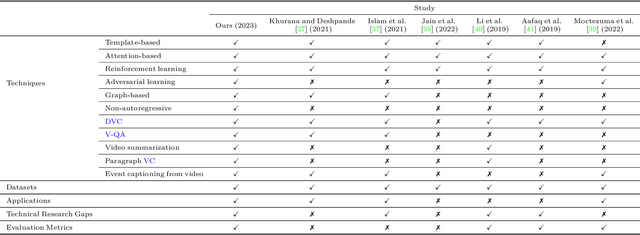
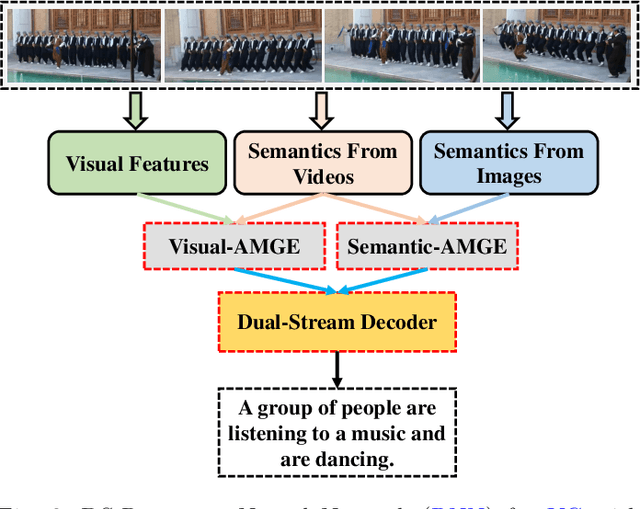
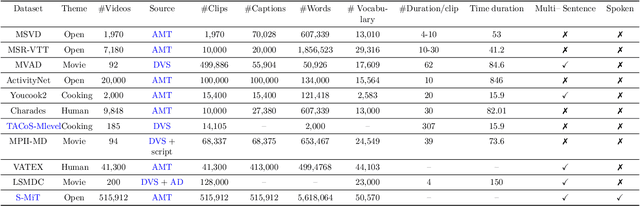
Video captioning (VC) is a fast-moving, cross-disciplinary area of research that bridges work in the fields of computer vision, natural language processing (NLP), linguistics, and human-computer interaction. In essence, VC involves understanding a video and describing it with language. Captioning is used in a host of applications from creating more accessible interfaces (e.g., low-vision navigation) to video question answering (V-QA), video retrieval and content generation. This survey covers deep learning-based VC, including but, not limited to, attention-based architectures, graph networks, reinforcement learning, adversarial networks, dense video captioning (DVC), and more. We discuss the datasets and evaluation metrics used in the field, and limitations, applications, challenges, and future directions for VC.
Exploring Incompatible Knowledge Transfer in Few-shot Image Generation
Apr 15, 2023Few-shot image generation (FSIG) learns to generate diverse and high-fidelity images from a target domain using a few (e.g., 10) reference samples. Existing FSIG methods select, preserve and transfer prior knowledge from a source generator (pretrained on a related domain) to learn the target generator. In this work, we investigate an underexplored issue in FSIG, dubbed as incompatible knowledge transfer, which would significantly degrade the realisticness of synthetic samples. Empirical observations show that the issue stems from the least significant filters from the source generator. To this end, we propose knowledge truncation to mitigate this issue in FSIG, which is a complementary operation to knowledge preservation and is implemented by a lightweight pruning-based method. Extensive experiments show that knowledge truncation is simple and effective, consistently achieving state-of-the-art performance, including challenging setups where the source and target domains are more distant. Project Page: yunqing-me.github.io/RICK.
CoSDA: Continual Source-Free Domain Adaptation
Apr 13, 2023


Without access to the source data, source-free domain adaptation (SFDA) transfers knowledge from a source-domain trained model to target domains. Recently, SFDA has gained popularity due to the need to protect the data privacy of the source domain, but it suffers from catastrophic forgetting on the source domain due to the lack of data. To systematically investigate the mechanism of catastrophic forgetting, we first reimplement previous SFDA approaches within a unified framework and evaluate them on four benchmarks. We observe that there is a trade-off between adaptation gain and forgetting loss, which motivates us to design a consistency regularization to mitigate forgetting. In particular, we propose a continual source-free domain adaptation approach named CoSDA, which employs a dual-speed optimized teacher-student model pair and is equipped with consistency learning capability. Our experiments demonstrate that CoSDA outperforms state-of-the-art approaches in continuous adaptation. Notably, our CoSDA can also be integrated with other SFDA methods to alleviate forgetting.
InceptionNeXt: When Inception Meets ConvNeXt
Mar 29, 2023Inspired by the long-range modeling ability of ViTs, large-kernel convolutions are widely studied and adopted recently to enlarge the receptive field and improve model performance, like the remarkable work ConvNeXt which employs 7x7 depthwise convolution. Although such depthwise operator only consumes a few FLOPs, it largely harms the model efficiency on powerful computing devices due to the high memory access costs. For example, ConvNeXt-T has similar FLOPs with ResNet-50 but only achieves 60% throughputs when trained on A100 GPUs with full precision. Although reducing the kernel size of ConvNeXt can improve speed, it results in significant performance degradation. It is still unclear how to speed up large-kernel-based CNN models while preserving their performance. To tackle this issue, inspired by Inceptions, we propose to decompose large-kernel depthwise convolution into four parallel branches along channel dimension, i.e. small square kernel, two orthogonal band kernels, and an identity mapping. With this new Inception depthwise convolution, we build a series of networks, namely IncepitonNeXt, which not only enjoy high throughputs but also maintain competitive performance. For instance, InceptionNeXt-T achieves 1.6x higher training throughputs than ConvNeX-T, as well as attains 0.2% top-1 accuracy improvement on ImageNet-1K. We anticipate InceptionNeXt can serve as an economical baseline for future architecture design to reduce carbon footprint. Code is available at https://github.com/sail-sg/inceptionnext.
Masked Diffusion Transformer is a Strong Image Synthesizer
Mar 25, 2023Despite its success in image synthesis, we observe that diffusion probabilistic models (DPMs) often lack contextual reasoning ability to learn the relations among object parts in an image, leading to a slow learning process. To solve this issue, we propose a Masked Diffusion Transformer (MDT) that introduces a mask latent modeling scheme to explicitly enhance the DPMs' ability of contextual relation learning among object semantic parts in an image. During training, MDT operates on the latent space to mask certain tokens. Then, an asymmetric masking diffusion transformer is designed to predict masked tokens from unmasked ones while maintaining the diffusion generation process. Our MDT can reconstruct the full information of an image from its incomplete contextual input, thus enabling it to learn the associated relations among image tokens. Experimental results show that MDT achieves superior image synthesis performance, e.g. a new SoTA FID score on the ImageNet dataset, and has about 3x faster learning speed than the previous SoTA DiT. The source code is released at https://github.com/sail-sg/MDT.
D4FT: A Deep Learning Approach to Kohn-Sham Density Functional Theory
Mar 01, 2023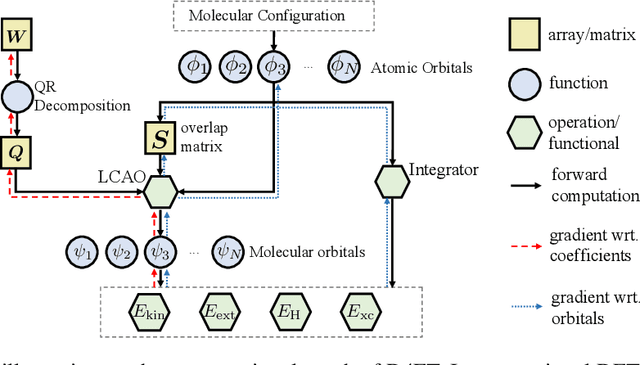

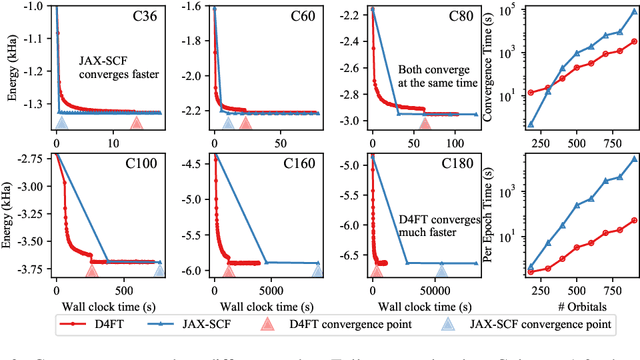

Kohn-Sham Density Functional Theory (KS-DFT) has been traditionally solved by the Self-Consistent Field (SCF) method. Behind the SCF loop is the physics intuition of solving a system of non-interactive single-electron wave functions under an effective potential. In this work, we propose a deep learning approach to KS-DFT. First, in contrast to the conventional SCF loop, we propose to directly minimize the total energy by reparameterizing the orthogonal constraint as a feed-forward computation. We prove that such an approach has the same expressivity as the SCF method, yet reduces the computational complexity from O(N^4) to O(N^3). Second, the numerical integration which involves a summation over the quadrature grids can be amortized to the optimization steps. At each step, stochastic gradient descent (SGD) is performed with a sampled minibatch of the grids. Extensive experiments are carried out to demonstrate the advantage of our approach in terms of efficiency and stability. In addition, we show that our approach enables us to explore more complex neural-based wave functions.
Contrastive Video Question Answering via Video Graph Transformer
Feb 27, 2023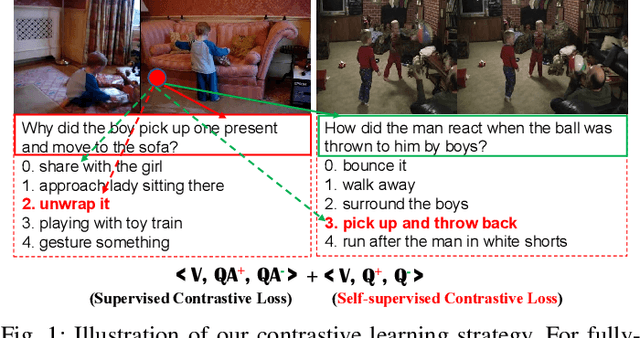

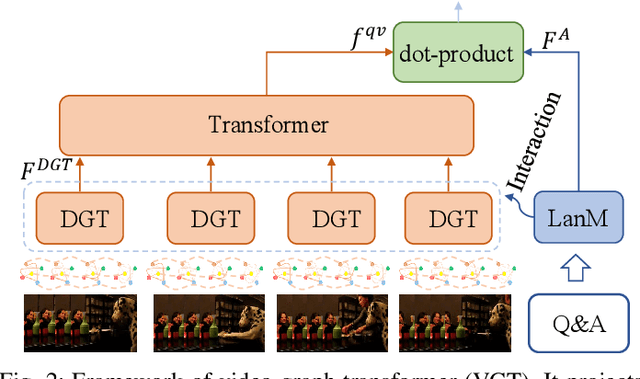

We propose to perform video question answering (VideoQA) in a Contrastive manner via a Video Graph Transformer model (CoVGT). CoVGT's uniqueness and superiority are three-fold: 1) It proposes a dynamic graph transformer module which encodes video by explicitly capturing the visual objects, their relations and dynamics, for complex spatio-temporal reasoning. 2) It designs separate video and text transformers for contrastive learning between the video and text to perform QA, instead of multi-modal transformer for answer classification. Fine-grained video-text communication is done by additional cross-modal interaction modules. 3) It is optimized by the joint fully- and self-supervised contrastive objectives between the correct and incorrect answers, as well as the relevant and irrelevant questions respectively. With superior video encoding and QA solution, we show that CoVGT can achieve much better performances than previous arts on video reasoning tasks. Its performances even surpass those models that are pretrained with millions of external data. We further show that CoVGT can also benefit from cross-modal pretraining, yet with orders of magnitude smaller data. The results demonstrate the effectiveness and superiority of CoVGT, and additionally reveal its potential for more data-efficient pretraining. We hope our success can advance VideoQA beyond coarse recognition/description towards fine-grained relation reasoning of video contents. Our code will be available at https://github.com/doc-doc/CoVGT.
On Calibrating Diffusion Probabilistic Models
Feb 21, 2023Recently, diffusion probabilistic models (DPMs) have achieved promising results in diverse generative tasks. A typical DPM framework includes a forward process that gradually diffuses the data distribution and a reverse process that recovers the data distribution from time-dependent data scores. In this work, we observe that the stochastic reverse process of data scores is a martingale, from which concentration bounds and the optional stopping theorem for data scores can be derived. Then, we discover a simple way for calibrating an arbitrary pretrained DPM, with which the score matching loss can be reduced and the lower bounds of model likelihood can consequently be increased. We provide general calibration guidelines under various model parametrizations. Our calibration method is performed only once and the resulting models can be used repeatedly for sampling. We conduct experiments on multiple datasets to empirically validate our proposal. Our code is at https://github.com/thudzj/Calibrated-DPMs.