 Add to Chrome
 Add to Firefox
 Add to Edge
UNITY: Attention Flow Networks for Adaptive Conditioning in Diffusion
Jun 18, 2026
We introduce UNITY, a Universal-to-Specialized adapter for efficient and scalable composite conditioning in diffusion based image generation. Unlike prior methods that train separate adapters for each conditioning modality, UNITY jointly learns shared semantics across multiple conditioning types and subsequently specializes without modifying the underlying architecture. The proposed two stage training paradigm consists of a Universal Stage that captures cross modal representations across all conditioning modalities using half of the total training steps, followed by a Specialization Stage that refines modality specific features using the remaining training budget. At the core of UNITY are the Morphable Attention Flow (MAF) Network and Morph Wrapper modules, which enable channel aware and spatially adaptive feature alignment through learnable flow fields and attention based fusion. This constant complexity formulation supports flexible operation under both single and composite conditioning settings while significantly reducing inference latency and memory consumption. Extensive experiments across multiple datasets demonstrate that UNITY achieves state of the art image fidelity while maintaining superior memory efficiency. Code: https://github.com/arya-domain/UNITY

FOCUS: Bridging Fine-Grained Recognition and Open-World Discovery across Domains
Mar 15, 2026We introduce the first unified framework for *Fine-Grained Domain-Generalized Generalized Category Discovery* (FG-DG-GCD), bringing open-world recognition closer to real-world deployment under domain shift. Unlike conventional GCD, which assumes labeled and unlabeled data come from the same distribution, DG-GCD learns only from labeled source data and must both recognize known classes and discover novel ones in unseen, unlabeled target domains. This problem is especially challenging in fine-grained settings, where subtle inter-class differences and large intra-class variation make domain generalization significantly harder. To support systematic evaluation, we establish the first *FG-DG-GCD benchmarks* by creating identity-preserving *painting* and *sketch* domains for CUB-200-2011, Stanford Cars, and FGVC-Aircraft using controlled diffusion-adapter stylization. On top of this ,we propose FoCUS, a single-stage framework that combines *Domain-Consistent Parts Discovery* (DCPD) for geometry-stable part reasoning with *Uncertainty-Aware Feature Augmentation* (UFA) for confidence-calibrated feature regularization through uncertainty-guided perturbations. Extensive experiments show that FoCUS outperforms strong GCD, FG-GCD, and DG-GCD baselines by **3.28%**, **9.68%**, and **2.07%**, respectively, in clustering accuracy on the proposed benchmarks. It also remains competitive on coarse-grained DG-GCD tasks while achieving nearly **3x** higher computational efficiency than the current state of the art. ^[Code and datasets will be released upon acceptance.]
QTrack: Query-Driven Reasoning for Multi-modal MOT
Mar 14, 2026Multi-object tracking (MOT) has traditionally focused on estimating trajectories of all objects in a video, without selectively reasoning about user-specified targets under semantic instructions. In this work, we introduce a query-driven tracking paradigm that formulates tracking as a spatiotemporal reasoning problem conditioned on natural language queries. Given a reference frame, a video sequence, and a textual query, the goal is to localize and track only the target(s) specified in the query while maintaining temporal coherence and identity consistency. To support this setting, we construct RMOT26, a large-scale benchmark with grounded queries and sequence-level splits to prevent identity leakage and enable robust evaluation of generalization. We further present QTrack, an end-to-end vision-language model that integrates multimodal reasoning with tracking-oriented localization. Additionally, we introduce a Temporal Perception-Aware Policy Optimization strategy with structured rewards to encourage motion-aware reasoning. Extensive experiments demonstrate the effectiveness of our approach for reasoning-centric, language-guided tracking. Code and data are available at https://github.com/gaash-lab/QTrack
GroundedSurg: A Multi-Procedure Benchmark for Language-Conditioned Surgical Tool Segmentation
Mar 01, 2026Clinically reliable perception of surgical scenes is essential for advancing intelligent, context-aware intraoperative assistance such as instrument handoff guidance, collision avoidance, and workflow-aware robotic support. Existing surgical tool benchmarks primarily evaluate category-level segmentation, requiring models to detect all instances of predefined instrument classes. However, real-world clinical decisions often require resolving references to a specific instrument instance based on its functional role, spatial relation, or anatomical interaction capabilities not captured by current evaluation paradigms. We introduce GroundedSurg, the first language-conditioned, instance-level surgical grounding benchmark. Each instance pairs a surgical image with a natural-language description targeting a single instrument, accompanied by structured spatial grounding annotations including bounding boxes and point-level anchors. The dataset spans ophthalmic, laparoscopic, robotic, and open procedures, encompassing diverse instrument types, imaging conditions, and operative complexities. By jointly evaluating linguistic reference resolution and pixel-level localization, GroundedSurg enables a systematic and realistic evaluation of vision-language models in clinically realistic multi-instrument scenes. Extensive experiments demonstrate substantial performance gaps across modern segmentation and VLMs, highlighting the urgent need for clinically grounded vision-language reasoning in surgical AI systems. Code and data are publicly available at https://github.com/gaash-lab/GroundedSurg
Debiasing CLIP: Interpreting and Correcting Bias in Attention Heads
May 23, 2025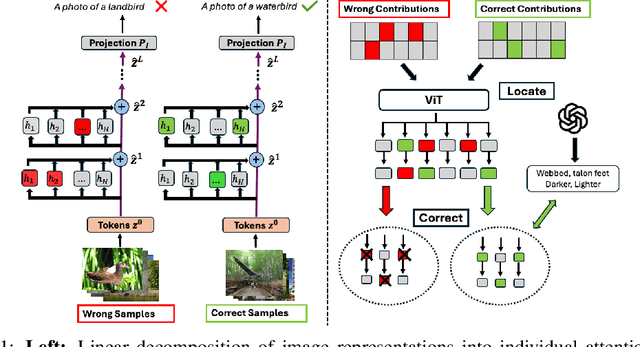
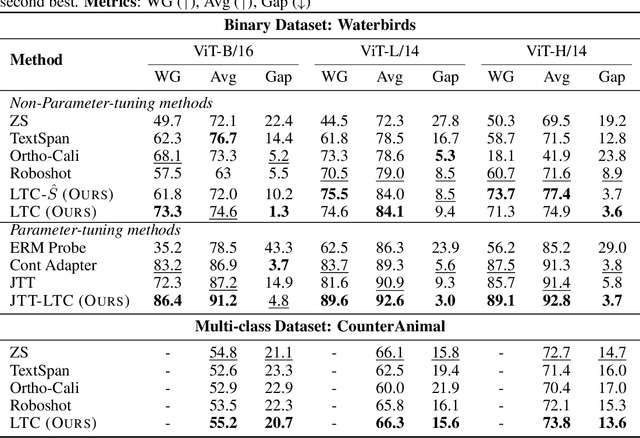
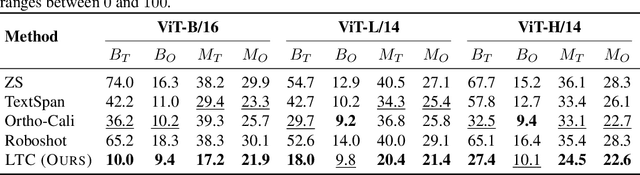
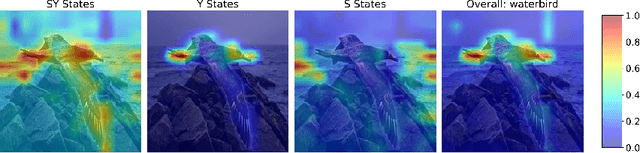
Multimodal models like CLIP have gained significant attention due to their remarkable zero-shot performance across various tasks. However, studies have revealed that CLIP can inadvertently learn spurious associations between target variables and confounding factors. To address this, we introduce \textsc{Locate-Then-Correct} (LTC), a contrastive framework that identifies spurious attention heads in Vision Transformers via mechanistic insights and mitigates them through targeted ablation. Furthermore, LTC identifies salient, task-relevant attention heads, enabling the integration of discriminative features through orthogonal projection to improve classification performance. We evaluate LTC on benchmarks with inherent background and gender biases, achieving over a $>50\%$ gain in worst-group accuracy compared to non-training post-hoc baselines. Additionally, we visualize the representation of selected heads and find that the presented interpretation corroborates our contrastive mechanism for identifying both spurious and salient attention heads. Code available at https://github.com/wj210/CLIP_LTC.
ATR-Bench: A Federated Learning Benchmark for Adaptation, Trust, and Reasoning
May 22, 2025Federated Learning (FL) has emerged as a promising paradigm for collaborative model training while preserving data privacy across decentralized participants. As FL adoption grows, numerous techniques have been proposed to tackle its practical challenges. However, the lack of standardized evaluation across key dimensions hampers systematic progress and fair comparison of FL methods. In this work, we introduce ATR-Bench, a unified framework for analyzing federated learning through three foundational dimensions: Adaptation, Trust, and Reasoning. We provide an in-depth examination of the conceptual foundations, task formulations, and open research challenges associated with each theme. We have extensively benchmarked representative methods and datasets for adaptation to heterogeneous clients and trustworthiness in adversarial or unreliable environments. Due to the lack of reliable metrics and models for reasoning in FL, we only provide literature-driven insights for this dimension. ATR-Bench lays the groundwork for a systematic and holistic evaluation of federated learning with real-world relevance. We will make our complete codebase publicly accessible and a curated repository that continuously tracks new developments and research in the FL literature.
FedMVP: Federated Multi-modal Visual Prompt Tuning for Vision-Language Models
Apr 29, 2025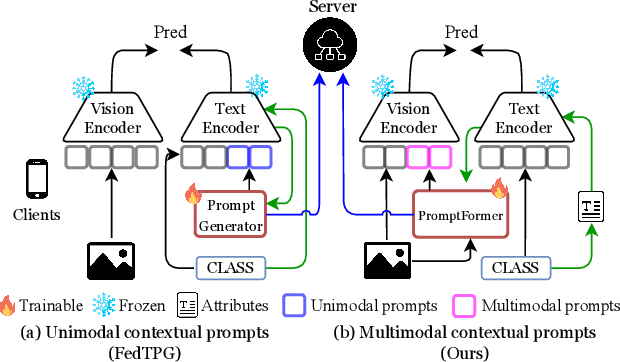
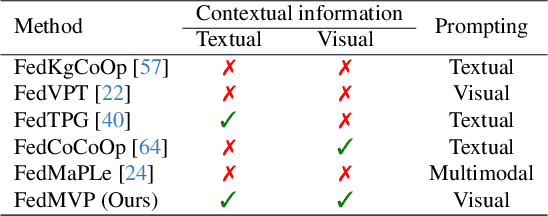
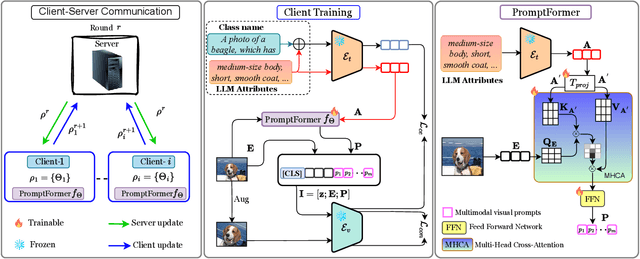
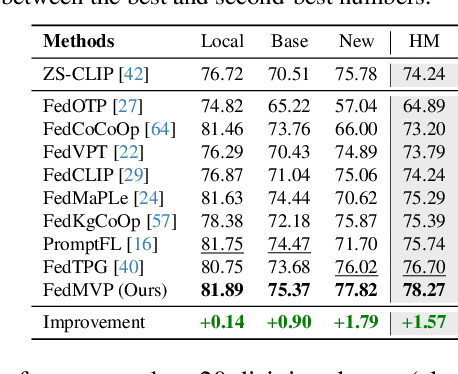
Textual prompt tuning adapts Vision-Language Models (e.g., CLIP) in federated learning by tuning lightweight input tokens (or prompts) on local client data, while keeping network weights frozen. Post training, only the prompts are shared by the clients with the central server for aggregation. However, textual prompt tuning often struggles with overfitting to known concepts and may be overly reliant on memorized text features, limiting its adaptability to unseen concepts. To address this limitation, we propose Federated Multimodal Visual Prompt Tuning (FedMVP) that conditions the prompts on comprehensive contextual information -- image-conditioned features and textual attribute features of a class -- that is multimodal in nature. At the core of FedMVP is a PromptFormer module that synergistically aligns textual and visual features through cross-attention, enabling richer contexual integration. The dynamically generated multimodal visual prompts are then input to the frozen vision encoder of CLIP, and trained with a combination of CLIP similarity loss and a consistency loss. Extensive evaluation on 20 datasets spanning three generalization settings demonstrates that FedMVP not only preserves performance on in-distribution classes and domains, but also displays higher generalizability to unseen classes and domains when compared to state-of-the-art methods. Codes will be released upon acceptance.
Enhance Hyperbolic Representation Learning via Second-order Pooling
Oct 29, 2024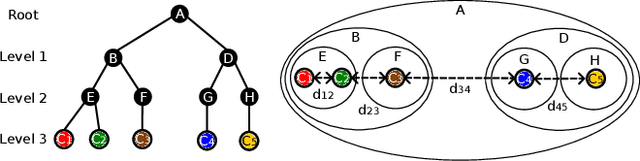


Hyperbolic representation learning is well known for its ability to capture hierarchical information. However, the distance between samples from different levels of hierarchical classes can be required large. We reveal that the hyperbolic discriminant objective forces the backbone to capture this hierarchical information, which may inevitably increase the Lipschitz constant of the backbone. This can hinder the full utilization of the backbone's generalization ability. To address this issue, we introduce second-order pooling into hyperbolic representation learning, as it naturally increases the distance between samples without compromising the generalization ability of the input features. In this way, the Lipschitz constant of the backbone does not necessarily need to be large. However, current off-the-shelf low-dimensional bilinear pooling methods cannot be directly employed in hyperbolic representation learning because they inevitably reduce the distance expansion capability. To solve this problem, we propose a kernel approximation regularization, which enables the low-dimensional bilinear features to approximate the kernel function well in low-dimensional space. Finally, we conduct extensive experiments on graph-structured datasets to demonstrate the effectiveness of the proposed method.
BayTTA: Uncertainty-aware medical image classification with optimized test-time augmentation using Bayesian model averaging
Jun 25, 2024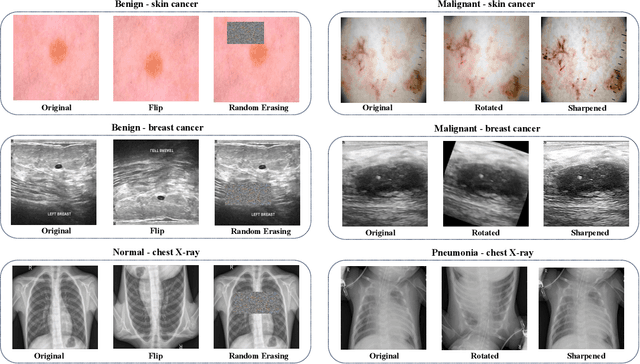
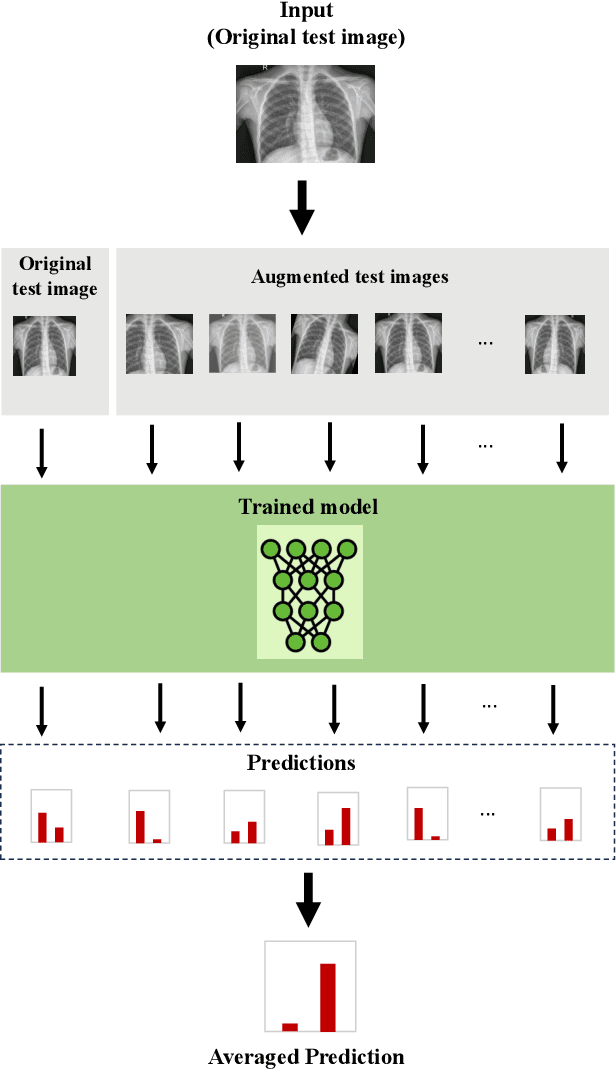
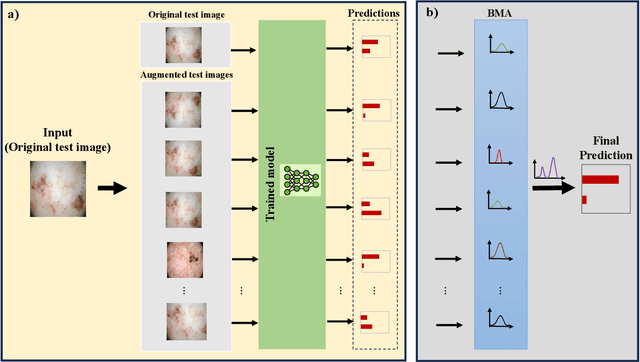
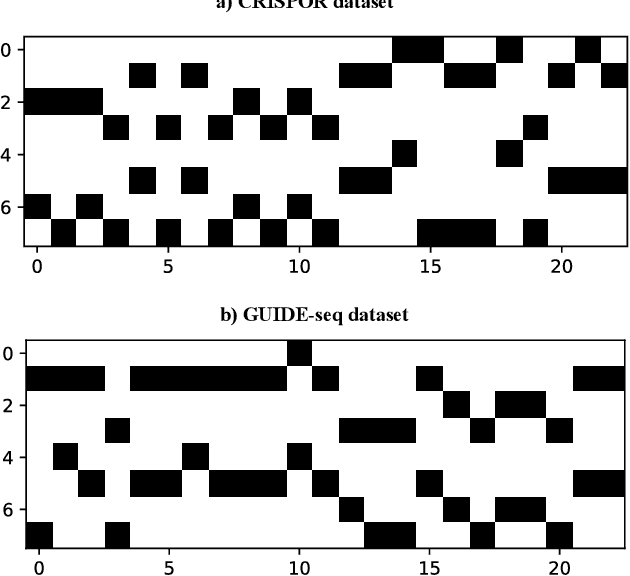
Test-time augmentation (TTA) is a well-known technique employed during the testing phase of computer vision tasks. It involves aggregating multiple augmented versions of input data. Combining predictions using a simple average formulation is a common and straightforward approach after performing TTA. This paper introduces a novel framework for optimizing TTA, called BayTTA (Bayesian-based TTA), which is based on Bayesian Model Averaging (BMA). First, we generate a model list associated with different variations of the input data created through TTA. Then, we use BMA to combine model predictions weighted by their respective posterior probabilities. Such an approach allows one to take into account model uncertainty, and thus to enhance the predictive performance of the related machine learning or deep learning model. We evaluate the performance of BayTTA on various public data, including three medical image datasets comprising skin cancer, breast cancer, and chest X-ray images and two well-known gene editing datasets, CRISPOR and GUIDE-seq. Our experimental results indicate that BayTTA can be effectively integrated into state-of-the-art deep learning models used in medical image analysis as well as into some popular pre-trained CNN models such as VGG-16, MobileNetV2, DenseNet201, ResNet152V2, and InceptionRes-NetV2, leading to the enhancement in their accuracy and robustness performance.
Unknown Prompt, the only Lacuna: Unveiling CLIP's Potential for Open Domain Generalization
Mar 31, 2024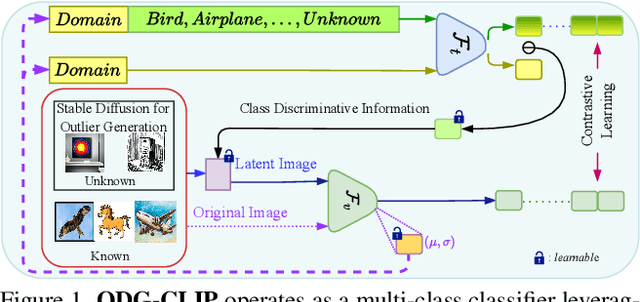
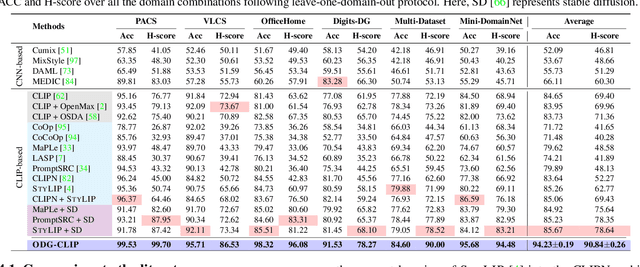
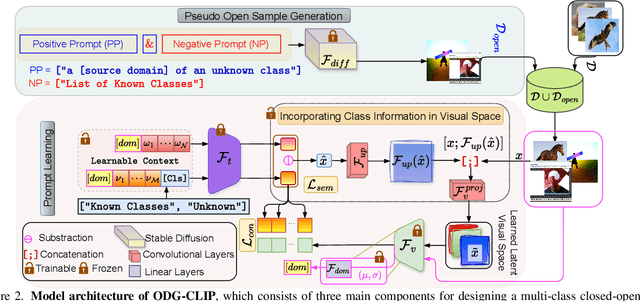
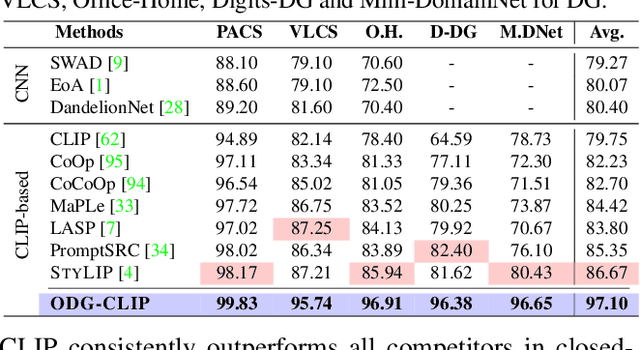
We delve into Open Domain Generalization (ODG), marked by domain and category shifts between training's labeled source and testing's unlabeled target domains. Existing solutions to ODG face limitations due to constrained generalizations of traditional CNN backbones and errors in detecting target open samples in the absence of prior knowledge. Addressing these pitfalls, we introduce ODG-CLIP, harnessing the semantic prowess of the vision-language model, CLIP. Our framework brings forth three primary innovations: Firstly, distinct from prevailing paradigms, we conceptualize ODG as a multi-class classification challenge encompassing both known and novel categories. Central to our approach is modeling a unique prompt tailored for detecting unknown class samples, and to train this, we employ a readily accessible stable diffusion model, elegantly generating proxy images for the open class. Secondly, aiming for domain-tailored classification (prompt) weights while ensuring a balance of precision and simplicity, we devise a novel visual stylecentric prompt learning mechanism. Finally, we infuse images with class-discriminative knowledge derived from the prompt space to augment the fidelity of CLIP's visual embeddings. We introduce a novel objective to safeguard the continuity of this infused semantic intel across domains, especially for the shared classes. Through rigorous testing on diverse datasets, covering closed and open-set DG contexts, ODG-CLIP demonstrates clear supremacy, consistently outpacing peers with performance boosts between 8%-16%. Code will be available at https://github.com/mainaksingha01/ODG-CLIP.