 Add to Chrome
 Add to Firefox
 Add to Edge
Crys-JEPA: Accelerating Crystal Discovery via Embedding Screening and Generative Refinement
May 14, 2026
De novo crystal generation seeks to discover materials that are not merely realistic, but also stable and novel. However, most existing generative models are trained to maximize the likelihood of observed crystals, which encourages samples to stay close to known materials yet not necessarily align with the criteria that matter in discovery. Through an empirical investigation, we show that current crystal generative models are caught in a pronounced stability--novelty trade-off: moving toward the observed distribution preserves stability but limits novelty, whereas moving away from it quickly destroys stability. This suggests that the useful region for discovering crystals that are both stable and novel is extremely narrow. To escape the trade-off, we introduce Crys-JEPA, a joint embedding predictive architecture for crystals that learns an energy-aware latent space preserving formation-energy differences. In this space, stability assessment can be reformulated as an embedding-based comparison against accessible training crystals, reducing the reliance on expensive energy evaluation and task-specific external references. Building on Crys-JEPA, we further develop a screening-and-refinement pipeline that identifies promising generated crystals and reintroduces them to refine the generative model. On MP-20 and Alex-MP-20 datasets, we achieve improvements over baselines up to 81.4% and 82.6% on V.S.U.N metric, respectively.

Composable Crystals: Controllable Materials Discovery via Concept Learning
May 14, 2026De novo crystal generation, a central task in materials discovery, aims to generate crystals that are simultaneously valid, stable, unique, and novel. Existing methods mainly rely on black-box stochastic sampling, providing limited control over how generated structures move beyond the observed distribution. In this paper, we introduce a concept-based compositional framework for crystal generation. We train a vector-quantized variational autoencoder to automatically discover a shared set of reusable crystal concepts, which serve as building blocks for guided generation. These learned concepts naturally exhibit interpretability from both local atomic environments and global symmetry patterns, and generalize to crystals from different distributions. By recombining such concepts, our framework enables controllable exploration of novel crystals beyond the training distribution, rather than relying solely on unconstrained random sampling. To further improve composition efficiency, we introduce a composition generator and iteratively refine it using high-quality samples generated by the model itself. The resulting concept compositions are then used to condition downstream crystal generation. Numerical experiments on MP-20 and Alex-MP-20 show that compositing concepts separately increase base model up to 53.2% and 51.7% on V.S.U.N metric, with particular gains in novelty.
Scalable learning of macroscopic stochastic dynamics
Nov 17, 2025Macroscopic dynamical descriptions of complex physical systems are crucial for understanding and controlling material behavior. With the growing availability of data and compute, machine learning has become a promising alternative to first-principles methods to build accurate macroscopic models from microscopic trajectory simulations. However, for spatially extended systems, direct simulations of sufficiently large microscopic systems that inform macroscopic behavior is prohibitive. In this work, we propose a framework that learns the macroscopic dynamics of large stochastic microscopic systems using only small-system simulations. Our framework employs a partial evolution scheme to generate training data pairs by evolving large-system snapshots within local patches. We subsequently identify the closure variables associated with the macroscopic observables and learn the macroscopic dynamics using a custom loss. Furthermore, we introduce a hierarchical upsampling scheme that enables efficient generation of large-system snapshots from small-system trajectory distributions. We empirically demonstrate the accuracy and robustness of our framework through a variety of stochastic spatially extended systems, including those described by stochastic partial differential equations, idealised lattice spin systems, and a more realistic NbMoTa alloy system.
Diagonalization without Diagonalization: A Direct Optimization Approach for Solid-State Density Functional Theory
Nov 06, 2024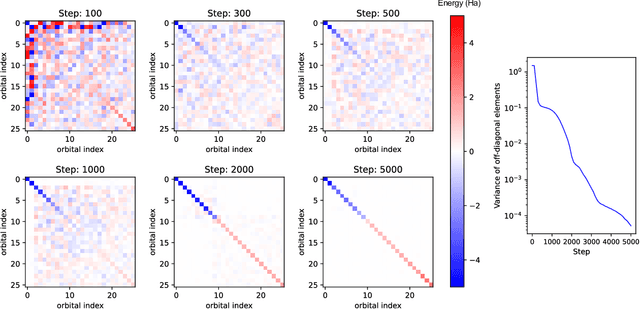
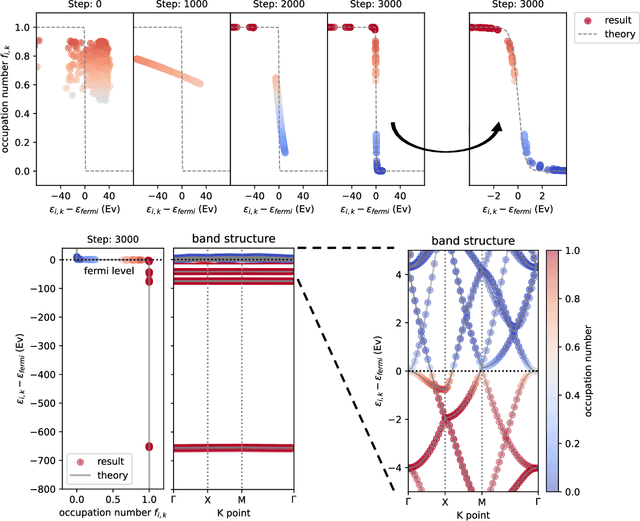
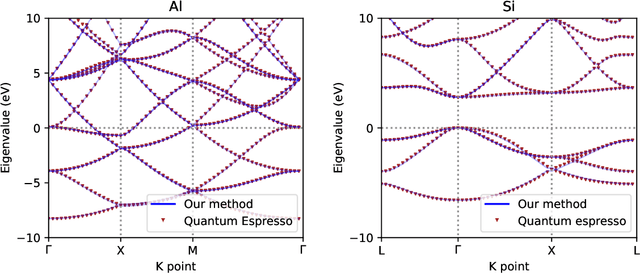
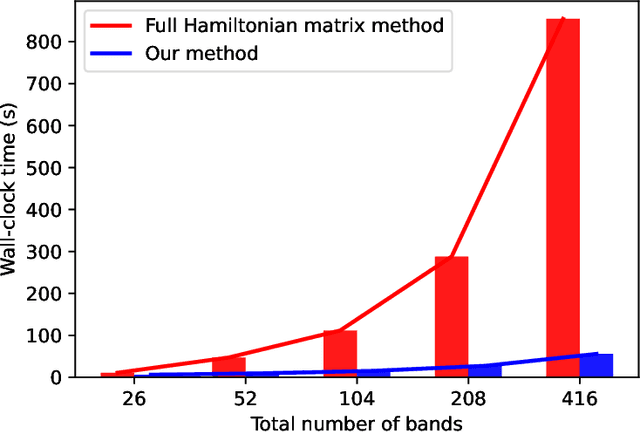
We present a novel approach to address the challenges of variable occupation numbers in direct optimization of density functional theory (DFT). By parameterizing both the eigenfunctions and the occupation matrix, our method minimizes the free energy with respect to these parameters. As the stationary conditions require the occupation matrix and the Kohn-Sham Hamiltonian to be simultaneously diagonalizable, this leads to the concept of ``self-diagonalization,'' where, by assuming a diagonal occupation matrix without loss of generality, the Hamiltonian matrix naturally becomes diagonal at stationary points. Our method incorporates physical constraints on both the eigenfunctions and the occupations into the parameterization, transforming the constrained optimization into an fully differentiable unconstrained problem, which is solvable via gradient descent. Implemented in JAX, our method was tested on aluminum and silicon, confirming that it achieves efficient self-diagonalization, produces the correct Fermi-Dirac distribution of the occupation numbers and yields band structures consistent with those obtained with SCF methods in Quantum Espresso.
Constructing Custom Thermodynamics Using Deep Learning
Aug 08, 2023One of the most exciting applications of AI is automated scientific discovery based on previously amassed data, coupled with restrictions provided by the known physical principles, including symmetries and conservation laws. Such automated hypothesis creation and verification can assist scientists in studying complex phenomena, where traditional physical intuition may fail. Of particular importance are complex dynamic systems where their time evolution is strongly influenced by varying external parameters. In this paper we develop a platform based on a generalised Onsager principle to learn macroscopic dynamical descriptions of arbitrary stochastic dissipative systems directly from observations of their microscopic trajectories. We focus on systems whose complexity and sheer sizes render complete microscopic description impractical, and constructing theoretical macroscopic models requires extensive domain knowledge or trial-and-error. Our machine learning approach addresses this by simultaneously constructing reduced thermodynamic coordinates and interpreting the dynamics on these coordinates. We demonstrate our method by studying theoretically and validating experimentally, the stretching of long polymer chains in an externally applied field. Specifically, we learn three interpretable thermodynamic coordinates and build a dynamical landscape of polymer stretching, including (1) the identification of stable and transition states and (2) the control of the stretching rate. We further demonstrate the universality of our approach by applying it to an unrelated problem in a different domain: constructing macroscopic dynamics for spatial epidemics, showing that our method addresses wide scientific and technological applications.
D4FT: A Deep Learning Approach to Kohn-Sham Density Functional Theory
Mar 01, 2023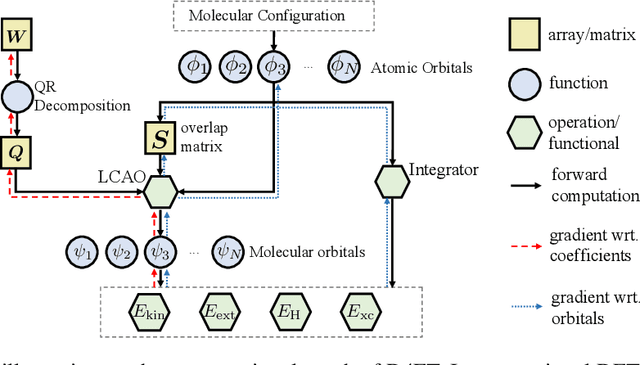

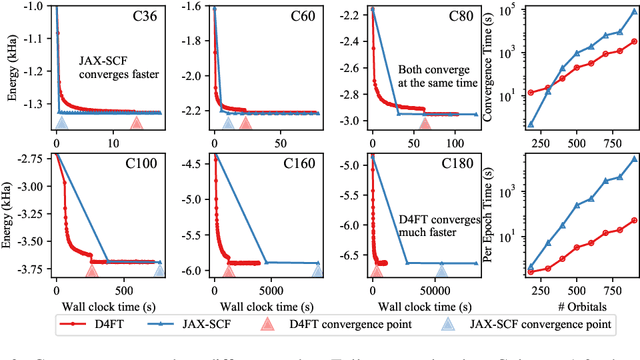

Kohn-Sham Density Functional Theory (KS-DFT) has been traditionally solved by the Self-Consistent Field (SCF) method. Behind the SCF loop is the physics intuition of solving a system of non-interactive single-electron wave functions under an effective potential. In this work, we propose a deep learning approach to KS-DFT. First, in contrast to the conventional SCF loop, we propose to directly minimize the total energy by reparameterizing the orthogonal constraint as a feed-forward computation. We prove that such an approach has the same expressivity as the SCF method, yet reduces the computational complexity from O(N^4) to O(N^3). Second, the numerical integration which involves a summation over the quadrature grids can be amortized to the optimization steps. At each step, stochastic gradient descent (SGD) is performed with a sampled minibatch of the grids. Extensive experiments are carried out to demonstrate the advantage of our approach in terms of efficiency and stability. In addition, we show that our approach enables us to explore more complex neural-based wave functions.