 Add to Chrome
 Add to Firefox
 Add to Edge
LHQ-SVC: Lightweight and High Quality Singing Voice Conversion Modeling
Sep 13, 2024
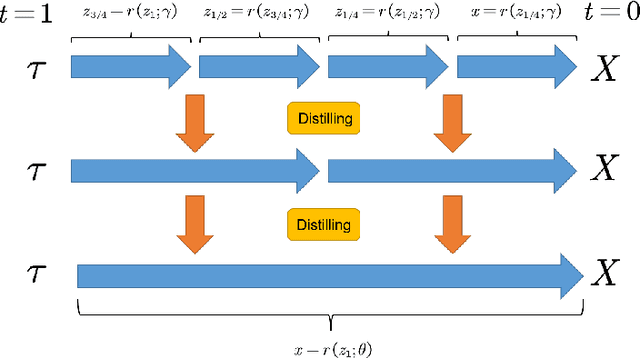
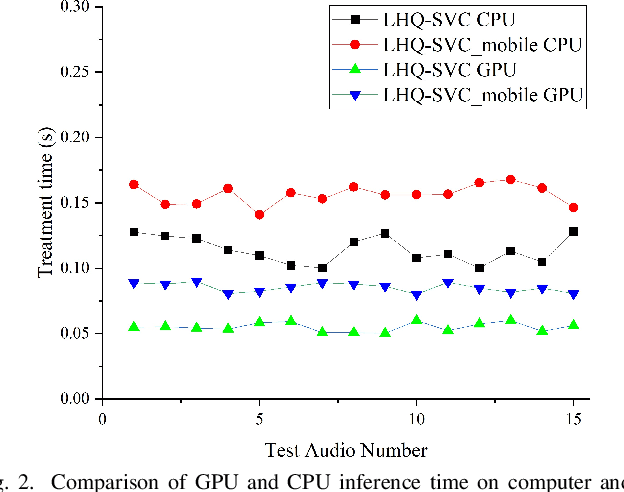
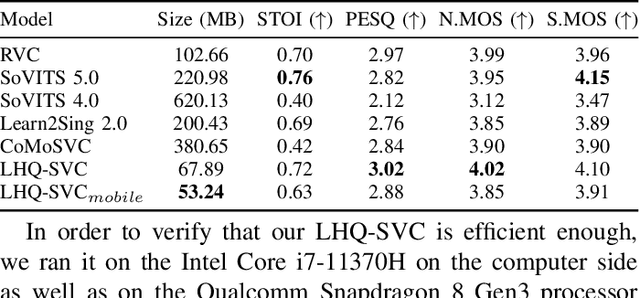
Singing Voice Conversion (SVC) has emerged as a significant subfield of Voice Conversion (VC), enabling the transformation of one singer's voice into another while preserving musical elements such as melody, rhythm, and timbre. Traditional SVC methods have limitations in terms of audio quality, data requirements, and computational complexity. In this paper, we propose LHQ-SVC, a lightweight, CPU-compatible model based on the SVC framework and diffusion model, designed to reduce model size and computational demand without sacrificing performance. We incorporate features to improve inference quality, and optimize for CPU execution by using performance tuning tools and parallel computing frameworks. Our experiments demonstrate that LHQ-SVC maintains competitive performance, with significant improvements in processing speed and efficiency across different devices. The results suggest that LHQ-SVC can meet

USV-AUV Collaboration Framework for Underwater Tasks under Extreme Sea Conditions
Sep 04, 2024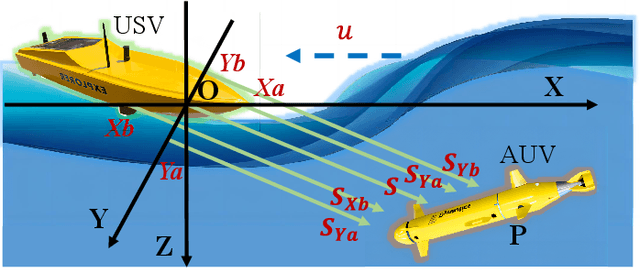

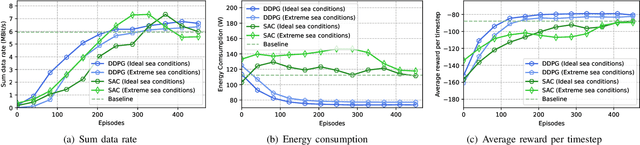
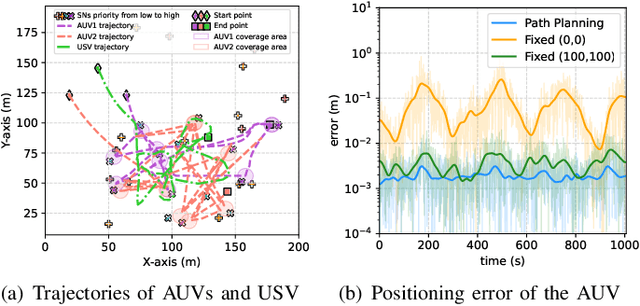
Autonomous underwater vehicles (AUVs) are valuable for ocean exploration due to their flexibility and ability to carry communication and detection units. Nevertheless, AUVs alone often face challenges in harsh and extreme sea conditions. This study introduces a unmanned surface vehicle (USV)-AUV collaboration framework, which includes high-precision multi-AUV positioning using USV path planning via Fisher information matrix optimization and reinforcement learning for multi-AUV cooperative tasks. Applied to a multi-AUV underwater data collection task scenario, extensive simulations validate the framework's feasibility and superior performance, highlighting exceptional coordination and robustness under extreme sea conditions. The simulation code will be made available as open-source to foster future research in this area.
Large Language Models as Efficient Reward Function Searchers for Custom-Environment Multi-Objective Reinforcement Learning
Sep 04, 2024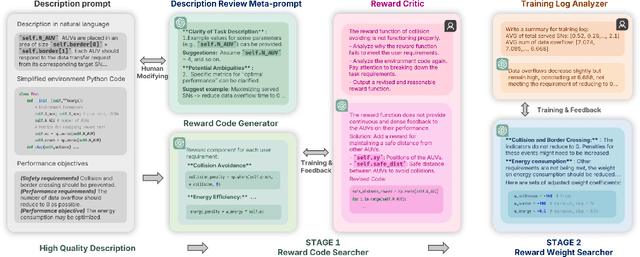
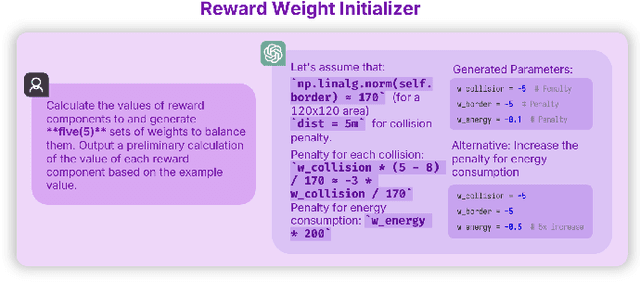
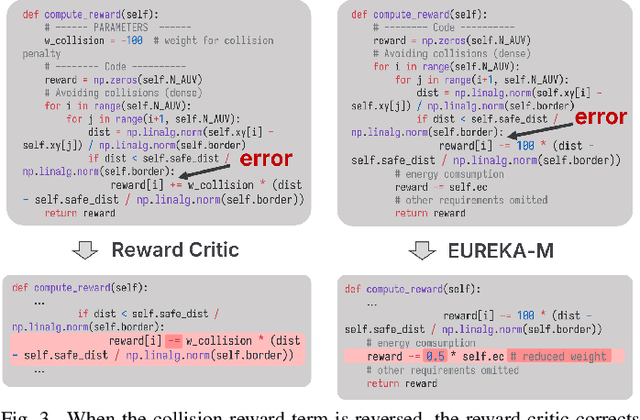
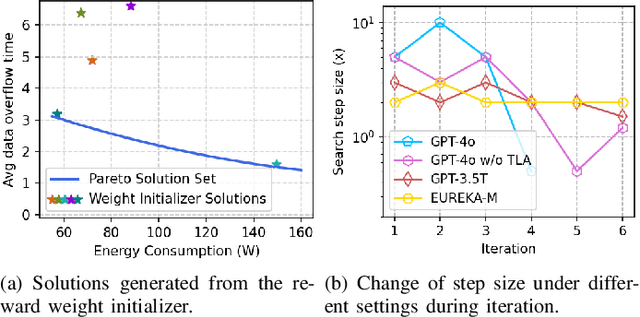
Leveraging large language models (LLMs) for designing reward functions demonstrates significant potential. However, achieving effective design and improvement of reward functions in reinforcement learning (RL) tasks with complex custom environments and multiple requirements presents considerable challenges. In this paper, we enable LLMs to be effective white-box searchers, highlighting their advanced semantic understanding capabilities. Specifically, we generate reward components for each explicit user requirement and employ the reward critic to identify the correct code form. Then, LLMs assign weights to the reward components to balance their values and iteratively search and optimize these weights based on the context provided by the training log analyzer, while adaptively determining the search step size. We applied the framework to an underwater information collection RL task without direct human feedback or reward examples (zero-shot). The reward critic successfully correct the reward code with only one feedback for each requirement, effectively preventing irreparable errors that can occur when reward function feedback is provided in aggregate. The effective initialization of weights enables the acquisition of different reward functions within the Pareto solution set without weight search. Even in the case where a weight is 100 times off, fewer than four iterations are needed to obtain solutions that meet user requirements. The framework also works well with most prompts utilizing GPT-3.5 Turbo, since it does not require advanced numerical understanding or calculation.
Pandora's Box or Aladdin's Lamp: A Comprehensive Analysis Revealing the Role of RAG Noise in Large Language Models
Aug 24, 2024


Retrieval-Augmented Generation (RAG) has emerged as a crucial method for addressing hallucinations in large language models (LLMs). While recent research has extended RAG models to complex noisy scenarios, these explorations often confine themselves to limited noise types and presuppose that noise is inherently detrimental to LLMs, potentially deviating from real-world retrieval environments and restricting practical applicability. In this paper, we define seven distinct noise types from a linguistic perspective and establish a Noise RAG Benchmark (NoiserBench), a comprehensive evaluation framework encompassing multiple datasets and reasoning tasks. Through empirical evaluation of eight representative LLMs with diverse architectures and scales, we reveal that these noises can be further categorized into two practical groups: noise that is beneficial to LLMs (aka beneficial noise) and noise that is harmful to LLMs (aka harmful noise). While harmful noise generally impairs performance, beneficial noise may enhance several aspects of model capabilities and overall performance. Our analysis offers insights for developing more robust, adaptable RAG solutions and mitigating hallucinations across diverse retrieval scenarios.
CDFGNN: a Systematic Design of Cache-based Distributed Full-Batch Graph Neural Network Training with Communication Reduction
Aug 01, 2024Graph neural network training is mainly categorized into mini-batch and full-batch training methods. The mini-batch training method samples subgraphs from the original graph in each iteration. This sampling operation introduces extra computation overhead and reduces the training accuracy. Meanwhile, the full-batch training method calculates the features and corresponding gradients of all vertices in each iteration, and therefore has higher convergence accuracy. However, in the distributed cluster, frequent remote accesses of vertex features and gradients lead to huge communication overhead, thus restricting the overall training efficiency. In this paper, we introduce the cached-based distributed full-batch graph neural network training framework (CDFGNN). We propose the adaptive cache mechanism to reduce the remote vertex access by caching the historical features and gradients of neighbor vertices. Besides, we further optimize the communication overhead by quantifying the messages and designing the graph partition algorithm for the hierarchical communication architecture. Experiments show that the adaptive cache mechanism reduces remote vertex accesses by 63.14% on average. Combined with communication quantization and hierarchical GP algorithm, CDFGNN outperforms the state-of-the-art distributed full-batch training frameworks by 30.39% in our experiments. Our results indicate that CDFGNN has great potential in accelerating distributed full-batch GNN training tasks.
AFIDAF: Alternating Fourier and Image Domain Adaptive Filters as an Efficient Alternative to Attention in ViTs
Jul 16, 2024We propose and demonstrate an alternating Fourier and image domain filtering approach for feature extraction as an efficient alternative to build a vision backbone without using the computationally intensive attention. The performance among the lightweight models reaches the state-of-the-art level on ImageNet-1K classification, and improves downstream tasks on object detection and segmentation consistently as well. Our approach also serves as a new tool to compress vision transformers (ViTs).
ASRRL-TTS: Agile Speaker Representation Reinforcement Learning for Text-to-Speech Speaker Adaptation
Jul 07, 2024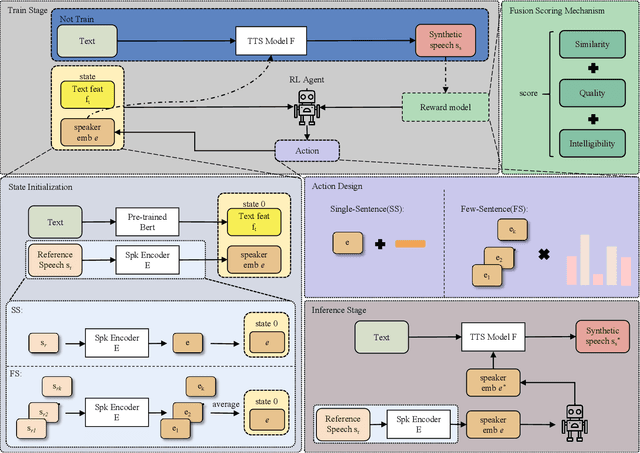


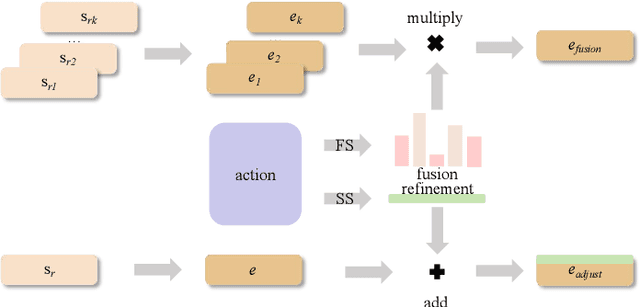
Speaker adaptation, which involves cloning voices from unseen speakers in the Text-to-Speech task, has garnered significant interest due to its numerous applications in multi-media fields. Despite recent advancements, existing methods often struggle with inadequate speaker representation accuracy and overfitting, particularly in limited reference speeches scenarios. To address these challenges, we propose an Agile Speaker Representation Reinforcement Learning strategy to enhance speaker similarity in speaker adaptation tasks. ASRRL is the first work to apply reinforcement learning to improve the modeling accuracy of speaker embeddings in speaker adaptation, addressing the challenge of decoupling voice content and timbre. Our approach introduces two action strategies tailored to different reference speeches scenarios. In the single-sentence scenario, a knowledge-oriented optimal routine searching RL method is employed to expedite the exploration and retrieval of refinement information on the fringe of speaker representations. In the few-sentence scenario, we utilize a dynamic RL method to adaptively fuse reference speeches, enhancing the robustness and accuracy of speaker modeling. To achieve optimal results in the target domain, a multi-scale fusion scoring mechanism based reward model that evaluates speaker similarity, speech quality, and intelligibility across three dimensions is proposed, ensuring that improvements in speaker similarity do not compromise speech quality or intelligibility. The experimental results on the LibriTTS and VCTK datasets within mainstream TTS frameworks demonstrate the extensibility and generalization capabilities of the proposed ASRRL method. The results indicate that the ASRRL method significantly outperforms traditional fine-tuning approaches, achieving higher speaker similarity and better overall speech quality with limited reference speeches.
Fake News Detection and Manipulation Reasoning via Large Vision-Language Models
Jul 02, 2024Fake news becomes a growing threat to information security and public opinion with the rapid sprawl of media manipulation. Therefore, fake news detection attracts widespread attention from academic community. Traditional fake news detection models demonstrate remarkable performance on authenticity binary classification but their ability to reason detailed faked traces based on the news content remains under-explored. Furthermore, due to the lack of external knowledge, the performance of existing methods on fact-related news is questionable, leaving their practical implementation unclear. In this paper, we propose a new multi-media research topic, namely manipulation reasoning. Manipulation reasoning aims to reason manipulations based on news content. To support the research, we introduce a benchmark for fake news detection and manipulation reasoning, referred to as Human-centric and Fact-related Fake News (HFFN). The benchmark highlights the centrality of human and the high factual relevance, with detailed manual annotations. HFFN encompasses four realistic domains with fake news samples generated through three manipulation approaches. Moreover, a Multi-modal news Detection and Reasoning langUage Model (M-DRUM) is presented not only to judge on the authenticity of multi-modal news, but also raise analytical reasoning about potential manipulations. On the feature extraction level, a cross-attention mechanism is employed to extract fine-grained fusion features from multi-modal inputs. On the reasoning level, a large vision-language model (LVLM) serves as the backbone to facilitate fact-related reasoning. A two-stage training framework is deployed to better activate the capacity of identification and reasoning. Comprehensive experiments demonstrate that our model outperforms state-of-the-art (SOTA) fake news detection models and powerful LVLMs like GPT-4 and LLaVA.
Learning on Transformers is Provable Low-Rank and Sparse: A One-layer Analysis
Jun 24, 2024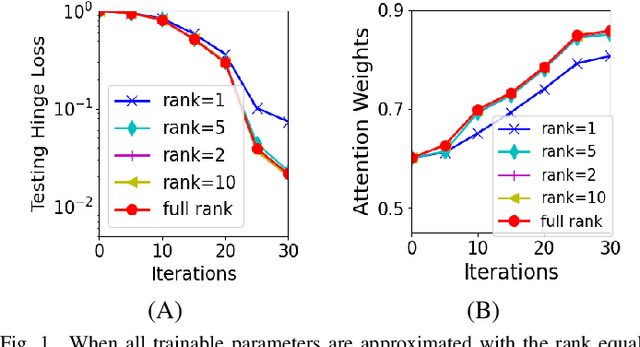
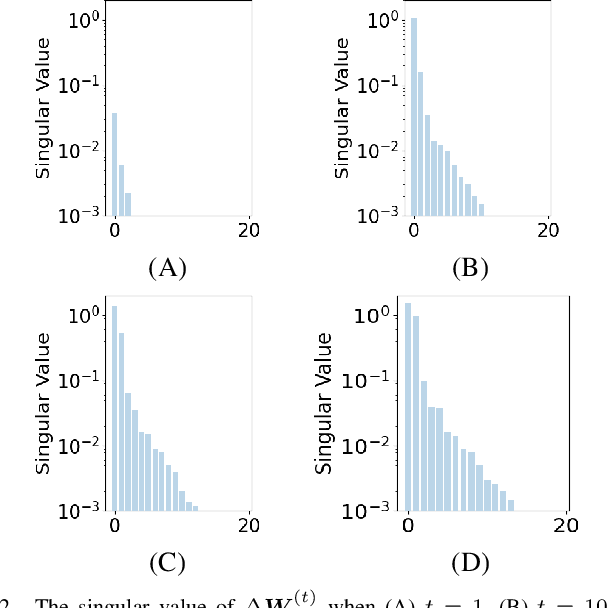
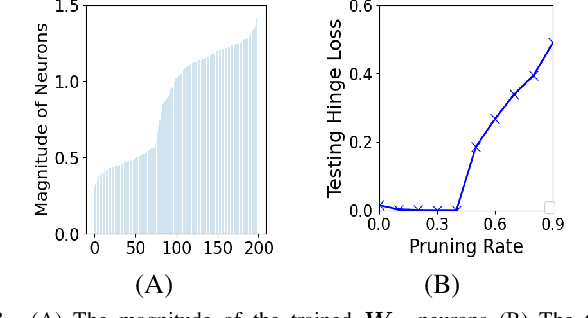
Efficient training and inference algorithms, such as low-rank adaption and model pruning, have shown impressive performance for learning Transformer-based large foundation models. However, due to the technical challenges of the non-convex optimization caused by the complicated architecture of Transformers, the theoretical study of why these methods can be applied to learn Transformers is mostly elusive. To the best of our knowledge, this paper shows the first theoretical analysis of the property of low-rank and sparsity of one-layer Transformers by characterizing the trained model after convergence using stochastic gradient descent. By focusing on a data model based on label-relevant and label-irrelevant patterns, we quantify that the gradient updates of trainable parameters are low-rank, which depends on the number of label-relevant patterns. We also analyze how model pruning affects the generalization while improving computation efficiency and conclude that proper magnitude-based pruning has a slight effect on the testing performance. We implement numerical experiments to support our findings.
Unveiling the Impact of Multi-Modal Interactions on User Engagement: A Comprehensive Evaluation in AI-driven Conversations
Jun 21, 2024Large Language Models (LLMs) have significantly advanced user-bot interactions, enabling more complex and coherent dialogues. However, the prevalent text-only modality might not fully exploit the potential for effective user engagement. This paper explores the impact of multi-modal interactions, which incorporate images and audio alongside text, on user engagement in chatbot conversations. We conduct a comprehensive analysis using a diverse set of chatbots and real-user interaction data, employing metrics such as retention rate and conversation length to evaluate user engagement. Our findings reveal a significant enhancement in user engagement with multi-modal interactions compared to text-only dialogues. Notably, the incorporation of a third modality significantly amplifies engagement beyond the benefits observed with just two modalities. These results suggest that multi-modal interactions optimize cognitive processing and facilitate richer information comprehension. This study underscores the importance of multi-modality in chatbot design, offering valuable insights for creating more engaging and immersive AI communication experiences and informing the broader AI community about the benefits of multi-modal interactions in enhancing user engagement.