 Add to Chrome
 Add to Firefox
 Add to Edge
Self-Improving Large Language Models via Progressive Experience Evolution
Aug 03, 2026
Large language models (LLMs) capable of self-improvement require not only effective policy optimization, but also a principled mechanism for transforming transient interaction experience into persistent model capabilities. Existing self-improvement paradigms remain fragmented: test-time methods can explicitly extract experience but cannot internalize it into model parameters, whereas training-time optimization methods can update model parameters but lack an explicit mechanism for accumulating transferable experience. Bridging these two paradigms requires a critical intermediate stage that remains underexplored, namely \emph{experience distillation}. To address this gap, we propose \textbf{SPEE} (\textbf{S}elf-\textbf{P}rogressive \textbf{E}xperience \textbf{E}volution), a unified post-training framework that sequentially performs explicit experience evolution followed by implicit policy optimization. During explicit experience evolution, SPEE reflects on trajectories collected from multiple interactions to extract, verify, and progressively evolve transferable experience, which is subsequently internalized into the policy through privilege-guided On-Policy Self-Distillation (OPSD). During implicit policy optimization, reward-driven reinforcement learning leverages these internalized priors to explore novel solution strategies. In the experience evolution stage, a continuously evolving global experience pool consolidates knowledge from both successful and failed trajectories, filters out low-utility experience, and mitigates post-hoc rationalization induced by individual trajectories. Experiments on five mathematical reasoning benchmarks demonstrate that SPEE consistently outperforms both test-time and training-time self-evolution baselines across three model scales. The source code is available at https://github.com/rrrsj/SPEE.

PointSplat: Compact Gaussian Splatting via Human-Centric Prediction
Jun 30, 2026Producing 3D human representations from input views on the fly is essential for immersive live streaming systems, where representation compactness is as critical as high fidelity given limited computational power and transmission bandwidth. Although recent feed-forward reconstruction methods achieve impressive quality through the view-centric prediction of 3D representations, they repeatedly encode the same subject content across multiple views, leading to significant inter-view redundancy. Our key insight is to perform predictions directly in 3D space, enabling the network to learn and produce a highly compact representation. To this end, we propose PointSplat, a novel human-centric approach that directly infers Gaussian primitives from an input point set. The proposed method first estimates a coarse geometric proxy and performs ray casting to prune redundant points and establish explicit 2D--3D correspondences. Subsequently, it employs a Point-Image Transformer to fuse appearance and geometry features, predicting Gaussian attributes in a single forward pass. This design restricts predictions to foreground regions of interest, substantially reducing the total number of Gaussians while improving novel-view rendering quality. Extensive experiments demonstrate that PointSplat achieves higher efficiency and quality while exhibiting strong robustness to variations in view count and image resolution across multiple datasets.
CS-Dialogue: A 104-Hour Dataset of Spontaneous Mandarin-English Code-Switching Dialogues for Speech Recognition
Feb 26, 2025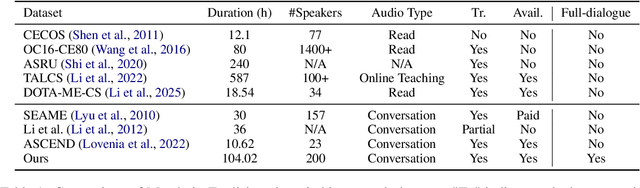
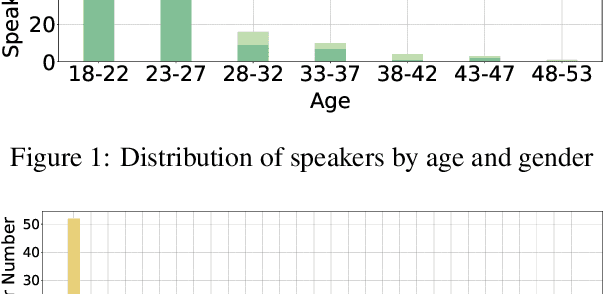
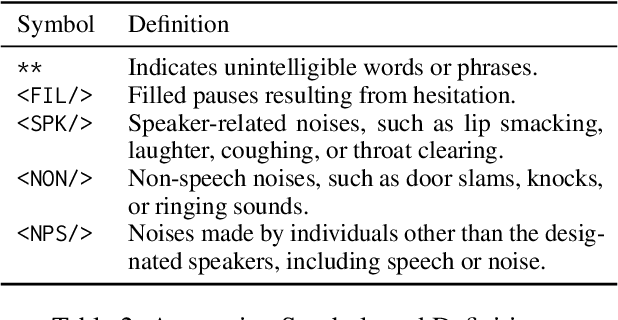
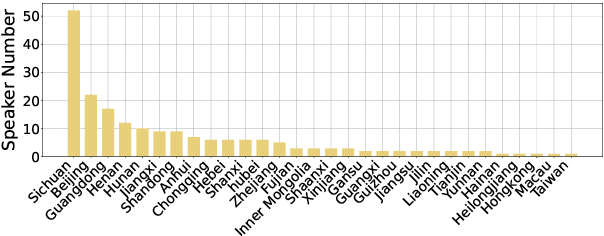
Code-switching (CS), the alternation between two or more languages within a single conversation, presents significant challenges for automatic speech recognition (ASR) systems. Existing Mandarin-English code-switching datasets often suffer from limitations in size, spontaneity, and the lack of full-length dialogue recordings with transcriptions, hindering the development of robust ASR models for real-world conversational scenarios. This paper introduces CS-Dialogue, a novel large-scale Mandarin-English code-switching speech dataset comprising 104 hours of spontaneous conversations from 200 speakers. Unlike previous datasets, CS-Dialogue provides full-length dialogue recordings with complete transcriptions, capturing naturalistic code-switching patterns in continuous speech. We describe the data collection and annotation processes, present detailed statistics of the dataset, and establish benchmark ASR performance using state-of-the-art models. Our experiments, using Transformer, Conformer, and Branchformer, demonstrate the challenges of code-switching ASR, and show that existing pre-trained models such as Whisper still have the space to improve. The CS-Dialogue dataset will be made freely available for all academic purposes.
ChildMandarin: A Comprehensive Mandarin Speech Dataset for Young Children Aged 3-5
Sep 27, 2024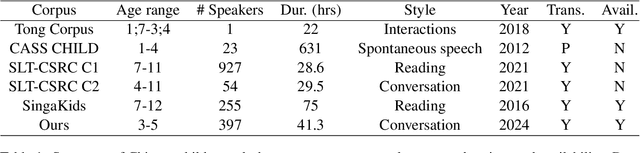
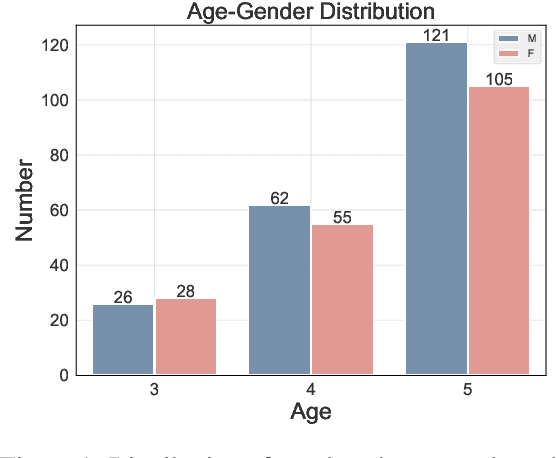
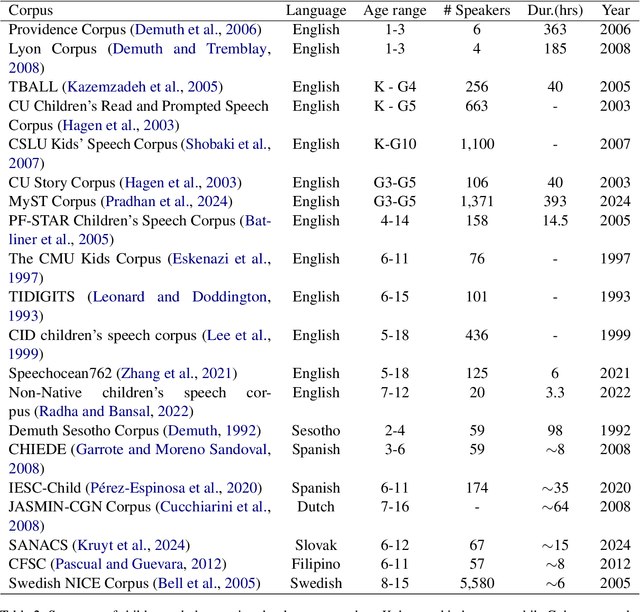
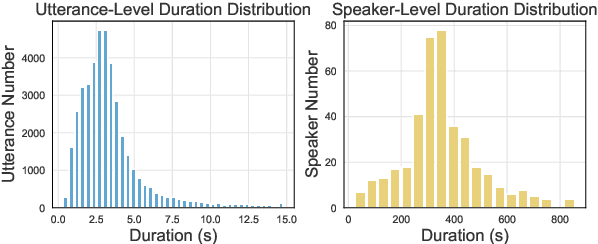
Automatic speech recognition (ASR) systems have advanced significantly with models like Whisper, Conformer, and self-supervised frameworks such as Wav2vec 2.0 and HuBERT. However, developing robust ASR models for young children's speech remains challenging due to differences in pronunciation, tone, and pace compared to adult speech. In this paper, we introduce a new Mandarin speech dataset focused on children aged 3 to 5, addressing the scarcity of resources in this area. The dataset comprises 41.25 hours of speech with carefully crafted manual transcriptions, collected from 397 speakers across various provinces in China, with balanced gender representation. We provide a comprehensive analysis of speaker demographics, speech duration distribution and geographic coverage. Additionally, we evaluate ASR performance on models trained from scratch, such as Conformer, as well as fine-tuned pre-trained models like HuBERT and Whisper, where fine-tuning demonstrates significant performance improvements. Furthermore, we assess speaker verification (SV) on our dataset, showing that, despite the challenges posed by the unique vocal characteristics of young children, the dataset effectively supports both ASR and SV tasks. This dataset is a valuable contribution to Mandarin child speech research and holds potential for applications in educational technology and child-computer interaction. It will be open-source and freely available for all academic purposes.