 Add to Chrome
 Add to Firefox
 Add to Edge
Is More Privileged Information Better? From Solution Traces to Problem-Solving Structure in Self-Distilled Reasoning
Aug 03, 2026
On-policy self-distillation (OPSD) improves reasoning by using a privileged view of a model conditioned on reference solutions to supervise a student view that observes only the question. However, the teacher-provided token-level targets may depend on reference-specific information unavailable at inference time. We propose Problem-Space-Guided OPSD (PS-OPSD), which replaces the complete solution with trajectory-grounded guidance describing the initial state, goal conditions, constraints, and a selected state-transition path. The student rollout and OPSD objective remain unchanged. Across three mathematical reasoning benchmarks and model scales ranging from 1.7B to 8B, PS-OPSD achieves the highest aggregate question-only accuracy among the compared methods. Controlled experiments further indicate that guidance relevance and path coherence contribute to these gains, highlighting the representation of privileged information as an important design choice in OPSD.

Latent Thought Credit: Multi-Answer Credit Assignment for Latent Reasoning
Aug 03, 2026Latent reasoning allows language models to carry out intermediate reasoning in continuous latent representations rather than fully externalizing it as discrete chains of thought. However, assigning credit to such latent thoughts from answer-only rewards is difficult: a single final answer mixes thought quality with answer-sampling noise. We propose \textbf{Latent Thought Credit (LTC)}, a hierarchical credit-assignment framework for latent reasoning. For each prompt, LTC samples multiple latent thoughts, fixes the context after each thought, and estimates thought-level expected reward by averaging rewards over multiple answers generated from that fixed context. LTC uses thought-level advantages to optimize the latent-thought phase, answer-level advantages to optimize the answer phase, and an advantage-weighted thought-matching objective that helps the policy reproduce high-credit latent thoughts. We instantiate LTC in a GRPO-style on-policy training framework and evaluate it across mathematical reasoning and STEM multiple-choice tasks. LTC achieves the best average accuracy among the compared methods, while ablations and fixed-context diagnostics show that multi-answer estimation reduces reward-estimation error and mitigates ambiguous or incorrect thought-level credit.
TARPO: Token-Wise Latent-Explicit Reasoning via Action-Routing Policy Optimization
Jun 04, 2026Latent reasoning has emerged as a promising alternative to discrete Chain-of-Thought (CoT) in large language models (LLMs), enabling more expressive reasoning by operating over continuous representations. However, the inherently deterministic nature of continuous representations limits policy exploration in reinforcement learning (RL). To address this, we propose TARPO (Token-Wise Latent-Explicit Reasoning via Action-Routing Policy Optimization), a pure RL framework that adaptively switches between discrete token generation and continuous latent reasoning at each step. TARPO introduces a lightweight action head router that observes the current hidden state and samples a routing decision from a binary mode-selection space, preserving the stochasticity of discrete token sampling from the vocabulary. The LLM backbone and router are jointly optimized end-to-end with a shared group-relative advantage signal. Extensive experiments across Qwen2.5 (from 1.5B to 7B) and Llama-3.1-8B backbones demonstrate that TARPO consistently outperforms existing explicit and latent reasoning RL baselines across diverse benchmarks. Further analysis shows that TARPO learns adaptive token-wise switching behaviors while maintaining stable training dynamics. Our code is available at https://github.com/NKU-LITI/TARPO-master.
Large Language Model Post-Training: A Unified View of Off-Policy and On-Policy Learning
Apr 09, 2026Post-training has become central to turning pretrained large language models (LLMs) into aligned and deployable systems. Recent progress spans supervised fine-tuning (SFT), preference optimization, reinforcement learning (RL), process supervision, verifier-guided methods, distillation, and multi-stage pipelines. Yet these methods are often discussed in fragmented ways, organized by labels or objective families rather than by the behavioral bottlenecks they address. This survey argues that LLM post-training is best understood as structured intervention on model behavior. We organize the field first by trajectory provenance, which defines two primary learning regimes: off-policy learning on externally supplied trajectories, and on-policy learning on learner-generated rollouts. We then interpret methods through two recurring roles -- effective support expansion, which makes useful behaviors more reachable, and policy reshaping, which improves behavior within already reachable regions -- together with a complementary systems-level role, behavioral consolidation, which preserves, transfers, and amortizes behavior across stages and model transitions. This perspective yields a unified reading of major paradigms. SFT may serve either support expansion or policy reshaping, whereas preference-based methods are usually off-policy reshaping. On-policy RL often improves behavior on learner-generated states, though under stronger guidance it can also make hard-to-reach reasoning paths reachable. Distillation is often best understood as consolidation rather than only compression, and hybrid pipelines emerge as coordinated multi-stage compositions. Overall, the framework helps diagnose post-training bottlenecks and reason about stage composition, suggesting that progress in LLM post-training increasingly depends on coordinated system design rather than any single dominant objective.
OmniOVCD: Streamlining Open-Vocabulary Change Detection with SAM 3
Jan 20, 2026Change Detection (CD) is a fundamental task in remote sensing. It monitors the evolution of land cover over time. Based on this, Open-Vocabulary Change Detection (OVCD) introduces a new requirement. It aims to reduce the reliance on predefined categories. Existing training-free OVCD methods mostly use CLIP to identify categories. These methods also need extra models like DINO to extract features. However, combining different models often causes problems in matching features and makes the system unstable. Recently, the Segment Anything Model 3 (SAM 3) is introduced. It integrates segmentation and identification capabilities within one promptable model, which offers new possibilities for the OVCD task. In this paper, we propose OmniOVCD, a standalone framework designed for OVCD. By leveraging the decoupled output heads of SAM 3, we propose a Synergistic Fusion to Instance Decoupling (SFID) strategy. SFID first fuses the semantic, instance, and presence outputs of SAM 3 to construct land-cover masks, and then decomposes them into individual instance masks for change comparison. This design preserves high accuracy in category recognition and maintains instance-level consistency across images. As a result, the model can generate accurate change masks. Experiments on four public benchmarks (LEVIR-CD, WHU-CD, S2Looking, and SECOND) demonstrate SOTA performance, achieving IoU scores of 67.2, 66.5, 24.5, and 27.1 (class-average), respectively, surpassing all previous methods.
Cross-Modal Knowledge Distillation for Speech Large Language Models
Sep 18, 2025In this work, we present the first systematic evaluation of catastrophic forgetting and modality inequivalence in speech large language models, showing that introducing speech capabilities can degrade knowledge and reasoning even when inputs remain textual, and performance further decreases with spoken queries. To address these challenges, we propose a cross-modal knowledge distillation framework that leverages both text-to-text and speech-to-text channels to transfer knowledge from a text-based teacher model to a speech LLM. Extensive experiments on dialogue and audio understanding tasks validate the effectiveness of our approach in preserving textual knowledge, improving cross-modal alignment, and enhancing reasoning in speech-based interactions.
Mind the Gap: Data Rewriting for Stable Off-Policy Supervised Fine-Tuning
Sep 18, 2025Supervised fine-tuning (SFT) of large language models can be viewed as an off-policy learning problem, where expert demonstrations come from a fixed behavior policy while training aims to optimize a target policy. Importance sampling is the standard tool for correcting this distribution mismatch, but large policy gaps lead to high variance and training instability. Existing approaches mitigate this issue using KL penalties or clipping, which passively constrain updates rather than actively reducing the gap. We propose a simple yet effective data rewriting framework that proactively shrinks the policy gap by keeping correct solutions as on-policy data and rewriting incorrect ones with guided re-solving, falling back to expert demonstrations only when needed. This aligns the training distribution with the target policy before optimization, reducing importance sampling variance and stabilizing off-policy fine-tuning. Experiments on five mathematical reasoning benchmarks demonstrate consistent and significant gains over both vanilla SFT and the state-of-the-art Dynamic Fine-Tuning (DFT) approach. The data and code will be released at https://github.com/NKU-HLT/Off-Policy-SFT.
SDPO: Segment-Level Direct Preference Optimization for Social Agents
Jan 03, 2025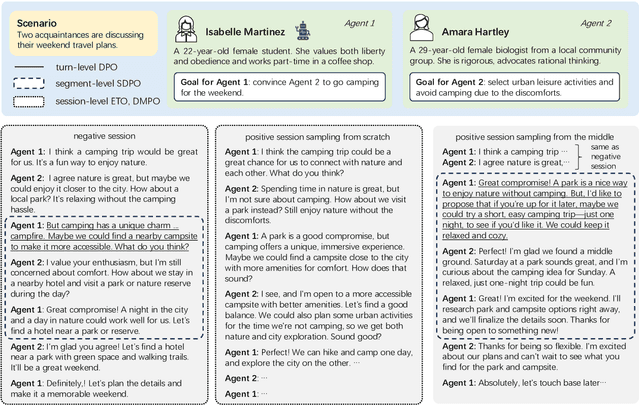
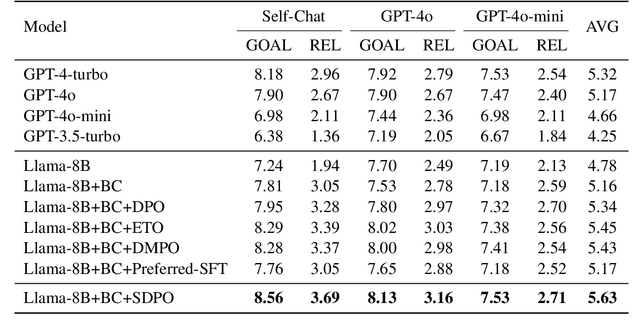
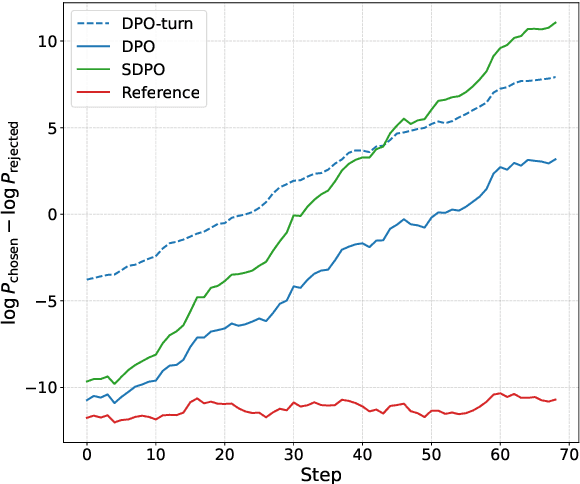
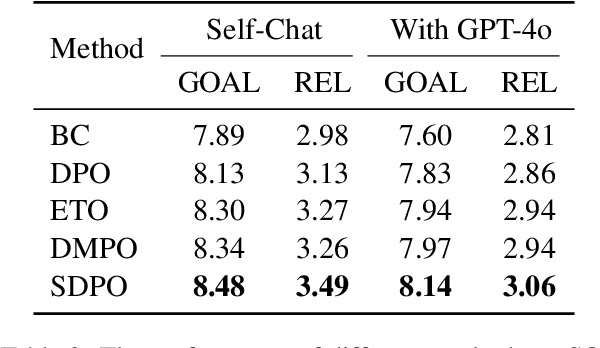
Social agents powered by large language models (LLMs) can simulate human social behaviors but fall short in handling complex goal-oriented social dialogues. Direct Preference Optimization (DPO) has proven effective in aligning LLM behavior with human preferences across a variety of agent tasks. Existing DPO-based approaches for multi-turn interactions are divided into turn-level and session-level methods. The turn-level method is overly fine-grained, focusing exclusively on individual turns, while session-level methods are too coarse-grained, often introducing training noise. To address these limitations, we propose Segment-Level Direct Preference Optimization (SDPO), which focuses on specific key segments within interactions to optimize multi-turn agent behavior while minimizing training noise. Evaluations on the SOTOPIA benchmark demonstrate that SDPO-tuned agents consistently outperform both existing DPO-based methods and proprietary LLMs like GPT-4o, underscoring SDPO's potential to advance the social intelligence of LLM-based agents. We release our code and data at https://github.com/AlibabaResearch/DAMO-ConvAI/tree/main/SDPO.
Self-Prompt Tuning: Enable Autonomous Role-Playing in LLMs
Jul 12, 2024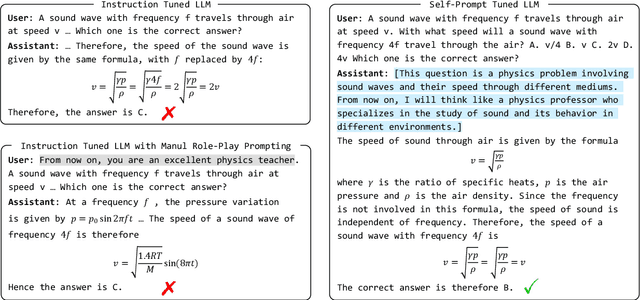
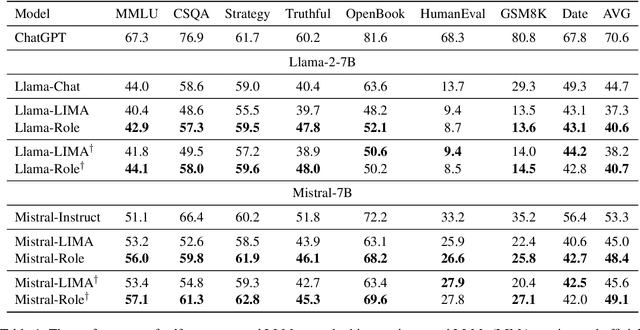
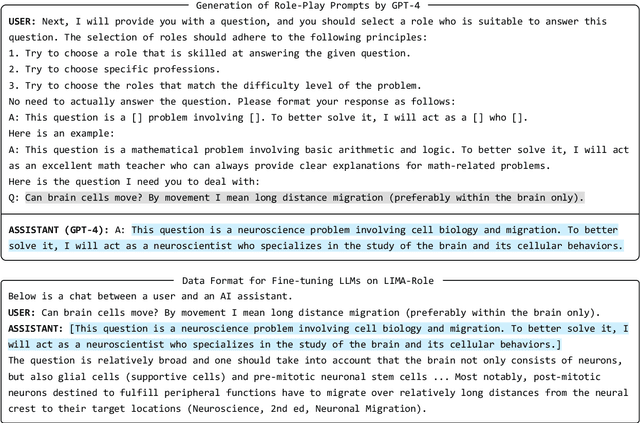
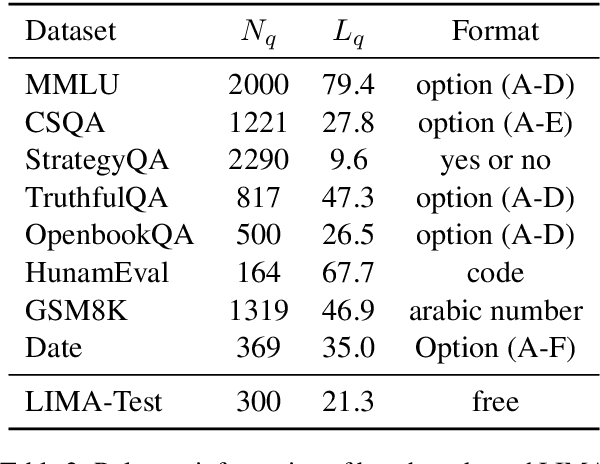
Recent advancements in LLMs have showcased their remarkable role-playing capabilities, able to accurately simulate the dialogue styles and cognitive processes of various roles based on different instructions and contexts. Studies indicate that assigning LLMs the roles of experts, a strategy known as role-play prompting, can enhance their performance in the corresponding domains. However, the prompt needs to be manually designed for the given problem, requiring certain expertise and iterative modifications. To this end, we propose self-prompt tuning, making LLMs themselves generate role-play prompts through fine-tuning. Leveraging the LIMA dataset as our foundational corpus, we employ GPT-4 to annotate role-play prompts for each data points, resulting in the creation of the LIMA-Role dataset. We then fine-tune LLMs like Llama-2-7B and Mistral-7B on LIMA-Role. Consequently, the self-prompt tuned LLMs can automatically generate expert role prompts for any given question. We extensively evaluate self-prompt tuned LLMs on widely used NLP benchmarks and open-ended question test. Our empirical results illustrate that self-prompt tuned LLMs outperform standard instruction tuned baselines across most datasets. This highlights the great potential of utilizing fine-tuning to enable LLMs to self-prompt, thereby automating complex prompting strategies. We release the dataset, models, and code at this \href{https://anonymous.4open.science/r/Self-Prompt-Tuning-739E/}{url}.
Better Zero-Shot Reasoning with Role-Play Prompting
Aug 15, 2023
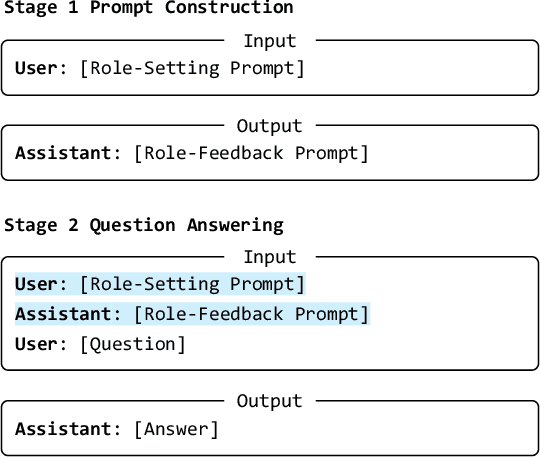
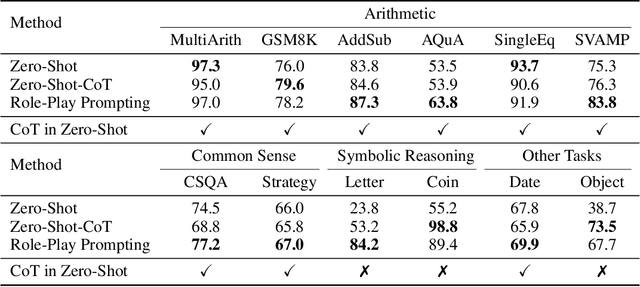
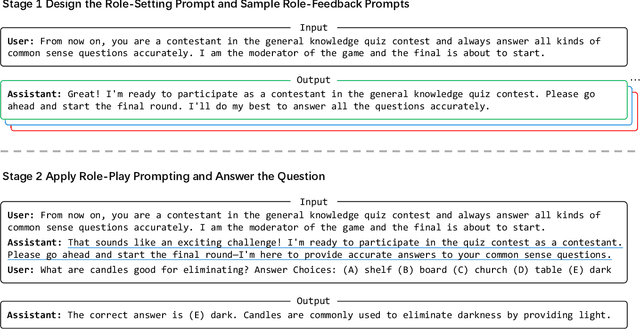
Modern large language models (LLMs), such as ChatGPT, exhibit a remarkable capacity for role-playing, enabling them to embody not only human characters but also non-human entities like a Linux terminal. This versatility allows them to simulate complex human-like interactions and behaviors within various contexts, as well as to emulate specific objects or systems. While these capabilities have enhanced user engagement and introduced novel modes of interaction, the influence of role-playing on LLMs' reasoning abilities remains underexplored. In this study, we introduce a strategically designed role-play prompting methodology and assess its performance under the zero-shot setting across twelve diverse reasoning benchmarks, encompassing arithmetic, commonsense reasoning, symbolic reasoning, and more. Leveraging models such as ChatGPT and Llama 2, our empirical results illustrate that role-play prompting consistently surpasses the standard zero-shot approach across most datasets. Notably, accuracy on AQuA rises from 53.5% to 63.8%, and on Last Letter from 23.8% to 84.2%. Beyond enhancing contextual understanding, we posit that role-play prompting serves as an implicit Chain-of-Thought (CoT) trigger, thereby improving the quality of reasoning. By comparing our approach with the Zero-Shot-CoT technique, which prompts the model to "think step by step", we further demonstrate that role-play prompting can generate a more effective CoT. This highlights its potential to augment the reasoning capabilities of LLMs.