 Add to Chrome
 Add to Firefox
 Add to Edge
Hallucination Self-Play: Bootstrapping Reinforced Detector via Evolved Generator
Jul 08, 2026
Identifying faithfulness hallucinations in LLM-generated outputs remains challenging due to the scarcity of high-quality annotated data. Recent work relies on advanced LLMs to synthesize training data, including rationales, labels, and hallucinated claims. However, these methods treat the generator as a static component, limiting iterative improvement of the detector. To address this limitation, we introduce Hallucination Self-Play (HSP), a novel framework that enables the detector to bootstrap with an evolved generator. HSP involves two roles initialized from the same base model, a detector that assesses the faithfulness of model outputs, and a generator that produces increasingly hard-to-detect hallucinated responses. Specifically, the detector is first fine-tuned on human-labeled data and then employed as a reward model to train the generator via reinforcement learning from AI feedback (RLAIF). In turn, the evolved generator synthesizes hallucination data to further optimize the detector through rule-based reinforcement learning. Experiments on RAGTruth benchmark and two model families demonstrate that the proposed framework can progressively enhance a small LLM to match or even outperform advanced LLMs without external supervision. Our code is available at https://anonymous.4open.science/r/Hallucination-Self-Play-50B5 .

RustMizan: A Compilable, Contamination-Aware Benchmarking Framework for Rust Vulnerabilities
Jul 06, 2026LLM agents are increasingly applied to vulnerability analysis, but existing benchmarks have not kept pace. They typically rely on small non-compilable snippets, focus on binary classification (vulnerable or not), and do not account for the risk that publicly-released datasets are part of model training corpora. We introduce RustMizan, a benchmarking framework for Rust vulnerability analysis that addresses these gaps. RustMizan contains compilable code variants at the crate, file, and function levels, with annotations for binary vulnerability detection, CWE classification, and function- and line-level localization. A paired mutation framework produces semantics-preserving code mutants for contamination testing and robustness probing. Across four frontier models in an agentic setup with command-line access, binary classification sits in the 56-65% range, but line localization F1 stays near 20%, and adversarial cues drop line F1 by about 27%.
Modularized Reinforcement Learning on LLMs: From MDP Creation to Exploration and Learning
Jun 20, 2026Reinforcement learning (RL) has become central to LLM post-training, yet the methods that dominate current pipelines, PPO and GRPO, represent only a narrow slice of what RL offers. Understanding why these methods prevail, and what alternatives exist, requires a principled examination of the design decisions that underlie any RL algorithm. This survey organizes that examination around three stages of algorithm construction. We begin with MDP creation: how the reward function, state space, action space, termination condition, and discount factor are, or could be, defined for LLM training. We then turn to exploration, covering temperature sampling, entropy regularization, intrinsic motivation, tree search, and curriculum learning. Finally, we address learning along four classical RL dimensions: model-free versus model-based, value-based versus policy-based versus actor-critic, on-policy versus off-policy, and credit assignment, including both Monte Carlo methods, which rely on full return estimates, and bootstrapping methods, which update estimates using other learned predictions. Mapping the LLM literature onto this taxonomy reveals a strikingly non-uniform distribution of research effort. Critic-free policy gradients and Monte Carlo credit assignment are densely populated, while value-based methods, off-policy actor-critic training, and bootstrapping-based credit assignment remain largely unexplored despite well-established counterparts in classical RL. These gaps represent concrete opportunities for transferring proven RL techniques to LLM training. By making these gaps explicit alongside the methods that have proven effective, this survey offers researchers in both RL and LLMs a shared framework for understanding current practice and identifying promising directions for future work.
VISOR: VIsual Spatial Object Reasoning for Language-driven Object Navigation
Feb 07, 2026Language-driven object navigation requires agents to interpret natural language descriptions of target objects, which combine intrinsic and extrinsic attributes for instance recognition and commonsense navigation. Existing methods either (i) use end-to-end trained models with vision-language embeddings, which struggle to generalize beyond training data and lack action-level explainability, or (ii) rely on modular zero-shot pipelines with large language models (LLMs) and open-set object detectors, which suffer from error propagation, high computational cost, and difficulty integrating their reasoning back into the navigation policy. To this end, we propose a compact 3B-parameter Vision-Language-Action (VLA) agent that performs human-like embodied reasoning for both object recognition and action selection, removing the need for stitched multi-model pipelines. Instead of raw embedding matching, our agent employs explicit image-grounded reasoning to directly answer "Is this the target object?" and "Why should I take this action?" The reasoning process unfolds in three stages: "think", "think summary", and "action", yielding improved explainability, stronger generalization, and more efficient navigation. Code and dataset available upon acceptance.
Quantifying the Robustness of Retrieval-Augmented Language Models Against Spurious Features in Grounding Data
Mar 07, 2025Robustness has become a critical attribute for the deployment of RAG systems in real-world applications. Existing research focuses on robustness to explicit noise (e.g., document semantics) but overlooks spurious features (a.k.a. implicit noise). While previous works have explored spurious features in LLMs, they are limited to specific features (e.g., formats) and narrow scenarios (e.g., ICL). In this work, we statistically confirm the presence of spurious features in the RAG paradigm, a robustness problem caused by the sensitivity of LLMs to semantic-agnostic features. Moreover, we provide a comprehensive taxonomy of spurious features and empirically quantify their impact through controlled experiments. Further analysis reveals that not all spurious features are harmful and they can even be beneficial sometimes. Extensive evaluation results across multiple LLMs suggest that spurious features are a widespread and challenging problem in the field of RAG. The code and dataset will be released to facilitate future research. We release all codes and data at: $\\\href{https://github.com/maybenotime/RAG-SpuriousFeatures}{https://github.com/maybenotime/RAG-SpuriousFeatures}$.
MuDAF: Long-Context Multi-Document Attention Focusing through Contrastive Learning on Attention Heads
Feb 19, 2025Large Language Models (LLMs) frequently show distracted attention due to irrelevant information in the input, which severely impairs their long-context capabilities. Inspired by recent studies on the effectiveness of retrieval heads in long-context factutality, we aim at addressing this distraction issue through improving such retrieval heads directly. We propose Multi-Document Attention Focusing (MuDAF), a novel method that explicitly optimizes the attention distribution at the head level through contrastive learning. According to the experimental results, MuDAF can significantly improve the long-context question answering performance of LLMs, especially in multi-document question answering. Extensive evaluations on retrieval scores and attention visualizations show that MuDAF possesses great potential in making attention heads more focused on relevant information and reducing attention distractions.
Fostering Natural Conversation in Large Language Models with NICO: a Natural Interactive COnversation dataset
Aug 18, 2024
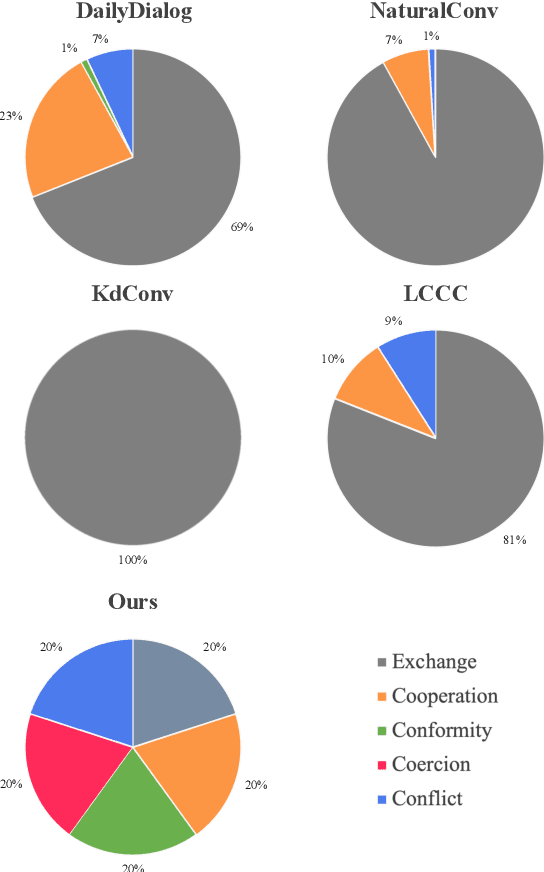
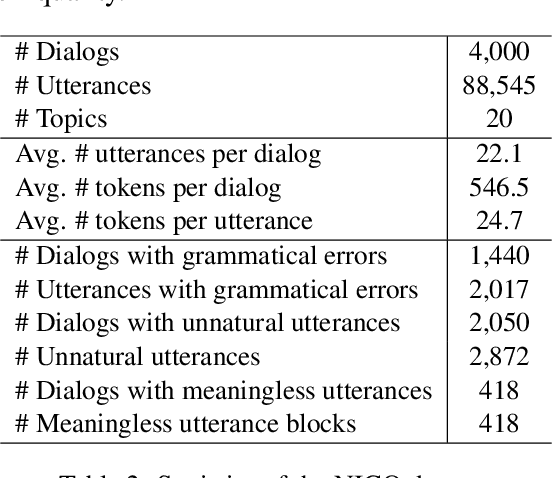
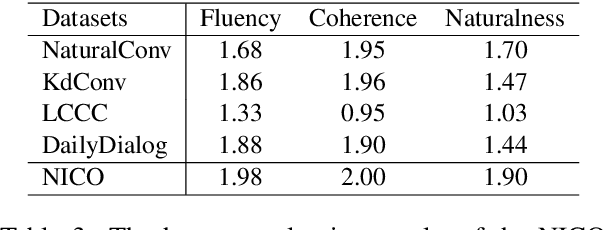
Benefiting from diverse instruction datasets, contemporary Large Language Models (LLMs) perform effectively as AI assistants in collaborating with humans. However, LLMs still struggle to generate natural and colloquial responses in real-world applications such as chatbots and psychological counseling that require more human-like interactions. To address these limitations, we introduce NICO, a Natural Interactive COnversation dataset in Chinese. We first use GPT-4-turbo to generate dialogue drafts and make them cover 20 daily-life topics and 5 types of social interactions. Then, we hire workers to revise these dialogues to ensure that they are free of grammatical errors and unnatural utterances. We define two dialogue-level natural conversation tasks and two sentence-level tasks for identifying and rewriting unnatural sentences. Multiple open-source and closed-source LLMs are tested and analyzed in detail. The experimental results highlight the challenge of the tasks and demonstrate how NICO can help foster the natural dialogue capabilities of LLMs. The dataset will be released.
A New Benchmark and Reverse Validation Method for Passage-level Hallucination Detection
Oct 24, 2023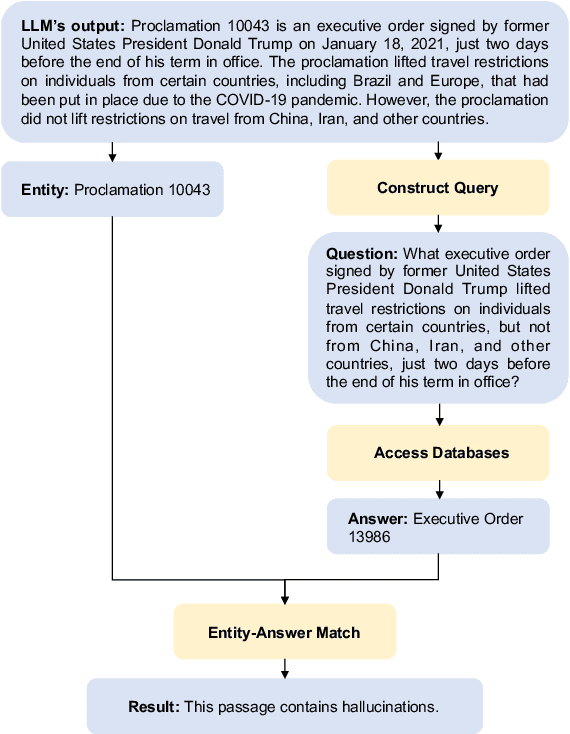

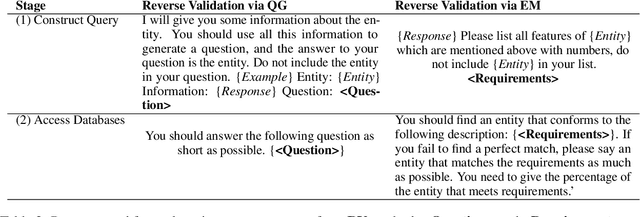
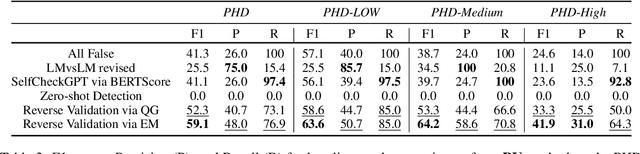
Large Language Models (LLMs) have shown their ability to collaborate effectively with humans in real-world scenarios. However, LLMs are apt to generate hallucinations, i.e., makeup incorrect text and unverified information, which can cause significant damage when deployed for mission-critical tasks. In this paper, we propose a self-check approach based on reverse validation to detect factual errors automatically in a zero-resource fashion. To facilitate future studies and assess different methods, we construct a hallucination detection benchmark named PHD, which is generated by ChatGPT and annotated by human annotators. Contrasting previous studies of zero-resource hallucination detection, our method and benchmark concentrate on passage-level detection instead of sentence-level. We empirically evaluate our method and existing zero-resource detection methods on two datasets. The experimental results demonstrate that the proposed method considerably outperforms the baselines while costing fewer tokens and less time. Furthermore, we manually analyze some hallucination cases that LLM failed to capture, revealing the shared limitation of zero-resource methods.
Multi-level Contrastive Learning for Script-based Character Understanding
Oct 20, 2023In this work, we tackle the scenario of understanding characters in scripts, which aims to learn the characters' personalities and identities from their utterances. We begin by analyzing several challenges in this scenario, and then propose a multi-level contrastive learning framework to capture characters' global information in a fine-grained manner. To validate the proposed framework, we conduct extensive experiments on three character understanding sub-tasks by comparing with strong pre-trained language models, including SpanBERT, Longformer, BigBird and ChatGPT-3.5. Experimental results demonstrate that our method improves the performances by a considerable margin. Through further in-depth analysis, we show the effectiveness of our method in addressing the challenges and provide more hints on the scenario of character understanding. We will open-source our work on github at https://github.com/David-Li0406/Script-based-Character-Understanding.
A New Dataset and Empirical Study for Sentence Simplification in Chinese
Jun 07, 2023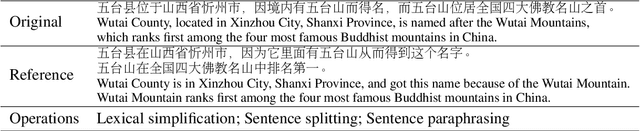
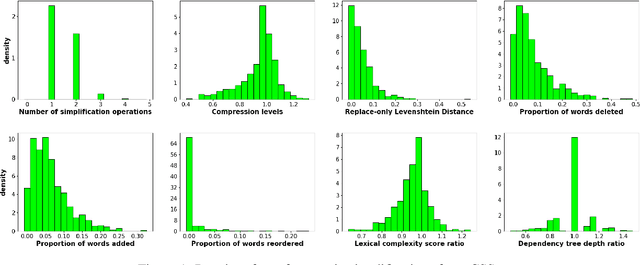
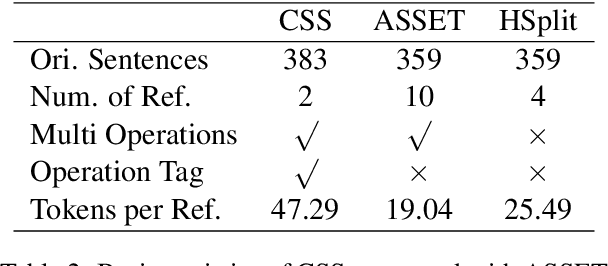
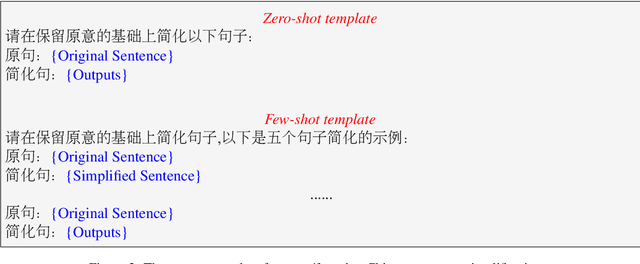
Sentence Simplification is a valuable technique that can benefit language learners and children a lot. However, current research focuses more on English sentence simplification. The development of Chinese sentence simplification is relatively slow due to the lack of data. To alleviate this limitation, this paper introduces CSS, a new dataset for assessing sentence simplification in Chinese. We collect manual simplifications from human annotators and perform data analysis to show the difference between English and Chinese sentence simplifications. Furthermore, we test several unsupervised and zero/few-shot learning methods on CSS and analyze the automatic evaluation and human evaluation results. In the end, we explore whether Large Language Models can serve as high-quality Chinese sentence simplification systems by evaluating them on CSS.