 Add to Chrome
 Add to Firefox
 Add to Edge
VISOR: VIsual Spatial Object Reasoning for Language-driven Object Navigation
Feb 07, 2026
Language-driven object navigation requires agents to interpret natural language descriptions of target objects, which combine intrinsic and extrinsic attributes for instance recognition and commonsense navigation. Existing methods either (i) use end-to-end trained models with vision-language embeddings, which struggle to generalize beyond training data and lack action-level explainability, or (ii) rely on modular zero-shot pipelines with large language models (LLMs) and open-set object detectors, which suffer from error propagation, high computational cost, and difficulty integrating their reasoning back into the navigation policy. To this end, we propose a compact 3B-parameter Vision-Language-Action (VLA) agent that performs human-like embodied reasoning for both object recognition and action selection, removing the need for stitched multi-model pipelines. Instead of raw embedding matching, our agent employs explicit image-grounded reasoning to directly answer "Is this the target object?" and "Why should I take this action?" The reasoning process unfolds in three stages: "think", "think summary", and "action", yielding improved explainability, stronger generalization, and more efficient navigation. Code and dataset available upon acceptance.

BarcodeMamba+: Advancing State-Space Models for Fungal Biodiversity Research
Dec 17, 2025Accurate taxonomic classification from DNA barcodes is a cornerstone of global biodiversity monitoring, yet fungi present extreme challenges due to sparse labelling and long-tailed taxa distributions. Conventional supervised learning methods often falter in this domain, struggling to generalize to unseen species and to capture the hierarchical nature of the data. To address these limitations, we introduce BarcodeMamba+, a foundation model for fungal barcode classification built on a powerful and efficient state-space model architecture. We employ a pretrain and fine-tune paradigm, which utilizes partially labelled data and we demonstrate this is substantially more effective than traditional fully-supervised methods in this data-sparse environment. During fine-tuning, we systematically integrate and evaluate a suite of enhancements--including hierarchical label smoothing, a weighted loss function, and a multi-head output layer from MycoAI--to specifically tackle the challenges of fungal taxonomy. Our experiments show that each of these components yields significant performance gains. On a challenging fungal classification benchmark with distinct taxonomic distribution shifts from the broad training set, our final model outperforms a range of existing methods across all taxonomic levels. Our work provides a powerful new tool for genomics-based biodiversity research and establishes an effective and scalable training paradigm for this challenging domain. Our code is publicly available at https://github.com/bioscan-ml/BarcodeMamba.
${M^2D}$NeRF: Multi-Modal Decomposition NeRF with 3D Feature Fields
May 08, 2024Neural fields (NeRF) have emerged as a promising approach for representing continuous 3D scenes. Nevertheless, the lack of semantic encoding in NeRFs poses a significant challenge for scene decomposition. To address this challenge, we present a single model, Multi-Modal Decomposition NeRF (${M^2D}$NeRF), that is capable of both text-based and visual patch-based edits. Specifically, we use multi-modal feature distillation to integrate teacher features from pretrained visual and language models into 3D semantic feature volumes, thereby facilitating consistent 3D editing. To enforce consistency between the visual and language features in our 3D feature volumes, we introduce a multi-modal similarity constraint. We also introduce a patch-based joint contrastive loss that helps to encourage object-regions to coalesce in the 3D feature space, resulting in more precise boundaries. Experiments on various real-world scenes show superior performance in 3D scene decomposition tasks compared to prior NeRF-based methods.
R3DS: Reality-linked 3D Scenes for Panoramic Scene Understanding
Mar 18, 2024
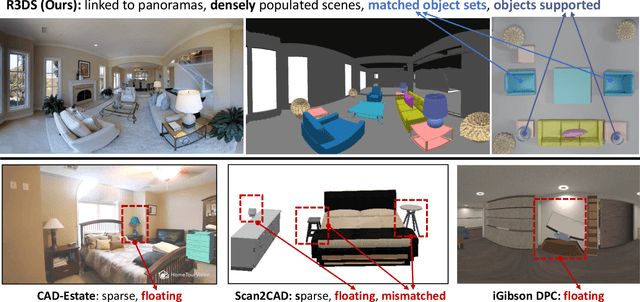

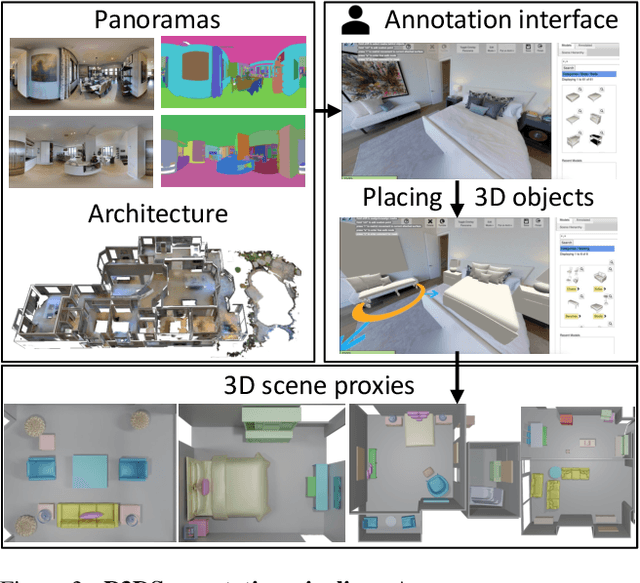
We introduce the Reality-linked 3D Scenes (R3DS) dataset of synthetic 3D scenes mirroring the real-world scene arrangements from Matterport3D panoramas. Compared to prior work, R3DS has more complete and densely populated scenes with objects linked to real-world observations in panoramas. R3DS also provides an object support hierarchy, and matching object sets (e.g., same chairs around a dining table) for each scene. Overall, R3DS contains 19K objects represented by 3,784 distinct CAD models from over 100 object categories. We demonstrate the effectiveness of R3DS on the Panoramic Scene Understanding task. We find that: 1) training on R3DS enables better generalization; 2) support relation prediction trained with R3DS improves performance compared to heuristically calculated support; and 3) R3DS offers a challenging benchmark for future work on panoramic scene understanding.