 Add to Chrome
 Add to Firefox
 Add to Edge
Hierarchical Solomonoff Induction: An Unbounded Machine Learning Model
Aug 02, 2026
Solomonoff Induction, or SolInd, provides an ideal unbounded model of a priori sequence prediction but cannot naturally describe extrapolation from a given training dataset, as performed by Large Language Models. We apply de Finetti's theorem on exchangeable distributions to SolInd to produce what we call Hierarchical Solomonoff Induction, or HSI, which maintains a hyperprior over all Solomonoff priors that can be conditioned on previously observed sequences. We extend Wood et al.'s proof that universal mixtures of semimeasures are equivalent to SolInd to show that universal mixtures of these mixtures are also equivalent, proving that HSI=SolInd. We also prove that HSI's excess error on any distribution, compared to its true generator, is bounded by that generator's complexity in the hyperprior. This result is directly comparable to SolInd's prediction error being bounded by the Kolmogorov complexity of the sequence being predicted, and forces HSI's average excess error to converge to 0 as a dataset grows, leading to optimal prediction in the limit. We claim that HSI is an ideal unbounded model of sequence prediction given a dataset in the same way that SolInd is ideal over individual sequences.

RustMizan: A Compilable, Contamination-Aware Benchmarking Framework for Rust Vulnerabilities
Jul 06, 2026LLM agents are increasingly applied to vulnerability analysis, but existing benchmarks have not kept pace. They typically rely on small non-compilable snippets, focus on binary classification (vulnerable or not), and do not account for the risk that publicly-released datasets are part of model training corpora. We introduce RustMizan, a benchmarking framework for Rust vulnerability analysis that addresses these gaps. RustMizan contains compilable code variants at the crate, file, and function levels, with annotations for binary vulnerability detection, CWE classification, and function- and line-level localization. A paired mutation framework produces semantics-preserving code mutants for contamination testing and robustness probing. Across four frontier models in an agentic setup with command-line access, binary classification sits in the 56-65% range, but line localization F1 stays near 20%, and adversarial cues drop line F1 by about 27%.
Transformers As Approximations of Solomonoff Induction
Aug 22, 2024Solomonoff Induction is an optimal-in-the-limit unbounded algorithm for sequence prediction, representing a Bayesian mixture of every computable probability distribution and performing close to optimally in predicting any computable sequence. Being an optimal form of computational sequence prediction, it seems plausible that it may be used as a model against which other methods of sequence prediction might be compared. We put forth and explore the hypothesis that Transformer models - the basis of Large Language Models - approximate Solomonoff Induction better than any other extant sequence prediction method. We explore evidence for and against this hypothesis, give alternate hypotheses that take this evidence into account, and outline next steps for modelling Transformers and other kinds of AI in this way.
Contrastive Learning with Logic-driven Data Augmentation for Logical Reasoning over Text
May 21, 2023Pre-trained large language model (LLM) is under exploration to perform NLP tasks that may require logical reasoning. Logic-driven data augmentation for representation learning has been shown to improve the performance of tasks requiring logical reasoning, but most of these data rely on designed templates and therefore lack generalization. In this regard, we propose an AMR-based logical equivalence-driven data augmentation method (AMR-LE) for generating logically equivalent data. Specifically, we first parse a text into the form of an AMR graph, next apply four logical equivalence laws (contraposition, double negation, commutative and implication laws) on the AMR graph to construct a logically equivalent/inequivalent AMR graph, and then convert it into a logically equivalent/inequivalent sentence. To help the model to better learn these logical equivalence laws, we propose a logical equivalence-driven contrastive learning training paradigm, which aims to distinguish the difference between logical equivalence and inequivalence. Our AMR-LE (Ensemble) achieves #2 on the ReClor leaderboard https://eval.ai/web/challenges/challenge-page/503/leaderboard/1347 . Our model shows better performance on seven downstream tasks, including ReClor, LogiQA, MNLI, MRPC, RTE, QNLI, and QQP. The source code and dataset are public at https://github.com/Strong-AI-Lab/Logical-Equivalence-driven-AMR-Data-Augmentation-for-Representation-Learning .
AbductionRules: Training Transformers to Explain Unexpected Inputs
Mar 23, 2022
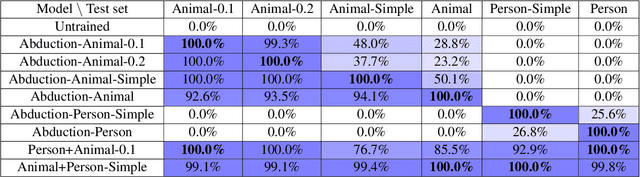
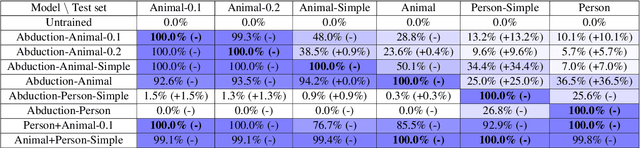
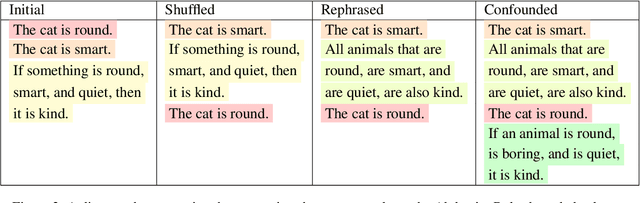
Transformers have recently been shown to be capable of reliably performing logical reasoning over facts and rules expressed in natural language, but abductive reasoning - inference to the best explanation of an unexpected observation - has been underexplored despite significant applications to scientific discovery, common-sense reasoning, and model interpretability. We present AbductionRules, a group of natural language datasets designed to train and test generalisable abduction over natural-language knowledge bases. We use these datasets to finetune pretrained Transformers and discuss their performance, finding that our models learned generalisable abductive techniques but also learned to exploit the structure of our data. Finally, we discuss the viability of this approach to abductive reasoning and ways in which it may be improved in future work.
Decentralized Control Systems Laboratory Using Human Centered Robotic Actuators
Apr 09, 2019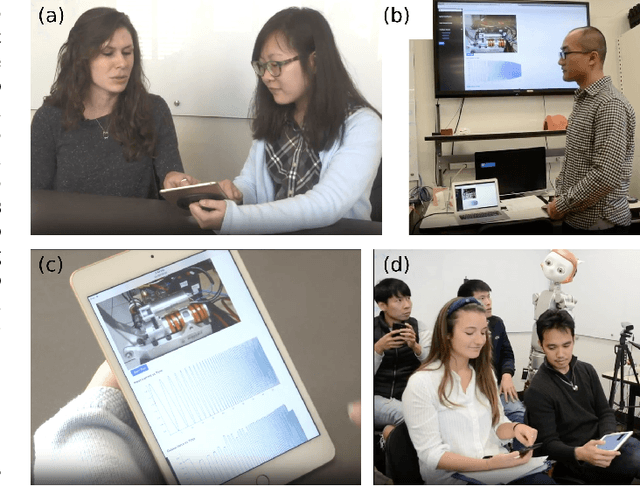
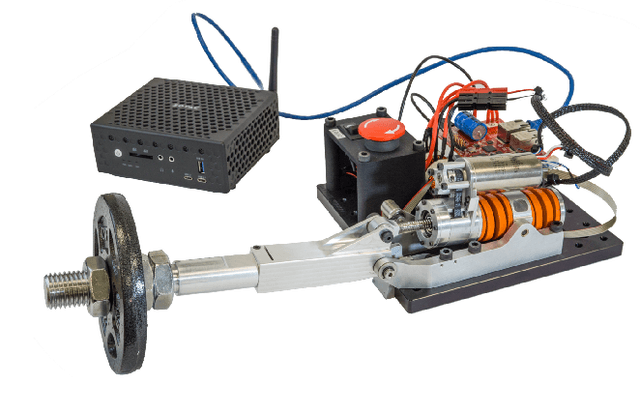
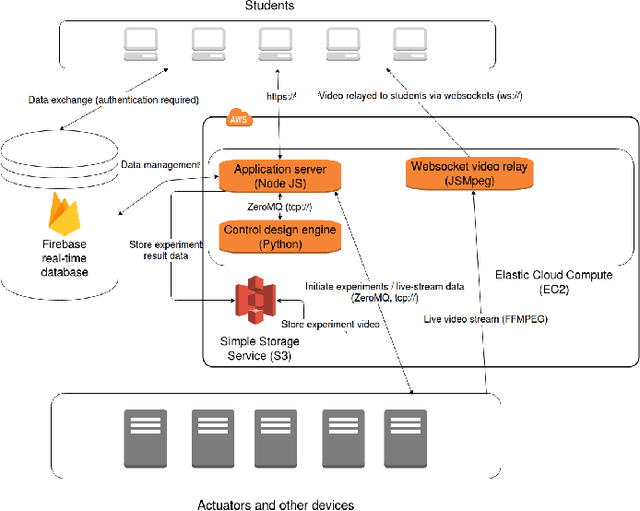
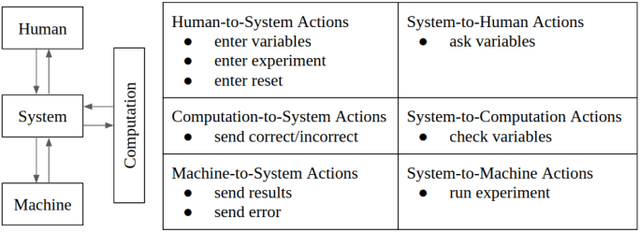
University laboratories deliver unique hands-on experimentation for STEM students but often lack state-of-the-art equipment and provide limited access to their equipment. The University of Texas Cloud Laboratory provides remote access to a cutting-edge series elastic actuators for student experimentation regarding human-centered robotics, dynamical systems, and controls. Through a browser-based interface, students are provided with various learning materials using the remote hardware-in-the-loop system for effective experiment-based education. This paper discusses the methods used to connect remote hardware to mobile browsers, the adaptation of textbook materials regarding system identification and feedback control, data processing to generate clean and useful results for student interpretation, and initial usage of the end-to-end system for individual and group learning.