 Add to Chrome
 Add to Firefox
 Add to Edge
PSL: Rethinking and Improving Softmax Loss from Pairwise Perspective for Recommendation
Oct 31, 2024


Softmax Loss (SL) is widely applied in recommender systems (RS) and has demonstrated effectiveness. This work analyzes SL from a pairwise perspective, revealing two significant limitations: 1) the relationship between SL and conventional ranking metrics like DCG is not sufficiently tight; 2) SL is highly sensitive to false negative instances. Our analysis indicates that these limitations are primarily due to the use of the exponential function. To address these issues, this work extends SL to a new family of loss functions, termed Pairwise Softmax Loss (PSL), which replaces the exponential function in SL with other appropriate activation functions. While the revision is minimal, we highlight three merits of PSL: 1) it serves as a tighter surrogate for DCG with suitable activation functions; 2) it better balances data contributions; and 3) it acts as a specific BPR loss enhanced by Distributionally Robust Optimization (DRO). We further validate the effectiveness and robustness of PSL through empirical experiments. The code is available at https://github.com/Tiny-Snow/IR-Benchmark.

Towards Dynamic Graph Neural Networks with Provably High-Order Expressive Power
Oct 02, 2024


Dynamic Graph Neural Networks (DyGNNs) have garnered increasing research attention for learning representations on evolving graphs. Despite their effectiveness, the limited expressive power of existing DyGNNs hinders them from capturing important evolving patterns of dynamic graphs. Although some works attempt to enhance expressive capability with heuristic features, there remains a lack of DyGNN frameworks with provable and quantifiable high-order expressive power. To address this research gap, we firstly propose the k-dimensional Dynamic WL tests (k-DWL) as the referencing algorithms to quantify the expressive power of DyGNNs. We demonstrate that the expressive power of existing DyGNNs is upper bounded by the 1-DWL test. To enhance the expressive power, we propose Dynamic Graph Neural Network with High-order expressive power (HopeDGN), which updates the representation of central node pair by aggregating the interaction history with neighboring node pairs. Our theoretical results demonstrate that HopeDGN can achieve expressive power equivalent to the 2-DWL test. We then present a Transformer-based implementation for the local variant of HopeDGN. Experimental results show that HopeDGN achieved performance improvements of up to 3.12%, demonstrating the effectiveness of HopeDGN.
DiffCP: Ultra-Low Bit Collaborative Perception via Diffusion Model
Sep 29, 2024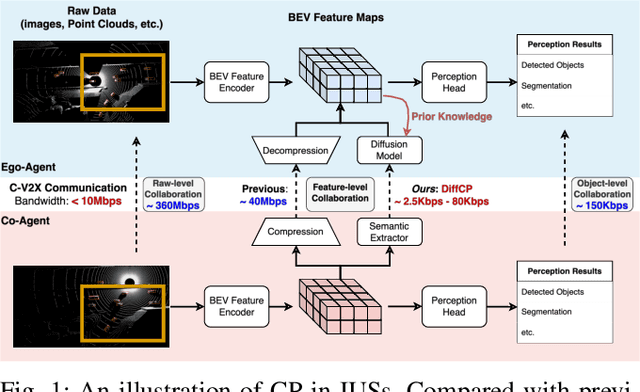
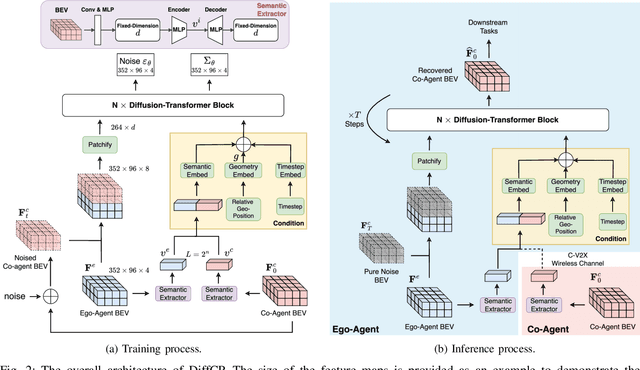
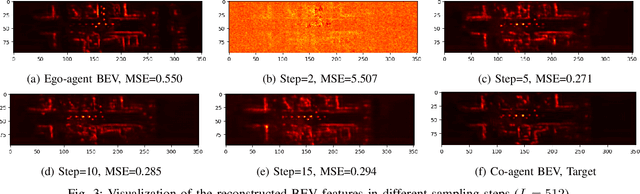
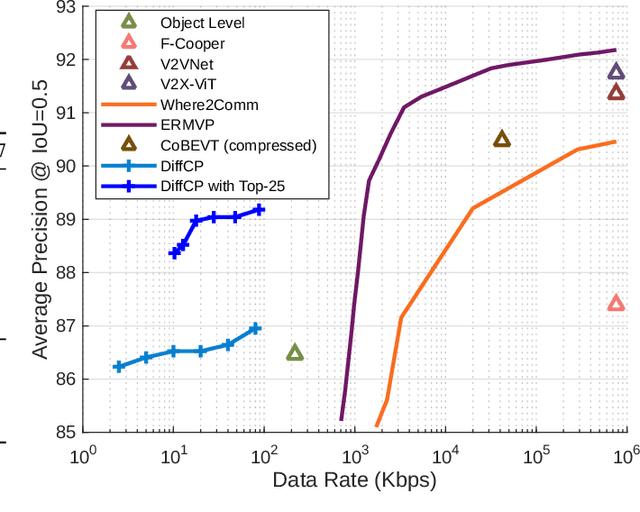
Collaborative perception (CP) is emerging as a promising solution to the inherent limitations of stand-alone intelligence. However, current wireless communication systems are unable to support feature-level and raw-level collaborative algorithms due to their enormous bandwidth demands. In this paper, we propose DiffCP, a novel CP paradigm that utilizes a specialized diffusion model to efficiently compress the sensing information of collaborators. By incorporating both geometric and semantic conditions into the generative model, DiffCP enables feature-level collaboration with an ultra-low communication cost, advancing the practical implementation of CP systems. This paradigm can be seamlessly integrated into existing CP algorithms to enhance a wide range of downstream tasks. Through extensive experimentation, we investigate the trade-offs between communication, computation, and performance. Numerical results demonstrate that DiffCP can significantly reduce communication costs by 14.5-fold while maintaining the same performance as the state-of-the-art algorithm.
Scene-Text Grounding for Text-Based Video Question Answering
Sep 22, 2024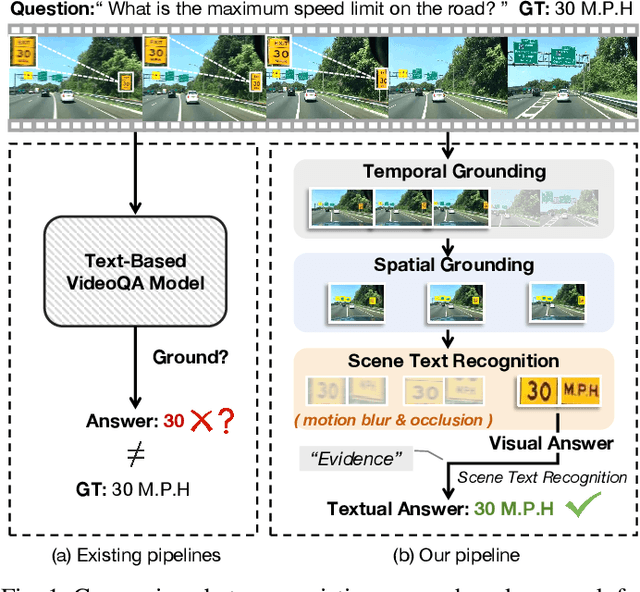

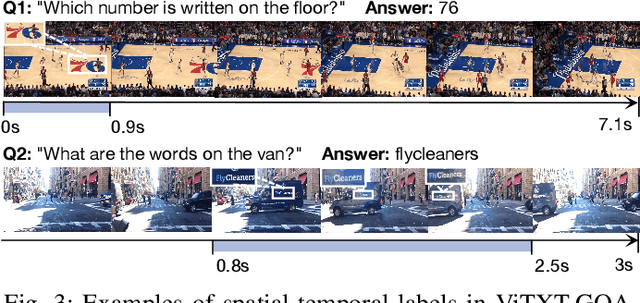
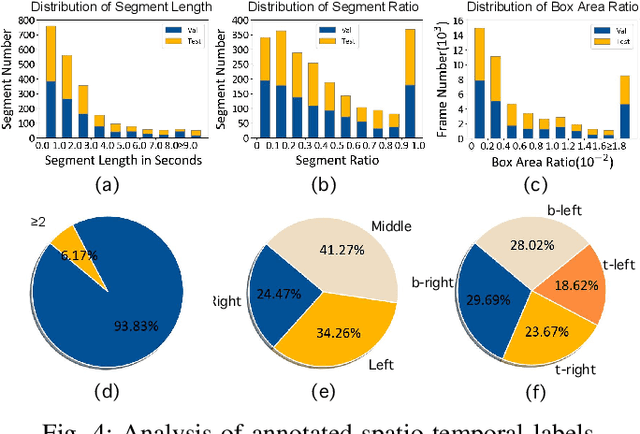
Existing efforts in text-based video question answering (TextVideoQA) are criticized for their opaque decisionmaking and heavy reliance on scene-text recognition. In this paper, we propose to study Grounded TextVideoQA by forcing models to answer questions and spatio-temporally localize the relevant scene-text regions, thus decoupling QA from scenetext recognition and promoting research towards interpretable QA. The task has three-fold significance. First, it encourages scene-text evidence versus other short-cuts for answer predictions. Second, it directly accepts scene-text regions as visual answers, thus circumventing the problem of ineffective answer evaluation by stringent string matching. Third, it isolates the challenges inherited in VideoQA and scene-text recognition. This enables the diagnosis of the root causes for failure predictions, e.g., wrong QA or wrong scene-text recognition? To achieve Grounded TextVideoQA, we propose the T2S-QA model that highlights a disentangled temporal-to-spatial contrastive learning strategy for weakly-supervised scene-text grounding and grounded TextVideoQA. To facilitate evaluation, we construct a new dataset ViTXT-GQA which features 52K scene-text bounding boxes within 2.2K temporal segments related to 2K questions and 729 videos. With ViTXT-GQA, we perform extensive experiments and demonstrate the severe limitations of existing techniques in Grounded TextVideoQA. While T2S-QA achieves superior results, the large performance gap with human leaves ample space for improvement. Our further analysis of oracle scene-text inputs posits that the major challenge is scene-text recognition. To advance the research of Grounded TextVideoQA, our dataset and code are at \url{https://github.com/zhousheng97/ViTXT-GQA.git}
SciDVS: A Scientific Event Camera with 1.7% Temporal Contrast Sensitivity at 0.7 lux
Sep 15, 2024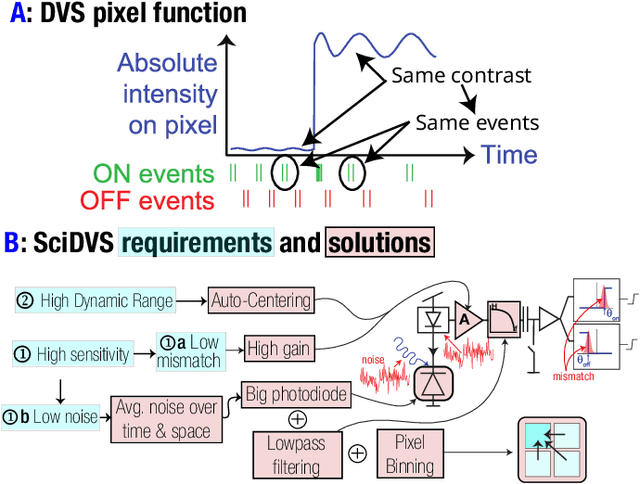
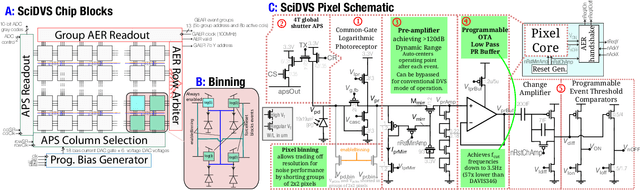
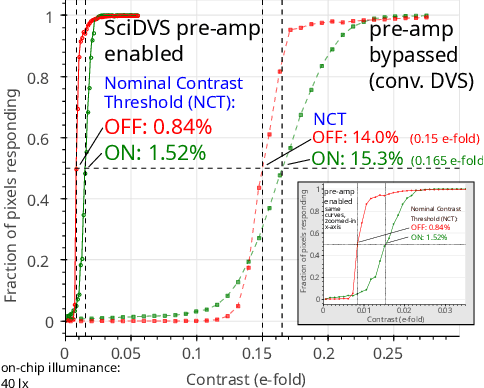
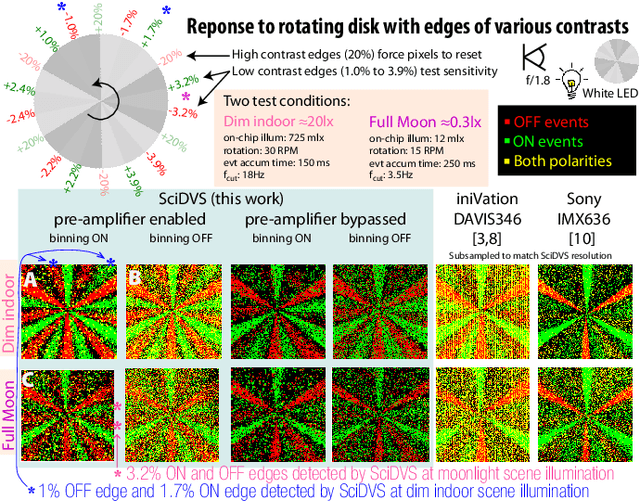
This paper reports a Dynamic Vision Sensor (DVS) event camera that is 6x more sensitive at 14x lower illumination than existing commercial and prototype cameras. Event cameras output a sparse stream of brightness change events. Their high dynamic range (HDR), quick response, and high temporal resolution provide key advantages for scientific applications that involve low lighting conditions and sparse visual events. However, current DVS are hindered by low sensitivity, resulting from shot noise and pixel-to-pixel mismatch. Commercial DVS have a minimum brightness change threshold of >10%. Sensitive prototypes achieved as low as 1%, but required kilo-lux illumination. Our SciDVS prototype fabricated in a 180nm CMOS image sensor process achieves 1.7% sensitivity at chip illumination of 0.7 lx and 18 Hz bandwidth. Novel features of SciDVS are (1) an auto-centering in-pixel preamplifier providing intrascene HDR and increased sensitivity, (2) improved control of bandwidth to limit shot noise, and (3) optional pixel binning, allowing the user to trade spatial resolution for sensitivity.
SAM-SP: Self-Prompting Makes SAM Great Again
Aug 22, 2024
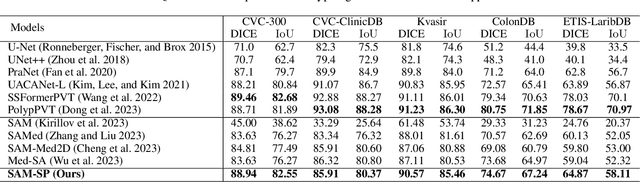


The recently introduced Segment Anything Model (SAM), a Visual Foundation Model (VFM), has demonstrated impressive capabilities in zero-shot segmentation tasks across diverse natural image datasets. Despite its success, SAM encounters noticeably performance degradation when applied to specific domains, such as medical images. Current efforts to address this issue have involved fine-tuning strategies, intended to bolster the generalizability of the vanilla SAM. However, these approaches still predominantly necessitate the utilization of domain specific expert-level prompts during the evaluation phase, which severely constrains the model's practicality. To overcome this limitation, we introduce a novel self-prompting based fine-tuning approach, called SAM-SP, tailored for extending the vanilla SAM model. Specifically, SAM-SP leverages the output from the previous iteration of the model itself as prompts to guide subsequent iteration of the model. This self-prompting module endeavors to learn how to generate useful prompts autonomously and alleviates the dependence on expert prompts during the evaluation phase, significantly broadening SAM's applicability. Additionally, we integrate a self-distillation module to enhance the self-prompting process further. Extensive experiments across various domain specific datasets validate the effectiveness of the proposed SAM-SP. Our SAM-SP not only alleviates the reliance on expert prompts but also exhibits superior segmentation performance comparing to the state-of-the-art task-specific segmentation approaches, the vanilla SAM, and SAM-based approaches.
Dynamic Graph Transformer with Correlated Spatial-Temporal Positional Encoding
Jul 24, 2024
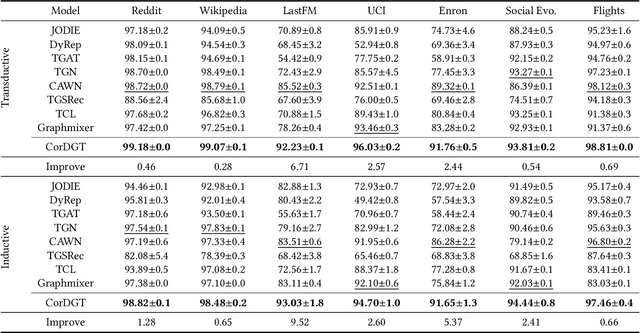

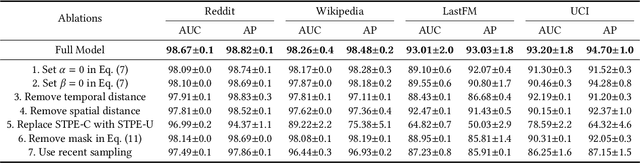
Learning effective representations for Continuous-Time Dynamic Graphs (CTDGs) has garnered significant research interest, largely due to its powerful capabilities in modeling complex interactions between nodes. A fundamental and crucial requirement for representation learning in CTDGs is the appropriate estimation and preservation of proximity. However, due to the sparse and evolving characteristics of CTDGs, the spatial-temporal properties inherent in high-order proximity remain largely unexplored. Despite its importance, this property presents significant challenges due to the computationally intensive nature of personalized interaction intensity estimation and the dynamic attributes of CTDGs. To this end, we propose a novel Correlated Spatial-Temporal Positional encoding that incorporates a parameter-free personalized interaction intensity estimation under the weak assumption of the Poisson Point Process. Building on this, we introduce the Dynamic Graph Transformer with \Correlated Spatial-Temporal Positional Encoding (CorDGT), which efficiently retains the evolving spatial-temporal high-order proximity for effective node representation learning in CTDGs. Extensive experiments on seven small and two large-scale datasets demonstrate the superior performance and scalability of the proposed CorDGT.
GC-Bench: An Open and Unified Benchmark for Graph Condensation
Jun 30, 2024Graph condensation (GC) has recently garnered considerable attention due to its ability to reduce large-scale graph datasets while preserving their essential properties. The core concept of GC is to create a smaller, more manageable graph that retains the characteristics of the original graph. Despite the proliferation of graph condensation methods developed in recent years, there is no comprehensive evaluation and in-depth analysis, which creates a great obstacle to understanding the progress in this field. To fill this gap, we develop a comprehensive Graph Condensation Benchmark (GC-Bench) to analyze the performance of graph condensation in different scenarios systematically. Specifically, GC-Bench systematically investigates the characteristics of graph condensation in terms of the following dimensions: effectiveness, transferability, and complexity. We comprehensively evaluate 12 state-of-the-art graph condensation algorithms in node-level and graph-level tasks and analyze their performance in 12 diverse graph datasets. Further, we have developed an easy-to-use library for training and evaluating different GC methods to facilitate reproducible research. The GC-Bench library is available at https://github.com/RingBDStack/GC-Bench.
C-MASS: Combinatorial Mobility-Aware Sensor Scheduling for Collaborative Perception with Second-Order Topology Approximation
Jun 29, 2024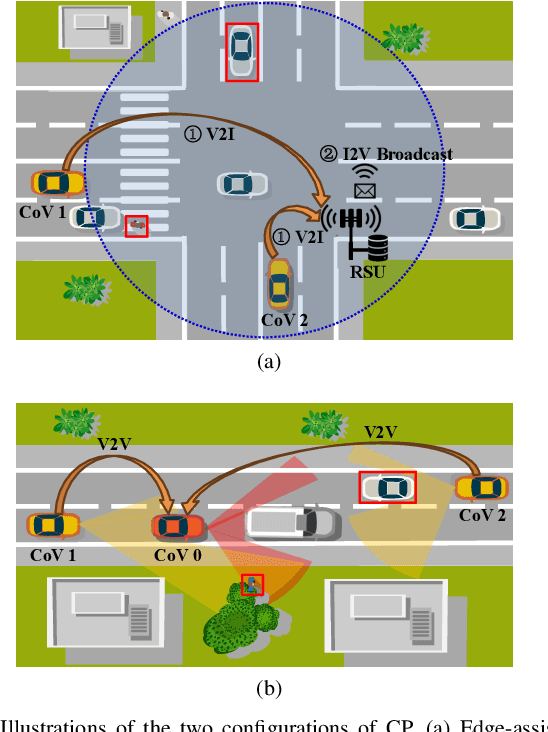
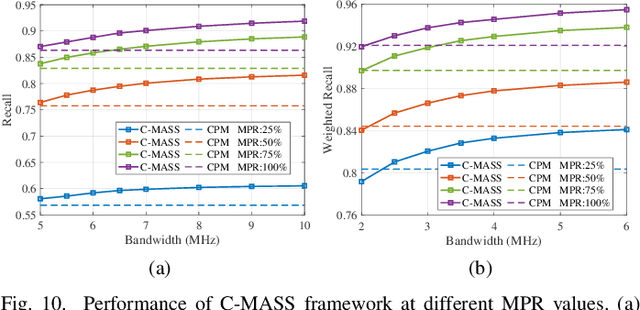
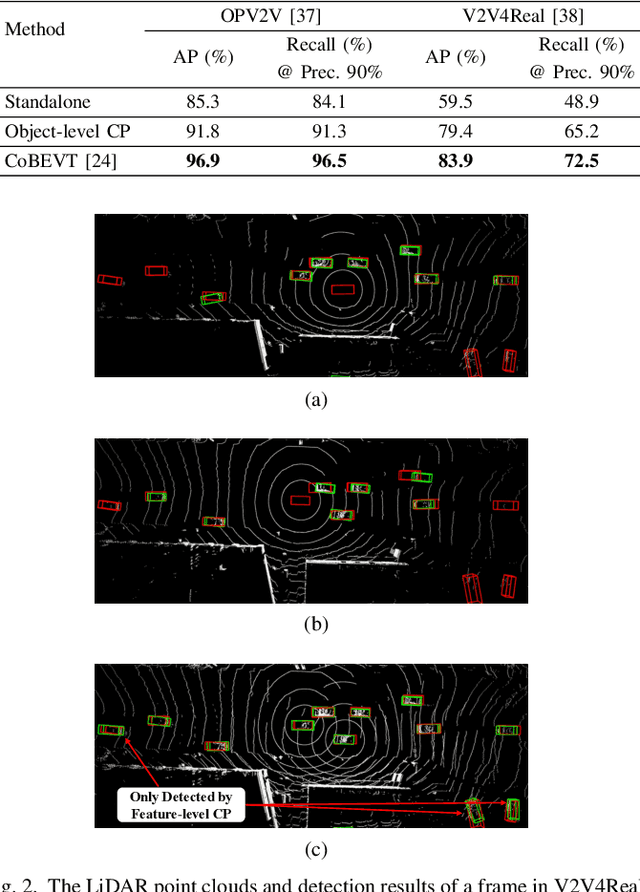
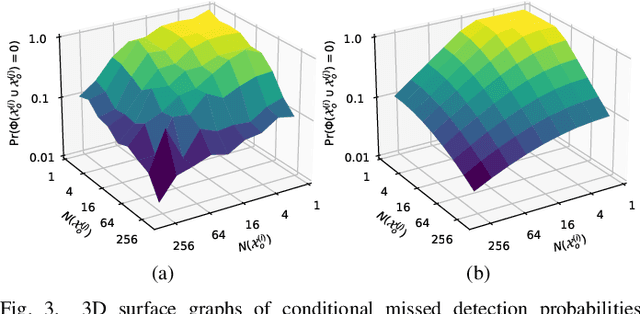
Collaborative Perception (CP) has been a promising solution to address occlusions in the traffic environment by sharing sensor data among collaborative vehicles (CoV) via vehicle-to-everything (V2X) network. With limited wireless bandwidth, CP necessitates task-oriented and receiver-aware sensor scheduling to prioritize important and complementary sensor data. However, due to vehicular mobility, it is challenging and costly to obtain the up-to-date perception topology, i.e., whether a combination of CoVs can jointly detect an object. In this paper, we propose a combinatorial mobility-aware sensor scheduling (C-MASS) framework for CP with minimal communication overhead. Specifically, detections are replayed with sensor data from individual CoVs and pairs of CoVs to maintain an empirical perception topology up to the second order, which approximately represents the complete perception topology. A hybrid greedy algorithm is then proposed to solve a variant of the budgeted maximum coverage problem with a worst-case performance guarantee. The C-MASS scheduling algorithm adapts the greedy algorithm by incorporating the topological uncertainty and the unexplored time of CoVs to balance exploration and exploitation, addressing the mobility challenge. Extensive numerical experiments demonstrate the near-optimality of the proposed C-MASS framework in both edge-assisted and distributed CP configurations. The weighted recall improvements over object-level CP are 5.8% and 4.2%, respectively. Compared to distance-based and area-based greedy heuristics, the gaps to the offline optimal solutions are reduced by up to 75% and 71%, respectively.
Dynamic Scheduling for Vehicle-to-Vehicle Communications Enhanced Federated Learning
Jun 25, 2024
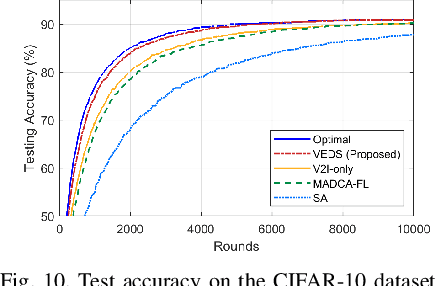
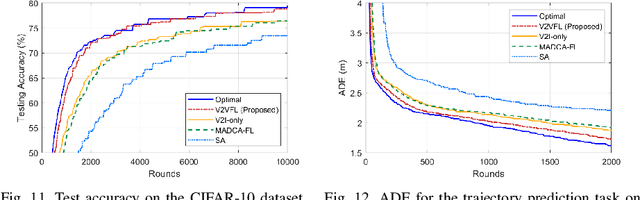

Leveraging the computing and sensing capabilities of vehicles, vehicular federated learning (VFL) has been applied to edge training for connected vehicles. The dynamic and interconnected nature of vehicular networks presents unique opportunities to harness direct vehicle-to-vehicle (V2V) communications, enhancing VFL training efficiency. In this paper, we formulate a stochastic optimization problem to optimize the VFL training performance, considering the energy constraints and mobility of vehicles, and propose a V2V-enhanced dynamic scheduling (VEDS) algorithm to solve it. The model aggregation requirements of VFL and the limited transmission time due to mobility result in a stepwise objective function, which presents challenges in solving the problem. We thus propose a derivative-based drift-plus-penalty method to convert the long-term stochastic optimization problem to an online mixed integer nonlinear programming (MINLP) problem, and provide a theoretical analysis to bound the performance gap between the online solution and the offline optimal solution. Further analysis of the scheduling priority reduces the original problem into a set of convex optimization problems, which are efficiently solved using the interior-point method. Experimental results demonstrate that compared with the state-of-the-art benchmarks, the proposed algorithm enhances the image classification accuracy on the CIFAR-10 dataset by 3.18% and reduces the average displacement errors on the Argoverse trajectory prediction dataset by 10.21%.