 Add to Chrome
 Add to Firefox
 Add to Edge
MMHBench: A Multi-Perspective Benchmark for Mental Health Understanding in Long-Form Videos
Jul 30, 2026
Mental health understanding in long-form videos requires nuanced reasoning over observable behavior, interpersonal context, and latent psychological states. Existing benchmarks largely reduce this task to coarse-grained classification, providing limited insight into whether models truly understand psychological phenomena or rely on superficial correlations. To address this limitation, we introduce MMHBench, a comprehensive multimodal benchmark for multi-perspective mental health understanding, comprising 268 long-form videos and 2,184 carefully curated questions. MMHBench organizes the evaluation into two complementary settings: (1) third-person assessment, consisting of 605 questions that focus on the interpretation of observable behaviors and multimodal evidence, and (2) first-person perspective-taking, comprising 1,579 questions that require perspective-conditioned reasoning to identify the interpretation of the mental state supported by the available multimodal evidence. We propose a Multi-Agent Question Generation (MAQG) framework that simulates diverse social roles to synthesize questions from multiple perspectives. The generated questions are refined through multi-role feedback and iterative optimization, followed by expert-guided verification to ensure quality and validity. Extensive evaluation of 22 representative multimodal large language models (MLLMs), spanning both open-source and leading closed-source models, demonstrates that long-form video mental health understanding remains highly challenging.

Benchmarking Dynamic Affective Reasoning: A Viewer-Centric Video Emotion Dataset
Jul 11, 2026Video emotion analysis is typically framed as a static classification problem, treating each clip as an independent labeled unit. However, such a formulation overlooks a key psychological fact: emotions change as a result of cumulative reactions to consecutive causal events. To bridge this gap, we introduce Dynamic Affective Reasoning, the first large-scale benchmark for viewer-centric affect transitions and causal reasoning over consecutive video events. DAR contains 15,087 videos and 36,908 event-aligned affective segments annotated with 27 emotion categories. Unlike existing video-based emotion datasets, DAR presents a new viewer-centric perspective on fine-grained emotional expressions and transitions, and provides dense, temporally grounded, and causally explicit reasoning chains. Based on DAR, we formally define three challenging tasks: affective segmentation, fine-grained emotion classification, and affective reasoning. Complementing this benchmark, we propose DAR-R1, a two-stage framework that combines supervised fine-tuning with Group Relative Policy Optimization. Experiments across 10+ MLLMs show that DAR-R1 sets a new state-of-the-art for dynamic affective reasoning, in terms of both emotional localization and affective reasoning. Project page: https://github.com/Zhang-Zhiyan/DAR.
SafeGuard: A Multi-Agent Perception-Reasoning Framework for Social-Risk AI-Generated Video Detection
Jul 03, 2026As video generation paradigms evolve from localized manipulation to full-scene synthesis, AI-generated video detection becomes increasingly challenging, as forgeries exhibit coherent global structure and high perceptual realism. However, existing benchmarks are biased toward perceptual fidelity and primarily evaluate detectors based on perceptual artifacts, providing limited coverage of scenarios that require reasoning about violations of physical laws, structural coherence, or social logic. This dataset bias shapes current approaches and results in a Perception-Reasoning Gap: artifact-centric models capture low-level statistical irregularities yet lack semantic inference, whereas vision-language models perform semantic reasoning but remain insensitive to fine-grained forensic cues. To bridge this gap, we propose SafeGuard, a multi-agent framework that enables collaborative specialization between forensic perception and semantic reasoning. A hierarchical perceptual solver extracts fine-grained forensic evidence, while a self-reflective verifier enforces consistency between semantic inference and physical plausibility, forming an interpretable evidence chain. To support evaluation, we introduce SafeVid, a novel AI-generated video detection benchmark comprising 20K videos spanning 10 social risk categories, designed to evaluate physical plausibility, structural consistency, and the rationality of social behaviors. Extensive experiments demonstrate the generalization of SafeGuard, improving accuracy on SafeVid by +18.7% and consistently outperforming prior methods across four public benchmarks.
Omni-Perception Policy Optimization for Multimodal Emotion Reasoning
Jun 24, 2026We find that current emotion-oriented Omni-MLLMs still lack reliable omni-modal perception: they (i) underutilize multimodal cues in their reasoning trajectories and (ii) exhibit unfaithful behavior, often hallucinating modality-specific statements from other modalities. Building on these insights, we propose OPPO (Omni-Perception Policy Optimization), a reinforcement learning framework that explicitly optimizes multimodal perception. First, an Omni-Perception Reward decomposes ground-truth reasoning into fine-grained visual, acoustic, and emotion cues and rewards trajectories that semantically recover these cues. Second, an Omni-Perception Loss compares the policy under full and unimodally masked inputs, applying a KL penalty only to modality-specific evidence tokens to suppress cross-modal hallucination. We further introduce MEP-Bench, a diagnostic benchmark that quantifies utilization and faithfulness. Experiments show that OPPO achieves state-of-the-art performance on MER-UniBench and MME-Emotion, while substantially improving utilization and faithfulness scores on MEP-Bench, highlighting the importance of sufficient and faithful omni perception for multimodal emotion reasoning.
A Multi-Agent Framework with Structured Reasoning and Reflective Refinement for Multimodal Empathetic Response Generation
Apr 21, 2026Multimodal empathetic response generation (MERG) aims to generate emotionally engaging and empathetic responses based on users' multimodal contexts. Existing approaches usually rely on an implicit one-pass generation paradigm from multimodal context to the final response, which overlooks two intrinsic characteristics of MERG: (1) Human perception of emotional cues is inherently structured rather than a direct mapping. The conventional paradigm neglects the hierarchical progression of emotion perception, leading to distorted emotional judgments. (2) Given the inherent complexity and ambiguity of human emotions, the conventional paradigm is prone to significant emotional biases, ultimately resulting in suboptimal empathy. In this paper, we propose a multi-agent framework for MERG, which enhances empathy through structured reasoning and reflective refinement. Specifically, we first introduce a structured empathetic reasoning-to-generation module that explicitly decomposes response generation via multimodal perception, consistency-aware emotion forecasting, pragmatic strategy planning, and strategy-guided response generation, providing a clearer intermediate path from multimodal evidence to response realization. Besides, we develop a global reflection and refinement module, in which a global reflection agent performs step-wise auditing over intermediate states and the generated response, eliminating existing emotional biases and empathy errors, and triggering targeted regeneration. Overall, such a closed-loop framework enables our model to gradually improve the accuracy of emotion perception and eliminate emotion biases during the iteration process. Experiments on several benchmarks, e.g., IEMOCAP and MELD, demonstrate that our model has superior empathic response generation capabilities compared to state-of-the-art methods.
FACE-net: Factual Calibration and Emotion Augmentation for Retrieval-enhanced Emotional Video Captioning
Mar 18, 2026Emotional Video Captioning (EVC) is an emerging task, which aims to describe factual content with the intrinsic emotions expressed in videos. Existing works perceive global emotional cues and then combine with video content to generate descriptions. However, insufficient factual and emotional cues mining and coordination during generation make their methods difficult to deal with the factual-emotional bias, which refers to the factual and emotional requirements being different in different samples on generation. To this end, we propose a retrieval-enhanced framework with FActual Calibration and Emotion augmentation (FACE-net), which through a unified architecture collaboratively mines factual-emotional semantics and provides adaptive and accurate guidance for generation, breaking through the compromising tendency of factual-emotional descriptions in all sample learning. Technically, we firstly introduces an external repository and retrieves the most relevant sentences with the video content to augment the semantic information. Subsequently, our factual calibration via uncertainty estimation module splits the retrieved information into subject-predicate-object triplets, and self-refines and cross-refines different components through video content to effectively mine the factual semantics; while our progressive visual emotion augmentation module leverages the calibrated factual semantics as experts, interacts with the video content and emotion dictionary to generate visual queries and candidate emotions, and then aggregates them to adaptively augment emotions to each factual semantics. Moreover, to alleviate the factual-emotional bias, we design a dynamic bias adjustment routing module to predict and adjust the degree of bias of a sample.
Beyond Emotion Recognition: A Multi-Turn Multimodal Emotion Understanding and Reasoning Benchmark
Aug 23, 2025Multimodal large language models (MLLMs) have been widely applied across various fields due to their powerful perceptual and reasoning capabilities. In the realm of psychology, these models hold promise for a deeper understanding of human emotions and behaviors. However, recent research primarily focuses on enhancing their emotion recognition abilities, leaving the substantial potential in emotion reasoning, which is crucial for improving the naturalness and effectiveness of human-machine interactions. Therefore, in this paper, we introduce a multi-turn multimodal emotion understanding and reasoning (MTMEUR) benchmark, which encompasses 1,451 video data from real-life scenarios, along with 5,101 progressive questions. These questions cover various aspects, including emotion recognition, potential causes of emotions, future action prediction, etc. Besides, we propose a multi-agent framework, where each agent specializes in a specific aspect, such as background context, character dynamics, and event details, to improve the system's reasoning capabilities. Furthermore, we conduct experiments with existing MLLMs and our agent-based method on the proposed benchmark, revealing that most models face significant challenges with this task.
Towards Efficient Partially Relevant Video Retrieval with Active Moment Discovering
Apr 15, 2025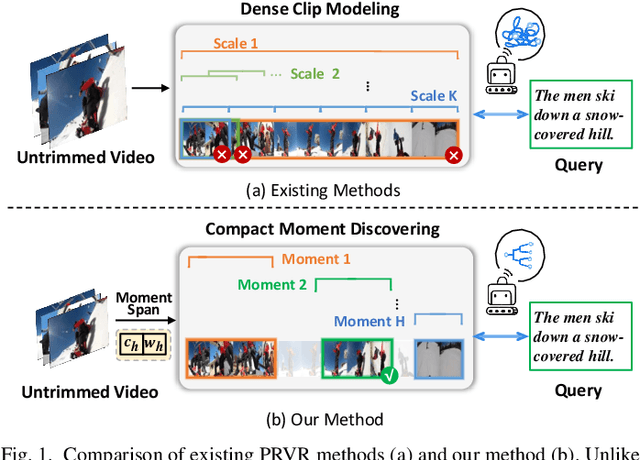
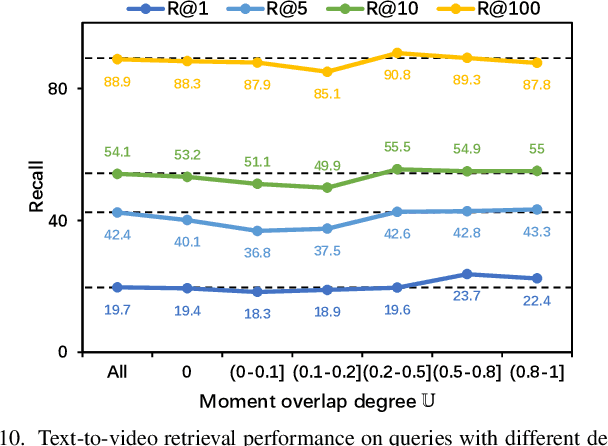
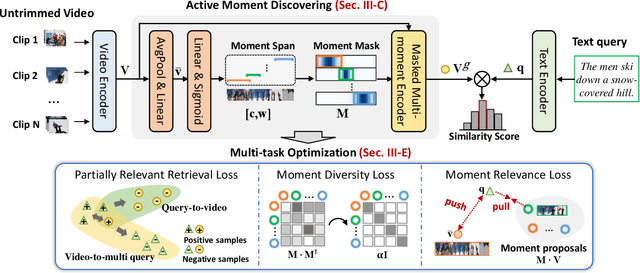
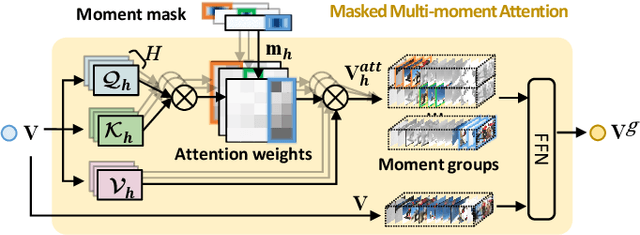
Partially relevant video retrieval (PRVR) is a practical yet challenging task in text-to-video retrieval, where videos are untrimmed and contain much background content. The pursuit here is of both effective and efficient solutions to capture the partial correspondence between text queries and untrimmed videos. Existing PRVR methods, which typically focus on modeling multi-scale clip representations, however, suffer from content independence and information redundancy, impairing retrieval performance. To overcome these limitations, we propose a simple yet effective approach with active moment discovering (AMDNet). We are committed to discovering video moments that are semantically consistent with their queries. By using learnable span anchors to capture distinct moments and applying masked multi-moment attention to emphasize salient moments while suppressing redundant backgrounds, we achieve more compact and informative video representations. To further enhance moment modeling, we introduce a moment diversity loss to encourage different moments of distinct regions and a moment relevance loss to promote semantically query-relevant moments, which cooperate with a partially relevant retrieval loss for end-to-end optimization. Extensive experiments on two large-scale video datasets (\ie, TVR and ActivityNet Captions) demonstrate the superiority and efficiency of our AMDNet. In particular, AMDNet is about 15.5 times smaller (\#parameters) while 6.0 points higher (SumR) than the up-to-date method GMMFormer on TVR.
Linguistics-Vision Monotonic Consistent Network for Sign Language Production
Dec 22, 2024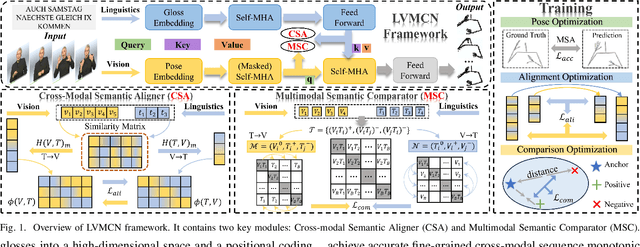
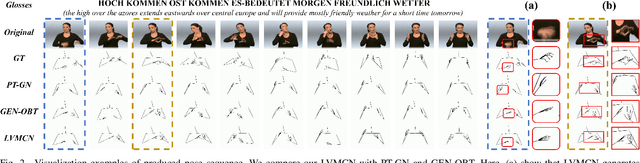
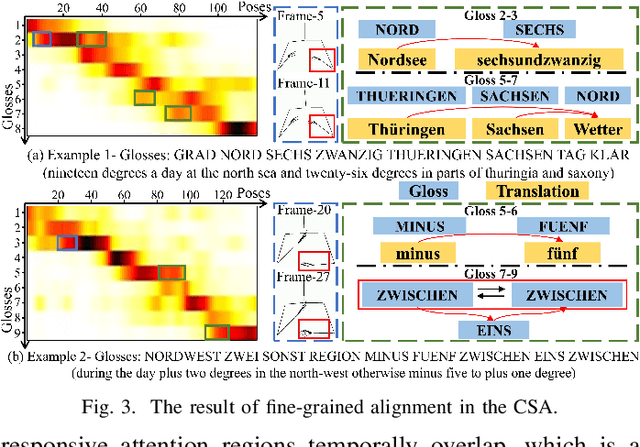
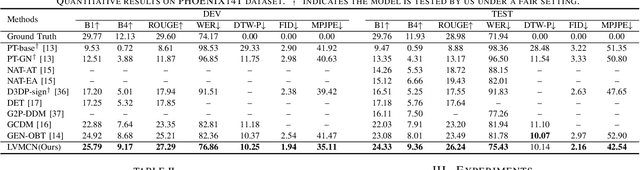
Sign Language Production (SLP) aims to generate sign videos corresponding to spoken language sentences, where the conversion of sign Glosses to Poses (G2P) is the key step. Due to the cross-modal semantic gap and the lack of word-action correspondence labels for strong supervision alignment, the SLP suffers huge challenges in linguistics-vision consistency. In this work, we propose a Transformer-based Linguistics-Vision Monotonic Consistent Network (LVMCN) for SLP, which constrains fine-grained cross-modal monotonic alignment and coarse-grained multimodal semantic consistency in language-visual cues through Cross-modal Semantic Aligner (CSA) and Multimodal Semantic Comparator (MSC). In the CSA, we constrain the implicit alignment between corresponding gloss and pose sequences by computing the cosine similarity association matrix between cross-modal feature sequences (i.e., the order consistency of fine-grained sign glosses and actions). As for MSC, we construct multimodal triplets based on paired and unpaired samples in batch data. By pulling closer the corresponding text-visual pairs and pushing apart the non-corresponding text-visual pairs, we constrain the semantic co-occurrence degree between corresponding gloss and pose sequences (i.e., the semantic consistency of coarse-grained textual sentences and sign videos). Extensive experiments on the popular PHOENIX14T benchmark show that the LVMCN outperforms the state-of-the-art.
Scene-Text Grounding for Text-Based Video Question Answering
Sep 22, 2024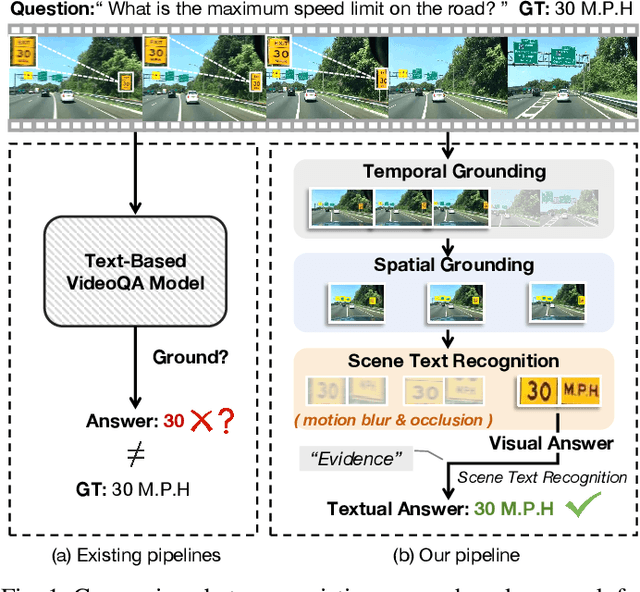

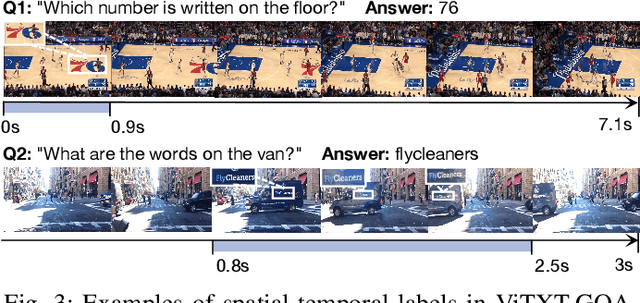
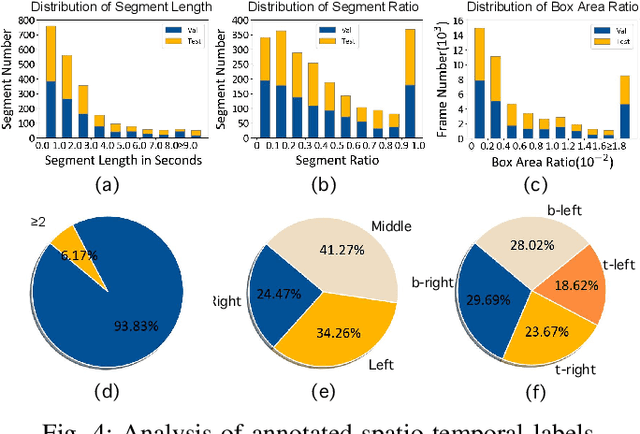
Existing efforts in text-based video question answering (TextVideoQA) are criticized for their opaque decisionmaking and heavy reliance on scene-text recognition. In this paper, we propose to study Grounded TextVideoQA by forcing models to answer questions and spatio-temporally localize the relevant scene-text regions, thus decoupling QA from scenetext recognition and promoting research towards interpretable QA. The task has three-fold significance. First, it encourages scene-text evidence versus other short-cuts for answer predictions. Second, it directly accepts scene-text regions as visual answers, thus circumventing the problem of ineffective answer evaluation by stringent string matching. Third, it isolates the challenges inherited in VideoQA and scene-text recognition. This enables the diagnosis of the root causes for failure predictions, e.g., wrong QA or wrong scene-text recognition? To achieve Grounded TextVideoQA, we propose the T2S-QA model that highlights a disentangled temporal-to-spatial contrastive learning strategy for weakly-supervised scene-text grounding and grounded TextVideoQA. To facilitate evaluation, we construct a new dataset ViTXT-GQA which features 52K scene-text bounding boxes within 2.2K temporal segments related to 2K questions and 729 videos. With ViTXT-GQA, we perform extensive experiments and demonstrate the severe limitations of existing techniques in Grounded TextVideoQA. While T2S-QA achieves superior results, the large performance gap with human leaves ample space for improvement. Our further analysis of oracle scene-text inputs posits that the major challenge is scene-text recognition. To advance the research of Grounded TextVideoQA, our dataset and code are at \url{https://github.com/zhousheng97/ViTXT-GQA.git}