 Add to Chrome
 Add to Firefox
 Add to Edge
Optimizing Antenna Coding for Pixel Antenna Empowered SISO-OFDM Systems
Mar 18, 2026
This work investigates antenna coding optimization to enhance the channel capacity of single-input single-output orthogonal frequency division multiplexing (SISO-OFDM) systems empowered by highly reconfigurable pixel antennas. We first introduce the model for pixel antenna empowered SISO-OFDM systems using a beamspace channel representation. We next formulate the problem to maximize the channel capacity through jointly optimizing antenna coding and the power allocation across subcarriers and solve it by Successive Exhaustive Boolean Optimization (SEBO) and water-filling (WF) algorithm. To reduce computational complexity, a codebook-based approach is also proposed for antenna coding optimization. Simulation results show that the channel capacity of SISO-OFDM system across all signal-to-noise-ratio (SNR) regions considered can be enhanced through leveraging pixel antennas as compared to using conventional antenna with fixed configuration. This result demonstrates the effectiveness of antenna coding technology empowered by pixel antenna in enhancing SISO-OFDM systems.

Active Beyond-Diagonal Reconfigurable Intelligent Surfaces: Modeling, Architecture Design, and Optimization
Mar 14, 2026Beyond-diagonal reconfigurable intelligent surfaces (BD-RISs) are an emerging RIS 2.0 technology for future wireless communication. However, BD-RISs are primarily passive without active amplification, suffering from severe multiplicative path loss. To address the concern of multiplicative path loss, in this work we investigate the active BD-RIS including the modeling, architecture design, and optimization. We first analyze the active BD-RIS using multiport network theory with scattering parameters and derive a physical and electromagnetic compliant active BD-RIS aided communication model. We also design two new active BD-RIS architectures, namely fully- and group-connected active BD-RISs. Based on the proposed model and architecture, we investigate the active BD-RIS aided single-input single-output system and derive the closed-form optimal solution and scaling law of the signal-to-noise ratio. We further investigate the active BD-RIS aided multiple-input multiple-output system and propose an iterative algorithm based on quadratically constrained quadratic programming to maximize the spectral efficiency. Numerical results are provided and show that the active BD-RIS can achieve higher spectral efficiency than the active/passive diagonal RIS and passive BD-RIS. For example, to achieve the same spectral efficiency, the number of elements required by active BD-RIS is less than half of that required by active diagonal RIS, showing the advantages of active BD-RIS.
Overcoming BS Down-Tilt for Air-Ground ISAC Coverage: Antenna Design, Beamforming and User Scheduling
Jan 18, 2026Integrated sensing and communication holds great promise for low-altitude economy applications. However, conventional downtilted base stations primarily provide sectorized forward lobes for ground services, failing to sense air targets due to backward blind zones. In this paper, a novel antenna structure is proposed to enable air-ground beam steering, facilitating simultaneous full-space sensing and communication (S&C). Specifically, instead of inserting a reflector behind the antenna array for backlobe mitigation, an omni-steering plate is introduced to collaborate with the active array for omnidirectional beamforming. Building on this hardware innovation, sum S&C mutual information (MI) is maximized, jointly optimizing user scheduling, passive coefficients of the omni-steering plate, and beamforming of the active array. The problem is decomposed into two subproblems: one for optimizing passive coefficients via Riemannian gradient on the manifold, and the other for optimizing user scheduling and active array beamforming. Exploiting relationships among S&C MI, data decoding MMSE, and parameter estimation MMSE, the original subproblem is equivalently transformed into a sum weighted MMSE problem, rigorously established via the Lagrangian and first-order optimality conditions. Simulations show that the proposed algorithm outperforms baselines in sum-MI and MSE, while providing 360 sensing coverage. Beampattern analysis further demonstrates effective user scheduling and accurate target alignment.
Two-Scale Spatial Deployment for Cost-Effective Wireless Networks via Cooperative IRSs and Movable Antennas
Jan 14, 2026This paper proposes a two-scale spatial deployment strategy to ensure reliable coverage for multiple target areas, integrating macroscopic intelligent reflecting surfaces (IRSs) and fine-grained movable antennas (MAs). Specifically, IRSs are selectively deployed from candidate sites to shape the propagation geometry, while MAs are locally repositioned among discretized locations to exploit small-scale channel variations. The objective is to minimize the total deployment cost of MAs and IRSs by jointly optimizing the IRS site selection, MA positions, transmit precoding, and IRS phase shifts, subject to the signal-to-noise ratio (SNR) requirements for all target areas. This leads to a challenging mixed-integer non-convex optimization problem that is intractable to solve directly. To address this, we first formulate an auxiliary problem to verify the feasibility. A penalty-based double-loop algorithm integrating alternating optimization and successive convex approximation (SCA) is developed to solve this feasibility issue, which is subsequently adapted to obtain a suboptimal solution for the original cost minimization problem. Finally, based on the obtained solution, we formulate an element refinement problem to further reduce the deployment cost, which is solved by a penalty-based SCA algorithm. Simulation results demonstrate that the proposed designs consistently outperform benchmarks relying on independent area planning or full IRS deployment in terms of cost-efficiency. Moreover, for cost minimization, MA architectures are preferable in large placement apertures, whereas fully populated FPA architectures excel in compact ones; for worst-case SNR maximization, MA architectures exhibit a lower cost threshold for feasibility, while FPA architectures can attain peak SNR at a lower total cost.
Antenna Coding Optimization for Pixel Antenna Empowered MIMO Wireless Power Transfer
Jan 12, 2026We investigate antenna coding utilizing pixel antennas as a new degree of freedom for enhancing multiple-input multiple-output (MIMO) wireless power transfer (WPT) systems. The objective is to enhance the output direct current (DC) power under RF combining and DC combining schemes by jointly exploiting gains from antenna coding, beamforming, and rectenna nonlinearity. We first propose the MIMO WPT system model with binary and continuous antenna coding using the beamspace channel model and formulate the joint antenna coding and beamforming optimization using a nonlinear rectenna model. We propose two efficient closed-form successive convex approximation algorithms to efficiently optimize the beamforming. To further reduce the computational complexity, we propose codebook-based antenna coding designs for output DC power maximization based on K-means clustering. Results show that the proposed pixel antenna empowered MIMO WPT system with binary antenna coding increases output DC power by more than 15 dB compared with conventional systems with fixed antenna configuration. With continuous antenna coding, the performance improves another 6 dB. Moreover, the proposed codebook design outperforms previous designs by up to 40% and shows good performance with reduced computational complexity. Overall, the significant improvement in output DC power verifies the potential of leveraging antenna coding utilizing pixel antennas to enhance WPT systems.
Low-Complexity Planar Beyond-Diagonal RIS Architecture Design Using Graph Theory
Jan 07, 2026Reconfigurable intelligent surfaces (RISs) enable programmable control of the wireless propagation environment and are key enablers for future networks. Beyond-diagonal RIS (BD-RIS) architectures enhance conventional RIS by interconnecting elements through tunable impedance components, offering greater flexibility with higher circuit complexity. However, excessive interconnections between BD-RIS elements require multi-layer printed circuit board (PCB) designs, increasing fabrication difficulty. In this letter, we use graph theory to characterize the BD-RIS architectures that can be realized on double-layer PCBs, denoted as planar-connected RISs. Among the possible planar-connected RISs, we identify the ones with the most degrees of freedom, expected to achieve the best performance under practical constraints.
Cooperative Rotatable IRSs for Wireless Communications: Joint Beamforming and Orientation Optimization
Dec 16, 2025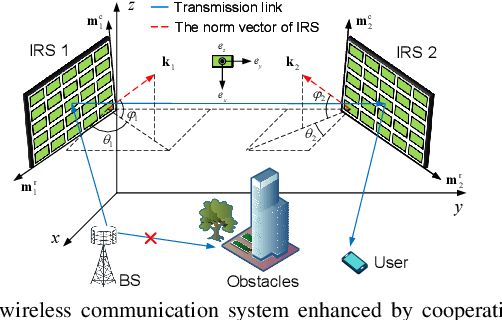
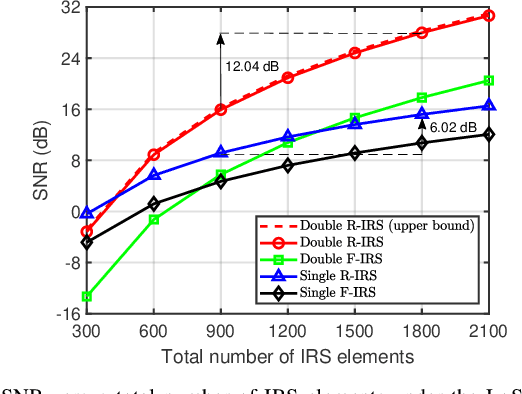
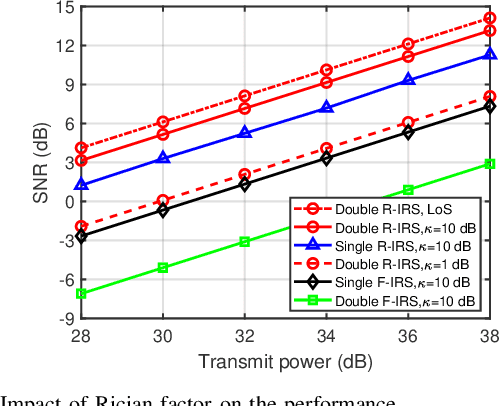
Rotatable intelligent reflecting surfaces (IRSs) introduce a new degree of freedom (DoF) for shaping wireless propagation by adaptively adjusting the orientation of IRSs. This paper considers an angle-dependent reflection model in a wireless communication system aided by two rotatable IRSs. Specifically, we study the joint design of the base station transmit beamforming, as well as the cooperative passive beamforming and orientation of the two IRSs, to maximize the received signal-to-noise ratio (SNR). Under the light-of-sight (LoS) channels, we first develop a particle swarm optimization (PSO) based method to determine the IRS rotation and derive an optimal rotation in a closed-form expression for a two-dimensional IRS deployment. Then, we extend the design to the general Rician fading channels by proposing an efficient alternating optimization and PSO (AO-PSO) algorithm. Numerical results validate the substantial gains achieved by the IRS rotation over fixed-IRS schemes and also demonstrate the superior performance of the double rotatable IRSs over a single rotatable IRS given a sufficient total number of IRS elements.
Antenna Coding Optimization Based on Pixel Antennas for MIMO Wireless Power Transfer with DC Combining
Dec 16, 2025This paper investigates antenna coding based on pixel antennas as a new degree of freedom for enhancing multiple-input multiple-output (MIMO) wireless power transfer (WPT) systems. Antenna coding is closely related to the Fluid Antenna System (FAS) concept and further generalizes the radiation pattern reconfigurability. We first introduce a beamspace channel model to demonstrate reconfigurable radiation patterns enabled by antenna coders. By jointly optimizing the antenna coding and transmit beamforming with perfect channel state information (CSI), we exploit gains from antenna coding, transmit beamforming, and rectenna nonlinearity to maximize the output DC power. We adopt an alternating optimization approach with the quasi-Newton method and Successive Exhaustive Boolean Optimization (SEBO) method with warm-start to handle the transmit beamforming design and antenna coding design respectively. Finally, simulation results show that the proposed MIMO WPT system with pixel antennas achieves up to 15 dB gain in average output DC power compared with a conventional system with fixed antenna configuration, highlighting the potential of pixel antennas for boosting the WPT efficiency.
Antenna Coding Design for Multi-User Transmissions Using Pixel Antennas
Dec 11, 2025This work investigates exploiting the potential of pixel antennas, which are a reconfigurable antenna technology that can flexibly adjust the antenna characteristics through antenna coding, in multi-user transmissions. To that end, we propose a multi-user multi-input single-output (MISO) pixel antenna system, which deploys the pixel antenna at users, and develop the system model including pixel antenna with antenna coding and multi-user beamspace channels. Aiming at maximizing the sum rate performance, we first propose an algorithm to alternatively design the precoding at the transmitter and the antenna coding at users, which explores the performance boundary for the proposed multi-user MISO pixel antenna system. To reduce the computational complexity, we propose a codebook-based antenna coding design algorithm, where the antenna coder is online optimized from an offline codebook. To further enhance the computation efficiency, we propose a hierarchical codebook-based antenna coding design that uses a multi-layer hierarchical search to achieve a better performance-complexity trade-off. Simulation results show that, adopting the proposed algorithms, the multi-user MISO pixel antenna system can always outperform conventional multi-user MISO systems with fixed antennas. More importantly, results validate that the proposed (hierarchical) codebook-based algorithms can significantly reduce the computational complexity while maintaining a satisfactory sum rate performance.
Rotatable IRS Aided Wireless Communication
Nov 13, 2025Rotatable intelligent reflecting surface (IRS) introduces a new spatial degree of freedom (DoF) by dynamically adjusting orientations without the need of changing its elements' positions in real time. To unleash the full potential of rotatable IRSs for wireless communications, this paper investigates the joint optimization of IRS rotation angles to maximize the minimum expected signal-to-noise ratio (SNR) over all locations within a given target area. We first propose an angle-dependent channel model that accurately characterizes the reception and reflection of each IRS element. Different from the conventional cosine-law assumption, the proposed model captures the practical electromagnetic characteristics of the IRS, including the effective reception area and reflection efficiency. For the single target location case, a particle swarm optimization (PSO)-based algorithm is developed to solve the SNR maximization problem, and a closed-form expression for a near-optimal solution is derived to provide useful insights. For the general area coverage enhancement case, the optimal rotation is obtained through a two-loop PSO-based iterative algorithm with null-point detection. In this algorithm, the outer loop updates the global rotation angles to maximize the minimum SNR over the target area, whereas the inner loop evaluates the SNR distribution within the area to identify the location corresponding to the minimum SNR through null-point detection. Numerical results demonstrate significant SNR improvement achieved by the proposed rotatable IRS design over various benchmark schemes under different system setups.