 Add to Chrome
 Add to Firefox
 Add to Edge
Multi-Mode Pinching-Antenna Systems: Polarization-Aware Full-Wave Modeling and Optimization
Apr 02, 2026
Millimeter-wave and terahertz communications face a fundamental challenge: overcoming severe path loss without sacrificing spectral efficiency. Pinching antenna systems (PASS) address this by bringing radiators physically close to users, yet existing frameworks treat the waveguide as a mere transmission line, overlooking its inherent multi-mode capabilities and the critical role of polarization. This paper develops the first polarization-aware, full-wave electromagnetic model for multi-mode PASS (MMPASS), capturing spatial radiation patterns, modal polarization states, and polarization matching efficiency from first principles. Leveraging this physically grounded model, we reveal fundamental trade-offs among waveguide attenuation, atmospheric absorption, and geometric spreading, yielding closed-form solutions for optimal PA placement and orientation in single-user scenarios. Extending to multi-user settings, we propose a modular optimization framework that integrates fractional programming with closed-form polarization updates, scaling gracefully to arbitrary numbers of waveguides, PAs, and users. Numerical results show that MMPASS achieves up to a 167% increase in spectral efficiency compared with single-mode PASS. Moreover, when comparing MMPASS with its polarization-ignorant counterpart, polarization awareness alone improves the sum rate by up to 23%. By bridging rigorous electromagnetic theory with scalable optimization, MMPASS establishes a physically complete and practically viable foundation for future high-frequency wireless networks.

Non-Orthogonal HARQ-CC over SDR: A GNU Radio-Based Implementation
Mar 04, 2026Hybrid Automatic Repeat Request (HARQ) schemes typically allocate all available resources to retransmit failed packets to ensure reliability. However, under stringent delay constraints, these schemes often exhibit low spectral efficiency and increased transmission latency. To address these challenges, this paper proposes an efficient Non-Orthogonal HARQ with Chase Combining (N-HARQ-CC) transmission strategy. Specifically, the proposed approach allocates a larger portion of retransmission resources to new data packets, reserving only a small fraction for retransmitting previously erroneous packets. This is based on the observation that only a small number of information bits are typically incorrect, enabling surplus communication resources to be utilized for transmitting new messages. The N-HARQ-CC scheme retransmits the same redundant version of a failed packet and employs Maximum Ratio Combining (MRC) for decoding. To minimize complex packet scheduling and decoding complexity, the proposed scheme limits superposition to at most two messages per transmission round. At the receiver, Successive Interference Cancellation (SIC) is used to decouple the superimposed messages. The proposed N-HARQ-CC system was implemented using GNU Radio and USRP platforms for validation. Compared to conventional Type-I HARQ and HARQ-CC schemes, the proposed scheme achieves a significant improvement in spectral efficiency of approximately 0.5 bps/Hz, aligning with the low-latency requirements of 6G networks.
Joint Sparsity and Beamforming Design for RDARS-Aided Systems
Jan 05, 2026Reconfigurable distributed antennas and reflecting surface (RDARS) has emerged as a promising architecture for communication and sensing performance enhancement. In particular, the new selection gain can be achieved by leveraging the dynamic working mode selection between connection and reflection modes, whereas low-complexity element configuration remains an open issue. In this paper, we consider a RDARS-assisted communication system, where the connected elements are formed as a uniform sparse array for simplified mode configuration while achieving enlarged physical array aperture. The sum rate maximization problem is then formulated by jointly optimizing the active and passive beamforming matrices and sparsity of connected element array. For the special cases of a single user equipment (UE) and two UEs, the optimal sparsity designs are derived in closed-form. Then, for an arbitrary number of UEs, a weighted minimum mean-square error-based alternating optimization (AO) algorithm is proposed to tackle the non-convex optimization problem. Numerical results demonstrate the importance of optimizing the sparsity and the effectiveness of low-complexity sparsity optimization.
Cooperative Rotatable IRSs for Wireless Communications: Joint Beamforming and Orientation Optimization
Dec 16, 2025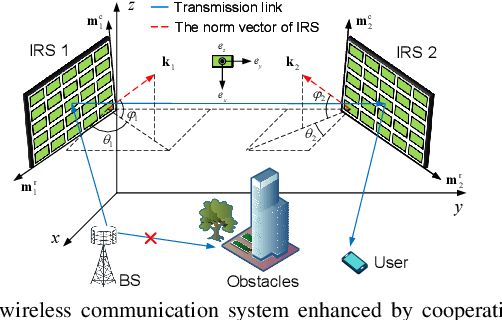
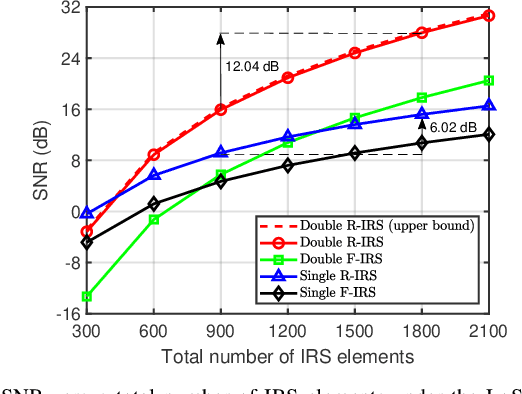
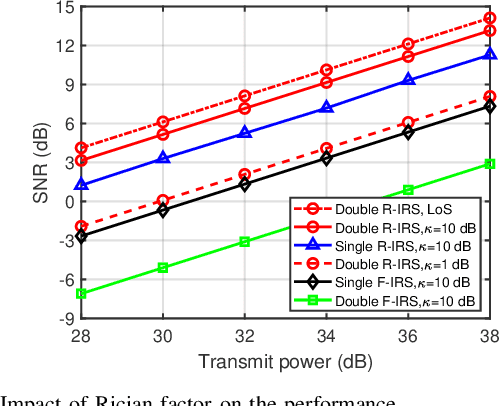
Rotatable intelligent reflecting surfaces (IRSs) introduce a new degree of freedom (DoF) for shaping wireless propagation by adaptively adjusting the orientation of IRSs. This paper considers an angle-dependent reflection model in a wireless communication system aided by two rotatable IRSs. Specifically, we study the joint design of the base station transmit beamforming, as well as the cooperative passive beamforming and orientation of the two IRSs, to maximize the received signal-to-noise ratio (SNR). Under the light-of-sight (LoS) channels, we first develop a particle swarm optimization (PSO) based method to determine the IRS rotation and derive an optimal rotation in a closed-form expression for a two-dimensional IRS deployment. Then, we extend the design to the general Rician fading channels by proposing an efficient alternating optimization and PSO (AO-PSO) algorithm. Numerical results validate the substantial gains achieved by the IRS rotation over fixed-IRS schemes and also demonstrate the superior performance of the double rotatable IRSs over a single rotatable IRS given a sufficient total number of IRS elements.
Rotatable IRS Aided Wireless Communication
Nov 13, 2025Rotatable intelligent reflecting surface (IRS) introduces a new spatial degree of freedom (DoF) by dynamically adjusting orientations without the need of changing its elements' positions in real time. To unleash the full potential of rotatable IRSs for wireless communications, this paper investigates the joint optimization of IRS rotation angles to maximize the minimum expected signal-to-noise ratio (SNR) over all locations within a given target area. We first propose an angle-dependent channel model that accurately characterizes the reception and reflection of each IRS element. Different from the conventional cosine-law assumption, the proposed model captures the practical electromagnetic characteristics of the IRS, including the effective reception area and reflection efficiency. For the single target location case, a particle swarm optimization (PSO)-based algorithm is developed to solve the SNR maximization problem, and a closed-form expression for a near-optimal solution is derived to provide useful insights. For the general area coverage enhancement case, the optimal rotation is obtained through a two-loop PSO-based iterative algorithm with null-point detection. In this algorithm, the outer loop updates the global rotation angles to maximize the minimum SNR over the target area, whereas the inner loop evaluates the SNR distribution within the area to identify the location corresponding to the minimum SNR through null-point detection. Numerical results demonstrate significant SNR improvement achieved by the proposed rotatable IRS design over various benchmark schemes under different system setups.
Model-Driven Deep Learning Enhanced Joint Beamforming and Mode Switching for RDARS-Aided MIMO Systems
Aug 01, 2025Reconfigurable distributed antenna and reflecting surface (RDARS) is a promising architecture for future sixth-generation (6G) wireless networks. In particular, the dynamic working mode configuration for the RDARS-aided system brings an extra selection gain compared to the existing reconfigurable intelligent surface (RIS)-aided system and distributed antenna system (DAS). In this paper, we consider the RDARS-aided downlink multiple-input multiple-output (MIMO) system and aim to maximize the weighted sum rate (WSR) by jointly optimizing the beamforming matrices at the based station (BS) and RDARS, as well as mode switching matrix at RDARS. The optimization problem is challenging to be solved due to the non-convex objective function and mixed integer binary constraint. To this end, a penalty term-based weight minimum mean square error (PWM) algorithm is proposed by integrating the majorization-minimization (MM) and weight minimum mean square error (WMMSE) methods. To further escape the local optimum point in the PWM algorithm, a model-driven DL method is integrated into this algorithm, where the key variables related to the convergence of PWM algorithm are trained to accelerate the convergence speed and improve the system performance. Simulation results are provided to show that the PWM-based beamforming network (PWM-BFNet) can reduce the number of iterations by half and achieve performance improvements of 26.53% and 103.2% at the scenarios of high total transmit power and a large number of RDARS transmit elements (TEs), respectively.
Out-of-Band Modality Synergy Based Multi-User Beam Prediction and Proactive BS Selection with Zero Pilot Overhead
Jun 18, 2025Multi-user millimeter-wave communication relies on narrow beams and dense cell deployments to ensure reliable connectivity. However, tracking optimal beams for multiple mobile users across multiple base stations (BSs) results in significant signaling overhead. Recent works have explored the capability of out-of-band (OOB) modalities in obtaining spatial characteristics of wireless channels and reducing pilot overhead in single-BS single-user/multi-user systems. However, applying OOB modalities for multi-BS selection towards dense cell deployments leads to high coordination overhead, i.e, excessive computing overhead and high latency in data exchange. How to leverage OOB modalities to eliminate pilot overhead and achieve efficient multi-BS coordination in multi-BS systems remains largely unexplored. In this paper, we propose a novel OOB modality synergy (OMS) based mobility management scheme to realize multi-user beam prediction and proactive BS selection by synergizing two OOB modalities, i.e., vision and location. Specifically, mobile users are initially identified via spatial alignment of visual sensing and location feedback, and then tracked according to the temporal correlation in image sequence. Subsequently, a binary encoding map based gain and beam prediction network (BEM-GBPN) is designed to predict beamforming gains and optimal beams for mobile users at each BS, such that a central unit can control the BSs to perform user handoff and beam switching. Simulation results indicate that the proposed OMS-based mobility management scheme enhances beam prediction and BS selection accuracy and enables users to achieve 91% transmission rates of the optimal with zero pilot overhead and significantly improve multi-BS coordination efficiency compared to existing methods.
When Feedback Empowers the Uplink: Integrating Adaptive Coding with Wireless Power Transfer
May 28, 2025Energy consumption and device lifetime are critical concerns for battery-constrained IoT devices. This paper introduces the Feedback-Aided Coding and Energy Transfer (FACET) framework, which synergistically combines adaptive feedback channel coding with wireless power transfer. FACET leverages the saturation effect of feedback coding, where increasing downlink power yields diminishing returns, to design a dual-purpose feedback mechanism that simultaneously guides uplink coding and replenishes device energy. We characterize the inherent tradeoff between feedback precision and harvested power, and formulate a fairness-constrained min-max optimization problem to minimize worst-case net energy consumption. An efficient algorithm based on alternating optimization and Lagrangian duality is developed, with each subproblem admitting a closed-form solution. Simulations show that FACET nearly triples device lifetime compared to conventional feedback coding architectures, and remains robust across a wide range of power regimes. These results suggest that FACET not only improves communication efficiency but also redefines the role of feedback in energy-constrained IoT systems.
Wireless Communication for Low-Altitude Economy with UAV Swarm Enabled Two-Level Movable Antenna System
May 28, 2025Unmanned aerial vehicle (UAV) is regarded as a key enabling platform for low-altitude economy, due to its advantages such as 3D maneuverability, flexible deployment, and LoS air-to-air/ground communication links. In particular, the intrinsic high mobility renders UAV especially suitable for operating as a movable antenna (MA) from the sky. In this paper, by exploiting the flexible mobility of UAV swarm and antenna position adjustment of MA, we propose a novel UAV swarm enabled two-level MA system, where UAVs not only individually deploy a local MA array, but also form a larger-scale MA system with their individual MA arrays via swarm coordination. We formulate a general optimization problem to maximize the minimum achievable rate over all ground UEs, by jointly optimizing the 3D UAV swarm placement positions, their individual MAs' positions, and receive beamforming for different UEs. We first consider the special case where each UAV has only one antenna, under different scenarios of one single UE, two UEs, and arbitrary number of UEs. In particular, for the two-UE case, we derive the optimal UAV swarm placement positions in closed-form that achieves IUI-free communication, where the UAV swarm forms a uniform sparse array (USA) satisfying collision avoidance constraint. While for the general case with arbitrary number of UEs, we propose an efficient alternating optimization algorithm to solve the formulated non-convex optimization problem. Then, we extend the results to the case where each UAV is equipped with multiple antennas. Numerical results verify that the proposed low-altitude UAV swarm enabled MA system significantly outperforms various benchmark schemes, thanks to the exploitation of two-level mobility to create more favorable channel conditions for multi-UE communications.
Reconfigurable Codebook-Based Beamforming for RDARS-Aided mmWave MU-MIMO Systems
Apr 02, 2025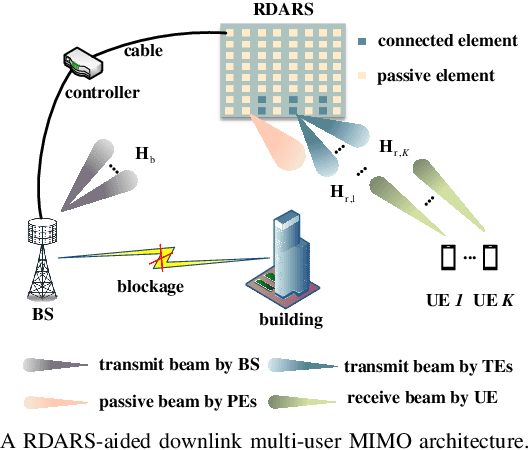
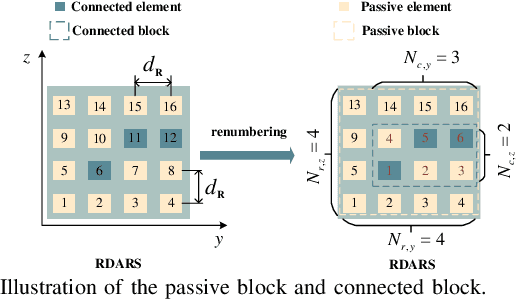
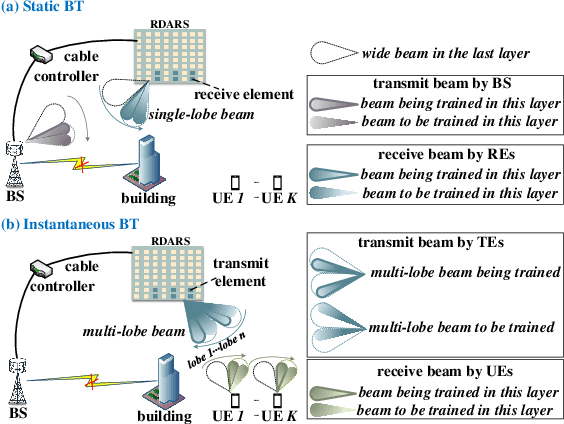
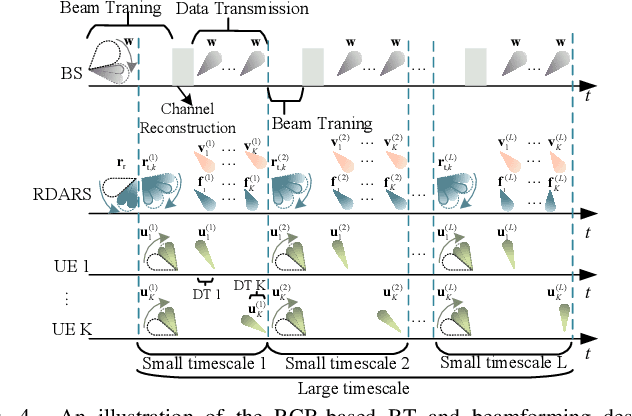
Reconfigurable distributed antenna and reflecting surface (RDARS) is a new architecture for the sixth-generation (6G) millimeter wave (mmWave) communications. In RDARS-aided mmWave systems, the active and passive beamforming design and working mode configuration for reconfigurable elements are crucial for system performance. In this paper, we aim to maximize the weighted sum rate (WSR) in the RDARS-aided mmWave system. To take advantage of RDARS, we first design a reconfigurable codebook (RCB) in which the number and dimension of the codeword can be flexibly adjusted. Then, a low overhead beam training scheme based on hierarchical search is proposed. Accordingly, the active and passive beamforming for data transmission is designed to achieve the maximum WSR for both space-division multiple access (SDMA) and time-division multiple access (TDMA) schemes. For the TDMA scheme, the optimal number of RDARS transmit elements and the allocated power budget for WSR maximization are derived in closed form. Besides, the superiority of the RDARS is verified and the conditions under which RDARS outperforms RIS and DAS are given. For the SDMA scheme, we characterize the relationship between the number of RDARS connected elements and the user distribution, followed by the derivation of the optimal placement positions of the RDARS transmit elements. High-quality beamforming design solutions are derived to minimize the inter-user interference (IUI) at the base station and RDARS side respectively, which nearly leads to the maximal WSR. Finally, simulation results confirm our theoretical findings and the superiority of the proposed schemes.