 Add to Chrome
 Add to Firefox
 Add to Edge
Cooperative Rotatable IRSs for Wireless Communications: Joint Beamforming and Orientation Optimization
Paper and Code
Dec 16, 2025
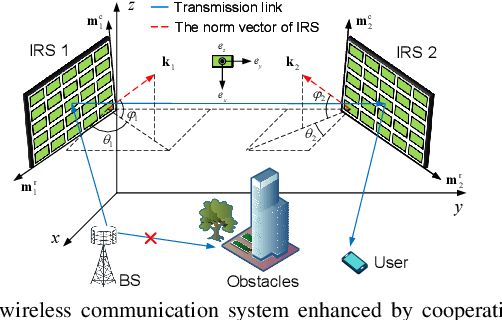
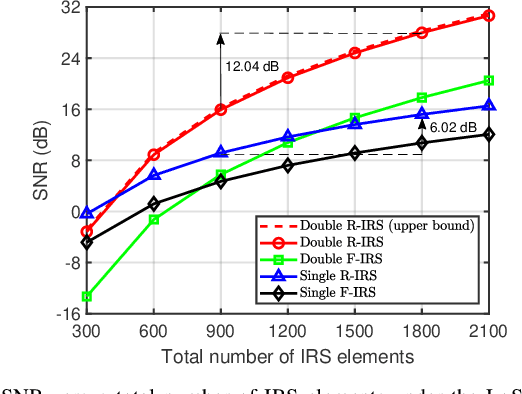
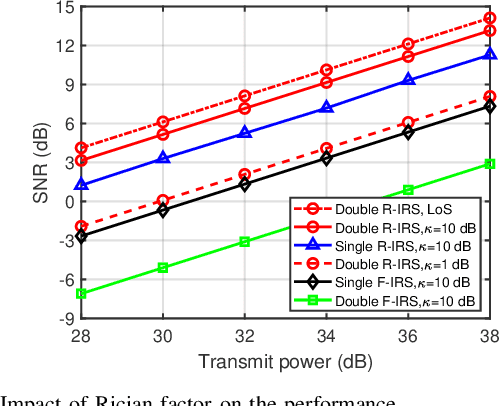
Rotatable intelligent reflecting surfaces (IRSs) introduce a new degree of freedom (DoF) for shaping wireless propagation by adaptively adjusting the orientation of IRSs. This paper considers an angle-dependent reflection model in a wireless communication system aided by two rotatable IRSs. Specifically, we study the joint design of the base station transmit beamforming, as well as the cooperative passive beamforming and orientation of the two IRSs, to maximize the received signal-to-noise ratio (SNR). Under the light-of-sight (LoS) channels, we first develop a particle swarm optimization (PSO) based method to determine the IRS rotation and derive an optimal rotation in a closed-form expression for a two-dimensional IRS deployment. Then, we extend the design to the general Rician fading channels by proposing an efficient alternating optimization and PSO (AO-PSO) algorithm. Numerical results validate the substantial gains achieved by the IRS rotation over fixed-IRS schemes and also demonstrate the superior performance of the double rotatable IRSs over a single rotatable IRS given a sufficient total number of IRS elements.
