 Add to Chrome
 Add to Firefox
 Add to Edge
When to Use Extra Context: Evidence-Grounded Terminology Adaptation for Simultaneous Speech Translation
Jul 20, 2026
Extra context is valuable for simultaneous speech translation of technical talks, but injecting the entire document context into every streaming segment is often too coarse. Through diagnostic experiments, we find that context gains mainly come from paper-specific terminology recovery rather than uniform semantic enhancement. We therefore propose EGTA, an Evidence-Grounded Terminology Adaptation framework that builds a document terminology memory, selects compact candidate terms conditioned on the current streaming state, and adapts ASR/speech-side and decoder-side decision spaces using only the selected terms. EGTA can be instantiated in cascaded, end-to-end, and generation-only SimulST settings without full-model fine-tuning. We evaluate EGTA on an ACL technical-talk SimulST evaluation suite consisting of MCIF-dev and ACL60/60-dev. On MCIF-dev, EGTA-RG improves BLEU by +1.05/+0.59, XCOMET-XL by +0.019/+0.006, named-entity recall by +79\%/+73\% relative, and acronym recall by +0.099/+0.171 on En$\rightarrow$Zh and En$\rightarrow$De. Across MCIF-dev latency settings, EGTA consistently improves XCOMET-XL, named-entity recall, and acronym recall. External validation on ACL60/60-dev further shows consistent terminology-recall gains without additional fine-tuning. Shuffled-memory controls and activation audits provide evidence that the improvements are tied to paper-specific evidence alignment rather than generic context prompting.

Evaluating and Preserving Lexical Stress in English-to-Chinese Speech-to-Speech Translation
Jun 13, 2026Speech-to-speech translation (S2ST) systems have achieved impressive progress in semantic accuracy and speech naturalness. However, the cross-lingual transfer of lexical stress, a vital cue for emphasis and speaker intent, remains heavily underexplored, compounded by a lack of reliable automatic evaluation metrics for tonal languages like Chinese. We investigate English-to-Chinese S2ST stress transfer by constructing a stress-annotated Chinese dataset and an XLS-R-based Mandarin stress detector. Integrating this with the English EmphAssess system, we propose a novel objective metric for cross-lingual stress evaluation. Furthermore, we fine-tune CosyVoice3 to build a stress-aware S2ST system. Experiments demonstrate that our proposed S2ST architecture significantly outperforms existing systems in stress translation capability while maintaining competitive translation quality. Furthermore, our evaluation metric exhibits a strong correlation with human subjective judgments.
Leveraging Audio-LLMs to Filter Speech-to-Speech Training Data
Jun 11, 2026Large-scale mined corpora provide abundant training data for end-to-end speech-to-speech translation (S2ST) but may contain noise, misalignment, and semantic errors. Filtering noisy data is crucial to maintain robust speech translation performance. We study how to train an audio-language model to make keep/drop decisions on paired speech directly from audio. To obtain reliable supervision without manual labels, we adopt a scalable two-stage Rank-to-Distill strategy. A lightweight ranker generates keep/drop pseudo-labels from noisy speech pairs, then trains an audio large language model to predict keep/drop directly from raw paired speech. The resulting model jointly captures acoustic fidelity and cross-lingual semantic consistency for the selection of speech-conditioned data. Experiments on CVSS-C and SpeechMatrix show consistent improvements over unfiltered training, yielding up to +1.4 ASR-BLEU for end-to-end S2ST.
Gradient-Informed Training for Low-Resource Multilingual Speech Translation
Mar 26, 2026In low-resource multilingual speech-to-text translation, uniform architectural sharing across languages frequently introduces representation conflicts that impede convergence. This work proposes a principled methodology to automatically determine layer-specific sharing patterns by mining training gradient information. Our approach employs three distinct analysis strategies: distance-based language clustering, self/cross-task divergence metrics for capacity allocation, and joint factorization coupled with canonical correlation analysis for subspace alignment. Extensive evaluation across four language pairs (using the SeamlessM4T-Medium architecture) demonstrates persistent improvements in translation quality metrics.
Understanding Mental States to Guide Social Influence in Multi-Person Group Dialogue
Jan 20, 2026Existing dynamic Theory of Mind (ToM) benchmarks mostly place language models in a passive role: the model reads a sequence of connected scenarios and reports what people believe, feel, intend, and do as these states change. In real social interaction, ToM is also used for action: a speaker plans what to say in order to shift another person's mental-state trajectory toward a goal. We introduce SocialMindChange, a benchmark that moves from tracking minds to changing minds in social interaction. Each instance defines a social context with 4 characters and five connected scenes. The model plays one character and generates dialogue across the five scenes to reach the target while remaining consistent with the evolving states of all participants. SocialMindChange also includes selected higher-order states. Using a structured four-step framework, we construct 1,200 social contexts, covering 6000 scenarios and over 90,000 questions, each validated for realism and quality. Evaluations on ten state-of-the-art LLMs show that their average performance is 54.2% below human performance. This gap suggests that current LLMs still struggle to maintain and change mental-state representations across long, linked interactions.
Redefining Machine Simultaneous Interpretation: From Incremental Translation to Human-Like Strategies
Jan 16, 2026Simultaneous Machine Translation (SiMT) requires high-quality translations under strict real-time constraints, which traditional policies with only READ/WRITE actions cannot fully address. We extend the action space of SiMT with four adaptive actions: Sentence_Cut, Drop, Partial_Summarization and Pronominalization, which enable real-time restructuring, omission, and simplification while preserving semantic fidelity. We adapt these actions in a large language model (LLM) framework and construct training references through action-aware prompting. To evaluate both quality and word-level monotonicity, we further develop a latency-aware TTS pipeline that maps textual outputs to speech with realistic timing. Experiments on the ACL60/60 English-Chinese, English-German and English-Japanese benchmarks show that our framework consistently improves semantic metrics and achieves lower delay compared to reference translations and salami-based baselines. Notably, combining Drop and Sentence_Cut leads to consistent improvements in the balance between fluency and latency. These results demonstrate that enriching the action space of LLM-based SiMT provides a promising direction for bridging the gap between human and machine interpretation.
SASST: Leveraging Syntax-Aware Chunking and LLMs for Simultaneous Speech Translation
Aug 11, 2025This work proposes a grammar-based chunking strategy that segments input streams into semantically complete units by parsing dependency relations (e.g., noun phrase boundaries, verb-object structures) and punctuation features. The method ensures chunk coherence and minimizes semantic fragmentation. Building on this mechanism, we present SASST (Syntax-Aware Simultaneous Speech Translation), an end-to-end framework integrating frozen Whisper encoder and decoder-only LLM. The unified architecture dynamically outputs translation tokens or <WAIT> symbols to jointly optimize translation timing and content, with target-side reordering addressing word-order divergence. Experiments on CoVoST2 multilingual corpus En-{De, Zh, Ja} demonstrate significant translation quality improvements across languages and validate the effectiveness of syntactic structures in LLM-driven SimulST systems.
Development of a Large-scale Dataset of Chest Computed Tomography Reports in Japanese and a High-performance Finding Classification Model
Dec 20, 2024
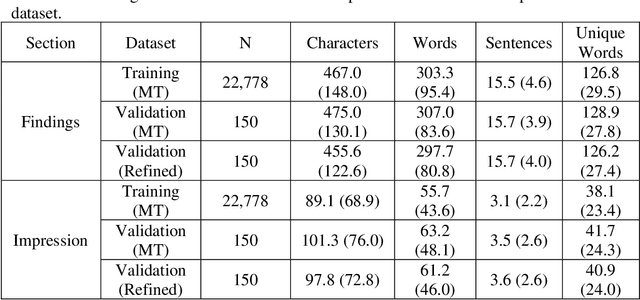


Background: Recent advances in large language models highlight the need for high-quality multilingual medical datasets. While Japan leads globally in CT scanner deployment and utilization, the lack of large-scale Japanese radiology datasets has hindered the development of specialized language models for medical imaging analysis. Objective: To develop a comprehensive Japanese CT report dataset through machine translation and establish a specialized language model for structured finding classification. Additionally, to create a rigorously validated evaluation dataset through expert radiologist review. Methods: We translated the CT-RATE dataset (24,283 CT reports from 21,304 patients) into Japanese using GPT-4o mini. The training dataset consisted of 22,778 machine-translated reports, while the validation dataset included 150 radiologist-revised reports. We developed CT-BERT-JPN based on "tohoku-nlp/bert-base-japanese-v3" architecture for extracting 18 structured findings from Japanese radiology reports. Results: Translation metrics showed strong performance with BLEU scores of 0.731 and 0.690, and ROUGE scores ranging from 0.770 to 0.876 for Findings and from 0.748 to 0.857 for Impression sections. CT-BERT-JPN demonstrated superior performance compared to GPT-4o in 11 out of 18 conditions, including lymphadenopathy (+14.2%), interlobular septal thickening (+10.9%), and atelectasis (+7.4%). The model maintained F1 scores exceeding 0.95 in 14 out of 18 conditions and achieved perfect scores in four conditions. Conclusions: Our study establishes a robust Japanese CT report dataset and demonstrates the effectiveness of a specialized language model for structured finding classification. The hybrid approach of machine translation and expert validation enables the creation of large-scale medical datasets while maintaining high quality.
Findings of the IWSLT 2024 Evaluation Campaign
Nov 07, 2024This paper reports on the shared tasks organized by the 21st IWSLT Conference. The shared tasks address 7 scientific challenges in spoken language translation: simultaneous and offline translation, automatic subtitling and dubbing, speech-to-speech translation, dialect and low-resource speech translation, and Indic languages. The shared tasks attracted 18 teams whose submissions are documented in 26 system papers. The growing interest towards spoken language translation is also witnessed by the constantly increasing number of shared task organizers and contributors to the overview paper, almost evenly distributed across industry and academia.
A Transformer Framework for Simultaneous Segmentation, Classification, and Caller Identification of Marmoset Vocalization
Nov 06, 2024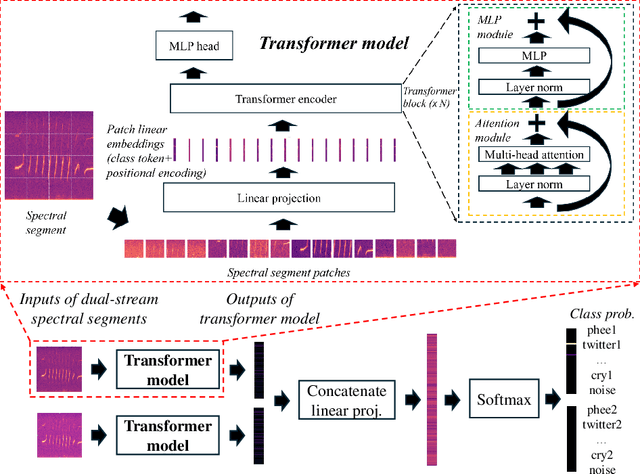

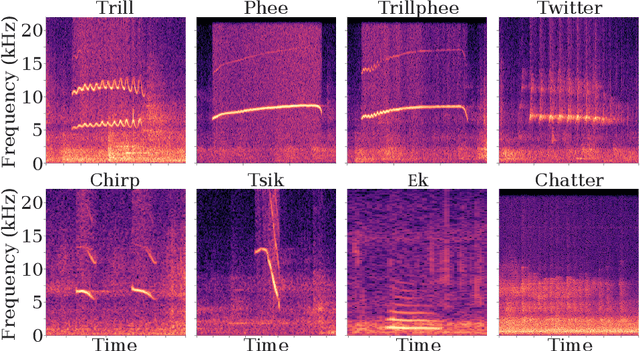
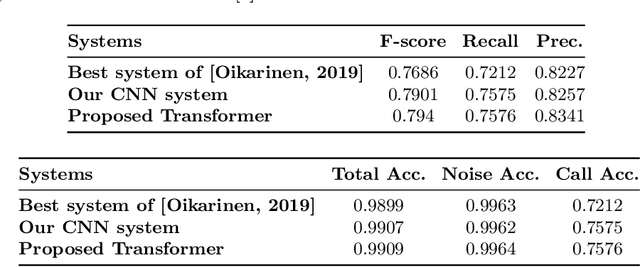
Marmoset, a highly vocalized primate, has become a popular animal model for studying social-communicative behavior and its underlying mechanism comparing with human infant linguistic developments. In the study of vocal communication, it is vital to know the caller identities, call contents, and vocal exchanges. Previous work of a CNN has achieved a joint model for call segmentation, classification, and caller identification for marmoset vocalizations. However, the CNN has limitations in modeling long-range acoustic patterns; the Transformer architecture that has been shown to outperform CNNs, utilizes the self-attention mechanism that efficiently segregates information parallelly over long distances and captures the global structure of marmoset vocalization. We propose using the Transformer to jointly segment and classify the marmoset calls and identify the callers for each vocalization.