 Add to Chrome
 Add to Firefox
 Add to Edge
Sarashina2.2-TTS: Tackling Kanji Polyphony in Japanese Speech Generation via Data Scaling and Targeted Data Synthesis
Jun 24, 2026
While large language model (LLM)-based text-to-speech (TTS) systems have achieved high-quality speech synthesis, most existing systems focus on English and Chinese. Japanese, however, remains under-explored, and its unique linguistic challenges, such as widespread context-dependent kanji polyphony, have yet to be adequately tackled. Here we introduce Sarashina2.2-TTS (https://github.com/sbintuitions/sarashina2.2-tts), a Japanese-centric LLM-TTS system that tackles these challenges through a dual approach: data strategy and evaluation methodology. First, we scale training to approximately 361k hours of speech, incorporating a balanced mix of Japanese and English data. Furthermore, we design a targeted data augmentation pipeline covering all 2,136 Joyo (regular-use) kanji designated by Japan's Agency for Cultural Affairs to efficiently address kanji polyphony disambiguation. Second, we introduce the Joyo Kanji Yomi Benchmark (https://github.com/sbintuitions/JoyoKanji-Yomi-Benchmark), covering all 2,136 Joyo kanji and their 4,378 readings. Alongside this benchmark, we propose Kana-CER, a metric that compares synthesized speech against reference readings in the kana space, eliminating orthographic variations to directly measure pronunciation correctness. Experiments demonstrate that our targeted data augmentation significantly improves reading accuracy. Overall, Sarashina2.2-TTS achieves state-of-the-art kanji-level reading accuracy and matches top baselines on general sentence-level pronunciation, while delivering the highest speaker similarity in zero-shot Japanese speech synthesis. Furthermore, cross-lingual evaluation reveals that Sarashina2.2-TTS is the only system that maintains stable Japanese pronunciation regardless of the prompt language, confirming that our balanced training approach improves cross-lingual robustness.

Speech-Worthy Alignment for Japanese SpeechLLMs via Direct Preference Optimization
Mar 13, 2026SpeechLLMs typically combine ASR-trained encoders with text-based LLM backbones, leading them to inherit written-style output patterns unsuitable for text-to-speech synthesis. This mismatch is particularly pronounced in Japanese, where spoken and written registers differ substantially in politeness markers, sentence-final particles, and syntactic complexity. We propose a preference-based alignment approach to adapt Japanese SpeechLLMs for speech-worthy outputs: text that is concise, conversational, and readily synthesized as natural speech. To rigorously evaluate this task, we introduce SpokenElyza, a benchmark for Japanese speech-worthiness derived from ELYZA-tasks-100 with auditory verification by native experts. Experiments show that our approach achieves substantial improvement on SpokenElyza while largely preserving performance on the original written-style evaluation. We will release SpokenElyza to support future research on Japanese spoken dialog systems.
Streaming Translation and Transcription Through Speech-to-Text Causal Alignment
Mar 12, 2026Simultaneous machine translation (SiMT) has traditionally relied on offline machine translation models coupled with human-engineered heuristics or learned policies. We propose Hikari, a policy-free, fully end-to-end model that performs simultaneous speech-to-text translation and streaming transcription by encoding READ/WRITE decisions into a probabilistic WAIT token mechanism. We also introduce Decoder Time Dilation, a mechanism that reduces autoregressive overhead and ensures a balanced training distribution. Additionally, we present a supervised fine-tuning strategy that trains the model to recover from delays, significantly improving the quality-latency trade-off. Evaluated on English-to-Japanese, German, and Russian, Hikari achieves new state-of-the-art BLEU scores in both low- and high-latency regimes, outperforming recent baselines.
SASST: Leveraging Syntax-Aware Chunking and LLMs for Simultaneous Speech Translation
Aug 11, 2025This work proposes a grammar-based chunking strategy that segments input streams into semantically complete units by parsing dependency relations (e.g., noun phrase boundaries, verb-object structures) and punctuation features. The method ensures chunk coherence and minimizes semantic fragmentation. Building on this mechanism, we present SASST (Syntax-Aware Simultaneous Speech Translation), an end-to-end framework integrating frozen Whisper encoder and decoder-only LLM. The unified architecture dynamically outputs translation tokens or <WAIT> symbols to jointly optimize translation timing and content, with target-side reordering addressing word-order divergence. Experiments on CoVoST2 multilingual corpus En-{De, Zh, Ja} demonstrate significant translation quality improvements across languages and validate the effectiveness of syntactic structures in LLM-driven SimulST systems.
LLMs Are Zero-Shot Context-Aware Simultaneous Translators
Jun 19, 2024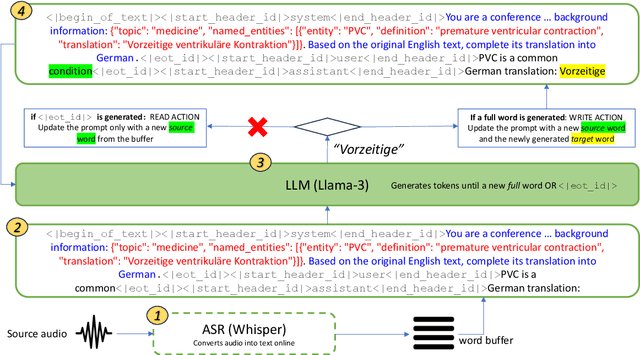

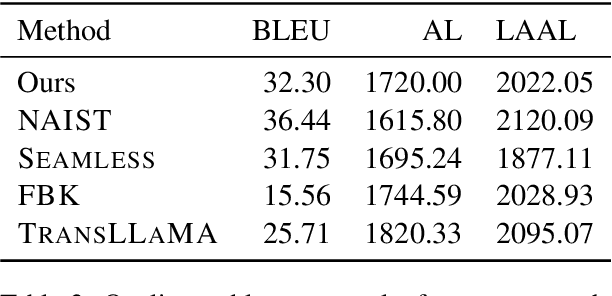

The advent of transformers has fueled progress in machine translation. More recently large language models (LLMs) have come to the spotlight thanks to their generality and strong performance in a wide range of language tasks, including translation. Here we show that open-source LLMs perform on par with or better than some state-of-the-art baselines in simultaneous machine translation (SiMT) tasks, zero-shot. We also demonstrate that injection of minimal background information, which is easy with an LLM, brings further performance gains, especially on challenging technical subject-matter. This highlights LLMs' potential for building next generation of massively multilingual, context-aware and terminologically accurate SiMT systems that require no resource-intensive training or fine-tuning.
TransLLaMa: LLM-based Simultaneous Translation System
Feb 07, 2024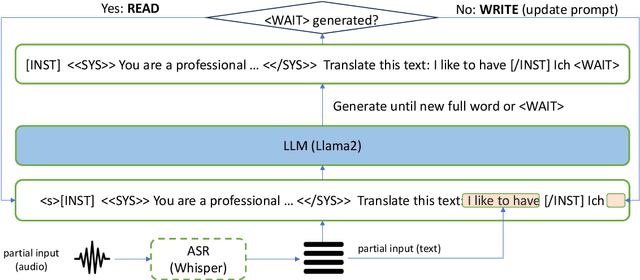


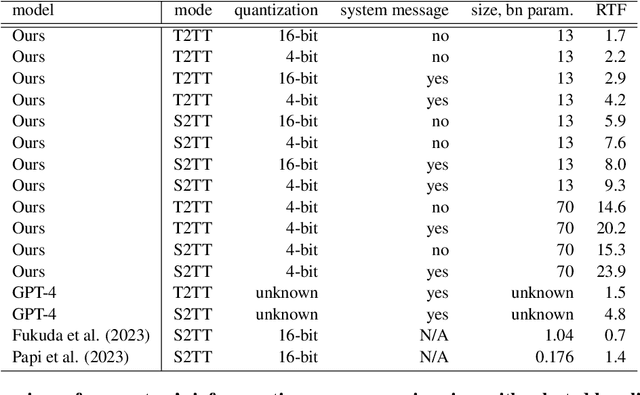
Decoder-only large language models (LLMs) have recently demonstrated impressive capabilities in text generation and reasoning. Nonetheless, they have limited applications in simultaneous machine translation (SiMT), currently dominated by encoder-decoder transformers. This study demonstrates that, after fine-tuning on a small dataset comprising causally aligned source and target sentence pairs, a pre-trained open-source LLM can control input segmentation directly by generating a special "wait" token. This obviates the need for a separate policy and enables the LLM to perform English-German and English-Russian SiMT tasks with BLEU scores that are comparable to those of specific state-of-the-art baselines. We also evaluated closed-source models such as GPT-4, which displayed encouraging results in performing the SiMT task without prior training (zero-shot), indicating a promising avenue for enhancing future SiMT systems.
convSeq: Fast and Scalable Method for Detecting Patterns in Spike Data
Feb 02, 2024Spontaneous neural activity, crucial in memory, learning, and spatial navigation, often manifests itself as repetitive spatiotemporal patterns. Despite their importance, analyzing these patterns in large neural recordings remains challenging due to a lack of efficient and scalable detection methods. Addressing this gap, we introduce convSeq, an unsupervised method that employs backpropagation for optimizing spatiotemporal filters that effectively identify these neural patterns. Our method's performance is validated on various synthetic data and real neural recordings, revealing spike sequences with unprecedented scalability and efficiency. Significantly surpassing existing methods in speed, convSeq sets a new standard for analyzing spontaneous neural activity, potentially advancing our understanding of information processing in neural circuits.