 Add to Chrome
 Add to Firefox
 Add to Edge
Low-Latency Real-Time Audio Game Commentary System via LLM-Based Parallel Text Generation
Jun 11, 2026
We present a low-latency real-time audio game commentary system that generates spoken commentary directly from live gameplay video. In this end-to-end setting, a key bottleneck is accumulated waiting time; conventional pipelines capture frames, generate text, and synthesize speech sequentially for each utterance, and do not request the next generation until speech playback has completed. This strict sequentiality causes long and unnatural silence between utterances. To address this latency bottleneck, our system runs text generation in parallel with speech playback and buffers multiple candidate utterances ahead of time, enabling immediate synthesis at playback boundaries. Experiments on fast-paced game videos show that our parallel design reduces the mean inter-utterance silence from 9.6 seconds to 0.3 seconds compared to sequential baselines. It also improves similarity to professional speaking--silence timing patterns by over 40 %, and a user study with 120 experienced game players confirms significantly improved perceived speaking rhythm. Our demo video is available at: https://youtu.be/pmrRUlvav8M.

Do speech foundation models perceive speaker similarity as humans do?
Jun 04, 2026This study presents a comparative analysis between the speaker embeddings of speech foundation models and human subjective perception of speaker similarity. Human listeners have the ability to judge speaker similarity on a continuous scale discerning how similar two voices are. In contrast, speech foundation models embed speaker characteristics into numerical representation. However, a question remains: does the numerical distance between speaker embeddings in these models truly align with the similarity perceived by humans? To address this, we conduct a comprehensive investigation using more than 40 models to compare model-derived distances with human-perceived similarity scores. Furthermore, we identify which factors in model configuration contribute most to a speaker embedding that mirrors human perception. Our findings provide insights for the development of more perceptually grounded speech foundation models.
Real-Time Generation of Game Video Commentary with Multimodal LLMs: Pause-Aware Decoding Approaches
Mar 03, 2026Real-time video commentary generation provides textual descriptions of ongoing events in videos. It supports accessibility and engagement in domains such as sports, esports, and livestreaming. Commentary generation involves two essential decisions: what to say and when to say it. While recent prompting-based approaches using multimodal large language models (MLLMs) have shown strong performance in content generation, they largely ignore the timing aspect. We investigate whether in-context prompting alone can support real-time commentary generation that is both semantically relevant and well-timed. We propose two prompting-based decoding strategies: 1) a fixed-interval approach, and 2) a novel dynamic interval-based decoding approach that adjusts the next prediction timing based on the estimated duration of the previous utterance. Both methods enable pause-aware generation without any fine-tuning. Experiments on Japanese and English datasets of racing and fighting games show that the dynamic interval-based decoding can generate commentary more closely aligned with human utterance timing and content using prompting alone. We release a multilingual benchmark dataset, trained models, and implementations to support future research on real-time video commentary generation.
Voice Conversion for Likability Control via Automated Rating of Speech Synthesis Corpora
Jul 02, 2025
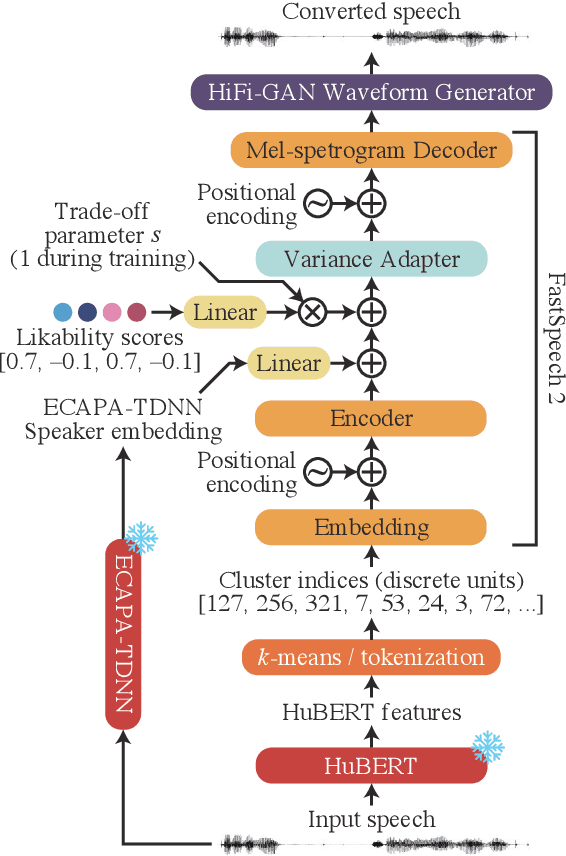
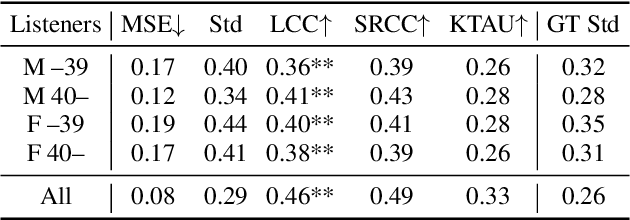
Perceived voice likability plays a crucial role in various social interactions, such as partner selection and advertising. A system that provides reference likable voice samples tailored to target audiences would enable users to adjust their speaking style and voice quality, facilitating smoother communication. To this end, we propose a voice conversion method that controls the likability of input speech while preserving both speaker identity and linguistic content. To improve training data scalability, we train a likability predictor on an existing voice likability dataset and employ it to automatically annotate a large speech synthesis corpus with likability ratings. Experimental evaluations reveal a significant correlation between the predictor's outputs and human-provided likability ratings. Subjective and objective evaluations further demonstrate that the proposed approach effectively controls voice likability while preserving both speaker identity and linguistic content.
Exploring the Effect of Segmentation and Vocabulary Size on Speech Tokenization for Speech Language Models
May 23, 2025The purpose of speech tokenization is to transform a speech signal into a sequence of discrete representations, serving as the foundation for speech language models (SLMs). While speech tokenization has many options, their effect on the performance of SLMs remains unclear. This paper investigates two key aspects of speech tokenization: the segmentation width and the cluster size of discrete units. First, we segment speech signals into fixed/variable widths and pooled representations. We then train K-means models in multiple cluster sizes. Through the evaluation on zero-shot spoken language understanding benchmarks, we find the positive effect of moderately coarse segmentation and bigger cluster size. Notably, among the best-performing models, the most efficient one achieves a 50% reduction in training data and a 70% decrease in training runtime. Our analysis highlights the importance of combining multiple tokens to enhance fine-grained spoken language understanding.
A Transformer Framework for Simultaneous Segmentation, Classification, and Caller Identification of Marmoset Vocalization
Nov 06, 2024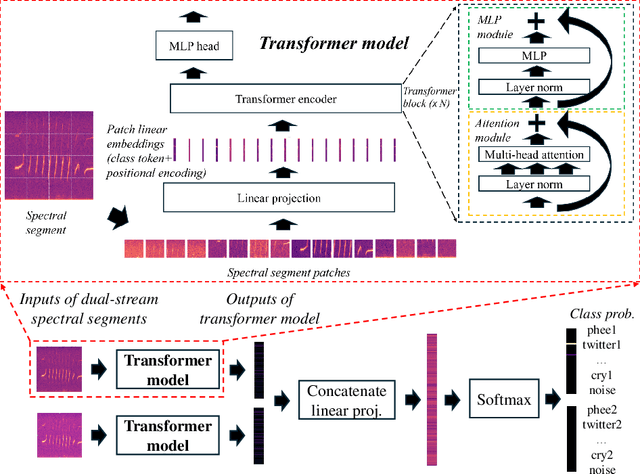

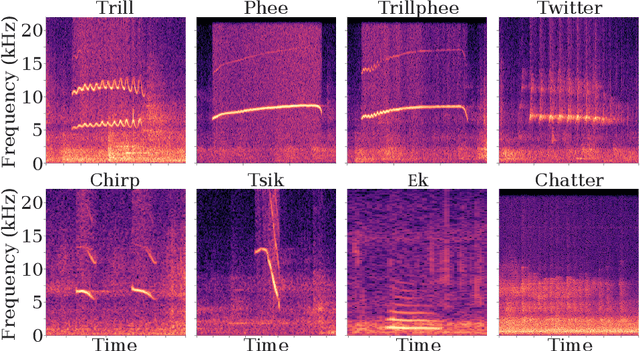
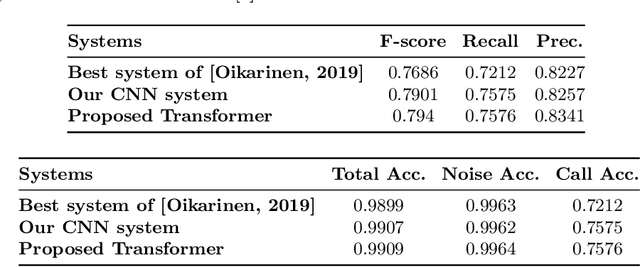
Marmoset, a highly vocalized primate, has become a popular animal model for studying social-communicative behavior and its underlying mechanism comparing with human infant linguistic developments. In the study of vocal communication, it is vital to know the caller identities, call contents, and vocal exchanges. Previous work of a CNN has achieved a joint model for call segmentation, classification, and caller identification for marmoset vocalizations. However, the CNN has limitations in modeling long-range acoustic patterns; the Transformer architecture that has been shown to outperform CNNs, utilizes the self-attention mechanism that efficiently segregates information parallelly over long distances and captures the global structure of marmoset vocalization. We propose using the Transformer to jointly segment and classify the marmoset calls and identify the callers for each vocalization.
A Neural Transformer Framework for Simultaneous Tasks of Segmentation, Classification, and Caller Identification of Marmoset Vocalization
Oct 30, 2024Marmoset, a highly vocalized primate, has become a popular animal model for studying social-communicative behavior and its underlying mechanism. In the study of vocal communication, it is vital to know the caller identities, call contents, and vocal exchanges. Previous work of a CNN has achieved a joint model for call segmentation, classification, and caller identification for marmoset vocalizations. However, the CNN has limitations in modeling long-range acoustic patterns; the Transformer architecture that has been shown to outperform CNNs, utilizes the self-attention mechanism that efficiently segregates information parallelly over long distances and captures the global structure of marmoset vocalization. We propose using the Transformer to jointly segment and classify the marmoset calls and identify the callers for each vocalization.
DNN-based ensemble singing voice synthesis with interactions between singers
Sep 16, 2024
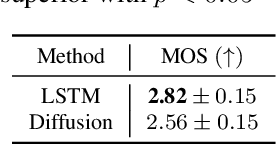
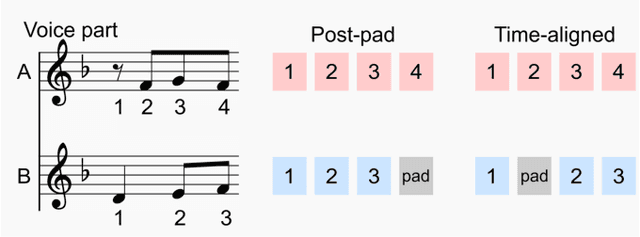
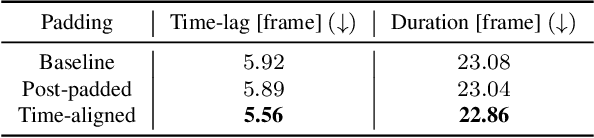
We propose a singing voice synthesis (SVS) method for a more unified ensemble singing voice by modeling interactions between singers. Most existing SVS methods aim to synthesize a solo voice, and do not consider interactions between singers, i.e., adjusting one's own voice to the others' voices. Since the production of ensemble voices from solo singing voices ignores the interactions, it can degrade the unity of the vocal ensemble. Therefore, we propose a SVS that reproduces the interactions. It is based on an architecture that uses musical scores of multiple voice parts, and loss functions that simulate the interactions' effect to acoustic features. Experimental results show that our methods improve the unity of the vocal ensemble.
Text-To-Speech Synthesis In The Wild
Sep 13, 2024Text-to-speech (TTS) systems are traditionally trained using modest databases of studio-quality, prompted or read speech collected in benign acoustic environments such as anechoic rooms. The recent literature nonetheless shows efforts to train TTS systems using data collected in the wild. While this approach allows for the use of massive quantities of natural speech, until now, there are no common datasets. We introduce the TTS In the Wild (TITW) dataset, the result of a fully automated pipeline, in this case, applied to the VoxCeleb1 dataset commonly used for speaker recognition. We further propose two training sets. TITW-Hard is derived from the transcription, segmentation, and selection of VoxCeleb1 source data. TITW-Easy is derived from the additional application of enhancement and additional data selection based on DNSMOS. We show that a number of recent TTS models can be trained successfully using TITW-Easy, but that it remains extremely challenging to produce similar results using TITW-Hard. Both the dataset and protocols are publicly available and support the benchmarking of TTS systems trained using TITW data.
BigCodec: Pushing the Limits of Low-Bitrate Neural Speech Codec
Sep 09, 2024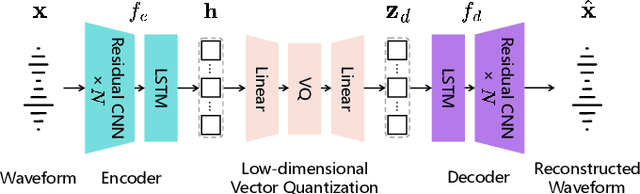
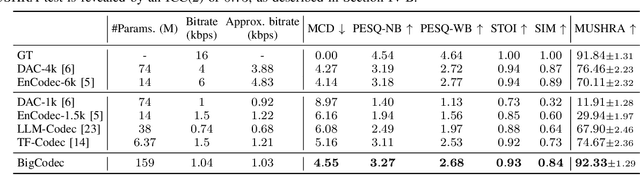


We present BigCodec, a low-bitrate neural speech codec. While recent neural speech codecs have shown impressive progress, their performance significantly deteriorates at low bitrates (around 1 kbps). Although a low bitrate inherently restricts performance, other factors, such as model capacity, also hinder further improvements. To address this problem, we scale up the model size to 159M parameters that is more than 10 times larger than popular codecs with about 10M parameters. Besides, we integrate sequential models into traditional convolutional architectures to better capture temporal dependency and adopt low-dimensional vector quantization to ensure a high code utilization. Comprehensive objective and subjective evaluations show that BigCodec, with a bitrate of 1.04 kbps, significantly outperforms several existing low-bitrate codecs. Furthermore, BigCodec achieves objective performance comparable to popular codecs operating at 4-6 times higher bitrates, and even delivers better subjective perceptual quality than the ground truth.