 Add to Chrome
 Add to Firefox
 Add to Edge
QC-GAN: A Parameter-Efficient Quaternion Conformer GAN for High-Fidelity Speech Enhancement
Jun 18, 2026
We propose a parameter-efficient speech enhancement framework, Quaternion Conformer GAN (QC-GAN), which combines a Quaternion Conformer generator with MetricGAN-based training. The Hamilton product encodes the magnitude and phase via structured weight sharing, reducing the number of layer parameters while preserving their interdependencies. A metric-learning discriminator was employed to maximize perceptual quality by optimizing the approximate perceptual evaluation scores. On the VoiceBank+DEMAND dataset, QC-GAN achieved a Perceptual Evaluation of Speech Quality (PESQ) score of 3.48 with only 0.89M parameters, delivering a performance comparable to state-of-the-art models at less than half their size. A 35K-parameter variant achieved a PESQ score of 3.23, surpassing conventional methods with significantly fewer parameters. Evaluation on the DNS-Challenge 3 dataset further confirmed generalization to real-world conditions.

NAIST Simultaneous Speech Translation System for IWSLT 2024
Jun 30, 2024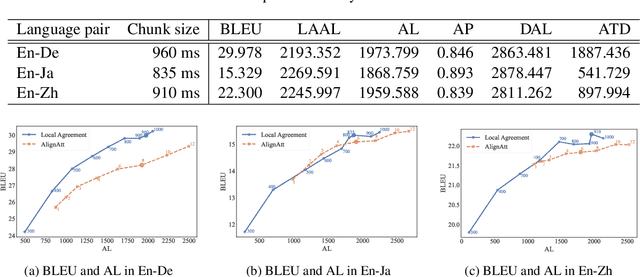

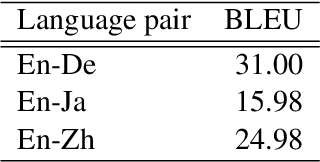

This paper describes NAIST's submission to the simultaneous track of the IWSLT 2024 Evaluation Campaign: English-to-{German, Japanese, Chinese} speech-to-text translation and English-to-Japanese speech-to-speech translation. We develop a multilingual end-to-end speech-to-text translation model combining two pre-trained language models, HuBERT and mBART. We trained this model with two decoding policies, Local Agreement (LA) and AlignAtt. The submitted models employ the LA policy because it outperformed the AlignAtt policy in previous models. Our speech-to-speech translation method is a cascade of the above speech-to-text model and an incremental text-to-speech (TTS) module that incorporates a phoneme estimation model, a parallel acoustic model, and a parallel WaveGAN vocoder. We improved our incremental TTS by applying the Transformer architecture with the AlignAtt policy for the estimation model. The results show that our upgraded TTS module contributed to improving the system performance.