 Add to Chrome
 Add to Firefox
 Add to Edge
Dense Metric Depth Completion from Sparse Direct Time-of-Flight Sensors
Aug 05, 2026
Direct Time-of-Flight (dToF) sensors provide highly accurate metric depth and are more robust than indirect ToF systems in challenging real-world conditions. However, their high manufacturing cost and limited photodiode array size produce depth maps that are extremely sparse, low-resolution, and noisy, making them unsuitable for VR/XR, robotics, and 3D perception tasks that require dense metric depth. Existing monocular and depth completion methods struggle to handle the unique sampling patterns and hardware artifacts of dToF devices, and their performance often deteriorates significantly under severe sparsity or noise. We present a generalizable framework for dense metric depth completion from sparse dToF measurements, capable of operating across diverse sensor types, sparsity levels, and noise conditions. Our model employs a depth-guided dual-branch Vision Transformer encoder that processes RGB images and sparse dToF measurements separately, while a masked joint attention module allows depth tokens to reliably guide image features without being overwritten by them. A lightweight decoder reconstructs dense metric depth efficiently, without diffusion-based or refinement-heavy post-processing. To address the scarcity of paired training data, we introduce a comprehensive dToF simulation pipeline that reproduces the characteristics of flash, sub-VGA flash, and rotating sensors, including hardware-induced degradation, irregular sparsity, and realistic noise distributions. Trained entirely on synthetic data, our model achieves strong zero-shot generalization across 6 datasets and 3 real dToF devices, outperforming state-of-the-art approaches in both accuracy and computational efficiency. This establishes a robust and practical solution for dense metric depth completion from sparse direct ToF sensors. Our code and models are open-sourced. See https://vclab.kaist.ac.kr/cvpr2026p3.

MoGe-3: Fine-Detail Monocular Geometry Estimation with Self-Guided Sparse Volumetric Refinement
Jul 21, 2026Monocular geometry estimation has recently achieved impressive performance across diverse scenes. However, state-of-the-art models still face notable distortion in local 3D structure, especially in fine details, like thin structures and small objects. We attribute this limitation to an architectural mismatch: most current models decode 3D geometry within a 2D parameterization, where feature interactions are governed by image-plane proximity rather than true 3D spatial relationships. This inadvertently mixes features from geometrically distant surfaces, resulting in over-smoothed geometry particularly around thin or elongated structure. In this paper, we propose MoGe-3, a fine-detail monocular geometry estimation model with Self-Guided Sparse 3D Refinement (SSR) that lifts monocular geometry modeling from 2D image space to 3D space for high-fidelity metric-scale point maps. MoGe-3 lifts the coarse point map from a foundation base model onto a sparse voxel shell and refines it via SSR. The SSR employs sparse convolutions that aggregate features based on 3D spatial locality, avoiding feature mixing across depth discontinuities. Extensive experiments on diverse datasets demonstrate that MoGe-3 significantly outperforms existing approaches in recovering fine detailed 3D geometry across both quantitative metrics and qualitative visualizations. Project page: https://qft-333.github.io/moge3page/
FM-VLA: Force-based Memory for Vision-Language-Action Models in Contact-Rich Manipulation
Jul 20, 2026Vision-language-action (VLA) models have achieved impressive generalization in robotic manipulation, and recent memory-augmented VLAs have relaxed the Markovian assumption by conditioning on past images or language summaries. Vision-based memory approaches address this by conditioning on sampled past image frames, but they are computationally expensive and fundamentally limited when temporal events are visually ambiguous, e.g., pushing a button multiple times with small movements. We propose FM-VLA, a VLA model with force-based memory, enabling temporal context reasoning for non-Markovian, contact-rich manipulation. We encode force histories into compact force memory tokens with a variational autoencoder (VAE) pretrained with force time series reconstruction. By projecting force latent representations and short state history as additional conditioning tokens to the action expert module, we enable VLAs to leverage accumulated contact event history to guide manipulation. We evaluate FM-VLA on three memory-dependent tasks, including finding a hidden block, pressing a button, and wiping a dish for a specific number of times. Our lightweight force memory achieves over 80% success rate with minimal inference overhead, significantly outperforming baseline approaches. Project page: https://qft-333.github.io/FM-VLA-Page/
Stabilizing Streaming Video Geometry via Dynamic Feature Normalization
May 25, 2026Consistent 3D geometry estimation from streaming RGB input is crucial for real-world applications such as autonomous driving, embodied AI, and large-scale reconstruction. While modern monocular geometry foundation models achieve strong single-image accuracy, they exhibit severe temporal inconsistency on continuous input, notably dominated by scale--shift drifting. Through targeted empirical analysis, we trace this instability to its root cause: fluctuations in latent feature statistics, whose mean and variance directly determine the predicted depth's scale and shift. Building on this insight, we introduce Dynamic Feature Normalization (DyFN), a lightweight, causal recurrent module that dynamically and robustly modulates feature statistics to maintain stable geometry over time. We adapt powerful pretrained monocular geometry models for streaming by finetuning only DyFN, a mere 2\% additional parameters, while keeping the backbone frozen, thereby achieving temporal consistency without compromising single-image accuracy. Extensive experiments across four benchmarks show that DyFN effectively eliminates temporal artifacts such as disjointed layering and positional jitter, and achieves state-of-the-art temporal stability, improving over prior streaming methods by up to 14\% and even outperforming heavier non-causal video baselines. Project Page: https://shawlyu.github.io/DyFN
Generative Modeling with Orbit-Space Particle Flow Matching
May 04, 2026We present Orbit-Space Geometric Probability Paths (OGPP), a particle-native flow-matching framework for generative modeling of particle systems. OGPP is motivated by two insights: (i) particles are defined up to permutation symmetries, so anonymous indexing inflates per-index target variance and yields curved, hard-to-learn flows; and (ii) particles live in physical space, so the flow terminal velocity has physical meaning and can encode geometric attributes, e.g., surface normals. OGPP instantiates three key components: (1) orbit-space canonicalization of the probability-path terminal endpoint, (2) particle index embeddings for role specialization, and (3) geometric probability paths with arc-length-aware terminal velocities that generate normals as a byproduct of the flow. We evaluate OGPP on minimal-surface benchmarks, where it reduces metric error by up to two orders of magnitude in a single inference step; on ShapeNet, where it matches the state of the art with 5x fewer steps and reaches airplane EMD comparable to DiT-3D with 26x fewer parameters and 5x fewer steps; and on single-shape encoding, where it produces normals and reconstructions competitive with 6D generators while operating entirely in 3D.
Native and Compact Structured Latents for 3D Generation
Dec 16, 2025Recent advancements in 3D generative modeling have significantly improved the generation realism, yet the field is still hampered by existing representations, which struggle to capture assets with complex topologies and detailed appearance. This paper present an approach for learning a structured latent representation from native 3D data to address this challenge. At its core is a new sparse voxel structure called O-Voxel, an omni-voxel representation that encodes both geometry and appearance. O-Voxel can robustly model arbitrary topology, including open, non-manifold, and fully-enclosed surfaces, while capturing comprehensive surface attributes beyond texture color, such as physically-based rendering parameters. Based on O-Voxel, we design a Sparse Compression VAE which provides a high spatial compression rate and a compact latent space. We train large-scale flow-matching models comprising 4B parameters for 3D generation using diverse public 3D asset datasets. Despite their scale, inference remains highly efficient. Meanwhile, the geometry and material quality of our generated assets far exceed those of existing models. We believe our approach offers a significant advancement in 3D generative modeling.
MoGe-2: Accurate Monocular Geometry with Metric Scale and Sharp Details
Jul 03, 2025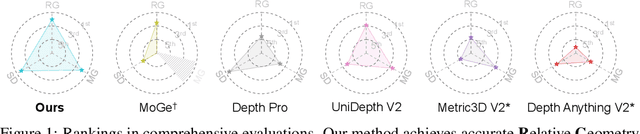
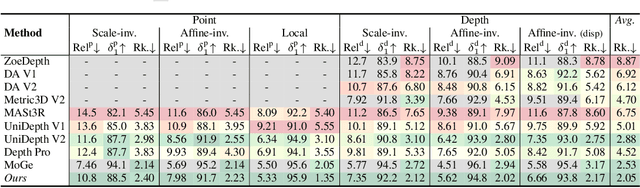
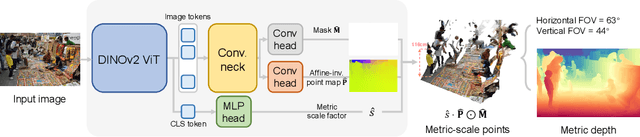
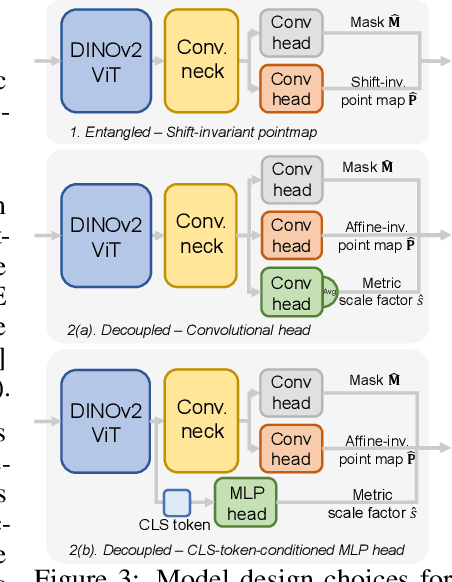
We propose MoGe-2, an advanced open-domain geometry estimation model that recovers a metric scale 3D point map of a scene from a single image. Our method builds upon the recent monocular geometry estimation approach, MoGe, which predicts affine-invariant point maps with unknown scales. We explore effective strategies to extend MoGe for metric geometry prediction without compromising the relative geometry accuracy provided by the affine-invariant point representation. Additionally, we discover that noise and errors in real data diminish fine-grained detail in the predicted geometry. We address this by developing a unified data refinement approach that filters and completes real data from different sources using sharp synthetic labels, significantly enhancing the granularity of the reconstructed geometry while maintaining the overall accuracy. We train our model on a large corpus of mixed datasets and conducted comprehensive evaluations, demonstrating its superior performance in achieving accurate relative geometry, precise metric scale, and fine-grained detail recovery -- capabilities that no previous methods have simultaneously achieved.
Populating cellular metamaterials on the extrema of attainable elasticity through neuroevolution
Dec 17, 2024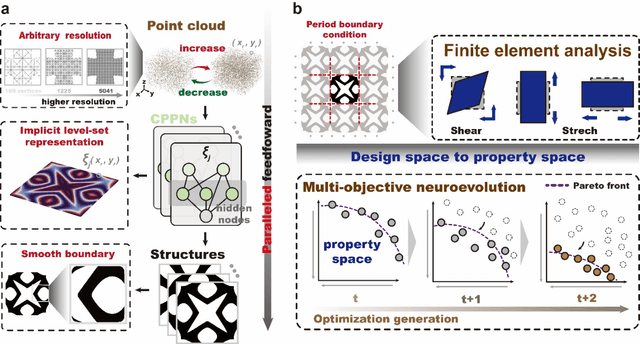
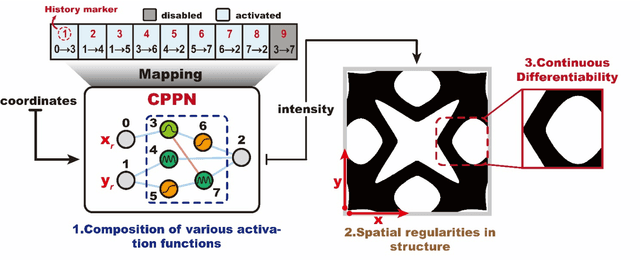

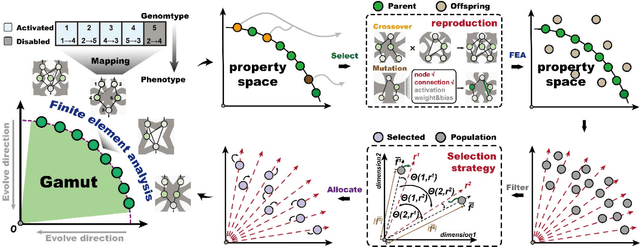
The trade-offs between different mechanical properties of materials pose fundamental challenges in engineering material design, such as balancing stiffness versus toughness, weight versus energy-absorbing capacity, and among the various elastic coefficients. Although gradient-based topology optimization approaches have been effective in finding specific designs and properties, they are not efficient tools for surveying the vast design space of metamaterials, and thus unable to reveal the attainable bound of interdependent material properties. Other common methods, such as parametric design or data-driven approaches, are limited by either the lack of diversity in geometry or the difficulty to extrapolate from known data, respectively. In this work, we formulate the simultaneous exploration of multiple competing material properties as a multi-objective optimization (MOO) problem and employ a neuroevolution algorithm to efficiently solve it. The Compositional Pattern-Producing Networks (CPPNs) is used as the generative model for unit cell designs, which provide very compact yet lossless encoding of geometry. A modified Neuroevolution of Augmenting Topologies (NEAT) algorithm is employed to evolve the CPPNs such that they create metamaterial designs on the Pareto front of the MOO problem, revealing empirical bounds of different combinations of elastic properties. Looking ahead, our method serves as a universal framework for the computational discovery of diverse metamaterials across a range of fields, including robotics, biomedicine, thermal engineering, and photonics.
Structured 3D Latents for Scalable and Versatile 3D Generation
Dec 02, 2024
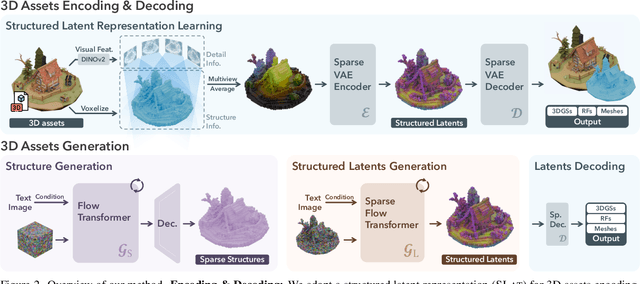
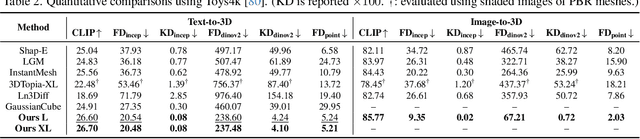

We introduce a novel 3D generation method for versatile and high-quality 3D asset creation. The cornerstone is a unified Structured LATent (SLAT) representation which allows decoding to different output formats, such as Radiance Fields, 3D Gaussians, and meshes. This is achieved by integrating a sparsely-populated 3D grid with dense multiview visual features extracted from a powerful vision foundation model, comprehensively capturing both structural (geometry) and textural (appearance) information while maintaining flexibility during decoding. We employ rectified flow transformers tailored for SLAT as our 3D generation models and train models with up to 2 billion parameters on a large 3D asset dataset of 500K diverse objects. Our model generates high-quality results with text or image conditions, significantly surpassing existing methods, including recent ones at similar scales. We showcase flexible output format selection and local 3D editing capabilities which were not offered by previous models. Code, model, and data will be released.
MoGe: Unlocking Accurate Monocular Geometry Estimation for Open-Domain Images with Optimal Training Supervision
Oct 24, 2024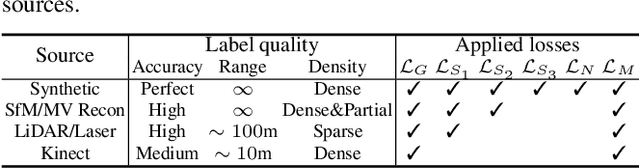


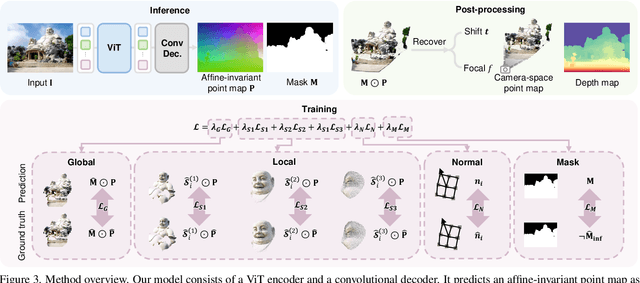
We present MoGe, a powerful model for recovering 3D geometry from monocular open-domain images. Given a single image, our model directly predicts a 3D point map of the captured scene with an affine-invariant representation, which is agnostic to true global scale and shift. This new representation precludes ambiguous supervision in training and facilitate effective geometry learning. Furthermore, we propose a set of novel global and local geometry supervisions that empower the model to learn high-quality geometry. These include a robust, optimal, and efficient point cloud alignment solver for accurate global shape learning, and a multi-scale local geometry loss promoting precise local geometry supervision. We train our model on a large, mixed dataset and demonstrate its strong generalizability and high accuracy. In our comprehensive evaluation on diverse unseen datasets, our model significantly outperforms state-of-the-art methods across all tasks, including monocular estimation of 3D point map, depth map, and camera field of view. Code and models will be released on our project page.