 Add to Chrome
 Add to Firefox
 Add to Edge
FoundationGeo: Learning Spatial Pixel-Wise Fields for Monocular Metric Geometry
Jul 14, 2026
We present FoundationGeo, a two-stage framework that explicitly bridges relative and metric prediction via spatial calibration and principled data design. Stage 1 learns a high-fidelity, affine-invariant geometry model by initializing with DINOv3 and training on a curated 10.2M-sample multi-domain corpus with complementary local-detail supervision, yielding sharp boundaries and strong cross-domain generalization. Stage 2 moves beyond global scaling by introducing lightweight pixel-wise calibration fields for metric estimation: a scale field for spatially varying metric alignment and a ray-direction correction field that mitigates directional bias in point-map geometry, together producing metrically consistent 3D point maps. Beyond model design, we identify camera intrinsic coverage, especially focal length distribution mismatch between training and test data, as a key bottleneck for zero-shot metric generalization: performance drops sharply when test intrinsics fall outside the training distribution. To address this, we synthesize additional training data across diverse focal lengths using a Blender-based data engine, repairing under-covered focal regimes and improving robustness under intrinsic shift. Extensive zero-shot evaluations across seven benchmarks show that FoundationGeo significantly strengthens cross-domain robustness, staying near the top across diverse domains while avoiding the sharp cross-domain performance drops observed in other methods. This consistency translates into the best overall performance, surpassing heavier baselines by over 5.2% on average.

Stabilizing Streaming Video Geometry via Dynamic Feature Normalization
May 25, 2026Consistent 3D geometry estimation from streaming RGB input is crucial for real-world applications such as autonomous driving, embodied AI, and large-scale reconstruction. While modern monocular geometry foundation models achieve strong single-image accuracy, they exhibit severe temporal inconsistency on continuous input, notably dominated by scale--shift drifting. Through targeted empirical analysis, we trace this instability to its root cause: fluctuations in latent feature statistics, whose mean and variance directly determine the predicted depth's scale and shift. Building on this insight, we introduce Dynamic Feature Normalization (DyFN), a lightweight, causal recurrent module that dynamically and robustly modulates feature statistics to maintain stable geometry over time. We adapt powerful pretrained monocular geometry models for streaming by finetuning only DyFN, a mere 2\% additional parameters, while keeping the backbone frozen, thereby achieving temporal consistency without compromising single-image accuracy. Extensive experiments across four benchmarks show that DyFN effectively eliminates temporal artifacts such as disjointed layering and positional jitter, and achieves state-of-the-art temporal stability, improving over prior streaming methods by up to 14\% and even outperforming heavier non-causal video baselines. Project Page: https://shawlyu.github.io/DyFN
PhysEditBench: A Protocol-Conditioned Benchmark for Dense Physical-Map Prediction with Image Editors
May 13, 2026Can general-purpose image editors predict physical maps from a single RGB image? General-purpose image editors differ from standard task-specific dense-prediction models: they do not directly take an image and output a physical map. Instead, they must be guided by prompts, examples, or image-based textual cues. To this end, we introduce PhysEditBench, a novel protocol-conditioned benchmark to evaluate and standardize image editors in dense physical-map prediction that covers five targets: depth, normal, albedo, roughness, and metallic maps. For evaluation data, we build a target-dependent benchmark substrate. We use OpenRooms-FF for depth, surface normal, albedo, and roughness, InteriorVerse as an additional source for depth, normal, albedo, and a new procedurally generated source for metallic maps. We curate the data with quality checks, valid-region masks, scene-level sampling, and lighting-based stress subsets to ensure reliable and diverse evaluation. For each target, PhysEditBench defines a fixed protocol that specifies the allowed input, expected output format, and scoring procedure. Each score, therefore, reflects the performance of a model under a specified protocol, rather than its best possible performance under all prompts or interaction modes. Experimental results show that specialized models remain much stronger on depth, normal, and albedo, and stronger image editors can produce more reasonable map-like outputs. For roughness and metallic, image editors can match or outperform specialized baselines on some scalar metrics, but they still suffer from structural errors, sparsity effects, and sensitivity to lighting.
When Verification Fails: How Compositionally Infeasible Claims Escape Rejection
Apr 13, 2026Scientific claim verification, the task of determining whether claims are entailed by scientific evidence, is fundamental to establishing discoveries in evidence while preventing misinformation. This process involves evaluating each asserted constraint against validated evidence. Under the Closed-World Assumption (CWA), a claim is accepted if and only if all asserted constraints are positively supported. We show that existing verification benchmarks cannot distinguish models enforcing this standard from models applying a simpler shortcut called salient-constraint checking, which applies CWA's rejection criterion only to the most salient constraint and accepts when that constraint is supported. Because existing benchmarks construct infeasible claims by perturbing a single salient element they are insufficient at distinguishing between rigorous claim verification and simple salient-constraint reliance. To separate the two, we construct compositionally infeasible claims where the salient constraint is supported but a non-salient constraint is contradicted. Across model families and modalities, models that otherwise saturate existing benchmarks consistently over-accept these claims, confirming the prevalence of such shortcut reasoning. Via model context interventions, we show that different models and prompting strategies occupy distinct positions on a shared ROC curve, indicating that the gap between model families reflects differences in verification threshold rather than underlying reasoning ability, and that the compositional inference bottleneck is a structural property of current verification behavior that strategy guidance alone cannot overcome.
Stream of Search : Learning to Search in Language
Apr 01, 2024Language models are rarely shown fruitful mistakes while training. They then struggle to look beyond the next token, suffering from a snowballing of errors and struggling to predict the consequence of their actions several steps ahead. In this paper, we show how language models can be taught to search by representing the process of search in language, as a flattened string -- a stream of search (SoS). We propose a unified language for search that captures an array of different symbolic search strategies. We demonstrate our approach using the simple yet difficult game of Countdown, where the goal is to combine input numbers with arithmetic operations to reach a target number. We pretrain a transformer-based language model from scratch on a dataset of streams of search generated by heuristic solvers. We find that SoS pretraining increases search accuracy by 25% over models trained to predict only the optimal search trajectory. We further finetune this model with two policy improvement methods: Advantage-Induced Policy Alignment (APA) and Self-Taught Reasoner (STaR). The finetuned SoS models solve 36% of previously unsolved problems, including problems that cannot be solved by any of the heuristic solvers. Our results indicate that language models can learn to solve problems via search, self-improve to flexibly use different search strategies, and potentially discover new ones.
LILO: Learning Interpretable Libraries by Compressing and Documenting Code
Oct 30, 2023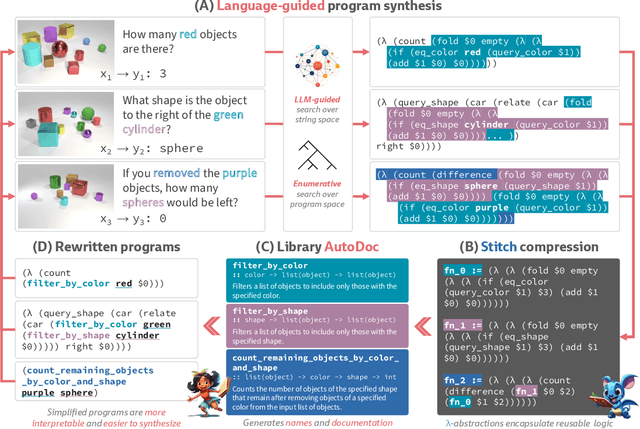
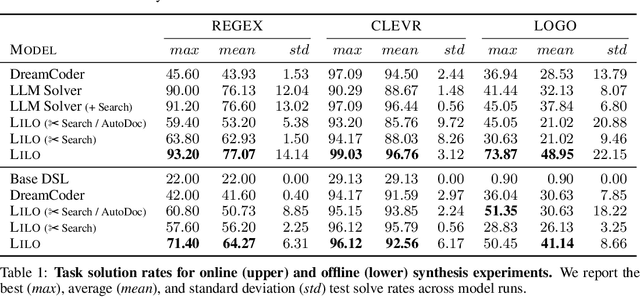
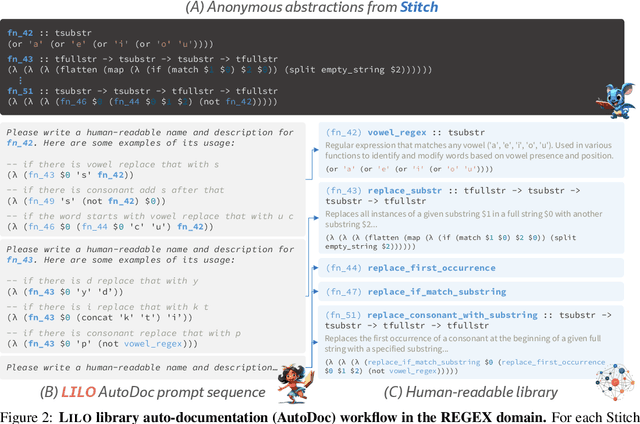
While large language models (LLMs) now excel at code generation, a key aspect of software development is the art of refactoring: consolidating code into libraries of reusable and readable programs. In this paper, we introduce LILO, a neurosymbolic framework that iteratively synthesizes, compresses, and documents code to build libraries tailored to particular problem domains. LILO combines LLM-guided program synthesis with recent algorithmic advances in automated refactoring from Stitch: a symbolic compression system that efficiently identifies optimal lambda abstractions across large code corpora. To make these abstractions interpretable, we introduce an auto-documentation (AutoDoc) procedure that infers natural language names and docstrings based on contextual examples of usage. In addition to improving human readability, we find that AutoDoc boosts performance by helping LILO's synthesizer to interpret and deploy learned abstractions. We evaluate LILO on three inductive program synthesis benchmarks for string editing, scene reasoning, and graphics composition. Compared to existing neural and symbolic methods - including the state-of-the-art library learning algorithm DreamCoder - LILO solves more complex tasks and learns richer libraries that are grounded in linguistic knowledge.