 Add to Chrome
 Add to Firefox
 Add to Edge
MoGe-3: Fine-Detail Monocular Geometry Estimation with Self-Guided Sparse Volumetric Refinement
Jul 21, 2026
Monocular geometry estimation has recently achieved impressive performance across diverse scenes. However, state-of-the-art models still face notable distortion in local 3D structure, especially in fine details, like thin structures and small objects. We attribute this limitation to an architectural mismatch: most current models decode 3D geometry within a 2D parameterization, where feature interactions are governed by image-plane proximity rather than true 3D spatial relationships. This inadvertently mixes features from geometrically distant surfaces, resulting in over-smoothed geometry particularly around thin or elongated structure. In this paper, we propose MoGe-3, a fine-detail monocular geometry estimation model with Self-Guided Sparse 3D Refinement (SSR) that lifts monocular geometry modeling from 2D image space to 3D space for high-fidelity metric-scale point maps. MoGe-3 lifts the coarse point map from a foundation base model onto a sparse voxel shell and refines it via SSR. The SSR employs sparse convolutions that aggregate features based on 3D spatial locality, avoiding feature mixing across depth discontinuities. Extensive experiments on diverse datasets demonstrate that MoGe-3 significantly outperforms existing approaches in recovering fine detailed 3D geometry across both quantitative metrics and qualitative visualizations. Project page: https://qft-333.github.io/moge3page/

FM-VLA: Force-based Memory for Vision-Language-Action Models in Contact-Rich Manipulation
Jul 20, 2026Vision-language-action (VLA) models have achieved impressive generalization in robotic manipulation, and recent memory-augmented VLAs have relaxed the Markovian assumption by conditioning on past images or language summaries. Vision-based memory approaches address this by conditioning on sampled past image frames, but they are computationally expensive and fundamentally limited when temporal events are visually ambiguous, e.g., pushing a button multiple times with small movements. We propose FM-VLA, a VLA model with force-based memory, enabling temporal context reasoning for non-Markovian, contact-rich manipulation. We encode force histories into compact force memory tokens with a variational autoencoder (VAE) pretrained with force time series reconstruction. By projecting force latent representations and short state history as additional conditioning tokens to the action expert module, we enable VLAs to leverage accumulated contact event history to guide manipulation. We evaluate FM-VLA on three memory-dependent tasks, including finding a hidden block, pressing a button, and wiping a dish for a specific number of times. Our lightweight force memory achieves over 80% success rate with minimal inference overhead, significantly outperforming baseline approaches. Project page: https://qft-333.github.io/FM-VLA-Page/
Accelerating Large Scale Knowledge Distillation via Dynamic Importance Sampling
Dec 03, 2018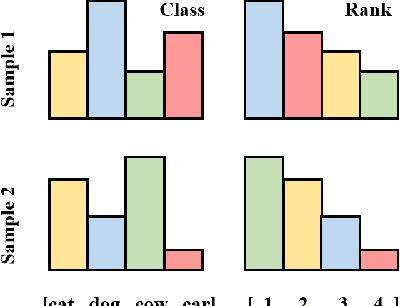
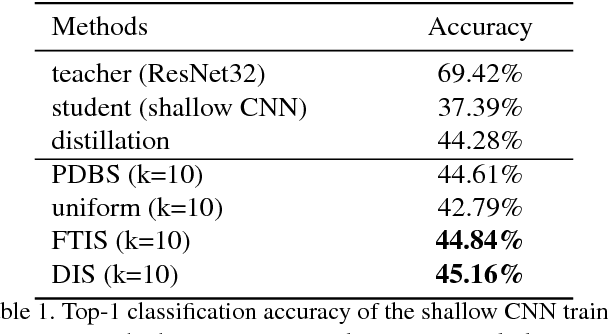
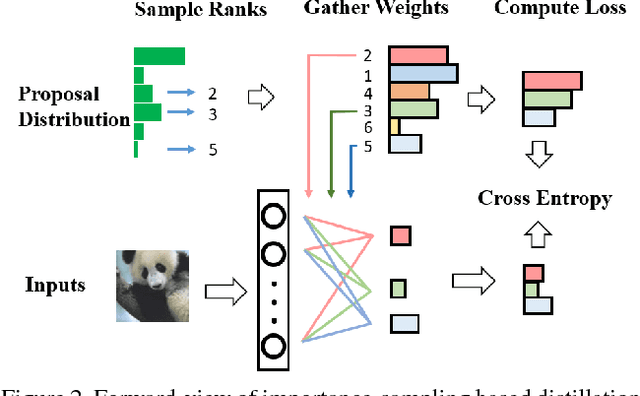
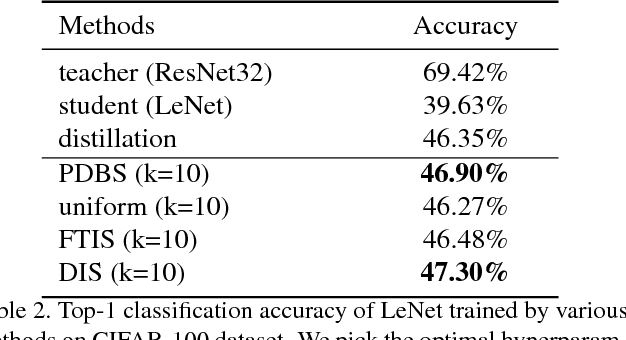
Knowledge distillation is an effective technique that transfers knowledge from a large teacher model to a shallow student. However, just like massive classification, large scale knowledge distillation also imposes heavy computational costs on training models of deep neural networks, as the softmax activations at the last layer involve computing probabilities over numerous classes. In this work, we apply the idea of importance sampling which is often used in Neural Machine Translation on large scale knowledge distillation. We present a method called dynamic importance sampling, where ranked classes are sampled from a dynamic distribution derived from the interaction between the teacher and student in full distillation. We highlight the utility of our proposal prior which helps the student capture the main information in the loss function. Our approach manages to reduce the computational cost at training time while maintaining the competitive performance on CIFAR-100 and Market-1501 person re-identification datasets.