 Add to Chrome
 Add to Firefox
 Add to Edge
FM-VLA: Force-based Memory for Vision-Language-Action Models in Contact-Rich Manipulation
Jul 20, 2026
Vision-language-action (VLA) models have achieved impressive generalization in robotic manipulation, and recent memory-augmented VLAs have relaxed the Markovian assumption by conditioning on past images or language summaries. Vision-based memory approaches address this by conditioning on sampled past image frames, but they are computationally expensive and fundamentally limited when temporal events are visually ambiguous, e.g., pushing a button multiple times with small movements. We propose FM-VLA, a VLA model with force-based memory, enabling temporal context reasoning for non-Markovian, contact-rich manipulation. We encode force histories into compact force memory tokens with a variational autoencoder (VAE) pretrained with force time series reconstruction. By projecting force latent representations and short state history as additional conditioning tokens to the action expert module, we enable VLAs to leverage accumulated contact event history to guide manipulation. We evaluate FM-VLA on three memory-dependent tasks, including finding a hidden block, pressing a button, and wiping a dish for a specific number of times. Our lightweight force memory achieves over 80% success rate with minimal inference overhead, significantly outperforming baseline approaches. Project page: https://qft-333.github.io/FM-VLA-Page/

SegDiff: Segmented Trajectory Diffusion for Consistent and Adaptive Robot Manipulation
Jul 13, 2026Imitation learning enables robots to acquire manipulation skills from demonstrations by mapping observations to actions. Existing approaches predict either short-horizon continuous action sequences or discrete keyposes. However, continuous prediction methods suffer from compounding errors due to short prediction horizons and struggle with multi-modal action distributions, whereas keypose-based methods necessitate an external planner, constraining real-time applicability. To address these challenges, we introduce SegDiff, a closed-loop visuomotor policy that integrates the strengths of both paradigms. SegDiff decomposes demonstrations into motion segments between keyposes and learns to predict the continuous trajectory from the current state to the next keypose, enabling long-horizon prediction with real-time refinement. Furthermore, we leverage the capability of diffusion models and DDIM inversion to propose a Dynamic Temporal Ensembling mechanism, which allows the policy to efficiently respond to dynamic environments and mitigate discontinuities caused by inconsistent multi-modal sampling. SegDiff demonstrates significant performance gains over existing approaches across various simulated and real-world scenarios, indicating its strong ability to reason over extended temporal dependencies while maintaining real-time adaptability and control stability.
Little Strokes Fell Great Oaks: Boosting the Hierarchical Features for Multi-exposure Image Fusion
Apr 10, 2024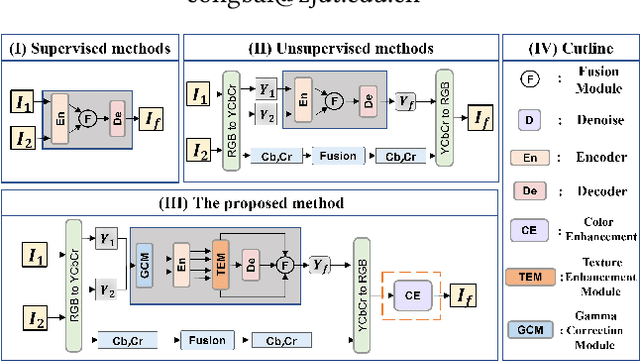
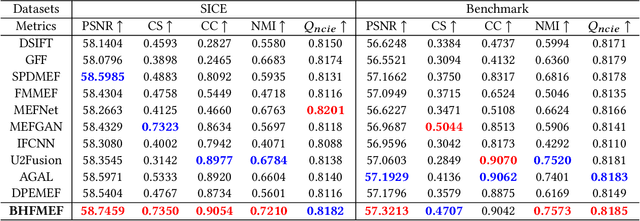
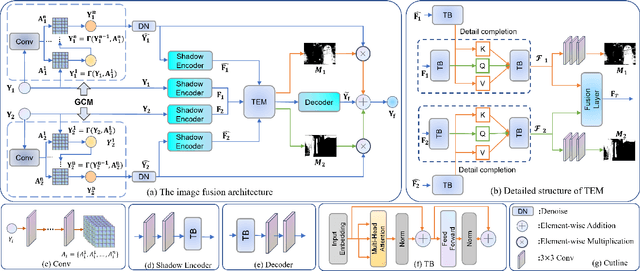
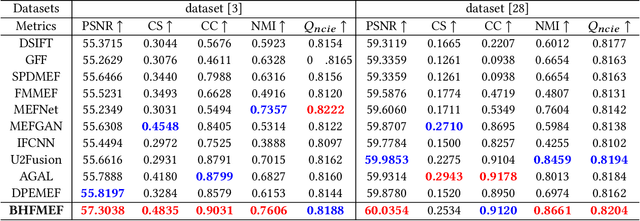
In recent years, deep learning networks have made remarkable strides in the domain of multi-exposure image fusion. Nonetheless, prevailing approaches often involve directly feeding over-exposed and under-exposed images into the network, which leads to the under-utilization of inherent information present in the source images. Additionally, unsupervised techniques predominantly employ rudimentary weighted summation for color channel processing, culminating in an overall desaturated final image tone. To partially mitigate these issues, this study proposes a gamma correction module specifically designed to fully leverage latent information embedded within source images. Furthermore, a modified transformer block, embracing with self-attention mechanisms, is introduced to optimize the fusion process. Ultimately, a novel color enhancement algorithm is presented to augment image saturation while preserving intricate details. The source code is available at https://github.com/ZhiyingDu/BHFMEF.