 Add to Chrome
 Add to Firefox
 Add to Edge
PASTA: Towards Flexible and Efficient HDR Imaging Via Progressively Aggregated Spatio-Temporal Aligment
Mar 15, 2024



Leveraging Transformer attention has led to great advancements in HDR deghosting. However, the intricate nature of self-attention introduces practical challenges, as existing state-of-the-art methods often demand high-end GPUs or exhibit slow inference speeds, especially for high-resolution images like 2K. Striking an optimal balance between performance and latency remains a critical concern. In response, this work presents PASTA, a novel Progressively Aggregated Spatio-Temporal Alignment framework for HDR deghosting. Our approach achieves effectiveness and efficiency by harnessing hierarchical representation during feature distanglement. Through the utilization of diverse granularities within the hierarchical structure, our method substantially boosts computational speed and optimizes the HDR imaging workflow. In addition, we explore within-scale feature modeling with local and global attention, gradually merging and refining them in a coarse-to-fine fashion. Experimental results showcase PASTA's superiority over current SOTA methods in both visual quality and performance metrics, accompanied by a substantial 3-fold (x3) increase in inference speed.

See More Details: Efficient Image Super-Resolution by Experts Mining
Feb 05, 2024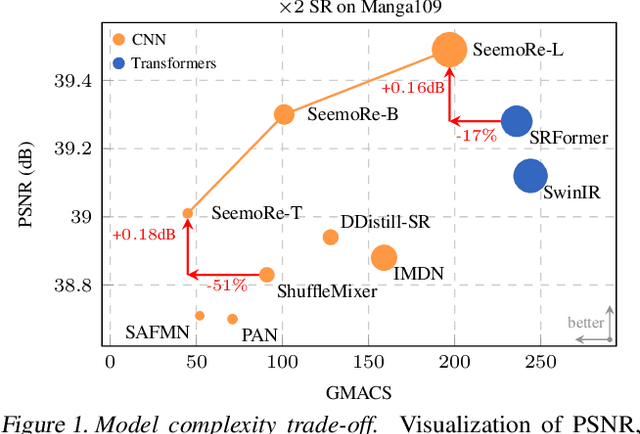

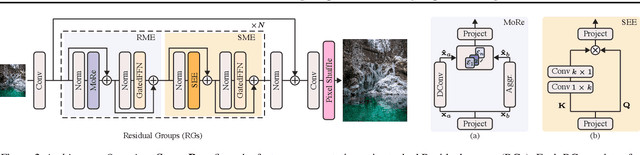

Reconstructing high-resolution (HR) images from low-resolution (LR) inputs poses a significant challenge in image super-resolution (SR). While recent approaches have demonstrated the efficacy of intricate operations customized for various objectives, the straightforward stacking of these disparate operations can result in a substantial computational burden, hampering their practical utility. In response, we introduce SeemoRe, an efficient SR model employing expert mining. Our approach strategically incorporates experts at different levels, adopting a collaborative methodology. At the macro scale, our experts address rank-wise and spatial-wise informative features, providing a holistic understanding. Subsequently, the model delves into the subtleties of rank choice by leveraging a mixture of low-rank experts. By tapping into experts specialized in distinct key factors crucial for accurate SR, our model excels in uncovering intricate intra-feature details. This collaborative approach is reminiscent of the concept of "see more", allowing our model to achieve an optimal performance with minimal computational costs in efficient settings. The source will be publicly made available at https://github.com/eduardzamfir/seemoredetails
High-Quality Image Restoration Following Human Instructions
Jan 31, 2024Image restoration is a fundamental problem that involves recovering a high-quality clean image from its degraded observation. All-In-One image restoration models can effectively restore images from various types and levels of degradation using degradation-specific information as prompts to guide the restoration model. In this work, we present the first approach that uses human-written instructions to guide the image restoration model. Given natural language prompts, our model can recover high-quality images from their degraded counterparts, considering multiple degradation types. Our method, InstructIR, achieves state-of-the-art results on several restoration tasks including image denoising, deraining, deblurring, dehazing, and (low-light) image enhancement. InstructIR improves +1dB over previous all-in-one restoration methods. Moreover, our dataset and results represent a novel benchmark for new research on text-guided image restoration and enhancement. Our code, datasets and models are available at: https://github.com/mv-lab/InstructIR
BSRAW: Improving Blind RAW Image Super-Resolution
Dec 24, 2023In smartphones and compact cameras, the Image Signal Processor (ISP) transforms the RAW sensor image into a human-readable sRGB image. Most popular super-resolution methods depart from a sRGB image and upscale it further, improving its quality. However, modeling the degradations in the sRGB domain is complicated because of the non-linear ISP transformations. Despite this known issue, only a few methods work directly with RAW images and tackle real-world sensor degradations. We tackle blind image super-resolution in the RAW domain. We design a realistic degradation pipeline tailored specifically for training models with raw sensor data. Our approach considers sensor noise, defocus, exposure, and other common issues. Our BSRAW models trained with our pipeline can upscale real-scene RAW images and improve their quality. As part of this effort, we also present a new DSLM dataset and benchmark for this task.
Single-Model and Any-Modality for Video Object Tracking
Nov 27, 2023


In the realm of video object tracking, auxiliary modalities such as depth, thermal, or event data have emerged as valuable assets to complement the RGB trackers. In practice, most existing RGB trackers learn a single set of parameters to use them across datasets and applications. However, a similar single-model unification for multi-modality tracking presents several challenges. These challenges stem from the inherent heterogeneity of inputs -- each with modality-specific representations, the scarcity of multi-modal datasets, and the absence of all the modalities at all times. In this work, we introduce Un-Track, a \underline{Un}ified Tracker of a single set of parameters for any modality. To handle any modality, our method learns their common latent space through low-rank factorization and reconstruction techniques. More importantly, we use only the RGB-X pairs to learn the common latent space. This unique shared representation seamlessly binds all modalities together, enabling effective unification and accommodating any missing modality, all within a single transformer-based architecture and without the need for modality-specific fine-tuning. Our Un-Track achieves +8.1 absolute F-score gain, on the DepthTrack dataset, by introducing only +2.14 (over 21.50) GFLOPs with +6.6M (over 93M) parameters, through a simple yet efficient prompting strategy. Extensive comparisons on five benchmark datasets with different modalities show that Un-Track surpasses both SOTA unified trackers and modality-specific finetuned counterparts, validating our effectiveness and practicality.
Deep Equilibrium Diffusion Restoration with Parallel Sampling
Nov 20, 2023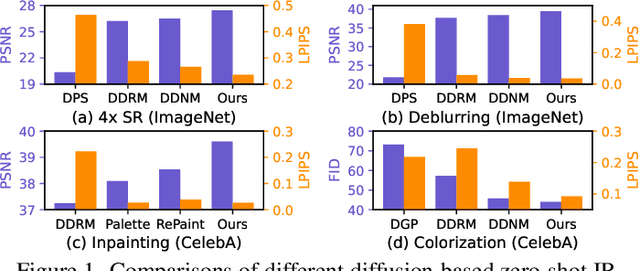
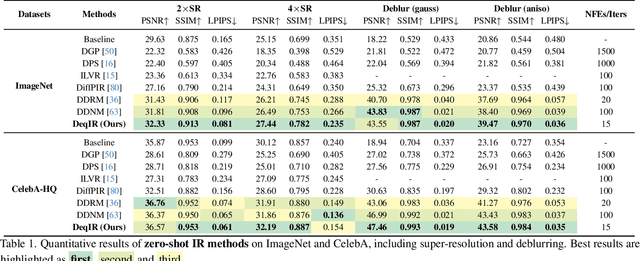

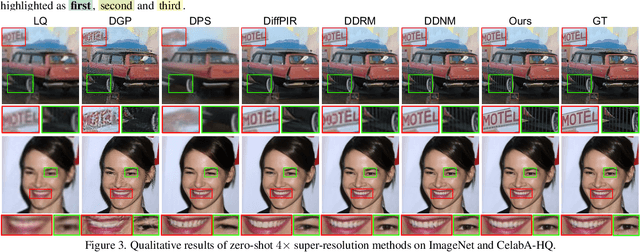
Diffusion-based image restoration (IR) methods aim to use diffusion models to recover high-quality (HQ) images from degraded images and achieve promising performance. Due to the inherent property of diffusion models, most of these methods need long serial sampling chains to restore HQ images step-by-step. As a result, it leads to expensive sampling time and high computation costs. Moreover, such long sampling chains hinder understanding the relationship between the restoration results and the inputs since it is hard to compute the gradients in the whole chains. In this work, we aim to rethink the diffusion-based IR models through a different perspective, i.e., a deep equilibrium (DEQ) fixed point system. Specifically, we derive an analytical solution by modeling the entire sampling chain in diffusion-based IR models as a joint multivariate fixed point system. With the help of the analytical solution, we are able to conduct single-image sampling in a parallel way and restore HQ images without training. Furthermore, we compute fast gradients in DEQ and found that initialization optimization can boost performance and control the generation direction. Extensive experiments on benchmarks demonstrate the effectiveness of our proposed method on typical IR tasks and real-world settings. The code and models will be made publicly available.
MoVideo: Motion-Aware Video Generation with Diffusion Models
Nov 19, 2023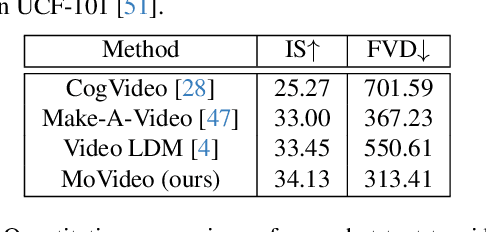


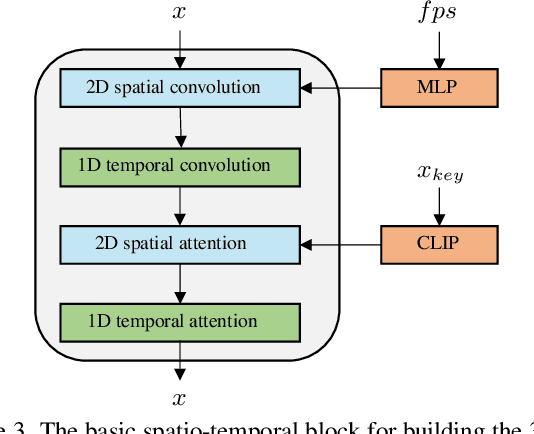
While recent years have witnessed great progress on using diffusion models for video generation, most of them are simple extensions of image generation frameworks, which fail to explicitly consider one of the key differences between videos and images, i.e., motion. In this paper, we propose a novel motion-aware video generation (MoVideo) framework that takes motion into consideration from two aspects: video depth and optical flow. The former regulates motion by per-frame object distances and spatial layouts, while the later describes motion by cross-frame correspondences that help in preserving fine details and improving temporal consistency. More specifically, given a key frame that exists or generated from text prompts, we first design a diffusion model with spatio-temporal modules to generate the video depth and the corresponding optical flows. Then, the video is generated in the latent space by another spatio-temporal diffusion model under the guidance of depth, optical flow-based warped latent video and the calculated occlusion mask. Lastly, we use optical flows again to align and refine different frames for better video decoding from the latent space to the pixel space. In experiments, MoVideo achieves state-of-the-art results in both text-to-video and image-to-video generation, showing promising prompt consistency, frame consistency and visual quality.
A Study of Forward-Forward Algorithm for Self-Supervised Learning
Sep 21, 2023Self-supervised representation learning has seen remarkable progress in the last few years, with some of the recent methods being able to learn useful image representations without labels. These methods are trained using backpropagation, the de facto standard. Recently, Geoffrey Hinton proposed the forward-forward algorithm as an alternative training method. It utilizes two forward passes and a separate loss function for each layer to train the network without backpropagation. In this study, for the first time, we study the performance of forward-forward vs. backpropagation for self-supervised representation learning and provide insights into the learned representation spaces. Our benchmark employs four standard datasets, namely MNIST, F-MNIST, SVHN and CIFAR-10, and three commonly used self-supervised representation learning techniques, namely rotation, flip and jigsaw. Our main finding is that while the forward-forward algorithm performs comparably to backpropagation during (self-)supervised training, the transfer performance is significantly lagging behind in all the studied settings. This may be caused by a combination of factors, including having a loss function for each layer and the way the supervised training is realized in the forward-forward paradigm. In comparison to backpropagation, the forward-forward algorithm focuses more on the boundaries and drops part of the information unnecessary for making decisions which harms the representation learning goal. Further investigation and research are necessary to stabilize the forward-forward strategy for self-supervised learning, to work beyond the datasets and configurations demonstrated by Geoffrey Hinton.
Neural Gradient Regularizer
Sep 13, 2023Owing to its significant success, the prior imposed on gradient maps has consistently been a subject of great interest in the field of image processing. Total variation (TV), one of the most representative regularizers, is known for its ability to capture the intrinsic sparsity prior underlying gradient maps. Nonetheless, TV and its variants often underestimate the gradient maps, leading to the weakening of edges and details whose gradients should not be zero in the original image (i.e., image structures is not describable by sparse priors of gradient maps). Recently, total deep variation (TDV) has been introduced, assuming the sparsity of feature maps, which provides a flexible regularization learned from large-scale datasets for a specific task. However, TDV requires to retrain the network with image/task variations, limiting its versatility. To alleviate this issue, in this paper, we propose a neural gradient regularizer (NGR) that expresses the gradient map as the output of a neural network. Unlike existing methods, NGR does not rely on any subjective sparsity or other prior assumptions on image gradient maps, thereby avoiding the underestimation of gradient maps. NGR is applicable to various image types and different image processing tasks, functioning in a zero-shot learning fashion, making it a versatile and plug-and-play regularizer. Extensive experimental results demonstrate the superior performance of NGR over state-of-the-art counterparts for a range of different tasks, further validating its effectiveness and versatility.
When Super-Resolution Meets Camouflaged Object Detection: A Comparison Study
Aug 08, 2023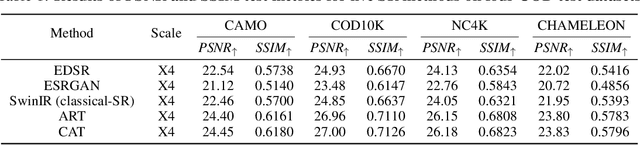
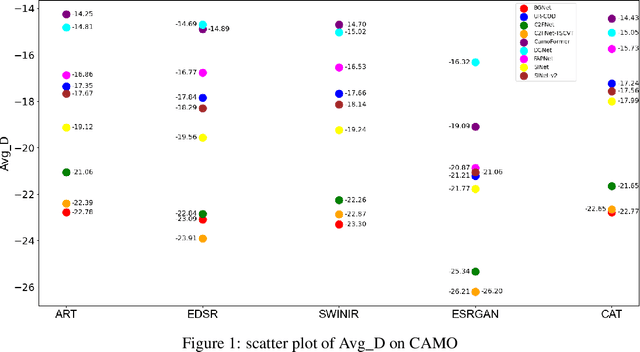
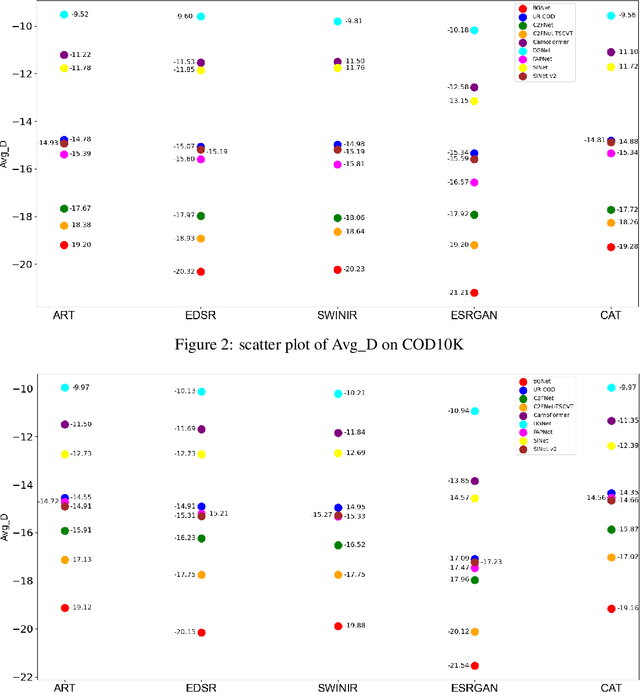
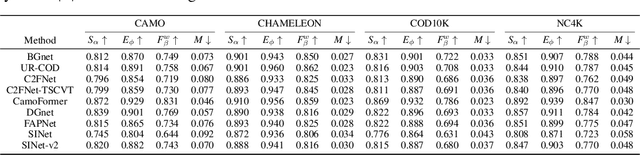
Super Resolution (SR) and Camouflaged Object Detection (COD) are two hot topics in computer vision with various joint applications. For instance, low-resolution surveillance images can be successively processed by super-resolution techniques and camouflaged object detection. However, in previous work, these two areas are always studied in isolation. In this paper, we, for the first time, conduct an integrated comparative evaluation for both. Specifically, we benchmark different super-resolution methods on commonly used COD datasets, and meanwhile, we evaluate the robustness of different COD models by using COD data processed by SR methods. Our goal is to bridge these two domains, discover novel experimental phenomena, summarize new experim.