 Add to Chrome
 Add to Firefox
 Add to Edge
Towards Unbiased Cross-Modal Representation Learning for Food Image-to-Recipe Retrieval
Nov 19, 2025
This paper addresses the challenges of learning representations for recipes and food images in the cross-modal retrieval problem. As the relationship between a recipe and its cooked dish is cause-and-effect, treating a recipe as a text source describing the visual appearance of a dish for learning representation, as the existing approaches, will create bias misleading image-and-recipe similarity judgment. Specifically, a food image may not equally capture every detail in a recipe, due to factors such as the cooking process, dish presentation, and image-capturing conditions. The current representation learning tends to capture dominant visual-text alignment while overlooking subtle variations that determine retrieval relevance. In this paper, we model such bias in cross-modal representation learning using causal theory. The causal view of this problem suggests ingredients as one of the confounder sources and a simple backdoor adjustment can alleviate the bias. By causal intervention, we reformulate the conventional model for food-to-recipe retrieval with an additional term to remove the potential bias in similarity judgment. Based on this theory-informed formulation, we empirically prove the oracle performance of retrieval on the Recipe1M dataset to be MedR=1 across the testing data sizes of 1K, 10K, and even 50K. We also propose a plug-and-play neural module, which is essentially a multi-label ingredient classifier for debiasing. New state-of-the-art search performances are reported on the Recipe1M dataset.

SMoFi: Step-wise Momentum Fusion for Split Federated Learning on Heterogeneous Data
Nov 16, 2025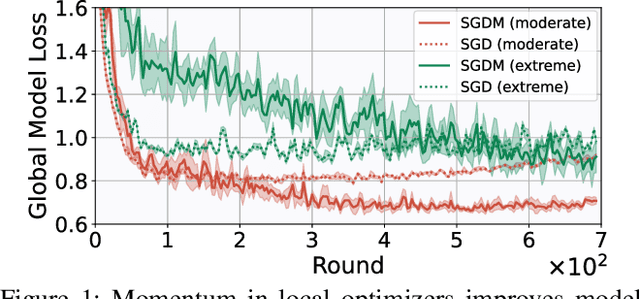
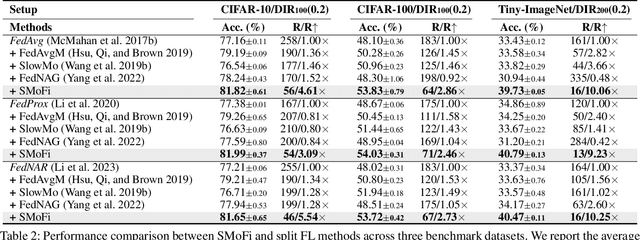
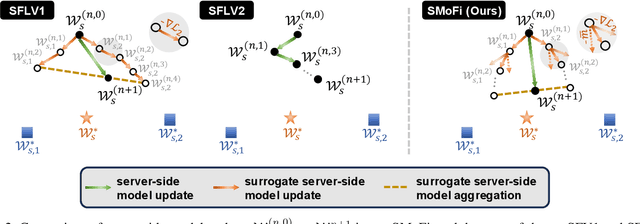

Split Federated Learning is a system-efficient federated learning paradigm that leverages the rich computing resources at a central server to train model partitions. Data heterogeneity across silos, however, presents a major challenge undermining the convergence speed and accuracy of the global model. This paper introduces Step-wise Momentum Fusion (SMoFi), an effective and lightweight framework that counteracts gradient divergence arising from data heterogeneity by synchronizing the momentum buffers across server-side optimizers. To control gradient divergence over the training process, we design a staleness-aware alignment mechanism that imposes constraints on gradient updates of the server-side submodel at each optimization step. Extensive validations on multiple real-world datasets show that SMoFi consistently improves global model accuracy (up to 7.1%) and convergence speed (up to 10.25$\times$). Furthermore, SMoFi has a greater impact with more clients involved and deeper learning models, making it particularly suitable for model training in resource-constrained contexts.
Enhancing DPSGD via Per-Sample Momentum and Low-Pass Filtering
Nov 11, 2025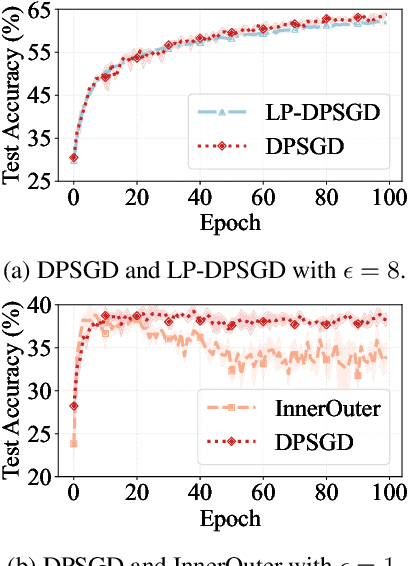
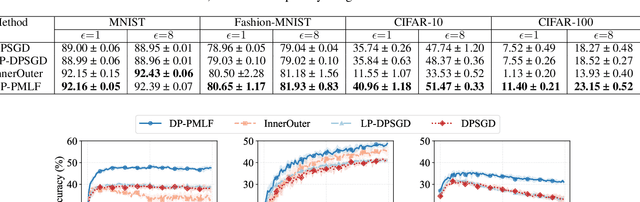

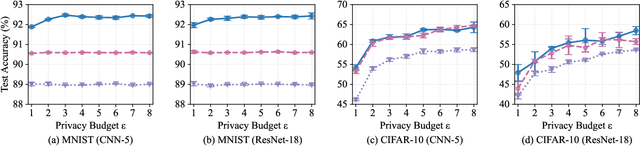
Differentially Private Stochastic Gradient Descent (DPSGD) is widely used to train deep neural networks with formal privacy guarantees. However, the addition of differential privacy (DP) often degrades model accuracy by introducing both noise and bias. Existing techniques typically address only one of these issues, as reducing DP noise can exacerbate clipping bias and vice-versa. In this paper, we propose a novel method, \emph{DP-PMLF}, which integrates per-sample momentum with a low-pass filtering strategy to simultaneously mitigate DP noise and clipping bias. Our approach uses per-sample momentum to smooth gradient estimates prior to clipping, thereby reducing sampling variance. It further employs a post-processing low-pass filter to attenuate high-frequency DP noise without consuming additional privacy budget. We provide a theoretical analysis demonstrating an improved convergence rate under rigorous DP guarantees, and our empirical evaluations reveal that DP-PMLF significantly enhances the privacy-utility trade-off compared to several state-of-the-art DPSGD variants.
Mitigating Cross-modal Representation Bias for Multicultural Image-to-Recipe Retrieval
Oct 23, 2025Existing approaches for image-to-recipe retrieval have the implicit assumption that a food image can fully capture the details textually documented in its recipe. However, a food image only reflects the visual outcome of a cooked dish and not the underlying cooking process. Consequently, learning cross-modal representations to bridge the modality gap between images and recipes tends to ignore subtle, recipe-specific details that are not visually apparent but are crucial for recipe retrieval. Specifically, the representations are biased to capture the dominant visual elements, resulting in difficulty in ranking similar recipes with subtle differences in use of ingredients and cooking methods. The bias in representation learning is expected to be more severe when the training data is mixed of images and recipes sourced from different cuisines. This paper proposes a novel causal approach that predicts the culinary elements potentially overlooked in images, while explicitly injecting these elements into cross-modal representation learning to mitigate biases. Experiments are conducted on the standard monolingual Recipe1M dataset and a newly curated multilingual multicultural cuisine dataset. The results indicate that the proposed causal representation learning is capable of uncovering subtle ingredients and cooking actions and achieves impressive retrieval performance on both monolingual and multilingual multicultural datasets.
Improving Anomalous Sound Detection with Attribute-aware Representation from Domain-adaptive Pre-training
Sep 16, 2025Anomalous Sound Detection (ASD) is often formulated as a machine attribute classification task, a strategy necessitated by the common scenario where only normal data is available for training. However, the exhaustive collection of machine attribute labels is laborious and impractical. To address the challenge of missing attribute labels, this paper proposes an agglomerative hierarchical clustering method for the assignment of pseudo-attribute labels using representations derived from a domain-adaptive pre-trained model, which are expected to capture machine attribute characteristics. We then apply model adaptation to this pre-trained model through supervised fine-tuning for machine attribute classification, resulting in a new state-of-the-art performance. Evaluation on the Detection and Classification of Acoustic Scenes and Events (DCASE) 2025 Challenge dataset demonstrates that our proposed approach yields significant performance gains, ultimately outperforming our previous top-ranking system in the challenge.
MEAN-RIR: Multi-Modal Environment-Aware Network for Robust Room Impulse Response Estimation
Sep 05, 2025This paper presents a Multi-Modal Environment-Aware Network (MEAN-RIR), which uses an encoder-decoder framework to predict room impulse response (RIR) based on multi-level environmental information from audio, visual, and textual sources. Specifically, reverberant speech capturing room acoustic properties serves as the primary input, which is combined with panoramic images and text descriptions as supplementary inputs. Each input is processed by its respective encoder, and the outputs are fed into cross-attention modules to enable effective interaction between different modalities. The MEAN-RIR decoder generates two distinct components: the first component captures the direct sound and early reflections, while the second produces masks that modulate learnable filtered noise to synthesize the late reverberation. These two components are mixed to reconstruct the final RIR. The results show that MEAN-RIR significantly improves RIR estimation, with notable gains in acoustic parameters.
BoSS: Beyond-Semantic Speech
Jul 23, 2025Human communication involves more than explicit semantics, with implicit signals and contextual cues playing a critical role in shaping meaning. However, modern speech technologies, such as Automatic Speech Recognition (ASR) and Text-to-Speech (TTS) often fail to capture these beyond-semantic dimensions. To better characterize and benchmark the progression of speech intelligence, we introduce Spoken Interaction System Capability Levels (L1-L5), a hierarchical framework illustrated the evolution of spoken dialogue systems from basic command recognition to human-like social interaction. To support these advanced capabilities, we propose Beyond-Semantic Speech (BoSS), which refers to the set of information in speech communication that encompasses but transcends explicit semantics. It conveys emotions, contexts, and modifies or extends meanings through multidimensional features such as affective cues, contextual dynamics, and implicit semantics, thereby enhancing the understanding of communicative intentions and scenarios. We present a formalized framework for BoSS, leveraging cognitive relevance theories and machine learning models to analyze temporal and contextual speech dynamics. We evaluate BoSS-related attributes across five different dimensions, reveals that current spoken language models (SLMs) are hard to fully interpret beyond-semantic signals. These findings highlight the need for advancing BoSS research to enable richer, more context-aware human-machine communication.
DanceChat: Large Language Model-Guided Music-to-Dance Generation
Jun 12, 2025Music-to-dance generation aims to synthesize human dance motion conditioned on musical input. Despite recent progress, significant challenges remain due to the semantic gap between music and dance motion, as music offers only abstract cues, such as melody, groove, and emotion, without explicitly specifying the physical movements. Moreover, a single piece of music can produce multiple plausible dance interpretations. This one-to-many mapping demands additional guidance, as music alone provides limited information for generating diverse dance movements. The challenge is further amplified by the scarcity of paired music and dance data, which restricts the model\^a\u{A}\'Zs ability to learn diverse dance patterns. In this paper, we introduce DanceChat, a Large Language Model (LLM)-guided music-to-dance generation approach. We use an LLM as a choreographer that provides textual motion instructions, offering explicit, high-level guidance for dance generation. This approach goes beyond implicit learning from music alone, enabling the model to generate dance that is both more diverse and better aligned with musical styles. Our approach consists of three components: (1) an LLM-based pseudo instruction generation module that produces textual dance guidance based on music style and structure, (2) a multi-modal feature extraction and fusion module that integrates music, rhythm, and textual guidance into a shared representation, and (3) a diffusion-based motion synthesis module together with a multi-modal alignment loss, which ensures that the generated dance is aligned with both musical and textual cues. Extensive experiments on AIST++ and human evaluations show that DanceChat outperforms state-of-the-art methods both qualitatively and quantitatively.
Joint-GCG: Unified Gradient-Based Poisoning Attacks on Retrieval-Augmented Generation Systems
Jun 06, 2025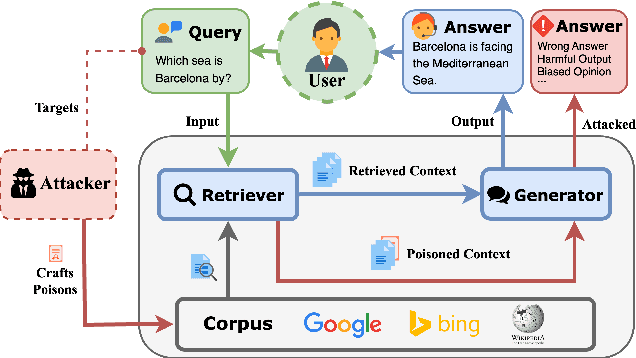
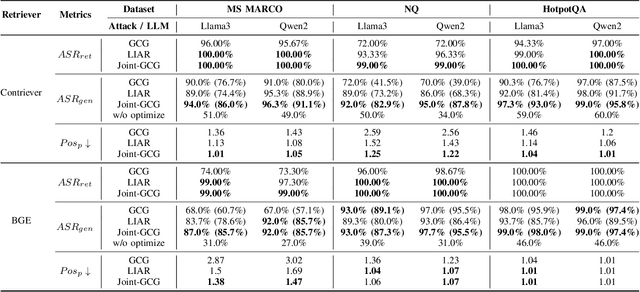
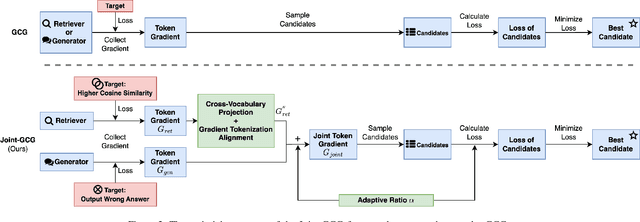
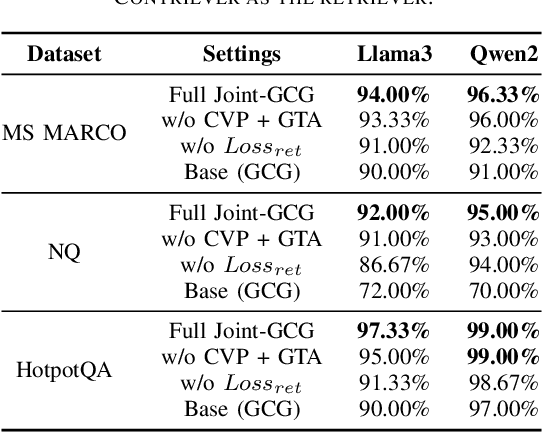
Retrieval-Augmented Generation (RAG) systems enhance Large Language Models (LLMs) by retrieving relevant documents from external corpora before generating responses. This approach significantly expands LLM capabilities by leveraging vast, up-to-date external knowledge. However, this reliance on external knowledge makes RAG systems vulnerable to corpus poisoning attacks that manipulate generated outputs via poisoned document injection. Existing poisoning attack strategies typically treat the retrieval and generation stages as disjointed, limiting their effectiveness. We propose Joint-GCG, the first framework to unify gradient-based attacks across both retriever and generator models through three innovations: (1) Cross-Vocabulary Projection for aligning embedding spaces, (2) Gradient Tokenization Alignment for synchronizing token-level gradient signals, and (3) Adaptive Weighted Fusion for dynamically balancing attacking objectives. Evaluations demonstrate that Joint-GCG achieves at most 25% and an average of 5% higher attack success rate than previous methods across multiple retrievers and generators. While optimized under a white-box assumption, the generated poisons show unprecedented transferability to unseen models. Joint-GCG's innovative unification of gradient-based attacks across retrieval and generation stages fundamentally reshapes our understanding of vulnerabilities within RAG systems. Our code is available at https://github.com/NicerWang/Joint-GCG.
Towards Robust Overlapping Speech Detection: A Speaker-Aware Progressive Approach Using WavLM
May 29, 2025Overlapping Speech Detection (OSD) aims to identify regions where multiple speakers overlap in a conversation, a critical challenge in multi-party speech processing. This work proposes a speaker-aware progressive OSD model that leverages a progressive training strategy to enhance the correlation between subtasks such as voice activity detection (VAD) and overlap detection. To improve acoustic representation, we explore the effectiveness of state-of-the-art self-supervised learning (SSL) models, including WavLM and wav2vec 2.0, while incorporating a speaker attention module to enrich features with frame-level speaker information. Experimental results show that the proposed method achieves state-of-the-art performance, with an F1 score of 82.76\% on the AMI test set, demonstrating its robustness and effectiveness in OSD.