 Add to Chrome
 Add to Firefox
 Add to Edge
MSU-Bench: Towards Speaker-Centric Understanding in Conversational Multi-Speaker Scenarios
Jun 22, 2026
Spoken Language Understanding (SLU) is moving from task-specific pipelines toward large audio language models (LALMs) that generate natural-language responses. However, existing speech benchmarks mainly focus on single-speaker settings or isolated subtasks, leaving speaker-centric understanding in realistic multi-speaker conversations insufficiently evaluated. We introduce MSU-Bench, a diagnostic benchmark for multi-speaker conversational understanding, covering 16 speaker-centric tasks and 2,300 QA instances in a two-tier framework from speaker grounding to dialogue reasoning. We build a Gemini-assisted annotation and QA generation pipeline with human-in-the-loop verification, achieving high QA validity and strong agreement between human answers and verified labels. We further analyze speaker-referencing schemes and diagnostic error types to reveal bottlenecks in speaker grounding and reasoning. Experiments reveal clear gaps across model families, with closed-source systems leading overall but all models still facing challenges in complex speaker grounding and multi-speaker reasoning. The benchmark annotations, metadata, and evaluation scripts will be available at the GitHub repository: https://github.com/ASLP-lab/MSU-Bench.

Audio-Mind: An Auditable Agentic Framework for Audio Understanding
May 27, 2026Audio agents extend large audio-language models (LALMs) by decomposing audio questions into tool calls, intermediate evidence, and iterative reasoning steps. However, as LALMs become stronger, the key challenge shifts from enabling tool use to determining when agentic evidence acquisition genuinely benefits audio understanding. We propose Audio-Mind, an auditable and pluggable framework for conditional evidence acquisition in audio understanding. Audio-Mind dynamically combines a strong frontend with planner-guided tool use, preserving frontend judgment when initial evidence is sufficient while acquiring bounded external evidence for questions with unresolved evidence gaps. Experiments on MMAR and MSU-Bench show that Audio-Mind outperforms prior audio-agent baselines, reaching 80.4% accuracy on MMAR and 82.8% accuracy on MSU-Bench. A matched-backbone comparison highlights why this design matters: under strong audio frontends, agentic decomposition can become an orchestration bottleneck when the workflow does not preserve the frontend's holistic audio-grounded judgment. Beyond accuracy, Audio-Mind produces higher-quality, auditable reasoning traces that expose uncertainty, tool evidence, and answer rationales, offering a potential basis for more reliable audio-QA annotation and error analysis.
Speaker-Reasoner: Scaling Interaction Turns and Reasoning Patterns for Timestamped Speaker-Attributed ASR
Apr 03, 2026Transcribing and understanding multi-speaker conversations requires speech recognition, speaker attribution, and timestamp localization. While speech LLMs excel at single-speaker tasks, multi-speaker scenarios remain challenging due to overlapping speech, backchannels, rapid turn-taking, and context window constraints. We propose Speaker-Reasoner, an end-to-end Speech LLM with agentic multi-turn temporal reasoning. Instead of single-pass inference, the model iteratively analyzes global audio structure, autonomously predicts temporal boundaries, and performs fine-grained segment analysis, jointly modeling speaker identity, gender, timestamps, and transcription. A speaker-aware cache further extends processing to audio exceeding the training context window. Trained with a three-stage progressive strategy, Speaker-Reasoner achieves consistent improvements over strong baselines on AliMeeting and AISHELL-4 datasets, particularly in handling overlapping speech and complex turn-taking.
Revealing Combinatorial Reasoning of GNNs via Graph Concept Bottleneck Layer
Mar 02, 2026Despite their success in various domains, the growing dependence on GNNs raises a critical concern about the nature of the combinatorial reasoning underlying their predictions, which is often hidden within their black-box architectures. Addressing this challenge requires understanding how GNNs translate topological patterns into logical rules. However, current works only uncover the hard logical rules over graph concepts, which cannot quantify the contribution of each concept to prediction. Moreover, they are post-hoc interpretable methods that generate explanations after model training and may not accurately reflect the true combinatorial reasoning of GNNs, since they approximate it with a surrogate. In this work, we develop a graph concept bottleneck layer that can be integrated into any GNN architectures to guide them to predict the selected discriminative global graph concepts. The predicted concept scores are further projected to class labels by a sparse linear layer. It enforces the combinatorial reasoning of GNNs' predictions to fit the soft logical rule over graph concepts and thus can quantify the contribution of each concept. To further improve the quality of the concept bottleneck, we treat concepts as "graph words" and graphs as "graph sentences", and leverage language models to learn graph concept embeddings. Extensive experiments on multiple datasets show that our method GCBMs achieve state-of-the-art performance both in classification and interpretability.
MSU-Bench: Towards Understanding the Conversational Multi-talker Scenarios
Aug 11, 2025Spoken Language Understanding (SLU) has progressed from traditional single-task methods to large audio language model (LALM) solutions. Yet, most existing speech benchmarks focus on single-speaker or isolated tasks, overlooking the challenges posed by multi-speaker conversations that are common in real-world scenarios. We introduce MSU-Bench, a comprehensive benchmark for evaluating multi-speaker conversational understanding with a speaker-centric design. Our hierarchical framework covers four progressive tiers: single-speaker static attribute understanding, single-speaker dynamic attribute understanding, multi-speaker background understanding, and multi-speaker interaction understanding. This structure ensures all tasks are grounded in speaker-centric contexts, from basic perception to complex reasoning across multiple speakers. By evaluating state-of-the-art models on MSU-Bench, we demonstrate that as task complexity increases across the benchmark's tiers, all models exhibit a significant performance decline. We also observe a persistent capability gap between open-source models and closed-source commercial ones, particularly in multi-speaker interaction reasoning. These findings validate the effectiveness of MSU-Bench for assessing and advancing conversational understanding in realistic multi-speaker environments. Demos can be found in the supplementary material.
Towards Robust Overlapping Speech Detection: A Speaker-Aware Progressive Approach Using WavLM
May 29, 2025Overlapping Speech Detection (OSD) aims to identify regions where multiple speakers overlap in a conversation, a critical challenge in multi-party speech processing. This work proposes a speaker-aware progressive OSD model that leverages a progressive training strategy to enhance the correlation between subtasks such as voice activity detection (VAD) and overlap detection. To improve acoustic representation, we explore the effectiveness of state-of-the-art self-supervised learning (SSL) models, including WavLM and wav2vec 2.0, while incorporating a speaker attention module to enrich features with frame-level speaker information. Experimental results show that the proposed method achieves state-of-the-art performance, with an F1 score of 82.76\% on the AMI test set, demonstrating its robustness and effectiveness in OSD.
DiffAttack: Diffusion-based Timbre-reserved Adversarial Attack in Speaker Identification
Jan 09, 2025

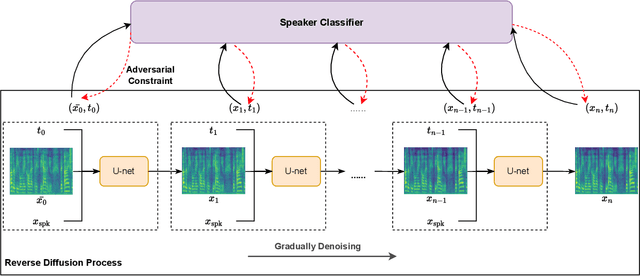
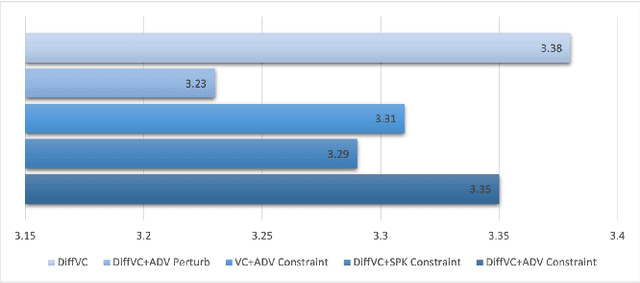
Being a form of biometric identification, the security of the speaker identification (SID) system is of utmost importance. To better understand the robustness of SID systems, we aim to perform more realistic attacks in SID, which are challenging for both humans and machines to detect. In this study, we propose DiffAttack, a novel timbre-reserved adversarial attack approach that exploits the capability of a diffusion-based voice conversion (DiffVC) model to generate adversarial fake audio with distinct target speaker attribution. By introducing adversarial constraints into the generative process of the diffusion-based voice conversion model, we craft fake samples that effectively mislead target models while preserving speaker-wise characteristics. Specifically, inspired by the use of randomly sampled Gaussian noise in conventional adversarial attacks and diffusion processes, we incorporate adversarial constraints into the reverse diffusion process. These constraints subtly guide the reverse diffusion process toward aligning with the target speaker distribution. Our experiments on the LibriTTS dataset indicate that DiffAttack significantly improves the attack success rate compared to vanilla DiffVC and other methods. Moreover, objective and subjective evaluations demonstrate that introducing adversarial constraints does not compromise the speech quality generated by the DiffVC model.