 Add to Chrome
 Add to Firefox
 Add to Edge
Game Theory Driven Multi-Agent Framework Mitigates Language Model Hallucination
Jul 09, 2026
The application of lightweight Large Language Models in rule-based scientific domains remains severely limited by their tendency to mimic linguistic patterns rather than reproduce axiomatic reasoning, causing frequent hallucinations. Here, we show that G-Frame, an adaptive multi-agent framework integrating Bayesian and team game principles, establishes an automated closed-loop for high-quality data synthesis and model training. By forcing the internalization of domain constraints through structured reasoning, we synthesized a specialized corpus of 363,045 chains-of-thought and 199,589 question-answer pairs. The resulting 7B model OmniChem achieves performance parity with GPT 4o mini on custom benchmarks and ChemBench while exhibiting a 79.46% reduction in hallucinations relative to its base architecture. We further demonstrate the advanced capabilities of OmniChem in molecular design and synthesis planning. This work establishes a scalable paradigm utilizing adaptive multi-agents to overcome inherent reasoning deficiencies, offering a feasible pathway for accelerating knowledge discovery in specialized scientific fields.

Optimal Auction Design in the Joint Advertising
Jul 10, 2025Online advertising is a vital revenue source for major internet platforms. Recently, joint advertising, which assigns a bundle of two advertisers in an ad slot instead of allocating a single advertiser, has emerged as an effective method for enhancing allocation efficiency and revenue. However, existing mechanisms for joint advertising fail to realize the optimality, as they tend to focus on individual advertisers and overlook bundle structures. This paper identifies an optimal mechanism for joint advertising in a single-slot setting. For multi-slot joint advertising, we propose \textbf{BundleNet}, a novel bundle-based neural network approach specifically designed for joint advertising. Our extensive experiments demonstrate that the mechanisms generated by \textbf{BundleNet} approximate the theoretical analysis results in the single-slot setting and achieve state-of-the-art performance in the multi-slot setting. This significantly increases platform revenue while ensuring approximate dominant strategy incentive compatibility and individual rationality.
Transfer Learning for Activity Recognition in Mobile Health
Jul 12, 2020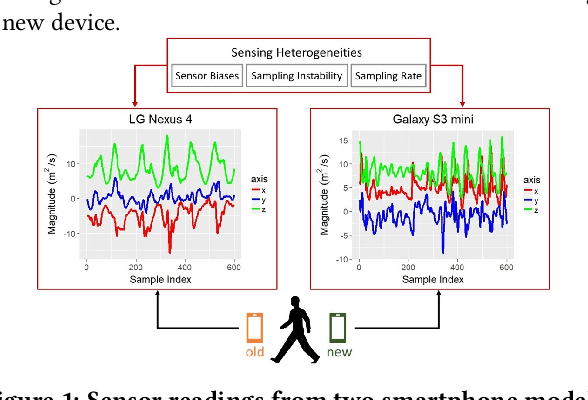
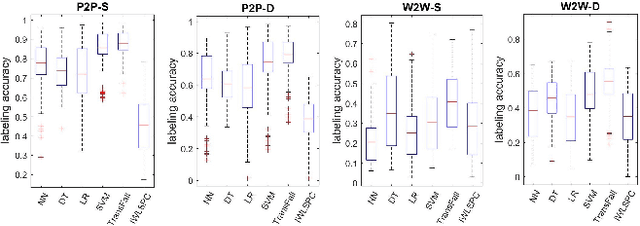
While activity recognition from inertial sensors holds potential for mobile health, differences in sensing platforms and user movement patterns cause performance degradation. Aiming to address these challenges, we propose a transfer learning framework, TransFall, for sensor-based activity recognition. TransFall's design contains a two-tier data transformation, a label estimation layer, and a model generation layer to recognize activities for the new scenario. We validate TransFall analytically and empirically.