 Add to Chrome
 Add to Firefox
 Add to Edge
InterPruner: Interactive Structured Pruning via Taylor-Implicit Criterion and Language-Prior Modulator for Multimodal Object Detection
Aug 11, 2026
Multimodal object detection proves effective in remote sensing, especially the RGB-Infrared paradigm. The parallel feature extractors provide rich multimodal information for robust detection, yet introduce substantial channel redundancy and computational overhead. Existing pruning methods can reduce channel redundancy, but they are designed for unimodal backbones, overlooking cross-modal interactions and dynamic scene-wise redundancy. In this paper, we propose InterPruner, the first interactive structured channel pruning framework for RGB-infrared object detectors. Specifically, we first derive a Taylor-Implicit Criterion(TIC) to quantify channel importance via high-order Taylor expansion and the implicit function theorem. Then, a Modality Interaction Redundancy Analyzer (MIRA) identifies redundant channels via mutual compensability assessment. Finally, a Scene-Prior Channel Anchor (SPCA) uses language priors as semantic anchors to measure channel-scene relevance for dynamic channel importance estimation. Cross-modality channel pruning for RGB-Infrared detection is yet unexplored. Extensive experiments on RGB-infrared object detection dataset demonstrate that InterPruner maintains high performance with negligible degradation. Specifically, it even achieves a 0.6% mAP increase on the FLIR dataset when pruning 50% of the channels. Code will be available on GitHub to facilitate future work.

Bridging Severe Cross-Modal Misalignment: End-to-End Visible-Infrared Object Detection via Explicit Feature-Domain Affine Registration
Aug 11, 2026Visible-infrared object detection relies on complementary RGB and thermal cues, but its performance is often degraded by cross-modal spatial misalignment. Most existing methods rely on implicit feature adaptation to handle weakly misaligned scenarios, while large-offset geometric discrepancies remain insufficiently addressed. In this paper, we propose a Joint Feature-domain Registration and Detection network (JFRDet), an end-to-end visible-infrared oriented object detector tailored for severely cross-modal geometric discrepancies. JFRDet introduces a Cross-Modal Affine Alignment (CMAA) module to estimate an image-level affine transformation for explicit multi-level feature alignment. Note that illumination changes directly affect the reliability of RGB cues, an Illumination-Guided Complementary Fusion (IGCF) module adaptively exploits modality reliability under varying illumination conditions for cross-modal fusion. Then, an Alignment Quality-Consistency Gating (AQCG) strategy stabilizes joint optimization by modulating detection supervision according to alignment reliability and gradient consistency. We further construct DroneVehicle Misaligned (DVMA), a benchmark for evaluating visible-infrared oriented object detection under severe cross-modal geometric misalignment. The proposed JFRDet achieves 69.7\% $\mathrm{mAP}_{50}$ on DVMA, which represents state-of-the-art (SOTA) performance. The code and dataset will be available on GitHub.
DA-NBV: A Direction-Aware Next-Best-View Planner for Efficient 3D Reconstruction of Ships at Sea
Aug 08, 2026Accurate 3D reconstruction of ships at sea is important for maritime supervision, damage assessment, and autonomous maritime operations. Although 3D reconstruction has advanced considerably, high-quality data acquisition still largely relies on manually designed trajectories or skilled operators, resulting in high costs and limited scalability. Next-best-view (NBV) planning automates this process by selecting subsequent viewpoints based on the current state. However, existing NBV policies mainly model spatial occupancy while overlooking directional observation history. This limitation is particularly problematic for ships: their complex superstructures and severe self-occlusions require observations from multiple viewpoints, and insufficient directional coverage often yields incomplete reconstructions. These challenges are further amplified at sea, where wave-induced heave, roll, and pitch continuously alter the ship's pose and surface visibility. Meanwhile, wind disturbances and limited onboard power impose stricter requirements on scanning efficiency. To address these challenges, we propose DA-NBV, a direction-aware NBV policy that augments the conventional occupancy state with directional observation statistics. We introduce a learnable Position Advantage Field (PAF) that uses directional information to guide viewpoint selection. The policy further adopts a locally constrained action space and a nonlinear coverage-shaping reward to improve scanning efficiency. We also develop the ship-oriented SeaShip-3D dataset and a configurable sea-state simulation environment. Experiments under varying heave, roll, and pitch conditions show that DA-NBV improves reconstruction completeness by approximately 3 percentage points and reduces Chamfer distance by 43% while achieving higher path efficiency.
Geometry Meets Semantics: Fractional Gradient Stabilization for Semantic-Driven Bounding Box Optimization in Visual Detection Tasks
Jul 26, 2026Bounding boxes are fundamental for object localization in visual detection tasks. Among them, oriented bounding boxes are widely used in visual detection tasks, which provide a more precise directional representation. Generally, IoU-based losses are widely adopted to optimize box regression. However, we observed that IoU-driven box optimization suffers from two key issues: (1) it relies solely on geometric properties while ignoring semantic cues; (2) orientation optimization suffers from unstable gradients, causing oscillations in orientation convergence. In this paper, we propose a Fractional Semantic IoU loss to achieve unified semantic-geometric learning with gradient stabilization. First, we design a semantic similarity metric to guide IoU optimization, building a Semantic IoU loss (SIoU loss) with an adaptive gradient gating mechanism. Then, we revisit the gradient instability issue in oriented box optimization and extend the SIoU loss to a fractional-order formulation to build the \textbf{Fr}actional \textbf{S}emantic \textbf{IoU} \textbf{loss} (FrSIoU loss). The FrSIoU loss accumulates historical IoU states to regularize abnormal gradients during bounding box optimization process. Extensive experiments demonstrate that our approach achieves stable performance gains across different bounding box formulations and diverse visual detection tasks. The code will be available on GitHub.
Prompt-Calibrated SAM 3 for Open-Vocabulary Remote Sensing Semantic Segmentation
Jun 20, 2026Open-vocabulary semantic segmentation (OVSS) in remote sensing images aims to segment categories beyond a fixed label space. Recent SAM 3-based methods provide a promising training-free foundation, yet three key issues remain: (1) a single class-name prompt lacks sufficient semantic coverage for complex remote sensing categories; (2) expanding each category into multiple prompts introduces redundant online text encoding; and (3) directly aggregating multiple prompt responses propagates noisy activations into the final prediction. To address these issues, we propose ProC-SAM3, which calibrates SAM 3's prompt interface for remote sensing OVSS from three complementary aspects. First, we construct an offline prompt pool where a Category Matcher groups MLLM-generated candidates into per-category sets, and Expansion Constraints further refine each set using category-specific prior knowledge. Second, the resulting text embeddings are cached and reused across all test images, eliminating repeated text encoding. Third, we introduce Presence-Guided Residual Fusion to gate unreliable decoder outputs by prompt presence and confidence, followed by peak-preserving class aggregation that retains fine-grained activations for small and sparse objects. Experiments on eight benchmarks show that ProC-SAM3 achieves an average mIoU of 56.1%, outperforming the previous best training-free method by 3.9 percentage points. Code will be available at https://github.com/YanghuiSong/ProC-SAM3.
ProCLIP: Progressive Vision-Language Alignment via LLM-based Embedder
Oct 22, 2025The original CLIP text encoder is limited by a maximum input length of 77 tokens, which hampers its ability to effectively process long texts and perform fine-grained semantic understanding. In addition, the CLIP text encoder lacks support for multilingual inputs. All these limitations significantly restrict its applicability across a broader range of tasks. Recent studies have attempted to replace the CLIP text encoder with an LLM-based embedder to enhance its ability in processing long texts, multilingual understanding, and fine-grained semantic comprehension. However, because the representation spaces of LLMs and the vision-language space of CLIP are pretrained independently without alignment priors, direct alignment using contrastive learning can disrupt the intrinsic vision-language alignment in the CLIP image encoder, leading to an underutilization of the knowledge acquired during pre-training. To address this challenge, we propose ProCLIP, a curriculum learning-based progressive vision-language alignment framework to effectively align the CLIP image encoder with an LLM-based embedder. Specifically, ProCLIP first distills knowledge from CLIP's text encoder into the LLM-based embedder to leverage CLIP's rich pretrained knowledge while establishing initial alignment between the LLM embedder and CLIP image encoder. Subsequently, ProCLIP further aligns the CLIP image encoder with the LLM-based embedder through image-text contrastive tuning, employing self-distillation regularization to avoid overfitting. To achieve a more effective alignment, instance semantic alignment loss and embedding structure alignment loss are employed during representation inheritance and contrastive tuning. The Code is available at https://github.com/VisionXLab/ProCLIP.
OsmLocator: locating overlapping scatter marks with a non-training generative perspective
Dec 22, 2023Automated mark localization in scatter images, greatly helpful for discovering knowledge and understanding enormous document images and reasoning in visual question answering AI systems, is a highly challenging problem because of the ubiquity of overlapping marks. Locating overlapping marks faces many difficulties such as no texture, less contextual information, hallow shape and tiny size. Here, we formulate it as a combinatorial optimization problem on clustering-based re-visualization from a non-training generative perspective, to locate scatter marks by finding the status of multi-variables when an objective function reaches a minimum. The objective function is constructed on difference between binarized scatter images and corresponding generated re-visualization based on their clustering. Fundamentally, re-visualization tries to generate a new scatter graph only taking a rasterized scatter image as an input, and clustering is employed to provide the information for such re-visualization. This method could stably locate severely-overlapping, variable-size and variable-shape marks in scatter images without dependence of any training dataset or reference. Meanwhile, we propose an adaptive variant of simulated annealing which can works on various connected regions. In addition, we especially built a dataset named SML2023 containing hundreds of scatter images with different markers and various levels of overlapping severity, and tested the proposed method and compared it to existing methods. The results show that it can accurately locate most marks in scatter images with different overlapping severity and marker types, with about 0.3 absolute increase on an assignment-cost-based metric in comparison with state-of-the-art methods. This work is of value to data mining on massive web pages and literatures, and shedding new light on image measurement such as bubble counting.
Oriented Feature Alignment for Fine-grained Object Recognition in High-Resolution Satellite Imagery
Oct 13, 2021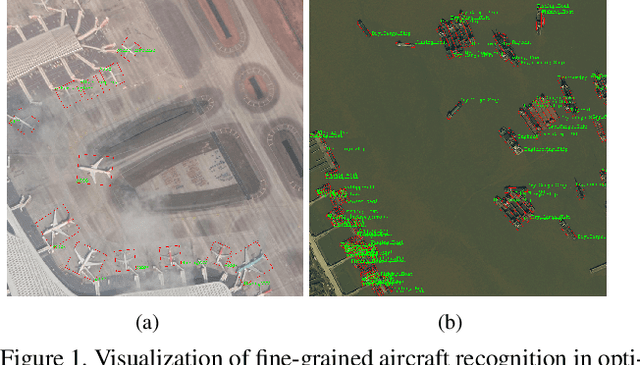
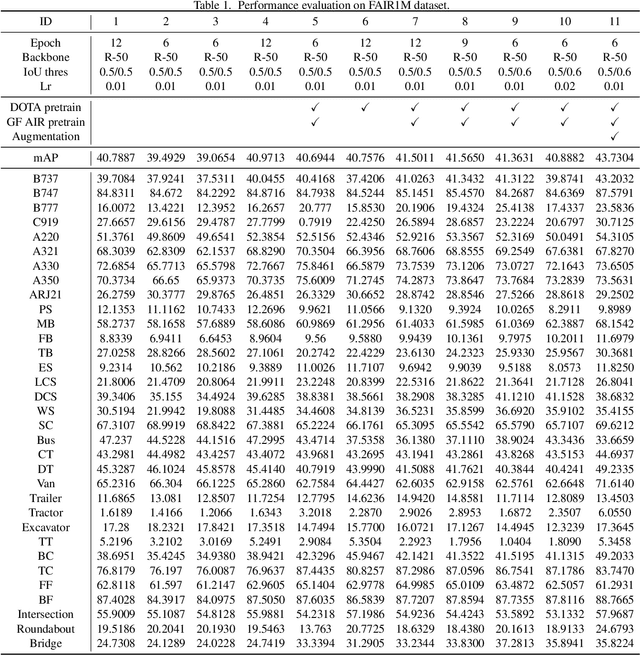
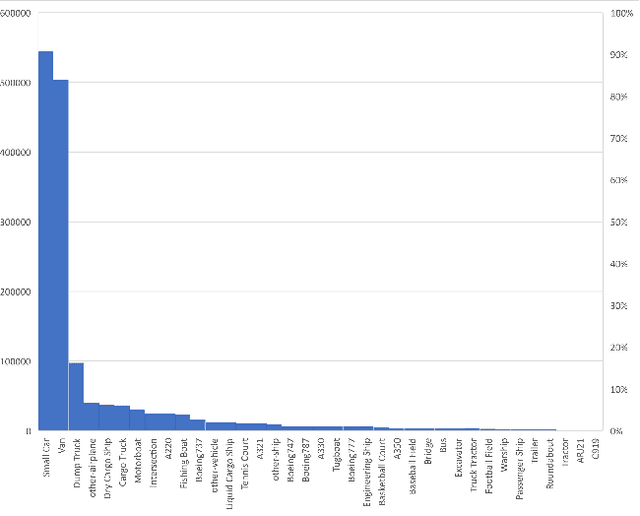
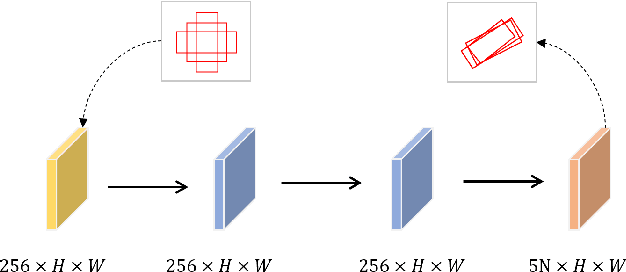
Oriented object detection in remote sensing images has made great progress in recent years. However, most of the current methods only focus on detecting targets, and cannot distinguish fine-grained objects well in complex scenes. In this technical report, we analyzed the key issues of fine-grained object recognition, and use an oriented feature alignment network (OFA-Net) to achieve high-performance fine-grained oriented object recognition in optical remote sensing images. OFA-Net achieves accurate object localization through a rotated bounding boxes refinement module. On this basis, the boundary-constrained rotation feature alignment module is applied to achieve local feature extraction, which is beneficial to fine-grained object classification. The single model of our method achieved mAP of 46.51\% in the GaoFen competition and won 3rd place in the ISPRS benchmark with the mAP of 43.73\%.
AdaL: Adaptive Gradient Transformation Contributes to Convergences and Generalizations
Jul 04, 2021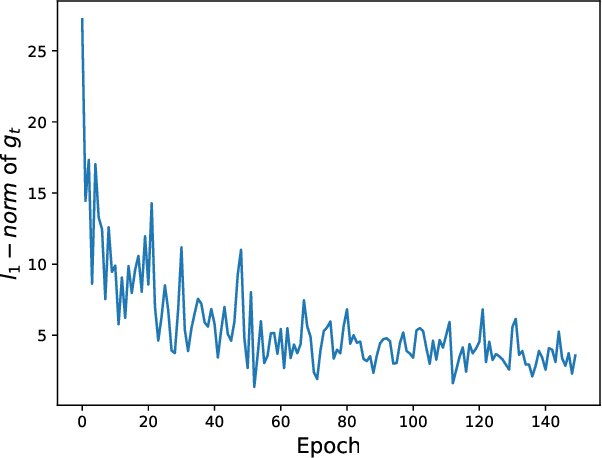
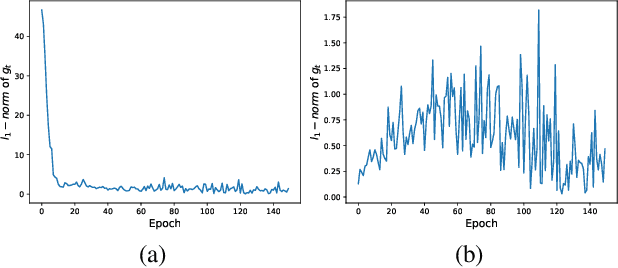
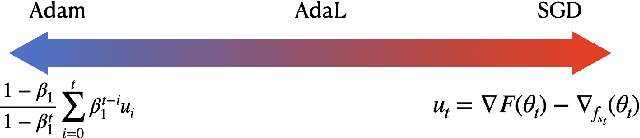
Adaptive optimization methods have been widely used in deep learning. They scale the learning rates adaptively according to the past gradient, which has been shown to be effective to accelerate the convergence. However, they suffer from poor generalization performance compared with SGD. Recent studies point that smoothing exponential gradient noise leads to generalization degeneration phenomenon. Inspired by this, we propose AdaL, with a transformation on the original gradient. AdaL accelerates the convergence by amplifying the gradient in the early stage, as well as dampens the oscillation and stabilizes the optimization by shrinking the gradient later. Such modification alleviates the smoothness of gradient noise, which produces better generalization performance. We have theoretically proved the convergence of AdaL and demonstrated its effectiveness on several benchmarks.
Learning High-Precision Bounding Box for Rotated Object Detection via Kullback-Leibler Divergence
Jun 04, 2021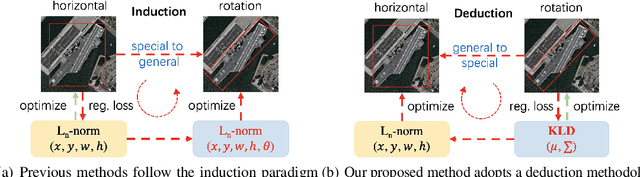
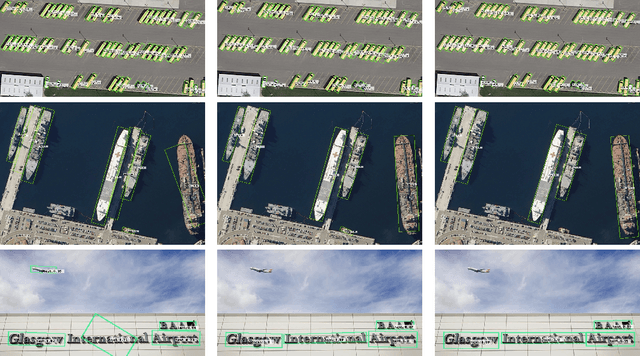
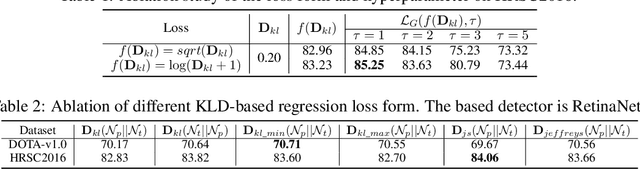
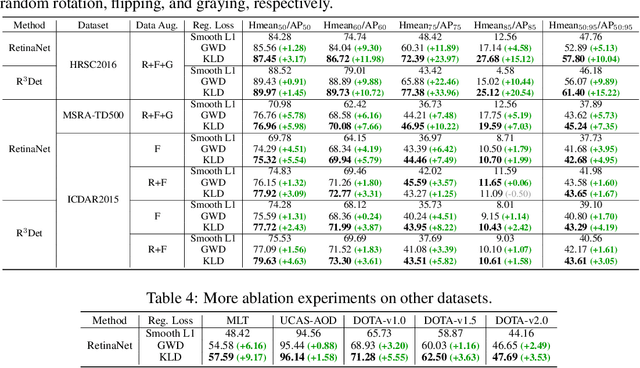
Existing rotated object detectors are mostly inherited from the horizontal detection paradigm, as the latter has evolved into a well-developed area. However, these detectors are difficult to perform prominently in high-precision detection due to the limitation of current regression loss design, especially for objects with large aspect ratios. Taking the perspective that horizontal detection is a special case for rotated object detection, in this paper, we are motivated to change the design of rotation regression loss from induction paradigm to deduction methodology, in terms of the relation between rotation and horizontal detection. We show that one essential challenge is how to modulate the coupled parameters in the rotation regression loss, as such the estimated parameters can influence to each other during the dynamic joint optimization, in an adaptive and synergetic way. Specifically, we first convert the rotated bounding box into a 2-D Gaussian distribution, and then calculate the Kullback-Leibler Divergence (KLD) between the Gaussian distributions as the regression loss. By analyzing the gradient of each parameter, we show that KLD (and its derivatives) can dynamically adjust the parameter gradients according to the characteristics of the object. It will adjust the importance (gradient weight) of the angle parameter according to the aspect ratio. This mechanism can be vital for high-precision detection as a slight angle error would cause a serious accuracy drop for large aspect ratios objects. More importantly, we have proved that KLD is scale invariant. We further show that the KLD loss can be degenerated into the popular $l_{n}$-norm loss for horizontal detection. Experimental results on seven datasets using different detectors show its consistent superiority, and codes are available at https://github.com/yangxue0827/RotationDetection.