 Add to Chrome
 Add to Firefox
 Add to Edge
InterPruner: Interactive Structured Pruning via Taylor-Implicit Criterion and Language-Prior Modulator for Multimodal Object Detection
Aug 11, 2026
Multimodal object detection proves effective in remote sensing, especially the RGB-Infrared paradigm. The parallel feature extractors provide rich multimodal information for robust detection, yet introduce substantial channel redundancy and computational overhead. Existing pruning methods can reduce channel redundancy, but they are designed for unimodal backbones, overlooking cross-modal interactions and dynamic scene-wise redundancy. In this paper, we propose InterPruner, the first interactive structured channel pruning framework for RGB-infrared object detectors. Specifically, we first derive a Taylor-Implicit Criterion(TIC) to quantify channel importance via high-order Taylor expansion and the implicit function theorem. Then, a Modality Interaction Redundancy Analyzer (MIRA) identifies redundant channels via mutual compensability assessment. Finally, a Scene-Prior Channel Anchor (SPCA) uses language priors as semantic anchors to measure channel-scene relevance for dynamic channel importance estimation. Cross-modality channel pruning for RGB-Infrared detection is yet unexplored. Extensive experiments on RGB-infrared object detection dataset demonstrate that InterPruner maintains high performance with negligible degradation. Specifically, it even achieves a 0.6% mAP increase on the FLIR dataset when pruning 50% of the channels. Code will be available on GitHub to facilitate future work.

Vision-Language Model for Object Detection and Segmentation: A Review and Evaluation
Apr 13, 2025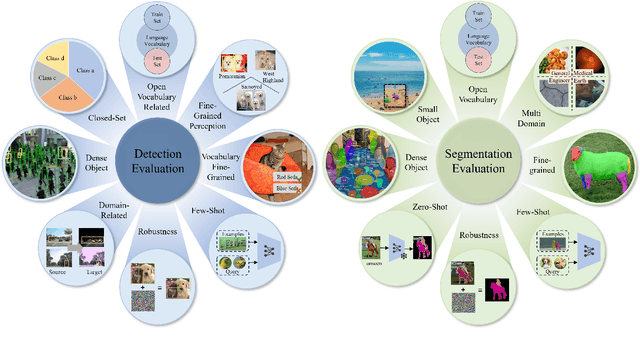
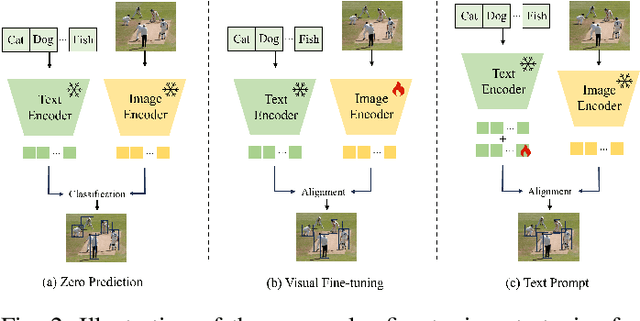
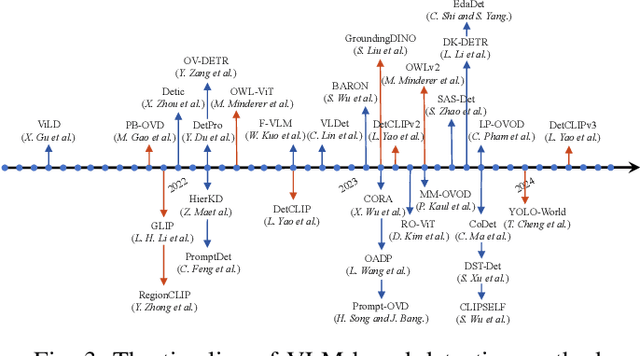
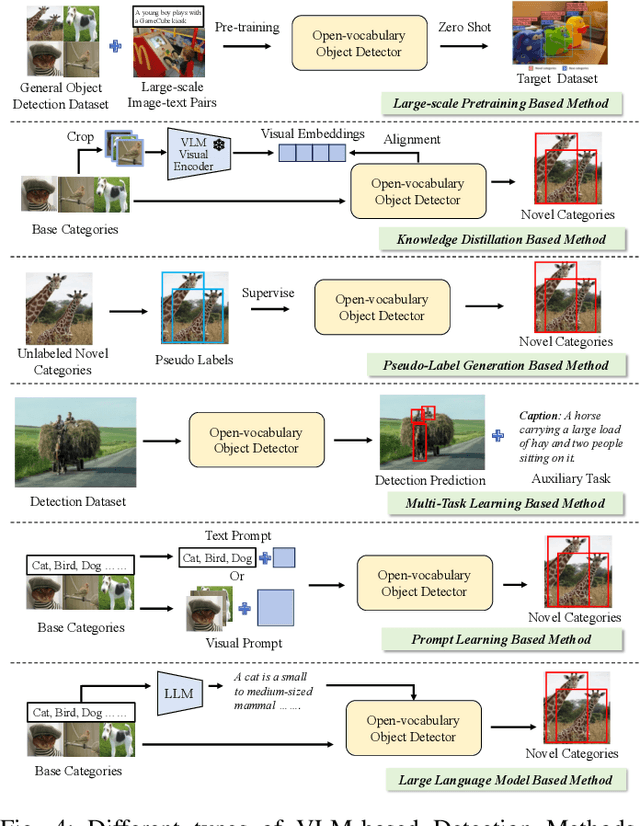
Vision-Language Model (VLM) have gained widespread adoption in Open-Vocabulary (OV) object detection and segmentation tasks. Despite they have shown promise on OV-related tasks, their effectiveness in conventional vision tasks has thus far been unevaluated. In this work, we present the systematic review of VLM-based detection and segmentation, view VLM as the foundational model and conduct comprehensive evaluations across multiple downstream tasks for the first time: 1) The evaluation spans eight detection scenarios (closed-set detection, domain adaptation, crowded objects, etc.) and eight segmentation scenarios (few-shot, open-world, small object, etc.), revealing distinct performance advantages and limitations of various VLM architectures across tasks. 2) As for detection tasks, we evaluate VLMs under three finetuning granularities: \textit{zero prediction}, \textit{visual fine-tuning}, and \textit{text prompt}, and further analyze how different finetuning strategies impact performance under varied task. 3) Based on empirical findings, we provide in-depth analysis of the correlations between task characteristics, model architectures, and training methodologies, offering insights for future VLM design. 4) We believe that this work shall be valuable to the pattern recognition experts working in the fields of computer vision, multimodal learning, and vision foundation models by introducing them to the problem, and familiarizing them with the current status of the progress while providing promising directions for future research. A project associated with this review and evaluation has been created at https://github.com/better-chao/perceptual_abilities_evaluation.