 Add to Chrome
 Add to Firefox
 Add to Edge
Bridging Severe Cross-Modal Misalignment: End-to-End Visible-Infrared Object Detection via Explicit Feature-Domain Affine Registration
Aug 11, 2026
Visible-infrared object detection relies on complementary RGB and thermal cues, but its performance is often degraded by cross-modal spatial misalignment. Most existing methods rely on implicit feature adaptation to handle weakly misaligned scenarios, while large-offset geometric discrepancies remain insufficiently addressed. In this paper, we propose a Joint Feature-domain Registration and Detection network (JFRDet), an end-to-end visible-infrared oriented object detector tailored for severely cross-modal geometric discrepancies. JFRDet introduces a Cross-Modal Affine Alignment (CMAA) module to estimate an image-level affine transformation for explicit multi-level feature alignment. Note that illumination changes directly affect the reliability of RGB cues, an Illumination-Guided Complementary Fusion (IGCF) module adaptively exploits modality reliability under varying illumination conditions for cross-modal fusion. Then, an Alignment Quality-Consistency Gating (AQCG) strategy stabilizes joint optimization by modulating detection supervision according to alignment reliability and gradient consistency. We further construct DroneVehicle Misaligned (DVMA), a benchmark for evaluating visible-infrared oriented object detection under severe cross-modal geometric misalignment. The proposed JFRDet achieves 69.7\% $\mathrm{mAP}_{50}$ on DVMA, which represents state-of-the-art (SOTA) performance. The code and dataset will be available on GitHub.

InterPruner: Interactive Structured Pruning via Taylor-Implicit Criterion and Language-Prior Modulator for Multimodal Object Detection
Aug 11, 2026Multimodal object detection proves effective in remote sensing, especially the RGB-Infrared paradigm. The parallel feature extractors provide rich multimodal information for robust detection, yet introduce substantial channel redundancy and computational overhead. Existing pruning methods can reduce channel redundancy, but they are designed for unimodal backbones, overlooking cross-modal interactions and dynamic scene-wise redundancy. In this paper, we propose InterPruner, the first interactive structured channel pruning framework for RGB-infrared object detectors. Specifically, we first derive a Taylor-Implicit Criterion(TIC) to quantify channel importance via high-order Taylor expansion and the implicit function theorem. Then, a Modality Interaction Redundancy Analyzer (MIRA) identifies redundant channels via mutual compensability assessment. Finally, a Scene-Prior Channel Anchor (SPCA) uses language priors as semantic anchors to measure channel-scene relevance for dynamic channel importance estimation. Cross-modality channel pruning for RGB-Infrared detection is yet unexplored. Extensive experiments on RGB-infrared object detection dataset demonstrate that InterPruner maintains high performance with negligible degradation. Specifically, it even achieves a 0.6% mAP increase on the FLIR dataset when pruning 50% of the channels. Code will be available on GitHub to facilitate future work.
eX-ViT: A Novel eXplainable Vision Transformer for Weakly Supervised Semantic Segmentation
Jul 12, 2022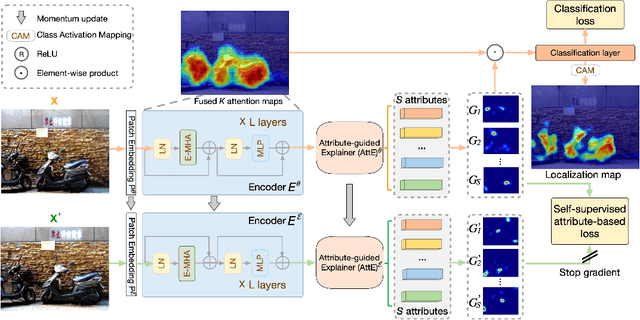
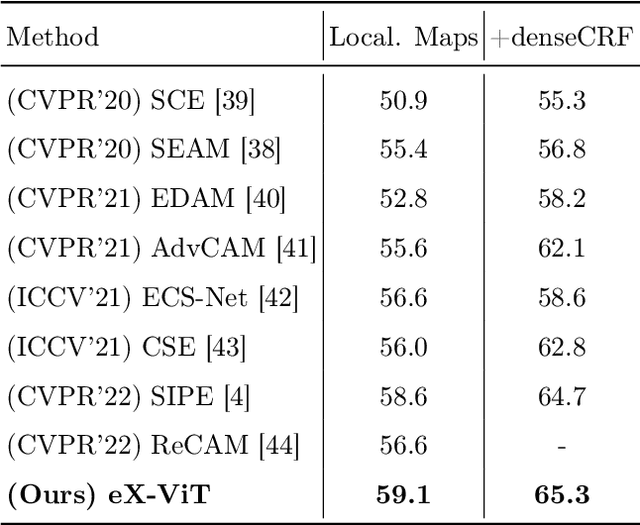
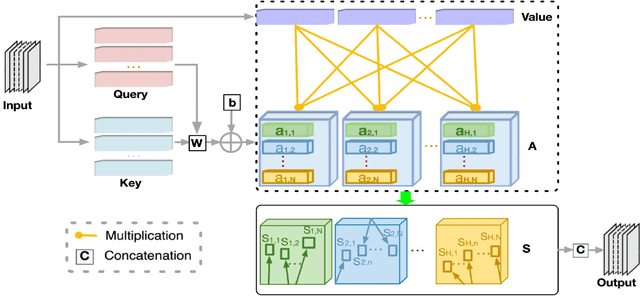
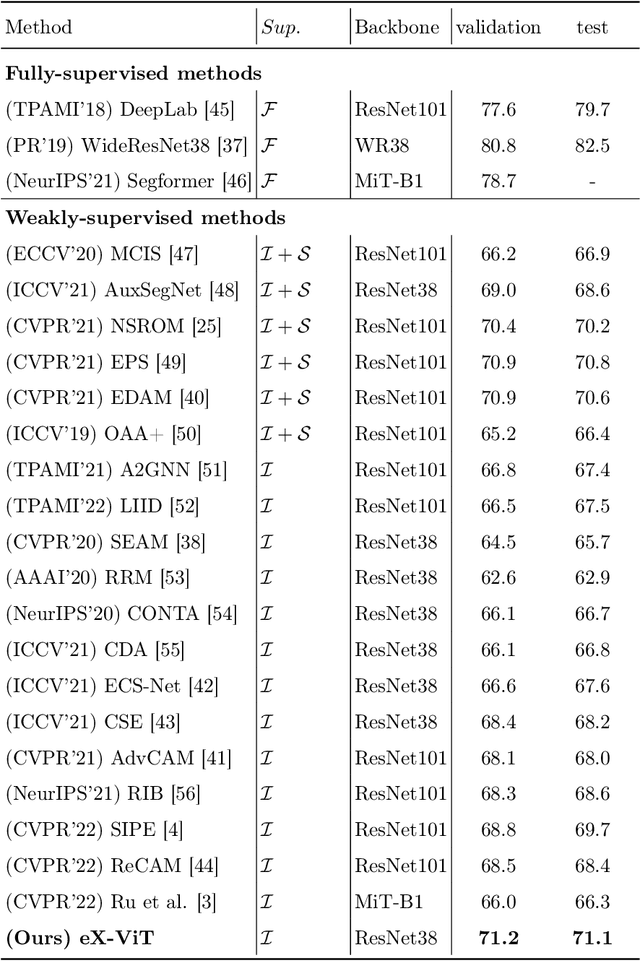
Recently vision transformer models have become prominent models for a range of vision tasks. These models, however, are usually opaque with weak feature interpretability. Moreover, there is no method currently built for an intrinsically interpretable transformer, which is able to explain its reasoning process and provide a faithful explanation. To close these crucial gaps, we propose a novel vision transformer dubbed the eXplainable Vision Transformer (eX-ViT), an intrinsically interpretable transformer model that is able to jointly discover robust interpretable features and perform the prediction. Specifically, eX-ViT is composed of the Explainable Multi-Head Attention (E-MHA) module, the Attribute-guided Explainer (AttE) module and the self-supervised attribute-guided loss. The E-MHA tailors explainable attention weights that are able to learn semantically interpretable representations from local patches in terms of model decisions with noise robustness. Meanwhile, AttE is proposed to encode discriminative attribute features for the target object through diverse attribute discovery, which constitutes faithful evidence for the model's predictions. In addition, a self-supervised attribute-guided loss is developed for our eX-ViT, which aims at learning enhanced representations through the attribute discriminability mechanism and attribute diversity mechanism, to localize diverse and discriminative attributes and generate more robust explanations. As a result, we can uncover faithful and robust interpretations with diverse attributes through the proposed eX-ViT.