 Add to Chrome
 Add to Firefox
 Add to Edge
Prompt-Calibrated SAM 3 for Open-Vocabulary Remote Sensing Semantic Segmentation
Jun 20, 2026
Open-vocabulary semantic segmentation (OVSS) in remote sensing images aims to segment categories beyond a fixed label space. Recent SAM 3-based methods provide a promising training-free foundation, yet three key issues remain: (1) a single class-name prompt lacks sufficient semantic coverage for complex remote sensing categories; (2) expanding each category into multiple prompts introduces redundant online text encoding; and (3) directly aggregating multiple prompt responses propagates noisy activations into the final prediction. To address these issues, we propose ProC-SAM3, which calibrates SAM 3's prompt interface for remote sensing OVSS from three complementary aspects. First, we construct an offline prompt pool where a Category Matcher groups MLLM-generated candidates into per-category sets, and Expansion Constraints further refine each set using category-specific prior knowledge. Second, the resulting text embeddings are cached and reused across all test images, eliminating repeated text encoding. Third, we introduce Presence-Guided Residual Fusion to gate unreliable decoder outputs by prompt presence and confidence, followed by peak-preserving class aggregation that retains fine-grained activations for small and sparse objects. Experiments on eight benchmarks show that ProC-SAM3 achieves an average mIoU of 56.1%, outperforming the previous best training-free method by 3.9 percentage points. Code will be available at https://github.com/YanghuiSong/ProC-SAM3.

Looped World Models
Jun 16, 2026Current world models face a fundamental tension: faithful long-horizon simulation demands deep computation, but deeper models are expensive to deploy and prone to compounding errors. We resolve this by introducing Looped World Models (LoopWM), which are the first looped architectures for world modelling. Our method iteratively refines latent environment states through a parameter-shared transformer block. This yield up to 100x parameter efficiency over conventional approaches with adaptive computation that automatically scales depth to match the complexity of each prediction step. Orthogonal to scaling model size and training data, LoopWM establishes iterative latent depth as a new scaling axis for world simulation, which might significantly push the community forward.
Fragile Preferences: A Deep Dive Into Order Effects in Large Language Models
Jun 17, 2025Large language models (LLMs) are increasingly used in decision-support systems across high-stakes domains such as hiring and university admissions, where decisions often involve selecting among competing alternatives. While prior work has noted positional order biases in LLM-driven comparisons, these biases have not been systematically dissected or linked to underlying preference structures. We provide the first comprehensive investigation of positional biases across multiple LLM architectures and domains, uncovering strong and consistent order effects, including a novel centrality bias not previously documented in human or machine decision-making. We also find a quality-dependent shift: when options are high quality, models exhibit primacy bias, but favor latter options when option quality is low. We further identify a previously undocumented bias favoring certain names over others. To distinguish superficial tie-breaking from true distortions of judgment, we introduce a framework that classifies pairwise preferences as robust, fragile, or indifferent. We show that order effects can lead models to select strictly inferior options, and that positional biases are typically stronger than gender biases. These findings suggest that LLMs are not merely inheriting human-like biases, but exhibit distinct failure modes not seen in human decision-making. We propose targeted mitigation strategies, including a novel use of the temperature parameter, to reduce order-driven distortions.
Semantic-Rearrangement-Based Multi-Level Alignment for Domain Generalized Segmentation
Apr 21, 2024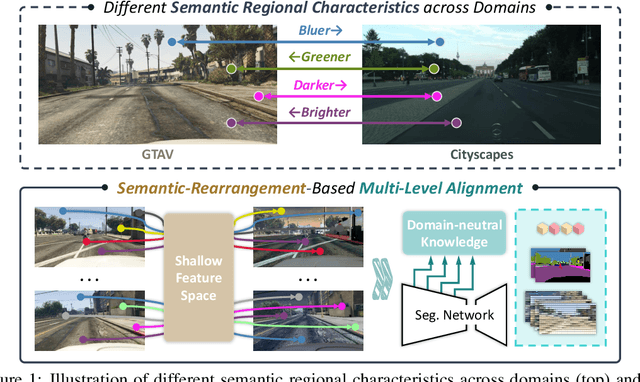
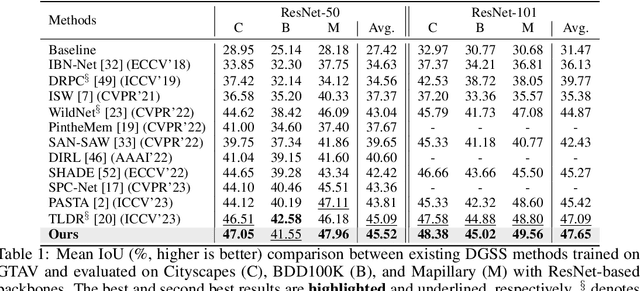
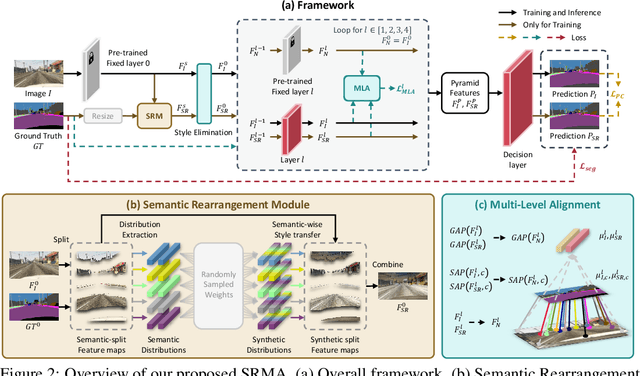

Domain generalized semantic segmentation is an essential computer vision task, for which models only leverage source data to learn the capability of generalized semantic segmentation towards the unseen target domains. Previous works typically address this challenge by global style randomization or feature regularization. In this paper, we argue that given the observation that different local semantic regions perform different visual characteristics from the source domain to the target domain, methods focusing on global operations are hard to capture such regional discrepancies, thus failing to construct domain-invariant representations with the consistency from local to global level. Therefore, we propose the Semantic-Rearrangement-based Multi-Level Alignment (SRMA) to overcome this problem. SRMA first incorporates a Semantic Rearrangement Module (SRM), which conducts semantic region randomization to enhance the diversity of the source domain sufficiently. A Multi-Level Alignment module (MLA) is subsequently proposed with the help of such diversity to establish the global-regional-local consistent domain-invariant representations. By aligning features across randomized samples with domain-neutral knowledge at multiple levels, SRMA provides a more robust way to handle the source-target domain gap. Extensive experiments demonstrate the superiority of SRMA over the current state-of-the-art works on various benchmarks.
LafitE: Latent Diffusion Model with Feature Editing for Unsupervised Multi-class Anomaly Detection
Jul 16, 2023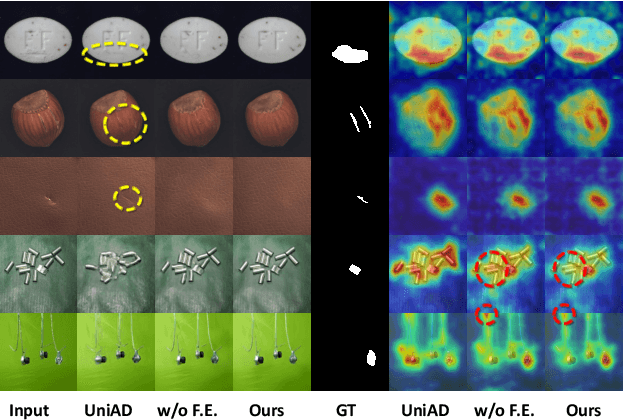
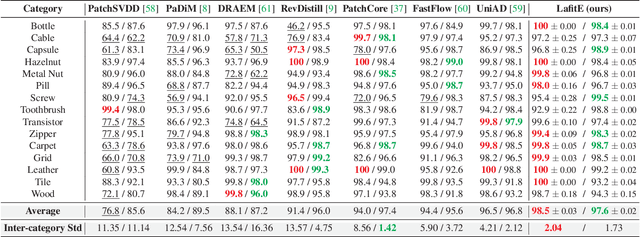
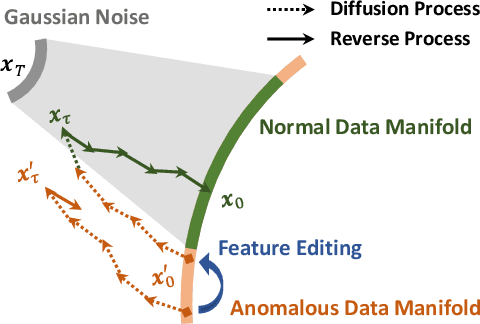
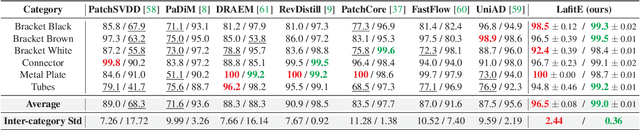
In the context of flexible manufacturing systems that are required to produce different types and quantities of products with minimal reconfiguration, this paper addresses the problem of unsupervised multi-class anomaly detection: develop a unified model to detect anomalies from objects belonging to multiple classes when only normal data is accessible. We first explore the generative-based approach and investigate latent diffusion models for reconstruction to mitigate the notorious ``identity shortcut'' issue in auto-encoder based methods. We then introduce a feature editing strategy that modifies the input feature space of the diffusion model to further alleviate ``identity shortcuts'' and meanwhile improve the reconstruction quality of normal regions, leading to fewer false positive predictions. Moreover, we are the first who pose the problem of hyperparameter selection in unsupervised anomaly detection, and propose a solution of synthesizing anomaly data for a pseudo validation set to address this problem. Extensive experiments on benchmark datasets MVTec-AD and MPDD show that the proposed LafitE, \ie, Latent Diffusion Model with Feature Editing, outperforms state-of-art methods by a significant margin in terms of average AUROC. The hyperparamters selected via our pseudo validation set are well-matched to the real test set.
Multi-Level Knowledge Distillation for Out-of-Distribution Detection in Text
Nov 21, 2022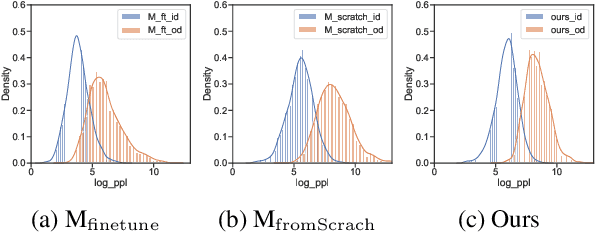
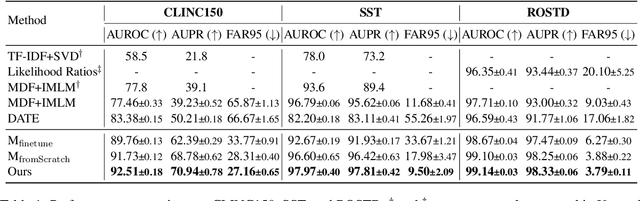
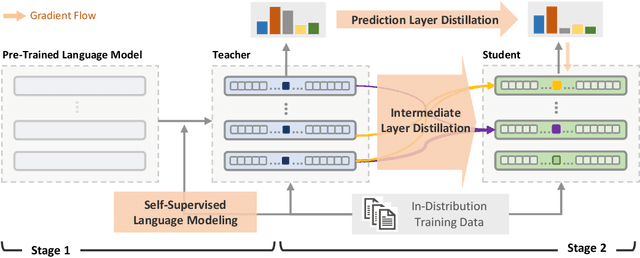
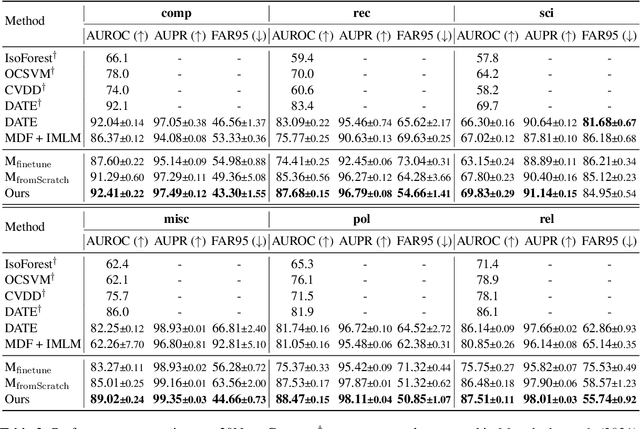
Self-supervised representation learning has proved to be a valuable component for out-of-distribution (OoD) detection with only the texts of in-distribution (ID) examples. These approaches either train a language model from scratch or fine-tune a pre-trained language model using ID examples, and then take perplexity as output by the language model as OoD scores. In this paper, we analyse the complementary characteristics of both OoD detection methods and propose a multi-level knowledge distillation approach to integrate their strengths, while mitigating their limitations. Specifically, we use a fine-tuned model as the teacher to teach a randomly initialized student model on the ID examples. Besides the prediction layer distillation, we present a similarity-based intermediate layer distillation method to facilitate the student's awareness of the information flow inside the teacher's layers. In this way, the derived student model gains the teacher's rich knowledge about the ID data manifold due to pre-training, while benefiting from seeing only ID examples during parameter learning, which promotes more distinguishable features for OoD detection. We conduct extensive experiments over multiple benchmark datasets, i.e., CLINC150, SST, 20 NewsGroups, and AG News; showing that the proposed method yields new state-of-the-art performance.