 Add to Chrome
 Add to Firefox
 Add to Edge
Prompt-Calibrated SAM 3 for Open-Vocabulary Remote Sensing Semantic Segmentation
Jun 20, 2026
Open-vocabulary semantic segmentation (OVSS) in remote sensing images aims to segment categories beyond a fixed label space. Recent SAM 3-based methods provide a promising training-free foundation, yet three key issues remain: (1) a single class-name prompt lacks sufficient semantic coverage for complex remote sensing categories; (2) expanding each category into multiple prompts introduces redundant online text encoding; and (3) directly aggregating multiple prompt responses propagates noisy activations into the final prediction. To address these issues, we propose ProC-SAM3, which calibrates SAM 3's prompt interface for remote sensing OVSS from three complementary aspects. First, we construct an offline prompt pool where a Category Matcher groups MLLM-generated candidates into per-category sets, and Expansion Constraints further refine each set using category-specific prior knowledge. Second, the resulting text embeddings are cached and reused across all test images, eliminating repeated text encoding. Third, we introduce Presence-Guided Residual Fusion to gate unreliable decoder outputs by prompt presence and confidence, followed by peak-preserving class aggregation that retains fine-grained activations for small and sparse objects. Experiments on eight benchmarks show that ProC-SAM3 achieves an average mIoU of 56.1%, outperforming the previous best training-free method by 3.9 percentage points. Code will be available at https://github.com/YanghuiSong/ProC-SAM3.

Enhancing Underwater Images via Deep Learning: A Comparative Study of VGG19 and ResNet50-Based Approaches
Aug 24, 2025This paper addresses the challenging problem of image enhancement in complex underwater scenes by proposing a solution based on deep learning. The proposed method skillfully integrates two deep convolutional neural network models, VGG19 and ResNet50, leveraging their powerful feature extraction capabilities to perform multi-scale and multi-level deep feature analysis of underwater images. By constructing a unified model, the complementary advantages of the two models are effectively integrated, achieving a more comprehensive and accurate image enhancement effect.To objectively evaluate the enhancement effect, this paper introduces image quality assessment metrics such as PSNR, UCIQE, and UIQM to quantitatively compare images before and after enhancement and deeply analyzes the performance of different models in different scenarios.Furthermore, to improve the practicality and stability of the underwater visual enhancement system, this paper also provides practical suggestions from aspects such as model optimization, multi-model fusion, and hardware selection, aiming to provide strong technical support for visual enhancement tasks in complex underwater environments.
DS_FusionNet: Dynamic Dual-Stream Fusion with Bidirectional Knowledge Distillation for Plant Disease Recognition
Apr 30, 2025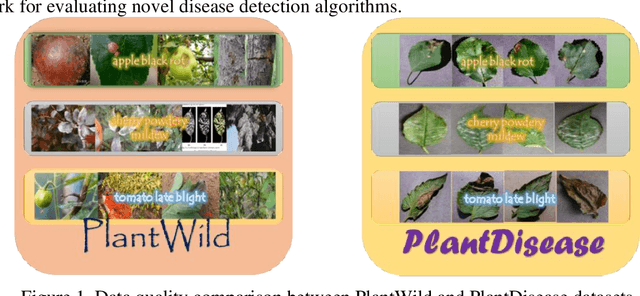
Given the severe challenges confronting the global growth security of economic crops, precise identification and prevention of plant diseases has emerged as a critical issue in artificial intelligence-enabled agricultural technology. To address the technical challenges in plant disease recognition, including small-sample learning, leaf occlusion, illumination variations, and high inter-class similarity, this study innovatively proposes a Dynamic Dual-Stream Fusion Network (DS_FusionNet). The network integrates a dual-backbone architecture, deformable dynamic fusion modules, and bidirectional knowledge distillation strategy, significantly enhancing recognition accuracy. Experimental results demonstrate that DS_FusionNet achieves classification accuracies exceeding 90% using only 10% of the PlantDisease and CIFAR-10 datasets, while maintaining 85% accuracy on the complex PlantWild dataset, exhibiting exceptional generalization capabilities. This research not only provides novel technical insights for fine-grained image classification but also establishes a robust foundation for precise identification and management of agricultural diseases.