 Add to Chrome
 Add to Firefox
 Add to Edge
Backdoor Decontamination Dynamics in LLM Agents
Aug 11, 2026
Open-weight LLM agents are vulnerable to backdoors installed during fine-tuning, which may be undetectable if the trigger conditions are never met during testing. Assuming defenders do not know the existing trigger, they cannot unlearn it directly. One decontamination strategy is to install a known backdoor (defensive poisoning) then to unlearn it, hoping that the original unknown backdoor is removed as a side effect. However, this procedure has uncertain outcomes: the original backdoor may persist or be erased or rerouted, among other possibilities. We introduce a framework for studying these dynamics in tool-calling agents, decoupling trigger, response, teacher, and fine-tuning method across systematic experiments on AgentDyn. Across 115 experiments, defensive poisoning alone erases around 56% of original backdoors; subsequent decontamination then drives almost all survivors to erasure, confirming that trigger recognition and malicious execution are behaviorally dissociable. Interestingly, our experiments find that malicious backdoors never persist when using different triggers of the same general type as the defensive backdoor when followed by decontamination via unlearning. Co-installing up to four backdoors increases resistance (around 36% erased), yet decontaminating a single known co-resident backdoor collaterally clears 52/60 co-residents (87%). Upon visualizing postdecontamination model internals using J-lens, we confirm that although the decontamination restores benign LLM responses, traces of original trigger awareness persist at intermediate layers.

PrivacyAlign: Contextual Privacy Alignment for LLM Agents
Jun 19, 2026AI agents acting on behalf of users are constantly making decisions, and for users to trust their agents, those decisions must align with what they actually want. Privacy is an important alignment problem for agents: every message, post, or tool call an agent makes is a contextual judgment about what is appropriate to share, with whom, and under which conditions. Because such judgments depend on social expectations and norms, human judgment does not merely label privacy violations but also helps define them. While existing work relies on unreliable proxies for both training and evaluation, we place human judgment at the center of agentic privacy alignment. We introduce PrivacyAlign, a dataset of 1,350 samples with 3,516 detailed annotations from 599 unique annotators across diverse scenarios where current LLMs actually leak, and use it to ground both alignment training and automated evaluation in human privacy norms. Building on these annotations, we first show that conditioning LLM judges on human annotations and explanations for reference responses to the same prompt makes their judgments more reliable. We then introduce annotation-conditioned reward modeling, which uses these annotations to score new responses during RL, and show that small open-weight agents trained with this reward better align with human privacy norms, with strong gains on PrivacyAlign and existing privacy benchmarks for agents.
MosaicLeaks:Privacy Risks in Querying-in-the-Open for Deep Research Agents
May 29, 2026Deep research agents increasingly combine private local documents with external tools like web retrieval, creating a privacy risk: an agent's external queries may leak sensitive information from its local context. This risk is amplified by the mosaic effect, where individual queries may appear harmless but become revealing in aggregate. We introduce MosaicLeaks, a benchmark of 1,001 multi-hop deep research tasks that chain private enterprise documents and a public web corpus, forcing agents to make external queries that depend on local information. We evaluate leakage with an adversary LLM that observes only the agent's external queries and attempts to infer private information at three levels: the agent's research intent, answers to specific private questions and verifiable claims about the enterprise documents. We find that models across families and sizes frequently leak at all three levels, that zero-shot privacy prompting reduces but does not eliminate leakage and that reinforcement learning for task performance alone worsens leakage. To address this, we propose Privacy-Aware Deep Research (PA-DR), an RL framework that combines situational rewards for task success with a learned privacy classifier to provide dense credit assignment over both per-query and mosaic-level leakage. Training Qwen3-4B-Instruct with PA-DR improves accuracy from 48.7% to 58.7% and reduces answer and full-information leakage from 34.0% to 9.9%.
How and What to Imagine? Visual Thinking in Unified Multimodal Models for Cross-View Spatial Reasoning
May 26, 2026Cross-view spatial reasoning remains a weak spot for vision-language models (VLMs): they often reason in language and lose the fine-grained geometry needed for the task. Thinking with images aims to address this by generating an intermediate thinking image, but recent work shows that models often ignore the visual evidence in these traces. We therefore ask how to make visual thinking matter, and what kind of visual thinking works best. We study these questions in unified multimodal models (UMMs), which natively support interleaved image-text generation. For the first question, we propose View Dropout (VDrop), a training-time intervention that hides parts of one input view from the answer span while keeping them visible to the thinking-image tokens. This encourages the model to use the thinking image when answering, instead of relying only on the input views. Once the thinking image is used for answer prediction, we study which type of visual thinking is most effective. We frame this as a learnability-informativeness tradeoff and compare three thinking-image variants: top-down, panoramic, and point-matching renderings. Trained on synthetic scenes and evaluated on five real-world out-of-domain benchmarks, panoramic visual thinking with VDrop is the only configuration that is both informative and learnable, and it achieves the best out-of-domain generalization.
Mem-$π$: Adaptive Memory through Learning When and What to Generate
May 20, 2026We present Mem-$π$, a framework for adaptive memory in large language model (LLM) agents, where useful guidance is generated on demand rather than retrieved from external memory stores. Existing memory-augmented agents typically rely on similarity-based retrieval from episodic memory banks or skill libraries, returning static entries that often misalign with the current context. In contrast, Mem-$π$ uses a dedicated language or vision-language model with its own parameters, separate from the downstream agent, to generate context-specific guidance for complex tasks. Conditioned on the current agent context, the model jointly decides when to produce guidance and what guidance to produce. We train it with a decision-content decoupled reinforcement learning (RL) objective, enabling it to abstain when generation would not help and otherwise produce concise, useful guidance. Across diverse agentic benchmarks spanning web navigation, terminal-based tool use, and text-based embodied interaction, Mem-$π$ consistently outperforms retrieval-based and prior RL-optimized memory baselines, achieving over 30% relative improvement on web navigation tasks.
Grounding Computer Use Agents on Human Demonstrations
Nov 10, 2025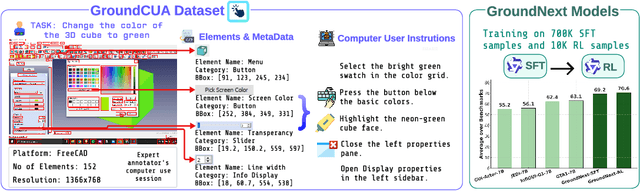
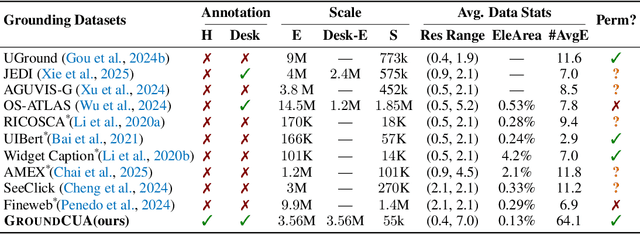
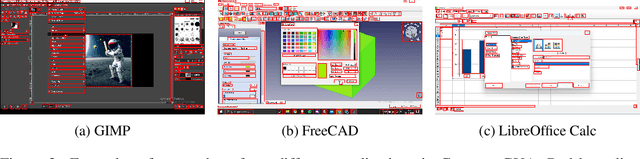
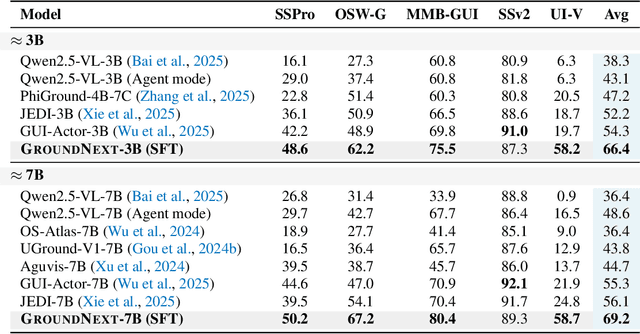
Building reliable computer-use agents requires grounding: accurately connecting natural language instructions to the correct on-screen elements. While large datasets exist for web and mobile interactions, high-quality resources for desktop environments are limited. To address this gap, we introduce GroundCUA, a large-scale desktop grounding dataset built from expert human demonstrations. It covers 87 applications across 12 categories and includes 56K screenshots, with every on-screen element carefully annotated for a total of over 3.56M human-verified annotations. From these demonstrations, we generate diverse instructions that capture a wide range of real-world tasks, providing high-quality data for model training. Using GroundCUA, we develop the GroundNext family of models that map instructions to their target UI elements. At both 3B and 7B scales, GroundNext achieves state-of-the-art results across five benchmarks using supervised fine-tuning, while requiring less than one-tenth the training data of prior work. Reinforcement learning post-training further improves performance, and when evaluated in an agentic setting on the OSWorld benchmark using o3 as planner, GroundNext attains comparable or superior results to models trained with substantially more data,. These results demonstrate the critical role of high-quality, expert-driven datasets in advancing general-purpose computer-use agents.
Rendering-Aware Reinforcement Learning for Vector Graphics Generation
May 27, 2025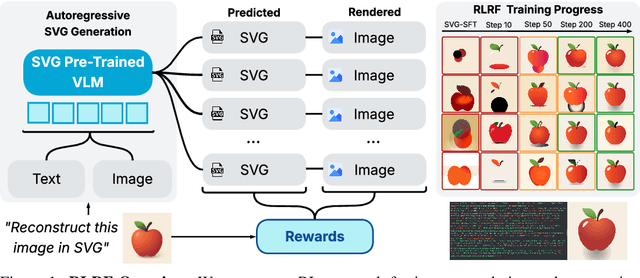
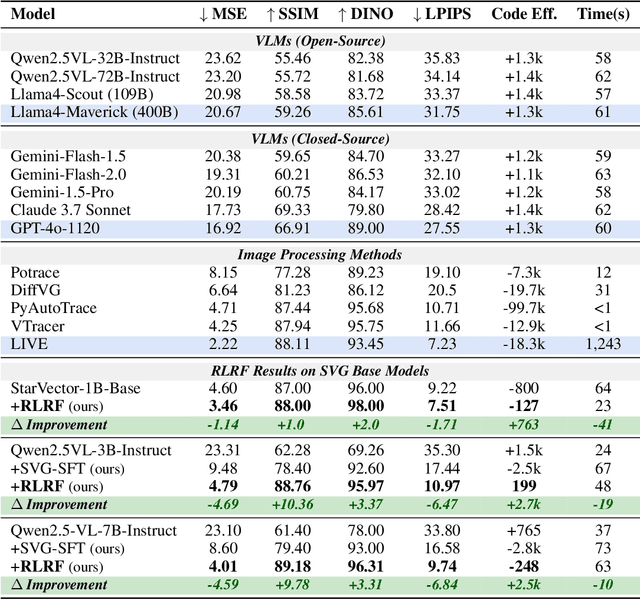
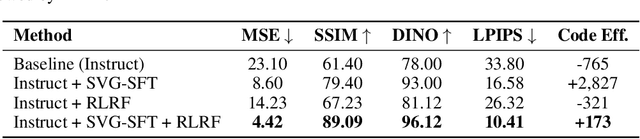
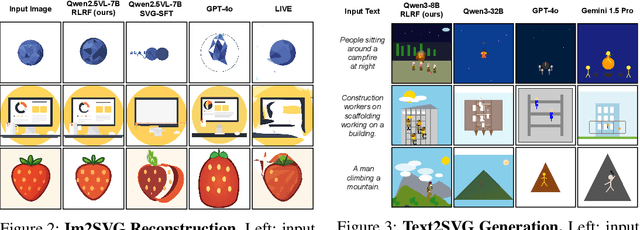
Scalable Vector Graphics (SVG) offer a powerful format for representing visual designs as interpretable code. Recent advances in vision-language models (VLMs) have enabled high-quality SVG generation by framing the problem as a code generation task and leveraging large-scale pretraining. VLMs are particularly suitable for this task as they capture both global semantics and fine-grained visual patterns, while transferring knowledge across vision, natural language, and code domains. However, existing VLM approaches often struggle to produce faithful and efficient SVGs because they never observe the rendered images during training. Although differentiable rendering for autoregressive SVG code generation remains unavailable, rendered outputs can still be compared to original inputs, enabling evaluative feedback suitable for reinforcement learning (RL). We introduce RLRF(Reinforcement Learning from Rendering Feedback), an RL method that enhances SVG generation in autoregressive VLMs by leveraging feedback from rendered SVG outputs. Given an input image, the model generates SVG roll-outs that are rendered and compared to the original image to compute a reward. This visual fidelity feedback guides the model toward producing more accurate, efficient, and semantically coherent SVGs. RLRF significantly outperforms supervised fine-tuning, addressing common failure modes and enabling precise, high-quality SVG generation with strong structural understanding and generalization.
StarFlow: Generating Structured Workflow Outputs From Sketch Images
Mar 27, 2025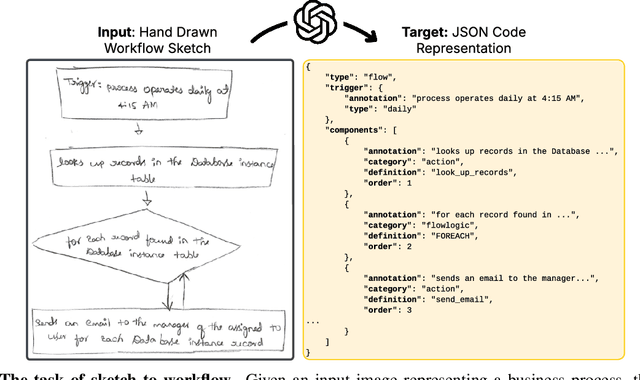
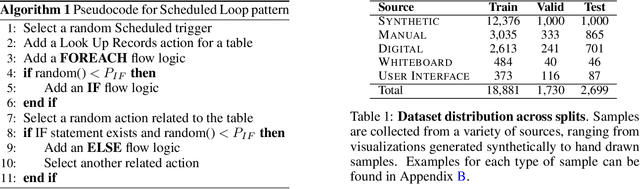
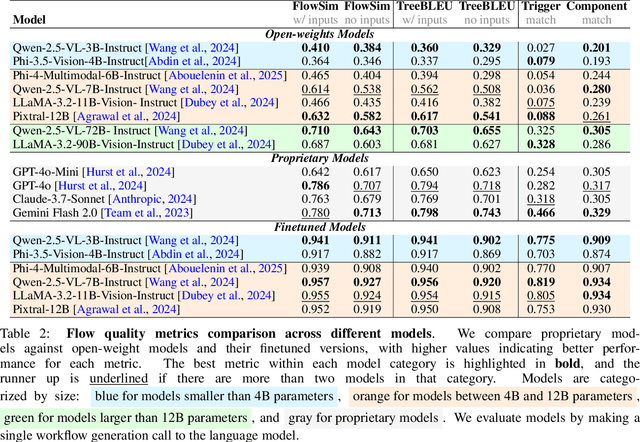
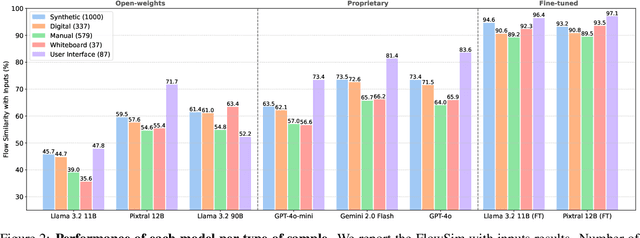
Workflows are a fundamental component of automation in enterprise platforms, enabling the orchestration of tasks, data processing, and system integrations. Despite being widely used, building workflows can be complex, often requiring manual configuration through low-code platforms or visual programming tools. To simplify this process, we explore the use of generative foundation models, particularly vision-language models (VLMs), to automatically generate structured workflows from visual inputs. Translating hand-drawn sketches or computer-generated diagrams into executable workflows is challenging due to the ambiguity of free-form drawings, variations in diagram styles, and the difficulty of inferring execution logic from visual elements. To address this, we introduce StarFlow, a framework for generating structured workflow outputs from sketches using vision-language models. We curate a diverse dataset of workflow diagrams -- including synthetic, manually annotated, and real-world samples -- to enable robust training and evaluation. We finetune and benchmark multiple vision-language models, conducting a series of ablation studies to analyze the strengths and limitations of our approach. Our results show that finetuning significantly enhances structured workflow generation, outperforming large vision-language models on this task.
UI-Vision: A Desktop-centric GUI Benchmark for Visual Perception and Interaction
Mar 19, 2025Autonomous agents that navigate Graphical User Interfaces (GUIs) to automate tasks like document editing and file management can greatly enhance computer workflows. While existing research focuses on online settings, desktop environments, critical for many professional and everyday tasks, remain underexplored due to data collection challenges and licensing issues. We introduce UI-Vision, the first comprehensive, license-permissive benchmark for offline, fine-grained evaluation of computer use agents in real-world desktop environments. Unlike online benchmarks, UI-Vision provides: (i) dense, high-quality annotations of human demonstrations, including bounding boxes, UI labels, and action trajectories (clicks, drags, and keyboard inputs) across 83 software applications, and (ii) three fine-to-coarse grained tasks-Element Grounding, Layout Grounding, and Action Prediction-with well-defined metrics to rigorously evaluate agents' performance in desktop environments. Our evaluation reveals critical limitations in state-of-the-art models like UI-TARS-72B, including issues with understanding professional software, spatial reasoning, and complex actions like drag-and-drop. These findings highlight the challenges in developing fully autonomous computer use agents. By releasing UI-Vision as open-source, we aim to advance the development of more capable agents for real-world desktop tasks.
Learning to Defer for Causal Discovery with Imperfect Experts
Feb 18, 2025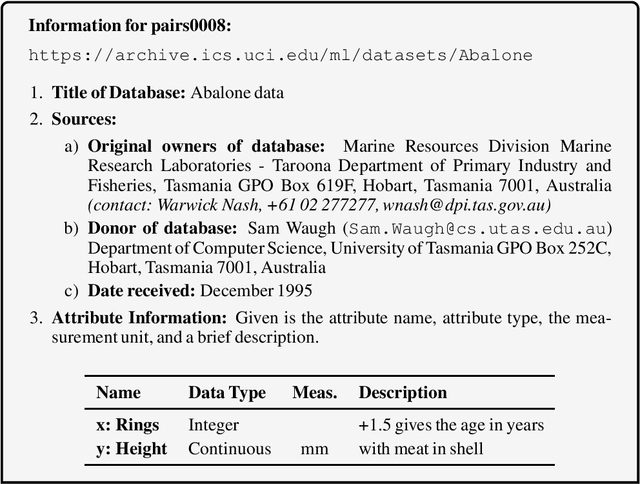
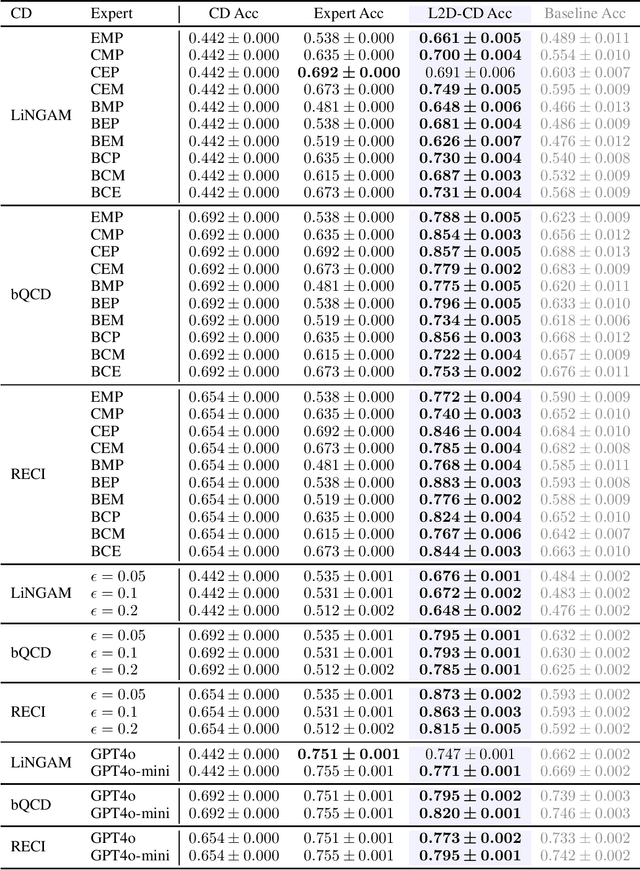
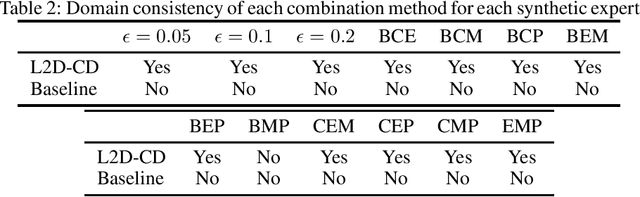
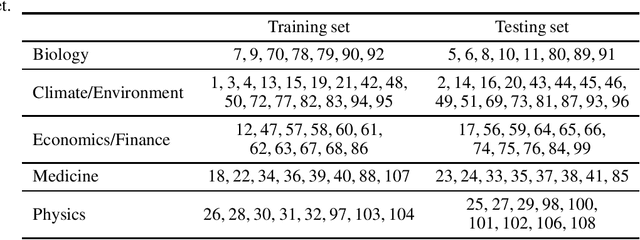
Integrating expert knowledge, e.g. from large language models, into causal discovery algorithms can be challenging when the knowledge is not guaranteed to be correct. Expert recommendations may contradict data-driven results, and their reliability can vary significantly depending on the domain or specific query. Existing methods based on soft constraints or inconsistencies in predicted causal relationships fail to account for these variations in expertise. To remedy this, we propose L2D-CD, a method for gauging the correctness of expert recommendations and optimally combining them with data-driven causal discovery results. By adapting learning-to-defer (L2D) algorithms for pairwise causal discovery (CD), we learn a deferral function that selects whether to rely on classical causal discovery methods using numerical data or expert recommendations based on textual meta-data. We evaluate L2D-CD on the canonical T\"ubingen pairs dataset and demonstrate its superior performance compared to both the causal discovery method and the expert used in isolation. Moreover, our approach identifies domains where the expert's performance is strong or weak. Finally, we outline a strategy for generalizing this approach to causal discovery on graphs with more than two variables, paving the way for further research in this area.