 Add to Chrome
 Add to Firefox
 Add to Edge
Programming Every Example: Lifting Pre-training Data Quality like Experts at Scale
Sep 25, 2024
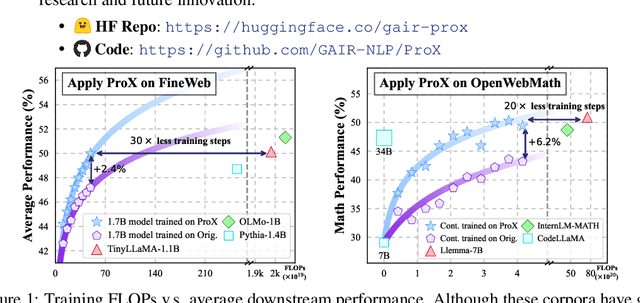
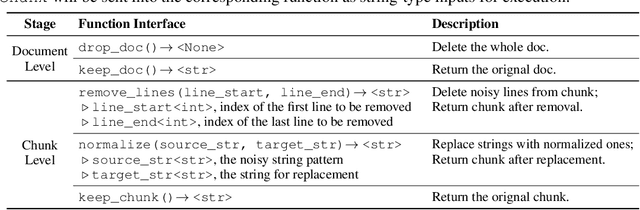
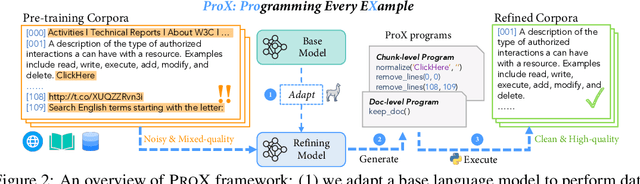
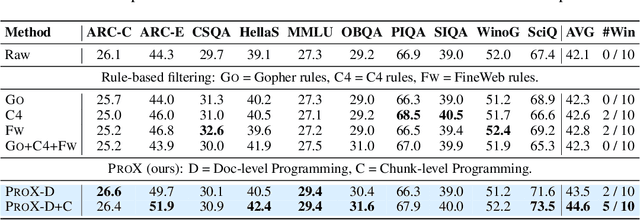
Large language model pre-training has traditionally relied on human experts to craft heuristics for improving the corpora quality, resulting in numerous rules developed to date. However, these rules lack the flexibility to address the unique characteristics of individual example effectively. Meanwhile, applying tailored rules to every example is impractical for human experts. In this paper, we demonstrate that even small language models, with as few as 0.3B parameters, can exhibit substantial data refining capabilities comparable to those of human experts. We introduce Programming Every Example (ProX), a novel framework that treats data refinement as a programming task, enabling models to refine corpora by generating and executing fine-grained operations, such as string normalization, for each individual example at scale. Experimental results show that models pre-trained on ProX-curated data outperform either original data or data filtered by other selection methods by more than 2% across various downstream benchmarks. Its effectiveness spans various model sizes and pre-training corpora, including C4, RedPajama-V2, and FineWeb. Furthermore, ProX exhibits significant potential in domain-specific continual pre-training: without domain specific design, models trained on OpenWebMath refined by ProX outperform human-crafted rule-based methods, improving average accuracy by 7.6% over Mistral-7B, with 14.6% for Llama-2-7B and 20.3% for CodeLlama-7B, all within 10B tokens to be comparable to models like Llemma-7B trained on 200B tokens. Further analysis highlights that ProX significantly saves training FLOPs, offering a promising path for efficient LLM pre-training.We are open-sourcing ProX with >100B corpus, models, and sharing all training and implementation details for reproducible research and future innovation. Code: https://github.com/GAIR-NLP/ProX

RAGChecker: A Fine-grained Framework for Diagnosing Retrieval-Augmented Generation
Aug 15, 2024


Despite Retrieval-Augmented Generation (RAG) has shown promising capability in leveraging external knowledge, a comprehensive evaluation of RAG systems is still challenging due to the modular nature of RAG, evaluation of long-form responses and reliability of measurements. In this paper, we propose a fine-grained evaluation framework, RAGChecker, that incorporates a suite of diagnostic metrics for both the retrieval and generation modules. Meta evaluation verifies that RAGChecker has significantly better correlations with human judgments than other evaluation metrics. Using RAGChecker, we evaluate 8 RAG systems and conduct an in-depth analysis of their performance, revealing insightful patterns and trade-offs in the design choices of RAG architectures. The metrics of RAGChecker can guide researchers and practitioners in developing more effective RAG systems.
OpenResearcher: Unleashing AI for Accelerated Scientific Research
Aug 13, 2024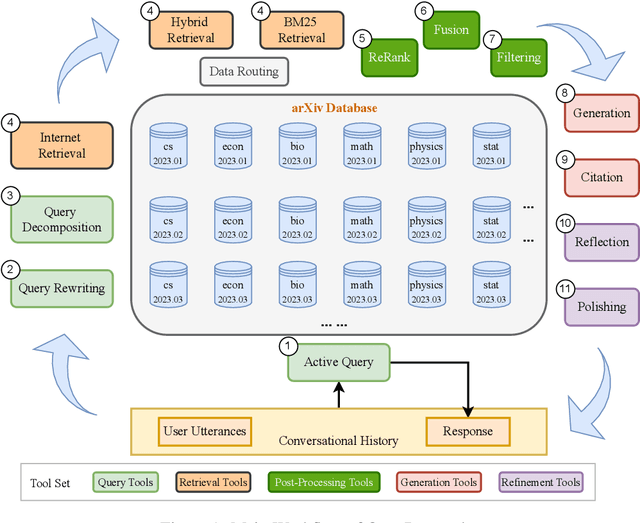
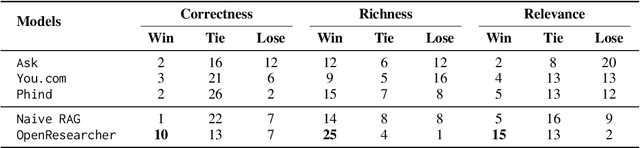

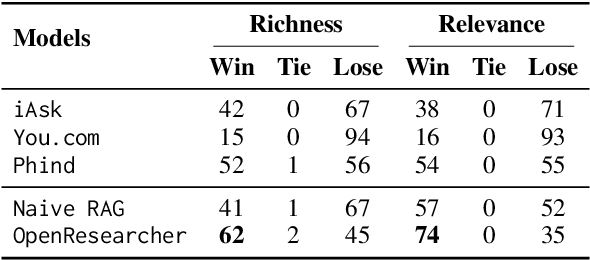
The rapid growth of scientific literature imposes significant challenges for researchers endeavoring to stay updated with the latest advancements in their fields and delve into new areas. We introduce OpenResearcher, an innovative platform that leverages Artificial Intelligence (AI) techniques to accelerate the research process by answering diverse questions from researchers. OpenResearcher is built based on Retrieval-Augmented Generation (RAG) to integrate Large Language Models (LLMs) with up-to-date, domain-specific knowledge. Moreover, we develop various tools for OpenResearcher to understand researchers' queries, search from the scientific literature, filter retrieved information, provide accurate and comprehensive answers, and self-refine these answers. OpenResearcher can flexibly use these tools to balance efficiency and effectiveness. As a result, OpenResearcher enables researchers to save time and increase their potential to discover new insights and drive scientific breakthroughs. Demo, video, and code are available at: https://github.com/GAIR-NLP/OpenResearcher.
Data Contamination Report from the 2024 CONDA Shared Task
Jul 31, 2024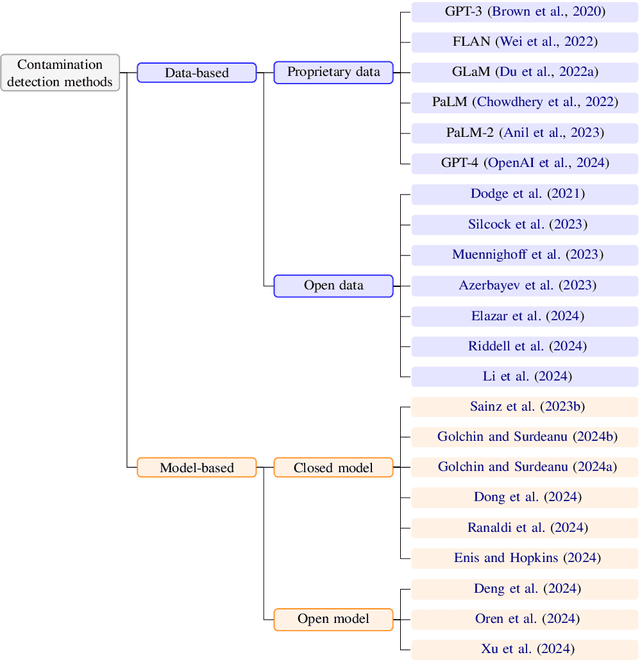

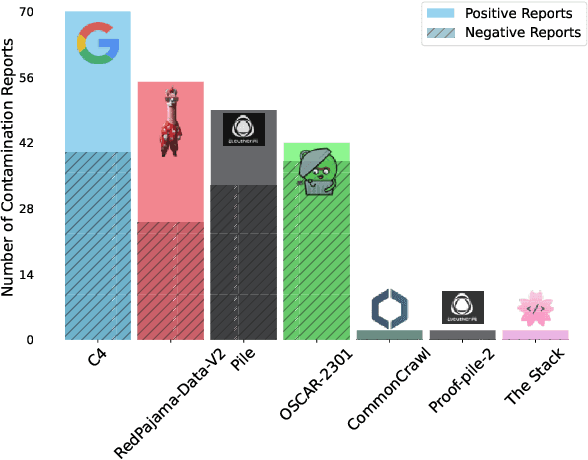
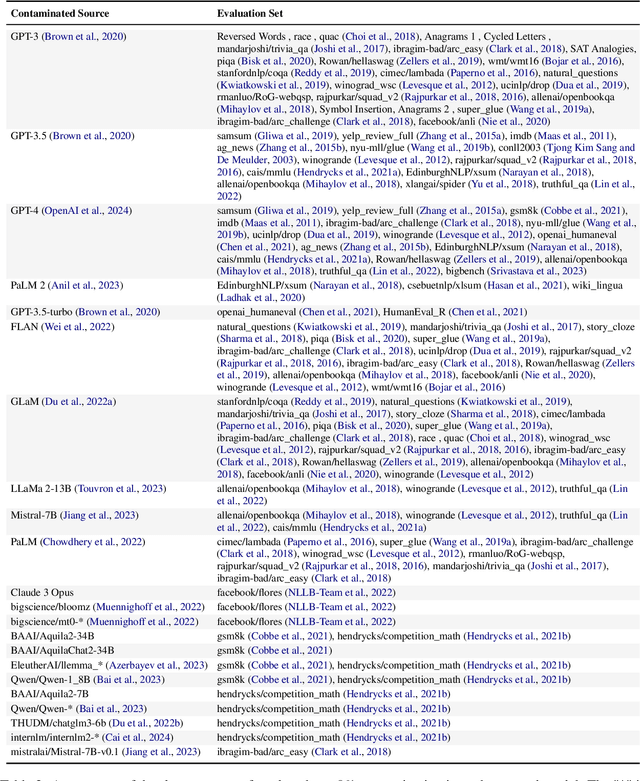
The 1st Workshop on Data Contamination (CONDA 2024) focuses on all relevant aspects of data contamination in natural language processing, where data contamination is understood as situations where evaluation data is included in pre-training corpora used to train large scale models, compromising evaluation results. The workshop fostered a shared task to collect evidence on data contamination in current available datasets and models. The goal of the shared task and associated database is to assist the community in understanding the extent of the problem and to assist researchers in avoiding reporting evaluation results on known contaminated resources. The shared task provides a structured, centralized public database for the collection of contamination evidence, open to contributions from the community via GitHub pool requests. This first compilation paper is based on 566 reported entries over 91 contaminated sources from a total of 23 contributors. The details of the individual contamination events are available in the platform. The platform continues to be online, open to contributions from the community.
OmniBal: Towards Fast Instruct-tuning for Vision-Language Models via Omniverse Computation Balance
Jul 30, 2024


Recently, vision-language instruct-tuning models have made significant progress due to their more comprehensive understanding of the world. In this work, we discovered that large-scale 3D parallel training on those models leads to an imbalanced computation load across different devices. The vision and language parts are inherently heterogeneous: their data distribution and model architecture differ significantly, which affects distributed training efficiency. We rebalanced the computational loads from data, model, and memory perspectives to address this issue, achieving more balanced computation across devices. These three components are not independent but are closely connected, forming an omniverse balanced training framework. Specifically, for the data, we grouped instances into new balanced mini-batches within and across devices. For the model, we employed a search-based method to achieve a more balanced partitioning. For memory optimization, we adaptively adjusted the re-computation strategy for each partition to utilize the available memory fully. We conducted extensive experiments to validate the effectiveness of our method. Compared with the open-source training code of InternVL-Chat, we significantly reduced GPU days, achieving about 1.8x speed-up. Our method's efficacy and generalizability were further demonstrated across various models and datasets. Codes will be released at https://github.com/ModelTC/OmniBal.
SAFETY-J: Evaluating Safety with Critique
Jul 25, 2024The deployment of Large Language Models (LLMs) in content generation raises significant safety concerns, particularly regarding the transparency and interpretability of content evaluations. Current methods, primarily focused on binary safety classifications, lack mechanisms for detailed critique, limiting their utility for model improvement and user trust. To address these limitations, we introduce SAFETY-J, a bilingual generative safety evaluator for English and Chinese with critique-based judgment. SAFETY-J utilizes a robust training dataset that includes diverse dialogues and augmented query-response pairs to assess safety across various scenarios comprehensively. We establish an automated meta-evaluation benchmark that objectively assesses the quality of critiques with minimal human intervention, facilitating scalable and continuous improvement. Additionally, SAFETY-J employs an iterative preference learning technique to dynamically refine safety assessments based on meta-evaluations and critiques. Our evaluations demonstrate that SAFETY-J provides more nuanced and accurate safety evaluations, thereby enhancing both critique quality and predictive reliability in complex content scenarios. To facilitate further research and application, we open-source SAFETY-J's training protocols, datasets, and code at \url{https://github.com/GAIR-NLP/Safety-J}.
Weak-to-Strong Reasoning
Jul 18, 2024When large language models (LLMs) exceed human-level capabilities, it becomes increasingly challenging to provide full-scale and accurate supervisions for these models. Weak-to-strong learning, which leverages a less capable model to unlock the latent abilities of a stronger model, proves valuable in this context. Yet, the efficacy of this approach for complex reasoning tasks is still untested. Furthermore, tackling reasoning tasks under the weak-to-strong setting currently lacks efficient methods to avoid blindly imitating the weak supervisor including its errors. In this paper, we introduce a progressive learning framework that enables the strong model to autonomously refine its training data, without requiring input from either a more advanced model or human-annotated data. This framework begins with supervised fine-tuning on a selective small but high-quality dataset, followed by preference optimization on contrastive samples identified by the strong model itself. Extensive experiments on the GSM8K and MATH datasets demonstrate that our method significantly enhances the reasoning capabilities of Llama2-70b using three separate weak models. This method is further validated in a forward-looking experimental setup, where Llama3-8b-instruct effectively supervises Llama3-70b on the highly challenging OlympicArena dataset. This work paves the way for a more scalable and sophisticated strategy to enhance AI reasoning powers. All relevant code and resources are available in \url{https://github.com/GAIR-NLP/weak-to-strong-reasoning}.
Understanding Reference Policies in Direct Preference Optimization
Jul 18, 2024Direct Preference Optimization (DPO) has become a widely used training method for the instruction fine-tuning of large language models (LLMs). In this work, we explore an under-investigated aspect of DPO - its dependency on the reference model or policy. Such reference policies, typically instantiated as the model to be further fine-tuned, are important since they can impose an upper limit on DPO's effectiveness. Therefore, we address three related research questions in this work. First, we explore the optimal strength of the KL-divergence constraint in DPO, which penalizes deviations from the reference policy, and find that DPO is sensitive to this strength. Next, we examine the necessity of reference policies for instruction fine-tuning by providing both theoretical and empirical comparisons between DPO and related learning objectives, demonstrating DPO's superiority. Additionally, we investigate whether DPO benefits from stronger reference policies, finding that a stronger reference policy can lead to improved performance, but only when it is similar to the model being fine-tuned. Our findings highlight the confounding role of reference policies in DPO and offer insights for best practices, while also identifying open research questions for future studies.
Halu-J: Critique-Based Hallucination Judge
Jul 17, 2024Large language models (LLMs) frequently generate non-factual content, known as hallucinations. Existing retrieval-augmented-based hallucination detection approaches typically address this by framing it as a classification task, evaluating hallucinations based on their consistency with retrieved evidence. However, this approach usually lacks detailed explanations for these evaluations and does not assess the reliability of these explanations. Furthermore, deficiencies in retrieval systems can lead to irrelevant or partially relevant evidence retrieval, impairing the detection process. Moreover, while real-world hallucination detection requires analyzing multiple pieces of evidence, current systems usually treat all evidence uniformly without considering its relevance to the content. To address these challenges, we introduce Halu-J, a critique-based hallucination judge with 7 billion parameters. Halu-J enhances hallucination detection by selecting pertinent evidence and providing detailed critiques. Our experiments indicate that Halu-J outperforms GPT-4o in multiple-evidence hallucination detection and matches its capability in critique generation and evidence selection. We also introduce ME-FEVER, a new dataset designed for multiple-evidence hallucination detection. Our code and dataset can be found in https://github.com/GAIR-NLP/factool .
ANOLE: An Open, Autoregressive, Native Large Multimodal Models for Interleaved Image-Text Generation
Jul 08, 2024Previous open-source large multimodal models (LMMs) have faced several limitations: (1) they often lack native integration, requiring adapters to align visual representations with pre-trained large language models (LLMs); (2) many are restricted to single-modal generation; (3) while some support multimodal generation, they rely on separate diffusion models for visual modeling and generation. To mitigate these limitations, we present Anole, an open, autoregressive, native large multimodal model for interleaved image-text generation. We build Anole from Meta AI's Chameleon, adopting an innovative fine-tuning strategy that is both data-efficient and parameter-efficient. Anole demonstrates high-quality, coherent multimodal generation capabilities. We have open-sourced our model, training framework, and instruction tuning data.