 Add to Chrome
 Add to Firefox
 Add to Edge
CompCPZ: Preserving Multi-Modal Intent in Language-Guided Robot Manipulation
Aug 18, 2026
A robot asked to "place the cup near the red plate or the blue plate" may reach the centroid between them and appear geometrically successful, while satisfying neither disjunct of the instruction. This silent semantic failure exposes a structural limitation of language-conditioned robot policies: representations that collapse a disjunctive instruction into a single connected set cannot preserve all feasible modes, and planners that commit to one action degrade under run-time mode uncertainty. We address this limitation with CompCPZ, a sound algebraic layer that language-conditioned learning systems wrap to recover multi-modal disjunctive representation, recursively composing per-primitive constrained polynomial zonotope enclosures along the language parse tree with distribution-free conformal coverage and sub-millisecond runtime. On a closed-loop ManiSkill3 tabletop-manipulation benchmark, CompCPZ outperforms convex set baselines, multi-peak decoders, and a zero-shot vision-language-action model (1,900/1,918 paired wins, p << 10^(-30)); the same compiler also transfers without retuning to planar real-robot trials on a Unitree Go2 quadruped under motion capture. These results suggest that compositional language grounding should be evaluated not only by reaching a decoded target, but by whether the represented feasibility set preserves the connected-component structure of the user's intent.

Probabilistic Reachable-Action Verification of Visuomotor Policies via Set-Based Training
Aug 03, 2026Reachability analysis for visuomotor policies is difficult because large visual encoders make end-to-end set propagation computationally expensive and excessively conservative. We therefore freeze the visual encoder and confine set propagation to a low-dimensional interface between it and the downstream policy, with the interface set calibrated from held-out camera-pose perturbations. Propagating this set through the policy with zonotopes yields a terminal output-enclosure width that set-based training optimizes directly. During evaluation, camera-pose perturbations are sampled from the prescribed distribution, and rollout-level split conformal calibration converts the resulting action-deviation scores into a probabilistic reachable-action radius with finite-sample coverage. In controlled manipulation experiments, set-based training reduces this radius while preserving closed-loop task capability, and matched behavior-only, observational-consistency, and pointwise-adversarial controls all leave a larger radius.
Certifying Plans under Model Mismatch: A Trilemma for Reachability from Scarce Data
Aug 03, 2026Sim-to-real policies are designed under nominal dynamics, but target-system trials may yield only a few isolated one-step transitions. We study pre-execution certification of a fixed control sequence, such as an action chunk produced by a learned policy. If the sequence reaches an unobserved state-input region, the observations remain consistent with target systems whose trajectories separate along it by an arbitrarily large amount. Any deterministic certifier sound for all of them must then decline to certify or return a reachable tube with arbitrarily large projected width. For bounded smooth classes of the target-nominal model error, we derive a finite plan-dependent projected-width lower bound. These results expose a trilemma among uniform trajectory containment, finite projected width, and unrestricted model-error behavior beyond the observations. ForeReach requires a supplied componentwise Lipschitz bound on the model error. Observed transition pairs can refute this declaration but cannot establish it outside the observed locations. Conditional on a valid declaration, our method constructs a set-membership envelope for the model error, propagates a zonotopic reachable tube, and certifies only when propagation remains within the certification domain and every projected tube slice avoids the unsafe set. In two benchmark systems, calibration baselines may remain narrow after losing trajectory containment outside data support, whereas our method declines to certify unsupported sequences and recovers certification when relevant target data and sufficient obstacle clearance are available.
The Intruder Threshold: A Spectral Law for LoRA Fine-Tuning
Jul 26, 2026LoRA fine-tuning can create intruder dimensions: new leading singular vectors of the updated weight matrix $W+BA$ that are nearly orthogonal to all pretrained singular vectors and that drive catastrophic forgetting. Since their discovery, no theory has predicted, layer by layer on measured spectra, when they appear. We derive a per-layer critical update strength $s^\ast=\barθ/(γσ_1(BA))$, computed from the measured spectrum of $W$ alone through the rectangular spiked-deformation transform, together with an exact secular-equation characterization of the updated spectrum, with no fitted parameters. In a pre-specified study spanning four dense Transformer families, a state-space model, a mixture-of-experts model, and an encoder-decoder (18 adapters, 9{,}840 layer scans), the law localizes the empirical threshold within a factor of two on $82\%$ of layers, separates intruder-bearing from intruder-free layers at deployment with a mean AUC of $0.89$, holds unchanged on six third-party adapters, and predicts where WikiText-2 perplexity begins to degrade; a combination of the two pre-specified edge evaluations reaches $98\%$ and is confirmed out-of-bag on the external adapters ($0.997$). Full fine-tuning disperses its update far below the threshold of every layer, which resolves the asymmetry between LoRA and full fine-tuning. Norm-matched interventions confirm that threshold-crossing layers, rather than update magnitude, carry the forgetting, and a spike-budget rule derived from the thresholds, requiring one SVD and no validation sweeps, reduces forgetting by $62\%$ on the most fragile model at no task cost.
Error Certificates for KV-Cache Eviction via Randomized Design
Jul 25, 2026Deterministic KV-cache eviction keeps the top-$k$ tokens under an importance score and deletes the rest. We prove that this design cannot know what it destroyed: evicted values can be altered so that everything the serving system retains is unchanged while the true attention-output error grows arbitrarily, so no serving-time estimator of that error is consistent. Randomized eviction restores identifiability. With a Poisson-sampled tail at known inclusion probabilities, one logit offset performs the Hájek correction inside the softmax, and a survey-sampling variance estimator over the retained set becomes a per-step error certificate with 0.97 empirical coverage at no accuracy cost. On real workloads, seven pre-registered claims locate the certificate's value precisely. Prediction goes to output confidence: question-aware eviction at 25--50\% budgets is nearly free, output log-probability predicts failure better than any cache-side signal, and certificate-gated budget escalation adds nothing. Attribution stays with the certificate: it separates cache-induced from inherent failures (AUC 0.65--0.75, against 0.47--0.54 for output confidence) and schedules recomputation better than random or confidence gating. Randomization buys attribution, not prediction.
How Can Reinforcement Learning Achieve Expert-level Placement?
Apr 28, 2026Chip placement is a critical step in physical design. While reinforcement learning (RL)-based methods have recently emerged, their training primarily focuses on wirelength optimization, and therefore often fail to achieve expert-quality layouts. We identify the reward design as the primary cause for the performance gap with experts, and instead of formalizing intricate processes, we circumvent this by directly learning from expert layouts to derive a reward model. Our approach starts from the final expert layouts to infer step-by-step expert trajectories. Using these trajectories as demonstrations or preferences, we train a model that captures the latent implicit rewards in expert results. Experiments show that our framework can efficiently learn from even a single design and generalize well to unseen cases.
FlowPlace: Flow Matching for Chip Placement
Apr 26, 2026Chip placement plays an important role in physical design. While generative models like diffusion models offer promising learning-based solutions, current methods have the following limitations: they use random synthetic data for pre-training, require long sampling times, and often result in overlaps due to their dependence on gradient-based solvers during the sampling process. To overcome these issues, we propose FlowPlace, which features mask-guided synthetic data generation, flow-based efficient training with flexible prior injection, and hard constraint sampling for overlap-free layouts. Experiments on OpenROAD and ICCAD 2015 benchmarks show FlowPlace achieves better PPA metrics, 10-50$\times$ faster sampling efficiency, and zero overlaps.
Data-Driven Reachability Analysis via Diffusion Models with PAC Guarantees
Mar 31, 2026We present a data-driven framework for reachability analysis of nonlinear dynamical systems that requires no explicit model. A denoising diffusion probabilistic model learns the time-evolving state distribution of a dynamical system from trajectory data alone. The predicted reachable set takes the form of a sublevel set of a nonconformity score derived from the reconstruction error, with the threshold calibrated via the Learn Then Test procedure so that the probability of excluding a reachable state is bounded with high probability. Experiments on three nonlinear systems, a forced Duffing oscillator, a planar quadrotor, and a high-dimensional reaction-diffusion system, confirm that the empirical miss rate remains below the Probably Approximately Correct (PAC) bound while scaling to state dimensions beyond the reach of classical grid-based and polynomial methods.
GNN-DIP: Neural Corridor Selection for Decomposition-Based Motion Planning
Mar 12, 2026Motion planning through narrow passages remains a core challenge: sampling-based planners rarely place samples inside these narrow but critical regions, and even when samples land inside a passage, the straight-line connections between them run close to obstacle boundaries and are frequently rejected by collision checking. Decomposition-based planners resolve both issues by partitioning free space into convex cells -- every passage is captured exactly as a cell boundary, and any path within a cell is collision-free by construction. However, the number of candidate corridors through the cell graph grows combinatorially with environment complexity, creating a bottleneck in corridor selection. We present GNN-DIP, a framework that addresses this by integrating a Graph Neural Network (GNN) with a two-phase Decomposition-Informed Planner (DIP). The GNN predicts portal scores on the cell adjacency graph to bias corridor search toward near-optimal regions while preserving completeness. In 2D, Constrained Delaunay Triangulation (CDT) with the Funnel algorithm yields exact shortest paths within corridors; in 3D, Slab convex decomposition with portal-face sampling provides near-optimal path evaluation. Benchmarks on 2D narrow-passage scenarios, 3D bottleneck environments with up to 246 obstacles, and dynamic 2D settings show that GNN-DIP achieves 99--100% success rates with 2--280 times speedup over sampling-based baselines.
Chain of Attack: On the Robustness of Vision-Language Models Against Transfer-Based Adversarial Attacks
Nov 24, 2024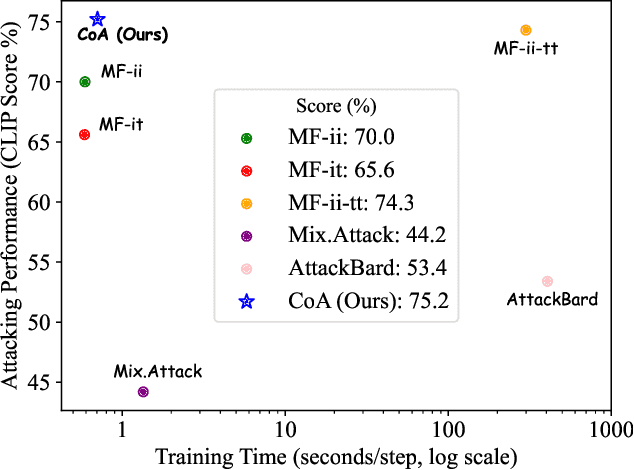
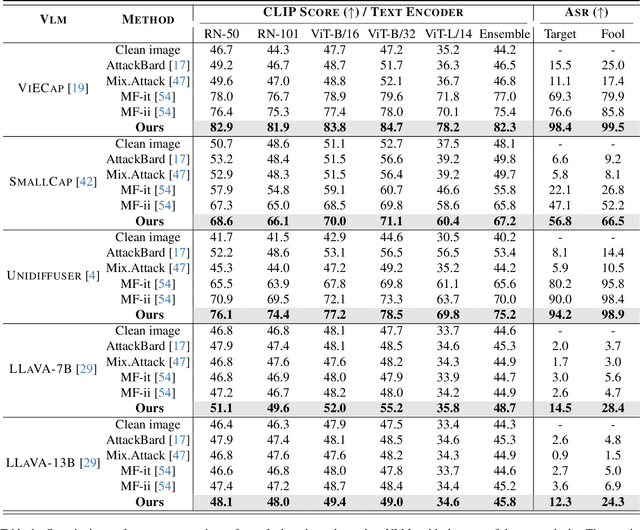
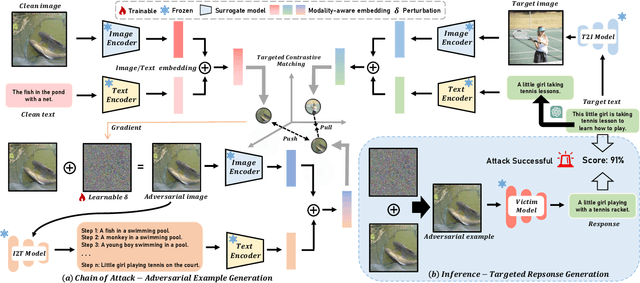
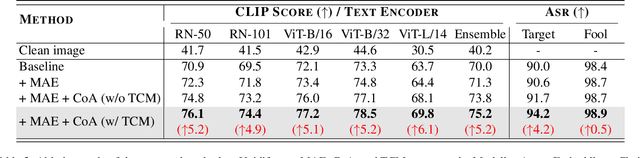
Pre-trained vision-language models (VLMs) have showcased remarkable performance in image and natural language understanding, such as image captioning and response generation. As the practical applications of vision-language models become increasingly widespread, their potential safety and robustness issues raise concerns that adversaries may evade the system and cause these models to generate toxic content through malicious attacks. Therefore, evaluating the robustness of open-source VLMs against adversarial attacks has garnered growing attention, with transfer-based attacks as a representative black-box attacking strategy. However, most existing transfer-based attacks neglect the importance of the semantic correlations between vision and text modalities, leading to sub-optimal adversarial example generation and attack performance. To address this issue, we present Chain of Attack (CoA), which iteratively enhances the generation of adversarial examples based on the multi-modal semantic update using a series of intermediate attacking steps, achieving superior adversarial transferability and efficiency. A unified attack success rate computing method is further proposed for automatic evasion evaluation. Extensive experiments conducted under the most realistic and high-stakes scenario, demonstrate that our attacking strategy can effectively mislead models to generate targeted responses using only black-box attacks without any knowledge of the victim models. The comprehensive robustness evaluation in our paper provides insight into the vulnerabilities of VLMs and offers a reference for the safety considerations of future model developments.