 Add to Chrome
 Add to Firefox
 Add to Edge
CompCPZ: Preserving Multi-Modal Intent in Language-Guided Robot Manipulation
Aug 18, 2026
A robot asked to "place the cup near the red plate or the blue plate" may reach the centroid between them and appear geometrically successful, while satisfying neither disjunct of the instruction. This silent semantic failure exposes a structural limitation of language-conditioned robot policies: representations that collapse a disjunctive instruction into a single connected set cannot preserve all feasible modes, and planners that commit to one action degrade under run-time mode uncertainty. We address this limitation with CompCPZ, a sound algebraic layer that language-conditioned learning systems wrap to recover multi-modal disjunctive representation, recursively composing per-primitive constrained polynomial zonotope enclosures along the language parse tree with distribution-free conformal coverage and sub-millisecond runtime. On a closed-loop ManiSkill3 tabletop-manipulation benchmark, CompCPZ outperforms convex set baselines, multi-peak decoders, and a zero-shot vision-language-action model (1,900/1,918 paired wins, p << 10^(-30)); the same compiler also transfers without retuning to planar real-robot trials on a Unitree Go2 quadruped under motion capture. These results suggest that compositional language grounding should be evaluated not only by reaching a decoded target, but by whether the represented feasibility set preserves the connected-component structure of the user's intent.

Probabilistic Reachable-Action Verification of Visuomotor Policies via Set-Based Training
Aug 03, 2026Reachability analysis for visuomotor policies is difficult because large visual encoders make end-to-end set propagation computationally expensive and excessively conservative. We therefore freeze the visual encoder and confine set propagation to a low-dimensional interface between it and the downstream policy, with the interface set calibrated from held-out camera-pose perturbations. Propagating this set through the policy with zonotopes yields a terminal output-enclosure width that set-based training optimizes directly. During evaluation, camera-pose perturbations are sampled from the prescribed distribution, and rollout-level split conformal calibration converts the resulting action-deviation scores into a probabilistic reachable-action radius with finite-sample coverage. In controlled manipulation experiments, set-based training reduces this radius while preserving closed-loop task capability, and matched behavior-only, observational-consistency, and pointwise-adversarial controls all leave a larger radius.
Certifying Plans under Model Mismatch: A Trilemma for Reachability from Scarce Data
Aug 03, 2026Sim-to-real policies are designed under nominal dynamics, but target-system trials may yield only a few isolated one-step transitions. We study pre-execution certification of a fixed control sequence, such as an action chunk produced by a learned policy. If the sequence reaches an unobserved state-input region, the observations remain consistent with target systems whose trajectories separate along it by an arbitrarily large amount. Any deterministic certifier sound for all of them must then decline to certify or return a reachable tube with arbitrarily large projected width. For bounded smooth classes of the target-nominal model error, we derive a finite plan-dependent projected-width lower bound. These results expose a trilemma among uniform trajectory containment, finite projected width, and unrestricted model-error behavior beyond the observations. ForeReach requires a supplied componentwise Lipschitz bound on the model error. Observed transition pairs can refute this declaration but cannot establish it outside the observed locations. Conditional on a valid declaration, our method constructs a set-membership envelope for the model error, propagates a zonotopic reachable tube, and certifies only when propagation remains within the certification domain and every projected tube slice avoids the unsafe set. In two benchmark systems, calibration baselines may remain narrow after losing trajectory containment outside data support, whereas our method declines to certify unsupported sequences and recovers certification when relevant target data and sufficient obstacle clearance are available.
Data-Driven Reachability Analysis via Diffusion Models with PAC Guarantees
Mar 31, 2026We present a data-driven framework for reachability analysis of nonlinear dynamical systems that requires no explicit model. A denoising diffusion probabilistic model learns the time-evolving state distribution of a dynamical system from trajectory data alone. The predicted reachable set takes the form of a sublevel set of a nonconformity score derived from the reconstruction error, with the threshold calibrated via the Learn Then Test procedure so that the probability of excluding a reachable state is bounded with high probability. Experiments on three nonlinear systems, a forced Duffing oscillator, a planar quadrotor, and a high-dimensional reaction-diffusion system, confirm that the empirical miss rate remains below the Probably Approximately Correct (PAC) bound while scaling to state dimensions beyond the reach of classical grid-based and polynomial methods.
Results of the 2024 CommonRoad Motion Planning Competition for Autonomous Vehicles
Dec 22, 2025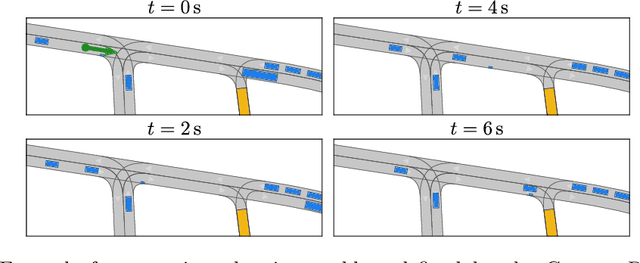

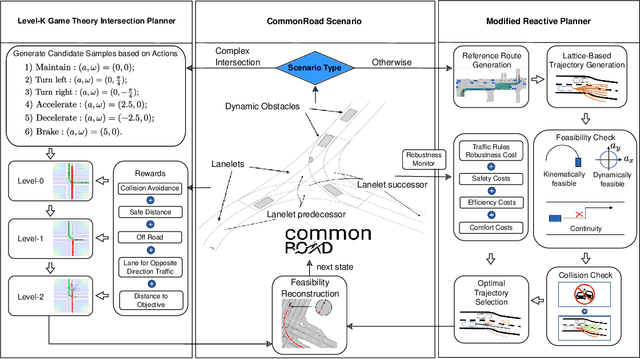
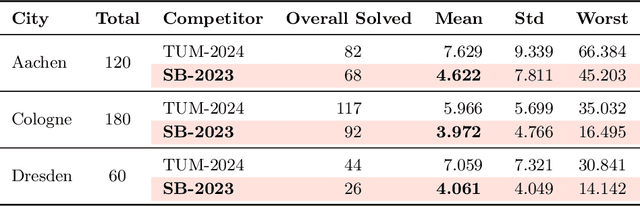
Over the past decade, a wide range of motion planning approaches for autonomous vehicles has been developed to handle increasingly complex traffic scenarios. However, these approaches are rarely compared on standardized benchmarks, limiting the assessment of relative strengths and weaknesses. To address this gap, we present the setup and results of the 4th CommonRoad Motion Planning Competition held in 2024, conducted using the CommonRoad benchmark suite. This annual competition provides an open-source and reproducible framework for benchmarking motion planning algorithms. The benchmark scenarios span highway and urban environments with diverse traffic participants, including passenger cars, buses, and bicycles. Planner performance is evaluated along four dimensions: efficiency, safety, comfort, and compliance with selected traffic rules. This report introduces the competition format and provides a comparison of representative high-performing planners from the 2023 and 2024 editions.
Predictive Traffic Rule Compliance using Reinforcement Learning
Mar 29, 2025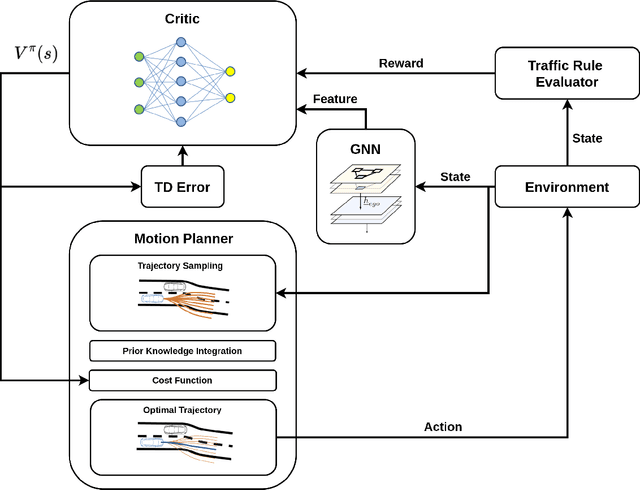
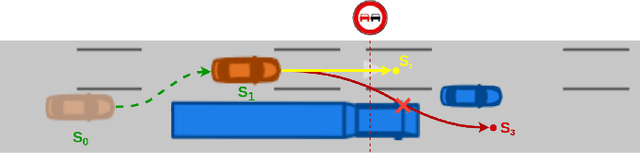
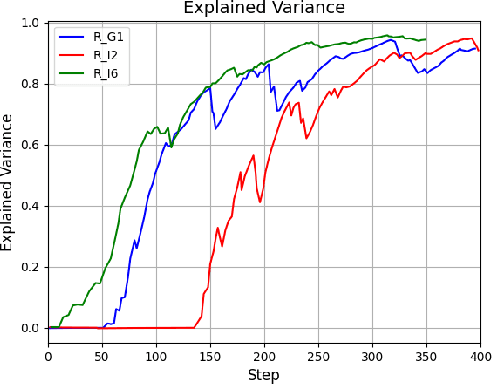
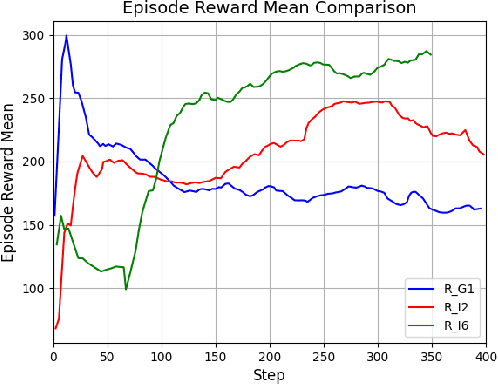
Autonomous vehicle path planning has reached a stage where safety and regulatory compliance are crucial. This paper presents a new approach that integrates a motion planner with a deep reinforcement learning model to predict potential traffic rule violations. In this setup, the predictions of the critic directly affect the cost function of the motion planner, guiding the choices of the trajectory. We incorporate key interstate rules from the German Road Traffic Regulation into a rule book and use a graph-based state representation to handle complex traffic information. Our main innovation is replacing the standard actor network in an actor-critic setup with a motion planning module, which ensures both predictable trajectory generation and prevention of long-term rule violations. Experiments on an open German highway dataset show that the model can predict and prevent traffic rule violations beyond the planning horizon, significantly increasing safety in challenging traffic conditions.
Path Planning based on 2D Object Bounding-box
Feb 22, 2024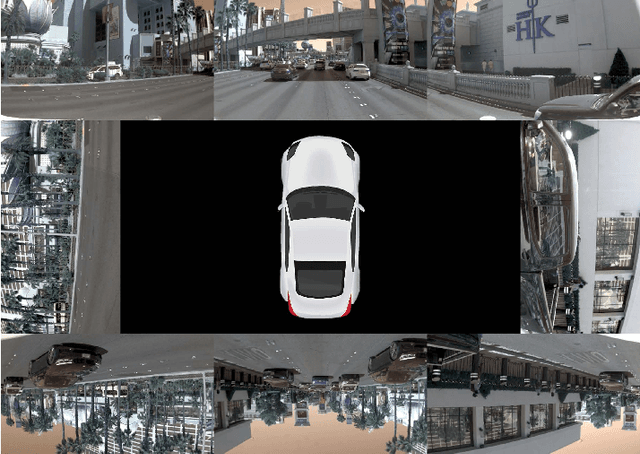
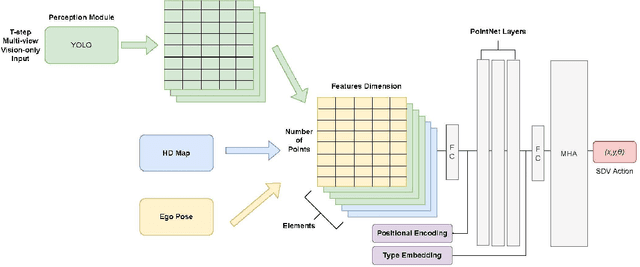
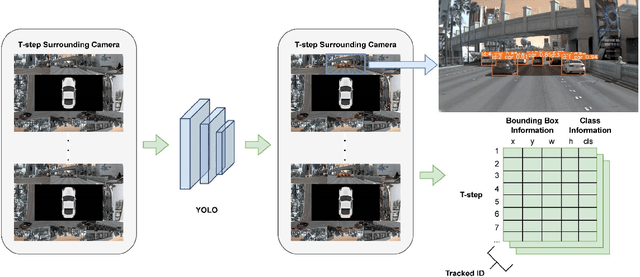

The implementation of Autonomous Driving (AD) technologies within urban environments presents significant challenges. These challenges necessitate the development of advanced perception systems and motion planning algorithms capable of managing situations of considerable complexity. Although the end-to-end AD method utilizing LiDAR sensors has achieved significant success in this scenario, we argue that its drawbacks may hinder its practical application. Instead, we propose the vision-centric AD as a promising alternative offering a streamlined model without compromising performance. In this study, we present a path planning method that utilizes 2D bounding boxes of objects, developed through imitation learning in urban driving scenarios. This is achieved by integrating high-definition (HD) map data with images captured by surrounding cameras. Subsequent perception tasks involve bounding-box detection and tracking, while the planning phase employs both local embeddings via Graph Neural Network (GNN) and global embeddings via Transformer for temporal-spatial feature aggregation, ultimately producing optimal path planning information. We evaluated our model on the nuPlan planning task and observed that it performs competitively in comparison to existing vision-centric methods.
YOLO-BEV: Generating Bird's-Eye View in the Same Way as 2D Object Detection
Oct 26, 2023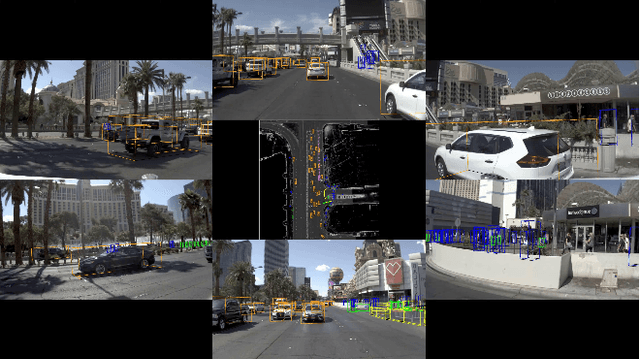
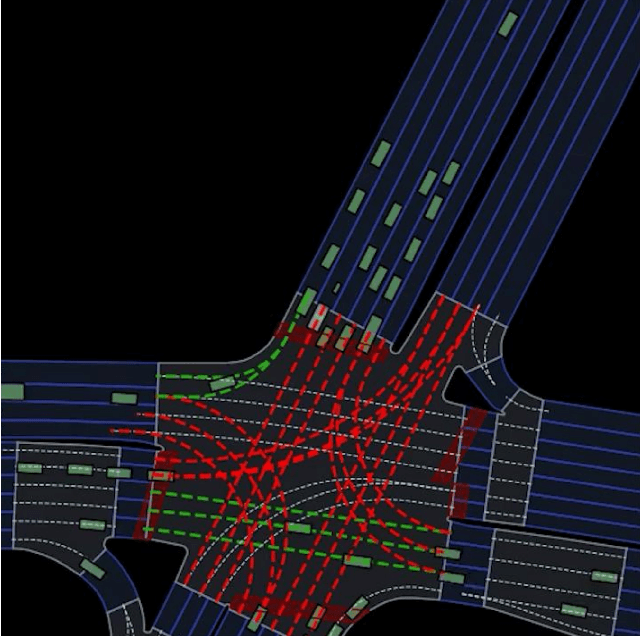
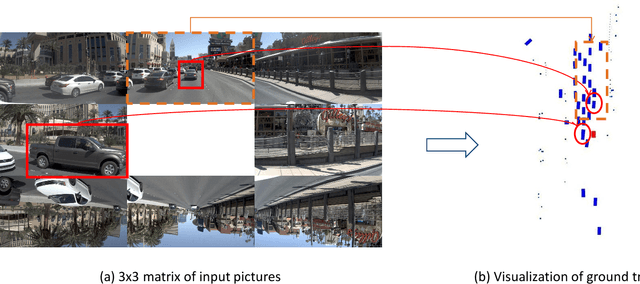
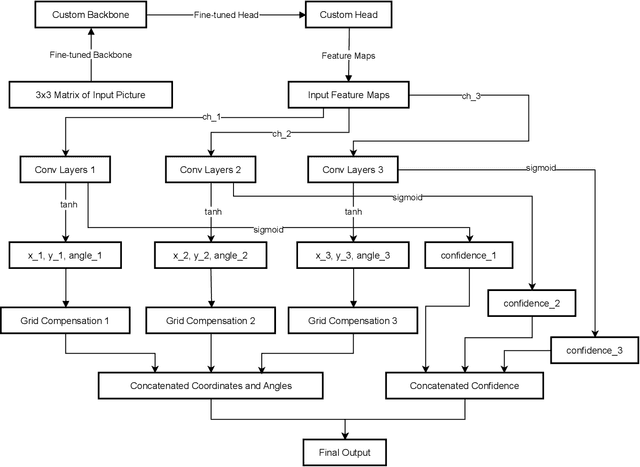
Vehicle perception systems strive to achieve comprehensive and rapid visual interpretation of their surroundings for improved safety and navigation. We introduce YOLO-BEV, an efficient framework that harnesses a unique surrounding cameras setup to generate a 2D bird's-eye view of the vehicular environment. By strategically positioning eight cameras, each at a 45-degree interval, our system captures and integrates imagery into a coherent 3x3 grid format, leaving the center blank, providing an enriched spatial representation that facilitates efficient processing. In our approach, we employ YOLO's detection mechanism, favoring its inherent advantages of swift response and compact model structure. Instead of leveraging the conventional YOLO detection head, we augment it with a custom-designed detection head, translating the panoramically captured data into a unified bird's-eye view map of ego car. Preliminary results validate the feasibility of YOLO-BEV in real-time vehicular perception tasks. With its streamlined architecture and potential for rapid deployment due to minimized parameters, YOLO-BEV poses as a promising tool that may reshape future perspectives in autonomous driving systems.