 Add to Chrome
 Add to Firefox
 Add to Edge
How Can Reinforcement Learning Achieve Expert-level Placement?
Apr 28, 2026
Chip placement is a critical step in physical design. While reinforcement learning (RL)-based methods have recently emerged, their training primarily focuses on wirelength optimization, and therefore often fail to achieve expert-quality layouts. We identify the reward design as the primary cause for the performance gap with experts, and instead of formalizing intricate processes, we circumvent this by directly learning from expert layouts to derive a reward model. Our approach starts from the final expert layouts to infer step-by-step expert trajectories. Using these trajectories as demonstrations or preferences, we train a model that captures the latent implicit rewards in expert results. Experiments show that our framework can efficiently learn from even a single design and generalize well to unseen cases.

FlowPlace: Flow Matching for Chip Placement
Apr 26, 2026Chip placement plays an important role in physical design. While generative models like diffusion models offer promising learning-based solutions, current methods have the following limitations: they use random synthetic data for pre-training, require long sampling times, and often result in overlaps due to their dependence on gradient-based solvers during the sampling process. To overcome these issues, we propose FlowPlace, which features mask-guided synthetic data generation, flow-based efficient training with flexible prior injection, and hard constraint sampling for overlap-free layouts. Experiments on OpenROAD and ICCAD 2015 benchmarks show FlowPlace achieves better PPA metrics, 10-50$\times$ faster sampling efficiency, and zero overlaps.
Reinforcement Learning Policy as Macro Regulator Rather than Macro Placer
Dec 10, 2024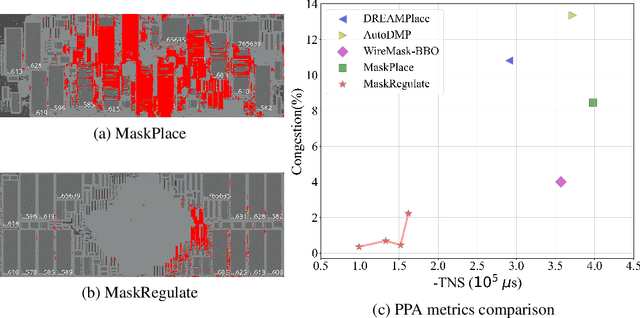
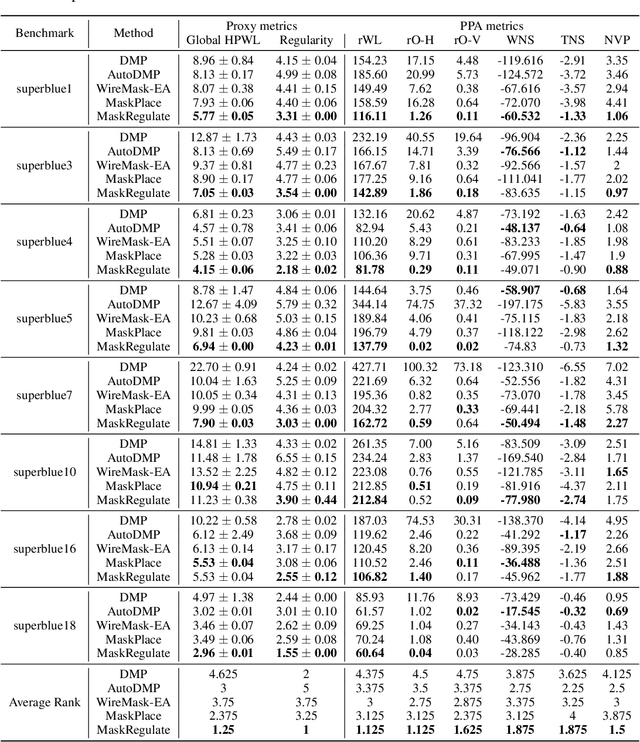
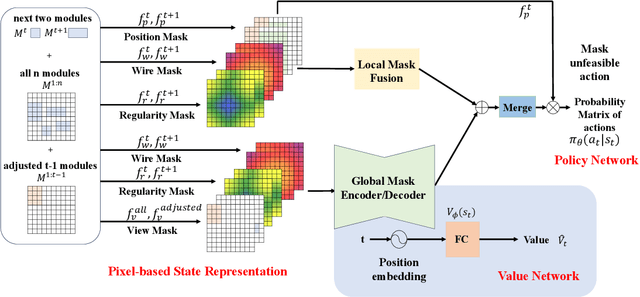
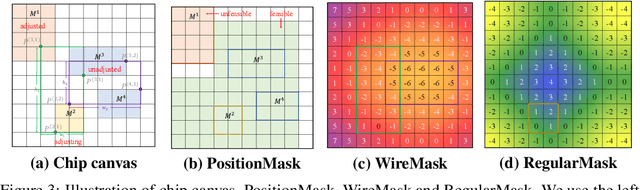
In modern chip design, placement aims at placing millions of circuit modules, which is an essential step that significantly influences power, performance, and area (PPA) metrics. Recently, reinforcement learning (RL) has emerged as a promising technique for improving placement quality, especially macro placement. However, current RL-based placement methods suffer from long training times, low generalization ability, and inability to guarantee PPA results. A key issue lies in the problem formulation, i.e., using RL to place from scratch, which results in limits useful information and inaccurate rewards during the training process. In this work, we propose an approach that utilizes RL for the refinement stage, which allows the RL policy to learn how to adjust existing placement layouts, thereby receiving sufficient information for the policy to act and obtain relatively dense and precise rewards. Additionally, we introduce the concept of regularity during training, which is considered an important metric in the chip design industry but is often overlooked in current RL placement methods. We evaluate our approach on the ISPD 2005 and ICCAD 2015 benchmark, comparing the global half-perimeter wirelength and regularity of our proposed method against several competitive approaches. Besides, we test the PPA performance using commercial software, showing that RL as a regulator can achieve significant PPA improvements. Our RL regulator can fine-tune placements from any method and enhance their quality. Our work opens up new possibilities for the application of RL in placement, providing a more effective and efficient approach to optimizing chip design. Our code is available at \url{https://github.com/lamda-bbo/macro-regulator}.