 Add to Chrome
 Add to Firefox
 Add to Edge
Provably Efficient Policy-Reward Co-Pretraining for Adversarial Imitation Learning
Jun 20, 2026
Adversarial imitation learning (AIL) achieves high-quality imitation compared to behavioral cloning (BC), but demands substantial online environment interaction. Recent empirical work has explored initializing AIL algorithms with BC pretrained policies to address this limitation, yet a rigorous theoretical understanding of pretraining's role in AIL remains elusive. This paper provides a systematic theoretical analysis and introduces principled pretraining algorithms for accelerating AIL. We begin by analyzing AIL with policy pretraining alone, identifying reward error as the dominant source of suboptimality. This reveals a critical and previously overlooked gap: the absence of reward pretraining. Motivated by this finding, we develop a principled policy-reward co-pretraining approach grounded in a reward shaping analysis. Our analysis uncovers a fundamental connection between expert policies and shaping rewards, which naturally gives rise to CoPT-AIL, an approach that jointly pretrains both policy and reward through a single BC procedure. We prove that CoPT-AIL achieves an improved imitation gap bound over standard AIL, establishing the first theoretical guarantee for the benefits of pretraining in AIL. Experimental results confirm CoPT-AIL's superior performance over existing AIL methods.

Cooperative Long Rope Skipping via Multi-Agent Reinforcement Learning
Jun 06, 2026Humans exhibit remarkable motor agility, enabling a wide range of dynamic skills such as running and jumping, which highlights the great potential of humanoid robots for athletic locomotion. Among athletic sports, long rope skipping requires two rope turners to cooperatively swing the rope while adapting to a player under different jumping rhythms, making it a meaningful yet challenging task for humanoid robots. Although existing methods for humanoid sports have achieved success in single-agent and interaction-free settings, such as running, dancing, and parkour, task scenarios that require precise coordination among multiple participants remain largely unexplored. To this end, we propose Marope, a multi-agent reinforcement learning (MARL) framework for cooperative long rope skipping with multiple humanoid robots. Specifically, Marope adopts a hierarchical reinforcement learning framework for policy training. At the lower level, it learns decentralized rope manipulation policies through MARL, while at the upper level, a centralized scheduling policy is trained to coordinate the execution of the lower-level policies. To improve generalization across different player behavioral styles, Marope further incorporates diverse jumping policies into cooperative game training. We evaluate our approach on Unitree G1 humanoid robots in both simulation and real-world settings. Experimental results demonstrate that Marope outperforms various baselines, achieving more efficient and stable rope manipulation as well as more robust and adaptable cooperation with varied players.
Adversarial Imitation Learning with General Function Approximation: Theoretical Analysis and Practical Algorithms
May 03, 2026Adversarial imitation learning (AIL), a prominent approach in imitation learning, has achieved significant practical success powered by neural network approximation. However, existing theoretical analyses of AIL are primarily confined to simplified settings, such as tabular and linear function approximation, and involve complex algorithmic designs that impede practical implementation. This creates a substantial gap between theory and practice. This paper bridges this gap by exploring the theoretical underpinnings of online AIL with general function approximation. We introduce a novel framework called optimization-based AIL (OPT-AIL), which performs online optimization for reward learning coupled with optimism-regularized optimization for policy learning. Within this framework, we develop two concrete methods: model-free OPT-AIL and model-based OPT-AIL. Our theoretical analysis demonstrates that both variants achieve polynomial expert sample complexity and interaction complexity for learning near-expert policies. To the best of our knowledge, they represent the first provably efficient AIL methods under general function approximation. From a practical standpoint, OPT-AIL requires only the approximate optimization of two objectives, thereby facilitating practical implementation. Empirical studies demonstrate that OPT-AIL outperforms previous state-of-the-art deep AIL methods across several challenging tasks.
How Can Reinforcement Learning Achieve Expert-level Placement?
Apr 28, 2026Chip placement is a critical step in physical design. While reinforcement learning (RL)-based methods have recently emerged, their training primarily focuses on wirelength optimization, and therefore often fail to achieve expert-quality layouts. We identify the reward design as the primary cause for the performance gap with experts, and instead of formalizing intricate processes, we circumvent this by directly learning from expert layouts to derive a reward model. Our approach starts from the final expert layouts to infer step-by-step expert trajectories. Using these trajectories as demonstrations or preferences, we train a model that captures the latent implicit rewards in expert results. Experiments show that our framework can efficiently learn from even a single design and generalize well to unseen cases.
Off-Policy Value-Based Reinforcement Learning for Large Language Models
Mar 24, 2026Improving data utilization efficiency is critical for scaling reinforcement learning (RL) for long-horizon tasks where generating trajectories is expensive. However, the dominant RL methods for LLMs are largely on-policy: they update each batch of data only once, discard it, and then collect fresh samples, resulting in poor sample efficiency. In this work, we explore an alternative value-based RL framework for LLMs that naturally enables off-policy learning. We propose ReVal, a Bellman-update-based method that combines stepwise signals capturing internal consistency with trajectory-level signals derived from outcome verification. ReVal naturally supports replay-buffer-based training, allowing efficient reuse of past trajectories. Experiments on standard mathematical reasoning benchmarks show that ReVal not only converges faster but also outperforms GRPO in final performance. On DeepSeek-R1-Distill-1.5B, ReVal improves training efficiency and achieves improvement of 2.7% in AIME24 and 4.5% in out-of-domain benchmark GPQA over GRPO. These results suggest that value-based RL is a practical alternative to policy-based methods for LLM training.
Non-Adversarial Imitation Learning Provably Free of Compounding Errors: The Role of Bellman Constraints
Mar 24, 2026Adversarial imitation learning (AIL) achieves high-quality imitation by mitigating compounding errors in behavioral cloning (BC), but often exhibits training instability due to adversarial optimization. To avoid this issue, a class of non-adversarial Q-based imitation learning (IL) methods, represented by IQ-Learn, has emerged and is widely believed to outperform BC by leveraging online environment interactions. However, this paper revisits IQ-Learn and demonstrates that it provably reduces to BC and suffers from an imitation gap lower bound with quadratic dependence on horizon, therefore still suffering from compounding errors. Theoretical analysis reveals that, despite using online interactions, IQ-Learn uniformly suppresses the Q-values for all actions on states uncovered by demonstrations, thereby failing to generalize. To address this limitation, we introduce a primal-dual framework for distribution matching, yielding a new Q-based IL method, Dual Q-DM. The key mechanism in Dual Q-DM is incorporating Bellman constraints to propagate high Q-values from visited states to unvisited ones, thereby achieving generalization beyond demonstrations. We prove that Dual Q-DM is equivalent to AIL and can recover expert actions beyond demonstrations, thereby mitigating compounding errors. To the best of our knowledge, Dual Q-DM is the first non-adversarial IL method that is theoretically guaranteed to eliminate compounding errors. Experimental results further corroborate our theoretical results.
Provably and Practically Efficient Adversarial Imitation Learning with General Function Approximation
Nov 01, 2024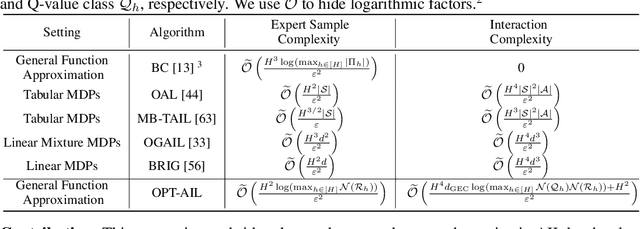
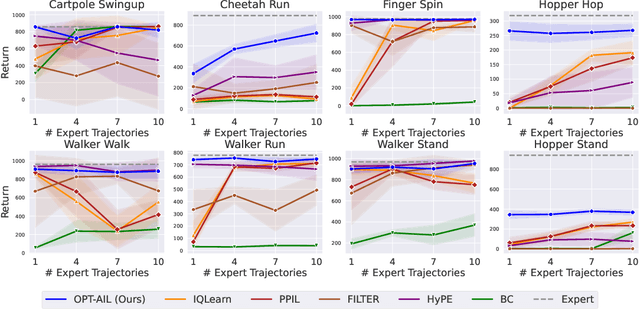
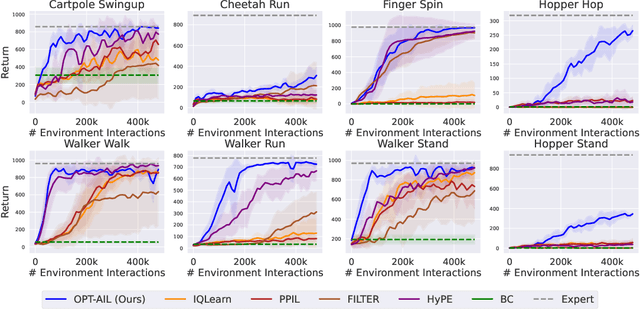
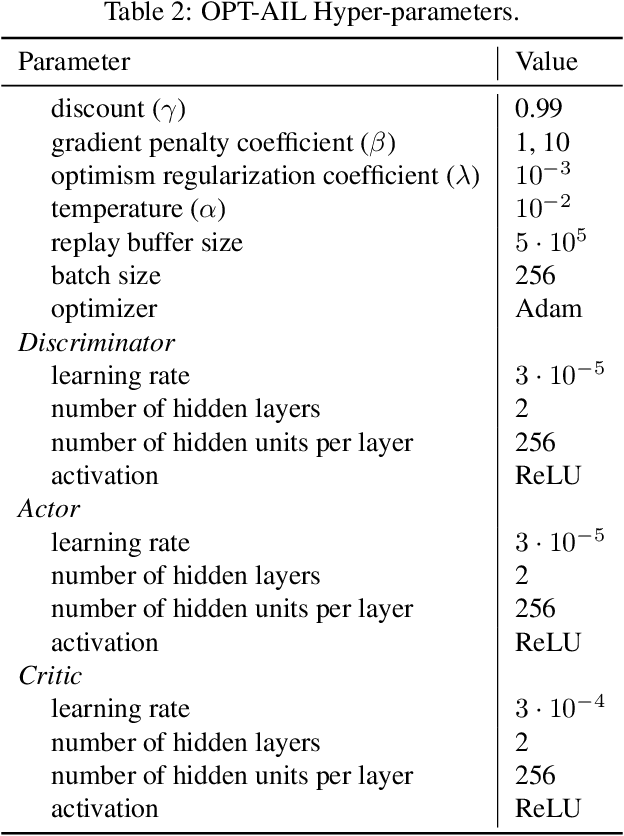
As a prominent category of imitation learning methods, adversarial imitation learning (AIL) has garnered significant practical success powered by neural network approximation. However, existing theoretical studies on AIL are primarily limited to simplified scenarios such as tabular and linear function approximation and involve complex algorithmic designs that hinder practical implementation, highlighting a gap between theory and practice. In this paper, we explore the theoretical underpinnings of online AIL with general function approximation. We introduce a new method called optimization-based AIL (OPT-AIL), which centers on performing online optimization for reward functions and optimism-regularized Bellman error minimization for Q-value functions. Theoretically, we prove that OPT-AIL achieves polynomial expert sample complexity and interaction complexity for learning near-expert policies. To our best knowledge, OPT-AIL is the first provably efficient AIL method with general function approximation. Practically, OPT-AIL only requires the approximate optimization of two objectives, thereby facilitating practical implementation. Empirical studies demonstrate that OPT-AIL outperforms previous state-of-the-art deep AIL methods in several challenging tasks.
Collaborative motion planning for multi-manipulator systems through Reinforcement Learning and Dynamic Movement Primitives
Oct 01, 2024Robotic tasks often require multiple manipulators to enhance task efficiency and speed, but this increases complexity in terms of collaboration, collision avoidance, and the expanded state-action space. To address these challenges, we propose a multi-level approach combining Reinforcement Learning (RL) and Dynamic Movement Primitives (DMP) to generate adaptive, real-time trajectories for new tasks in dynamic environments using a demonstration library. This method ensures collision-free trajectory generation and efficient collaborative motion planning. We validate the approach through experiments in the PyBullet simulation environment with UR5e robotic manipulators.
Entropic Distribution Matching in Supervised Fine-tuning of LLMs: Less Overfitting and Better Diversity
Aug 29, 2024Large language models rely on Supervised Fine-Tuning (SFT) to specialize in downstream tasks. Cross Entropy (CE) loss is the de facto choice in SFT, but it often leads to overfitting and limited output diversity due to its aggressive updates to the data distribution. This paper aim to address these issues by introducing the maximum entropy principle, which favors models with flatter distributions that still effectively capture the data. Specifically, we develop a new distribution matching method called GEM, which solves reverse Kullback-Leibler divergence minimization with an entropy regularizer. For the SFT of Llama-3-8B models, GEM outperforms CE in several aspects. First, when applied to the UltraFeedback dataset to develop general instruction-following abilities, GEM exhibits reduced overfitting, evidenced by lower perplexity and better performance on the IFEval benchmark. Furthermore, GEM enhances output diversity, leading to performance gains of up to 7 points on math reasoning and code generation tasks using best-of-n sampling, even without domain-specific data. Second, when fine-tuning with domain-specific datasets for math reasoning and code generation, GEM also shows less overfitting and improvements of up to 10 points compared with CE.
AI-driven platform for systematic nomenclature and intelligent knowledge acquisition of natural medicinal materials
Dec 27, 2023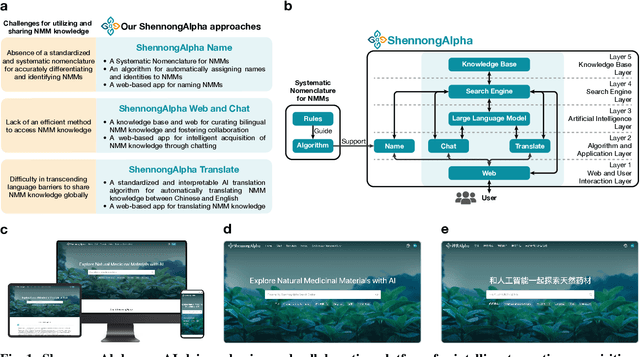
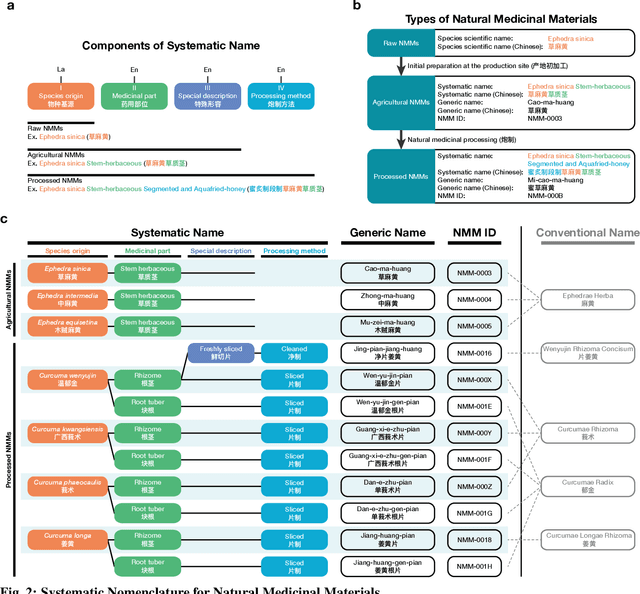
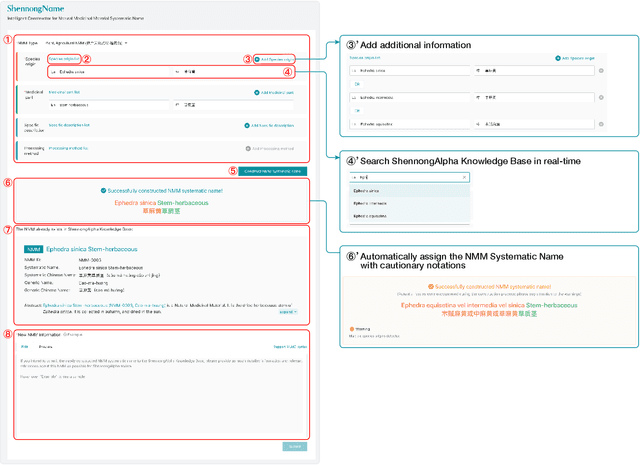

Natural Medicinal Materials (NMMs) have a long history of global clinical applications, accompanied by extensive informational records. Despite their significant impact on healthcare, the field faces a major challenge: the non-standardization of NMM knowledge, stemming from historical complexities and causing limitations in broader applications. To address this, we introduce a Systematic Nomenclature for NMMs, underpinned by ShennongAlpha, an AI-driven platform designed for intelligent knowledge acquisition. This nomenclature system enables precise identification and differentiation of NMMs. ShennongAlpha, cataloging over ten thousand NMMs with standardized bilingual information, enhances knowledge management and application capabilities, thereby overcoming traditional barriers. Furthermore, it pioneers AI-empowered conversational knowledge acquisition and standardized machine translation. These synergistic innovations mark the first major advance in integrating domain-specific NMM knowledge with AI, propelling research and applications across both NMM and AI fields while establishing a groundbreaking precedent in this crucial area.