 Add to Chrome
 Add to Firefox
 Add to Edge
Pattern Integration and Enhancement Vision Transformer for Self-Supervised Learning in Remote Sensing
Nov 09, 2024
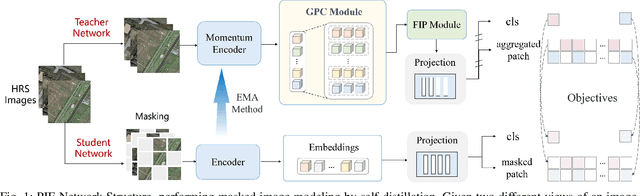

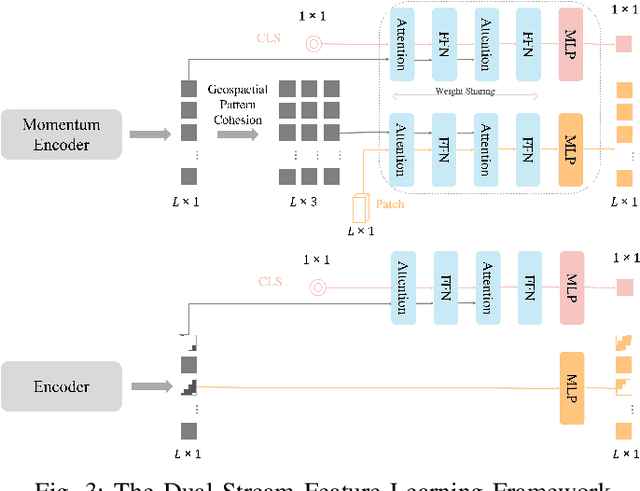
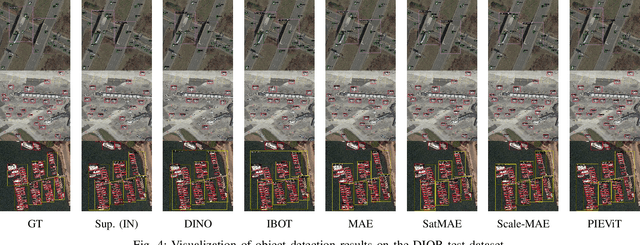
Recent self-supervised learning (SSL) methods have demonstrated impressive results in learning visual representations from unlabeled remote sensing images. However, most remote sensing images predominantly consist of scenographic scenes containing multiple ground objects without explicit foreground targets, which limits the performance of existing SSL methods that focus on foreground targets. This raises the question: Is there a method that can automatically aggregate similar objects within scenographic remote sensing images, thereby enabling models to differentiate knowledge embedded in various geospatial patterns for improved feature representation? In this work, we present the Pattern Integration and Enhancement Vision Transformer (PIEViT), a novel self-supervised learning framework designed specifically for remote sensing imagery. PIEViT utilizes a teacher-student architecture to address both image-level and patch-level tasks. It employs the Geospatial Pattern Cohesion (GPC) module to explore the natural clustering of patches, enhancing the differentiation of individual features. The Feature Integration Projection (FIP) module further refines masked token reconstruction using geospatially clustered patches. We validated PIEViT across multiple downstream tasks, including object detection, semantic segmentation, and change detection. Experiments demonstrated that PIEViT enhances the representation of internal patch features, providing significant improvements over existing self-supervised baselines. It achieves excellent results in object detection, land cover classification, and change detection, underscoring its robustness, generalization, and transferability for remote sensing image interpretation tasks.

MIA-DPO: Multi-Image Augmented Direct Preference Optimization For Large Vision-Language Models
Oct 23, 2024
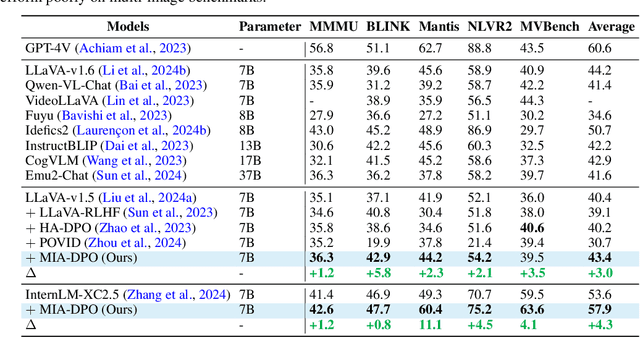


Visual preference alignment involves training Large Vision-Language Models (LVLMs) to predict human preferences between visual inputs. This is typically achieved by using labeled datasets of chosen/rejected pairs and employing optimization algorithms like direct preference optimization (DPO). Existing visual alignment methods, primarily designed for single-image scenarios, struggle to effectively handle the complexity of multi-image tasks due to the scarcity of diverse training data and the high cost of annotating chosen/rejected pairs. We present Multi-Image Augmented Direct Preference Optimization (MIA-DPO), a visual preference alignment approach that effectively handles multi-image inputs. MIA-DPO mitigates the scarcity of diverse multi-image training data by extending single-image data with unrelated images arranged in grid collages or pic-in-pic formats, significantly reducing the costs associated with multi-image data annotations. Our observation reveals that attention values of LVLMs vary considerably across different images. We use attention values to identify and filter out rejected responses the model may have mistakenly focused on. Our attention-aware selection for constructing the chosen/rejected pairs without relying on (i) human annotation, (ii) extra data, and (iii) external models or APIs. MIA-DPO is compatible with various architectures and outperforms existing methods on five multi-image benchmarks, achieving an average performance boost of 3.0% on LLaVA-v1.5 and 4.3% on the recent InternLM-XC2.5. Moreover, MIA-DPO has a minimal effect on the model's ability to understand single images.
PyramidDrop: Accelerating Your Large Vision-Language Models via Pyramid Visual Redundancy Reduction
Oct 22, 2024In large vision-language models (LVLMs), images serve as inputs that carry a wealth of information. As the idiom "A picture is worth a thousand words" implies, representing a single image in current LVLMs can require hundreds or even thousands of tokens. This results in significant computational costs, which grow quadratically as input image resolution increases, thereby severely impacting the efficiency of both training and inference. Previous approaches have attempted to reduce the number of image tokens either before or within the early layers of LVLMs. However, these strategies inevitably result in the loss of crucial image information, ultimately diminishing model performance. To address this challenge, we conduct an empirical study revealing that all visual tokens are necessary for LVLMs in the shallow layers, and token redundancy progressively increases in the deeper layers of the model. To this end, we propose PyramidDrop, a visual redundancy reduction strategy for LVLMs to boost their efficiency in both training and inference with neglectable performance loss. Specifically, we partition the LVLM into several stages and drop part of the image tokens at the end of each stage with a pre-defined ratio, creating pyramid-like visual tokens across model layers. The dropping is based on a lightweight similarity calculation with a negligible time overhead. Extensive experiments demonstrate that PyramidDrop can achieve a 40% training time and 55% inference FLOPs acceleration of LLaVA-NeXT with comparable performance. Besides, the PyramidDrop could also serve as a plug-and-play strategy for inference acceleration without training, with better performance and lower inference cost than counterparts. We hope that the insights and approach introduced by PyramidDrop will inspire future research to further investigate the role of image tokens in LVLMs.
SAM2Long: Enhancing SAM 2 for Long Video Segmentation with a Training-Free Memory Tree
Oct 21, 2024The Segment Anything Model 2 (SAM 2) has emerged as a powerful foundation model for object segmentation in both images and videos, paving the way for various downstream video applications. The crucial design of SAM 2 for video segmentation is its memory module, which prompts object-aware memories from previous frames for current frame prediction. However, its greedy-selection memory design suffers from the "error accumulation" problem, where an errored or missed mask will cascade and influence the segmentation of the subsequent frames, which limits the performance of SAM 2 toward complex long-term videos. To this end, we introduce SAM2Long, an improved training-free video object segmentation strategy, which considers the segmentation uncertainty within each frame and chooses the video-level optimal results from multiple segmentation pathways in a constrained tree search manner. In practice, we maintain a fixed number of segmentation pathways throughout the video. For each frame, multiple masks are proposed based on the existing pathways, creating various candidate branches. We then select the same fixed number of branches with higher cumulative scores as the new pathways for the next frame. After processing the final frame, the pathway with the highest cumulative score is chosen as the final segmentation result. Benefiting from its heuristic search design, SAM2Long is robust toward occlusions and object reappearances, and can effectively segment and track objects for complex long-term videos. Notably, SAM2Long achieves an average improvement of 3.0 points across all 24 head-to-head comparisons, with gains of up to 5.3 points in J&F on long-term video object segmentation benchmarks such as SA-V and LVOS. The code is released at https://github.com/Mark12Ding/SAM2Long.
Deciphering Cross-Modal Alignment in Large Vision-Language Models with Modality Integration Rate
Oct 09, 2024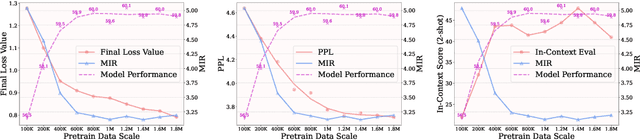

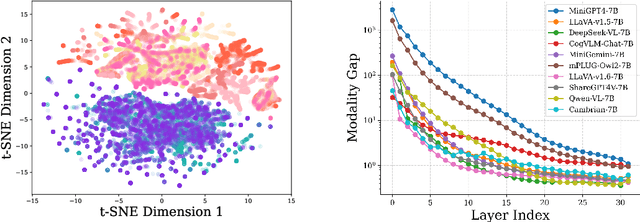
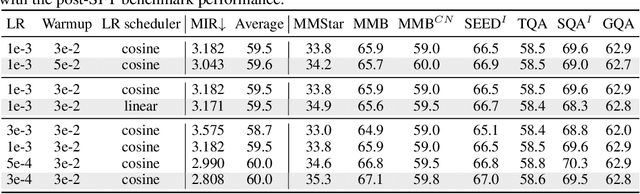
We present the Modality Integration Rate (MIR), an effective, robust, and generalized metric to indicate the multi-modal pre-training quality of Large Vision Language Models (LVLMs). Large-scale pre-training plays a critical role in building capable LVLMs, while evaluating its training quality without the costly supervised fine-tuning stage is under-explored. Loss, perplexity, and in-context evaluation results are commonly used pre-training metrics for Large Language Models (LLMs), while we observed that these metrics are less indicative when aligning a well-trained LLM with a new modality. Due to the lack of proper metrics, the research of LVLMs in the critical pre-training stage is hindered greatly, including the training data choice, efficient module design, etc. In this paper, we propose evaluating the pre-training quality from the inter-modal distribution distance perspective and present MIR, the Modality Integration Rate, which is 1) \textbf{Effective} to represent the pre-training quality and show a positive relation with the benchmark performance after supervised fine-tuning. 2) \textbf{Robust} toward different training/evaluation data. 3) \textbf{Generalize} across training configurations and architecture choices. We conduct a series of pre-training experiments to explore the effectiveness of MIR and observe satisfactory results that MIR is indicative about training data selection, training strategy schedule, and model architecture design to get better pre-training results. We hope MIR could be a helpful metric for building capable LVLMs and inspire the following research about modality alignment in different areas. Our code is at: https://github.com/shikiw/Modality-Integration-Rate.
BroadWay: Boost Your Text-to-Video Generation Model in a Training-free Way
Oct 08, 2024

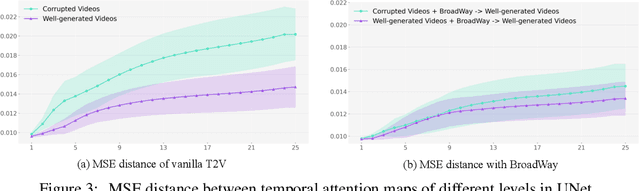

The text-to-video (T2V) generation models, offering convenient visual creation, have recently garnered increasing attention. Despite their substantial potential, the generated videos may present artifacts, including structural implausibility, temporal inconsistency, and a lack of motion, often resulting in near-static video. In this work, we have identified a correlation between the disparity of temporal attention maps across different blocks and the occurrence of temporal inconsistencies. Additionally, we have observed that the energy contained within the temporal attention maps is directly related to the magnitude of motion amplitude in the generated videos. Based on these observations, we present BroadWay, a training-free method to improve the quality of text-to-video generation without introducing additional parameters, augmenting memory or sampling time. Specifically, BroadWay is composed of two principal components: 1) Temporal Self-Guidance improves the structural plausibility and temporal consistency of generated videos by reducing the disparity between the temporal attention maps across various decoder blocks. 2) Fourier-based Motion Enhancement enhances the magnitude and richness of motion by amplifying the energy of the map. Extensive experiments demonstrate that BroadWay significantly improves the quality of text-to-video generation with negligible additional cost.
VLMEvalKit: An Open-Source Toolkit for Evaluating Large Multi-Modality Models
Jul 16, 2024
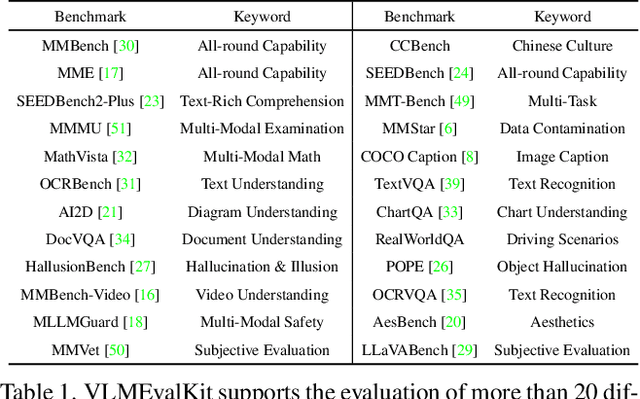

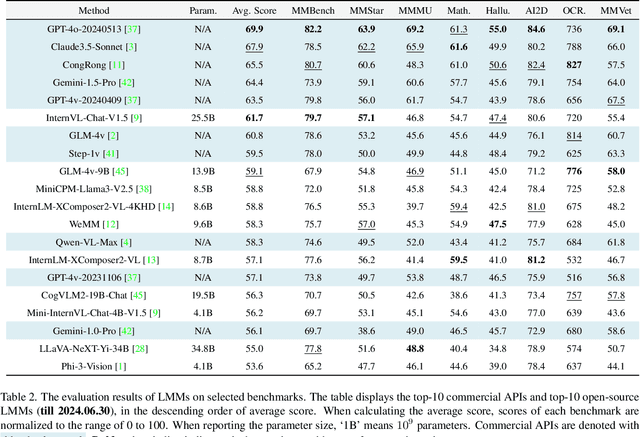
We present VLMEvalKit: an open-source toolkit for evaluating large multi-modality models based on PyTorch. The toolkit aims to provide a user-friendly and comprehensive framework for researchers and developers to evaluate existing multi-modality models and publish reproducible evaluation results. In VLMEvalKit, we implement over 70 different large multi-modality models, including both proprietary APIs and open-source models, as well as more than 20 different multi-modal benchmarks. By implementing a single interface, new models can be easily added to the toolkit, while the toolkit automatically handles the remaining workloads, including data preparation, distributed inference, prediction post-processing, and metric calculation. Although the toolkit is currently mainly used for evaluating large vision-language models, its design is compatible with future updates that incorporate additional modalities, such as audio and video. Based on the evaluation results obtained with the toolkit, we host OpenVLM Leaderboard, a comprehensive leaderboard to track the progress of multi-modality learning research. The toolkit is released at https://github.com/open-compass/VLMEvalKit and is actively maintained.
InternLM-XComposer-2.5: A Versatile Large Vision Language Model Supporting Long-Contextual Input and Output
Jul 03, 2024

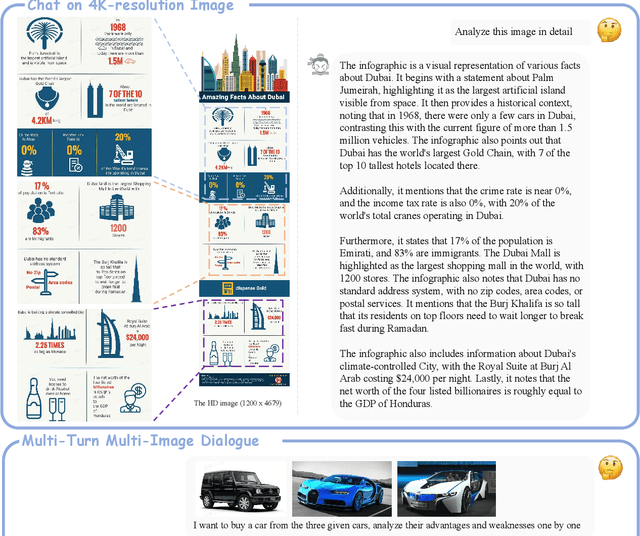
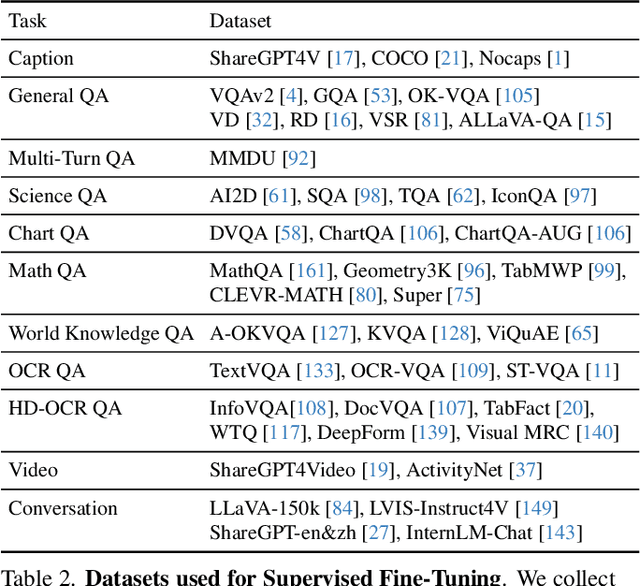
We present InternLM-XComposer-2.5 (IXC-2.5), a versatile large-vision language model that supports long-contextual input and output. IXC-2.5 excels in various text-image comprehension and composition applications, achieving GPT-4V level capabilities with merely 7B LLM backend. Trained with 24K interleaved image-text contexts, it can seamlessly extend to 96K long contexts via RoPE extrapolation. This long-context capability allows IXC-2.5 to excel in tasks requiring extensive input and output contexts. Compared to its previous 2.0 version, InternLM-XComposer-2.5 features three major upgrades in vision-language comprehension: (1) Ultra-High Resolution Understanding, (2) Fine-Grained Video Understanding, and (3) Multi-Turn Multi-Image Dialogue. In addition to comprehension, IXC-2.5 extends to two compelling applications using extra LoRA parameters for text-image composition: (1) Crafting Webpages and (2) Composing High-Quality Text-Image Articles. IXC-2.5 has been evaluated on 28 benchmarks, outperforming existing open-source state-of-the-art models on 16 benchmarks. It also surpasses or competes closely with GPT-4V and Gemini Pro on 16 key tasks. The InternLM-XComposer-2.5 is publicly available at https://github.com/InternLM/InternLM-XComposer.
Research on target detection method of distracted driving behavior based on improved YOLOv8
Jul 02, 2024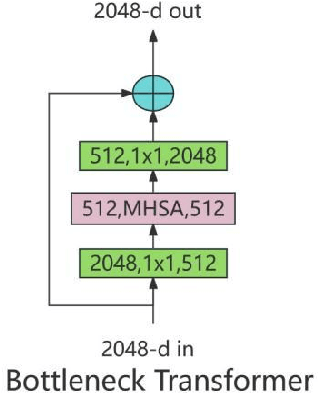
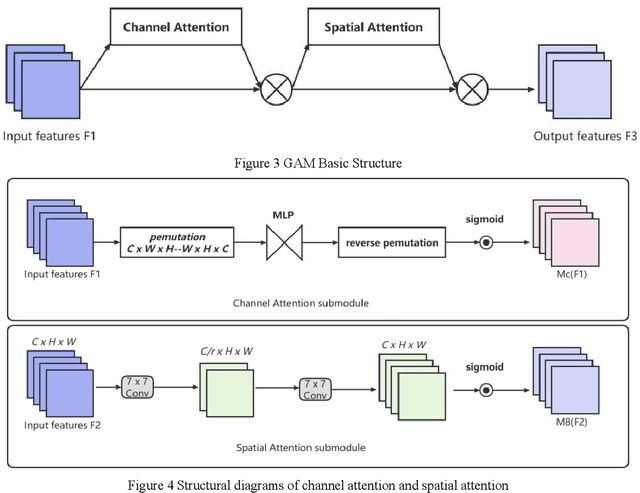
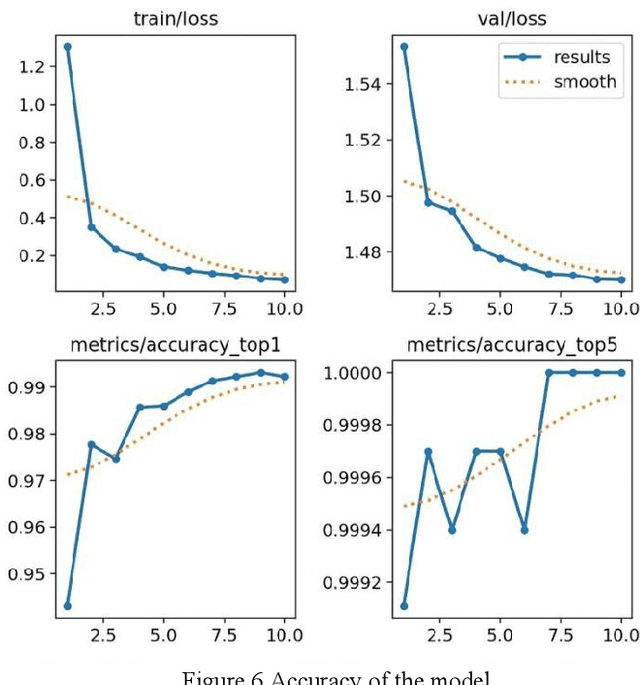
With the development of deep learning technology, the detection and classification of distracted driving behaviour requires higher accuracy. Existing deep learning-based methods are computationally intensive and parameter redundant, limiting the efficiency and accuracy in practical applications. To solve this problem, this study proposes an improved YOLOv8 detection method based on the original YOLOv8 model by integrating the BoTNet module, GAM attention mechanism and EIoU loss function. By optimising the feature extraction and multi-scale feature fusion strategies, the training and inference processes are simplified, and the detection accuracy and efficiency are significantly improved. Experimental results show that the improved model performs well in both detection speed and accuracy, with an accuracy rate of 99.4%, and the model is smaller and easy to deploy, which is able to identify and classify distracted driving behaviours in real time, provide timely warnings, and enhance driving safety.
MMLongBench-Doc: Benchmarking Long-context Document Understanding with Visualizations
Jul 01, 2024Understanding documents with rich layouts and multi-modal components is a long-standing and practical task. Recent Large Vision-Language Models (LVLMs) have made remarkable strides in various tasks, particularly in single-page document understanding (DU). However, their abilities on long-context DU remain an open problem. This work presents MMLongBench-Doc, a long-context, multi-modal benchmark comprising 1,062 expert-annotated questions. Distinct from previous datasets, it is constructed upon 130 lengthy PDF-formatted documents with an average of 49.4 pages and 20,971 textual tokens. Towards comprehensive evaluation, answers to these questions rely on pieces of evidence from (1) different sources (text, image, chart, table, and layout structure) and (2) various locations (i.e. page number). Moreover, 33.2% of the questions are cross-page questions requiring evidence across multiple pages. 22.8% of the questions are designed to be unanswerable for detecting potential hallucinations. Experiments on 14 LVLMs demonstrate that long-context DU greatly challenges current models. Notably, the best-performing model, GPT-4o, achieves an F1 score of only 42.7%, while the second-best, GPT-4V, scores 31.4%. Furthermore, 12 LVLMs (all except GPT-4o and GPT-4V) even present worse performance than their LLM counterparts which are fed with lossy-parsed OCR documents. These results validate the necessity of future research toward more capable long-context LVLMs. Project Page: https://mayubo2333.github.io/MMLongBench-Doc