 Add to Chrome
 Add to Firefox
 Add to Edge
EMDB: The Electromagnetic Database of Global 3D Human Pose and Shape in the Wild
Aug 31, 2023
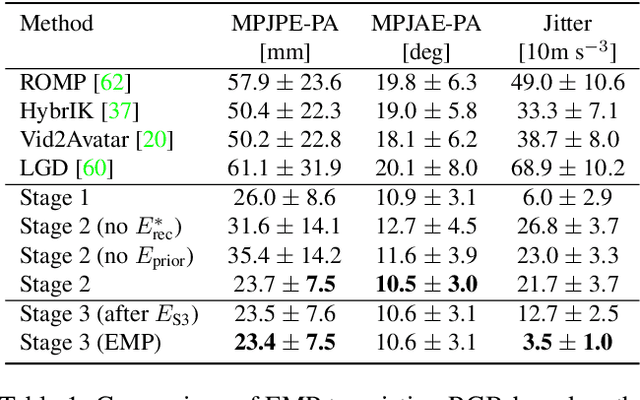
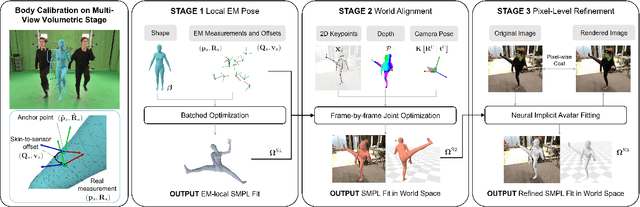

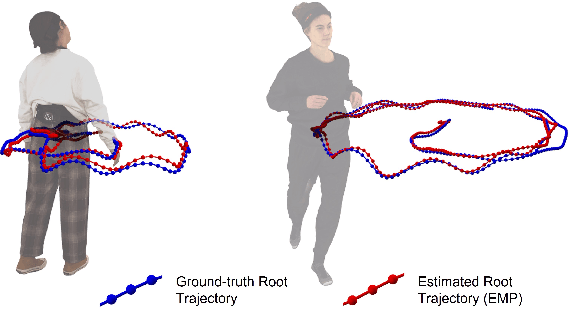
We present EMDB, the Electromagnetic Database of Global 3D Human Pose and Shape in the Wild. EMDB is a novel dataset that contains high-quality 3D SMPL pose and shape parameters with global body and camera trajectories for in-the-wild videos. We use body-worn, wireless electromagnetic (EM) sensors and a hand-held iPhone to record a total of 58 minutes of motion data, distributed over 81 indoor and outdoor sequences and 10 participants. Together with accurate body poses and shapes, we also provide global camera poses and body root trajectories. To construct EMDB, we propose a multi-stage optimization procedure, which first fits SMPL to the 6-DoF EM measurements and then refines the poses via image observations. To achieve high-quality results, we leverage a neural implicit avatar model to reconstruct detailed human surface geometry and appearance, which allows for improved alignment and smoothness via a dense pixel-level objective. Our evaluations, conducted with a multi-view volumetric capture system, indicate that EMDB has an expected accuracy of 2.3 cm positional and 10.6 degrees angular error, surpassing the accuracy of previous in-the-wild datasets. We evaluate existing state-of-the-art monocular RGB methods for camera-relative and global pose estimation on EMDB. EMDB is publicly available under https://ait.ethz.ch/emdb

Palm: Predicting Actions through Language Models @ Ego4D Long-Term Action Anticipation Challenge 2023
Jun 28, 2023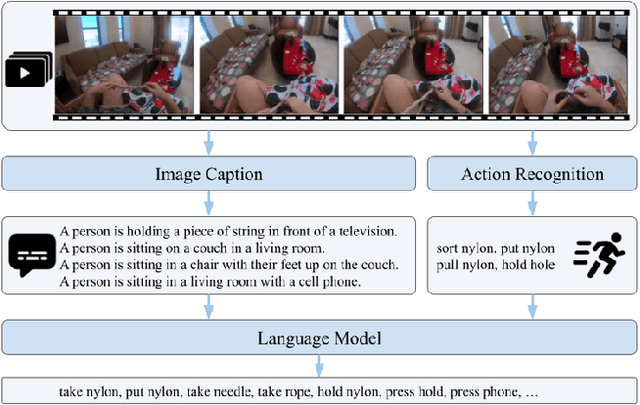
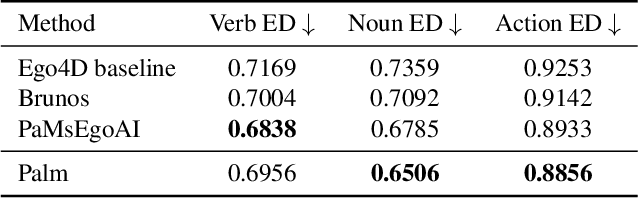
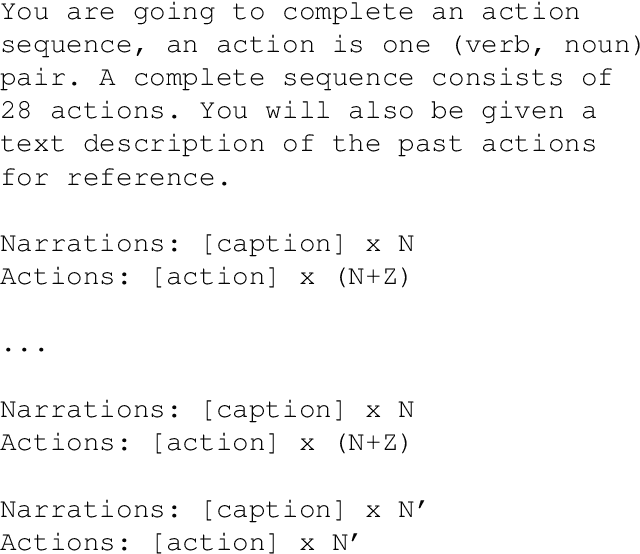
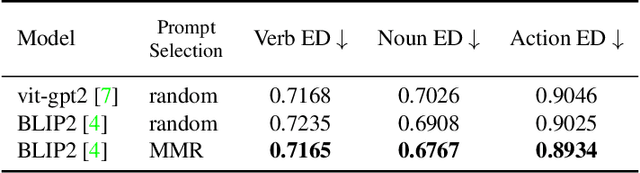
We present Palm, a solution to the Long-Term Action Anticipation (LTA) task utilizing vision-language and large language models. Given an input video with annotated action periods, the LTA task aims to predict possible future actions. We hypothesize that an optimal solution should capture the interdependency between past and future actions, and be able to infer future actions based on the structure and dependency encoded in the past actions. Large language models have demonstrated remarkable commonsense-based reasoning ability. Inspired by that, Palm chains an image captioning model and a large language model. It predicts future actions based on frame descriptions and action labels extracted from the input videos. Our method outperforms other participants in the EGO4D LTA challenge and achieves the best performance in terms of action prediction. Our code is available at https://github.com/DanDoge/Palm
EFE: End-to-end Frame-to-Gaze Estimation
May 09, 2023


Despite the recent development of learning-based gaze estimation methods, most methods require one or more eye or face region crops as inputs and produce a gaze direction vector as output. Cropping results in a higher resolution in the eye regions and having fewer confounding factors (such as clothing and hair) is believed to benefit the final model performance. However, this eye/face patch cropping process is expensive, erroneous, and implementation-specific for different methods. In this paper, we propose a frame-to-gaze network that directly predicts both 3D gaze origin and 3D gaze direction from the raw frame out of the camera without any face or eye cropping. Our method demonstrates that direct gaze regression from the raw downscaled frame, from FHD/HD to VGA/HVGA resolution, is possible despite the challenges of having very few pixels in the eye region. The proposed method achieves comparable results to state-of-the-art methods in Point-of-Gaze (PoG) estimation on three public gaze datasets: GazeCapture, MPIIFaceGaze, and EVE, and generalizes well to extreme camera view changes.
AG3D: Learning to Generate 3D Avatars from 2D Image Collections
May 03, 2023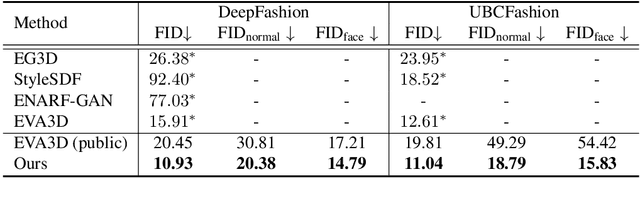
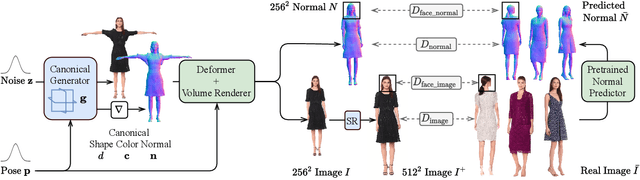
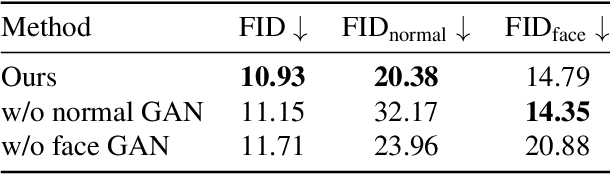
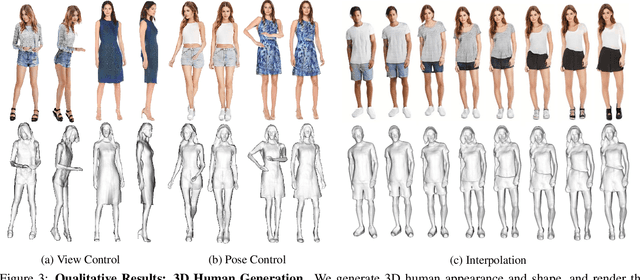
While progress in 2D generative models of human appearance has been rapid, many applications require 3D avatars that can be animated and rendered. Unfortunately, most existing methods for learning generative models of 3D humans with diverse shape and appearance require 3D training data, which is limited and expensive to acquire. The key to progress is hence to learn generative models of 3D avatars from abundant unstructured 2D image collections. However, learning realistic and complete 3D appearance and geometry in this under-constrained setting remains challenging, especially in the presence of loose clothing such as dresses. In this paper, we propose a new adversarial generative model of realistic 3D people from 2D images. Our method captures shape and deformation of the body and loose clothing by adopting a holistic 3D generator and integrating an efficient and flexible articulation module. To improve realism, we train our model using multiple discriminators while also integrating geometric cues in the form of predicted 2D normal maps. We experimentally find that our method outperforms previous 3D- and articulation-aware methods in terms of geometry and appearance. We validate the effectiveness of our model and the importance of each component via systematic ablation studies.
Learning Locally Editable Virtual Humans
Apr 28, 2023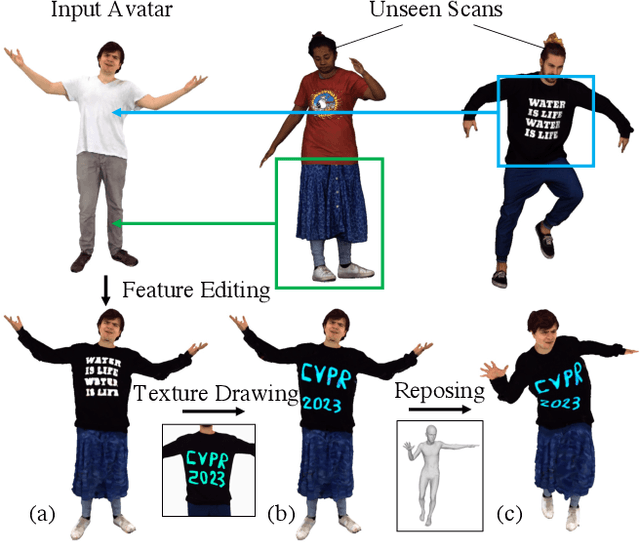
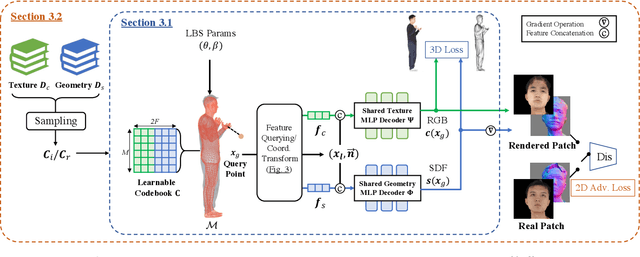
In this paper, we propose a novel hybrid representation and end-to-end trainable network architecture to model fully editable and customizable neural avatars. At the core of our work lies a representation that combines the modeling power of neural fields with the ease of use and inherent 3D consistency of skinned meshes. To this end, we construct a trainable feature codebook to store local geometry and texture features on the vertices of a deformable body model, thus exploiting its consistent topology under articulation. This representation is then employed in a generative auto-decoder architecture that admits fitting to unseen scans and sampling of realistic avatars with varied appearances and geometries. Furthermore, our representation allows local editing by swapping local features between 3D assets. To verify our method for avatar creation and editing, we contribute a new high-quality dataset, dubbed CustomHumans, for training and evaluation. Our experiments quantitatively and qualitatively show that our method generates diverse detailed avatars and achieves better model fitting performance compared to state-of-the-art methods. Our code and dataset are available at https://custom-humans.github.io/.
Learning Human-to-Robot Handovers from Point Clouds
Mar 30, 2023We propose the first framework to learn control policies for vision-based human-to-robot handovers, a critical task for human-robot interaction. While research in Embodied AI has made significant progress in training robot agents in simulated environments, interacting with humans remains challenging due to the difficulties of simulating humans. Fortunately, recent research has developed realistic simulated environments for human-to-robot handovers. Leveraging this result, we introduce a method that is trained with a human-in-the-loop via a two-stage teacher-student framework that uses motion and grasp planning, reinforcement learning, and self-supervision. We show significant performance gains over baselines on a simulation benchmark, sim-to-sim transfer and sim-to-real transfer.
Human from Blur: Human Pose Tracking from Blurry Images
Mar 30, 2023We propose a method to estimate 3D human poses from substantially blurred images. The key idea is to tackle the inverse problem of image deblurring by modeling the forward problem with a 3D human model, a texture map, and a sequence of poses to describe human motion. The blurring process is then modeled by a temporal image aggregation step. Using a differentiable renderer, we can solve the inverse problem by backpropagating the pixel-wise reprojection error to recover the best human motion representation that explains a single or multiple input images. Since the image reconstruction loss alone is insufficient, we present additional regularization terms. To the best of our knowledge, we present the first method to tackle this problem. Our method consistently outperforms other methods on significantly blurry inputs since they lack one or multiple key functionalities that our method unifies, i.e. image deblurring with sub-frame accuracy and explicit 3D modeling of non-rigid human motion.
Hi4D: 4D Instance Segmentation of Close Human Interaction
Mar 27, 2023

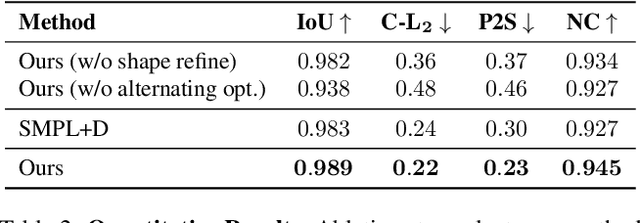

We propose Hi4D, a method and dataset for the automatic analysis of physically close human-human interaction under prolonged contact. Robustly disentangling several in-contact subjects is a challenging task due to occlusions and complex shapes. Hence, existing multi-view systems typically fuse 3D surfaces of close subjects into a single, connected mesh. To address this issue we leverage i) individually fitted neural implicit avatars; ii) an alternating optimization scheme that refines pose and surface through periods of close proximity; and iii) thus segment the fused raw scans into individual instances. From these instances we compile Hi4D dataset of 4D textured scans of 20 subject pairs, 100 sequences, and a total of more than 11K frames. Hi4D contains rich interaction-centric annotations in 2D and 3D alongside accurately registered parametric body models. We define varied human pose and shape estimation tasks on this dataset and provide results from state-of-the-art methods on these benchmarks.
Efficient Learning of High Level Plans from Play
Mar 16, 2023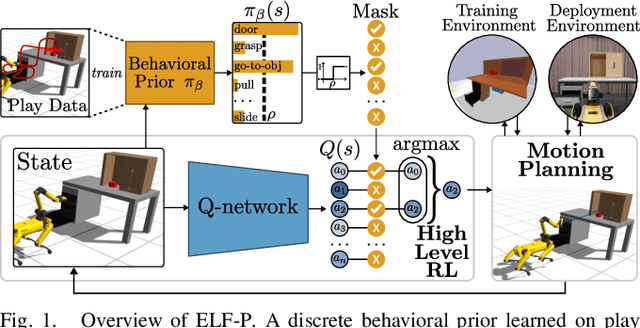
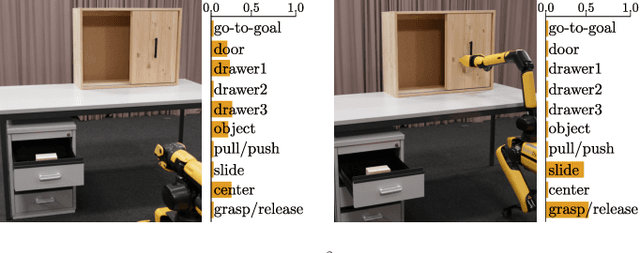
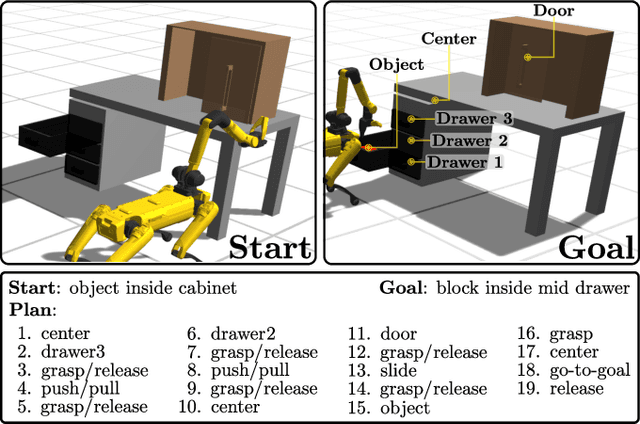

Real-world robotic manipulation tasks remain an elusive challenge, since they involve both fine-grained environment interaction, as well as the ability to plan for long-horizon goals. Although deep reinforcement learning (RL) methods have shown encouraging results when planning end-to-end in high-dimensional environments, they remain fundamentally limited by poor sample efficiency due to inefficient exploration, and by the complexity of credit assignment over long horizons. In this work, we present Efficient Learning of High-Level Plans from Play (ELF-P), a framework for robotic learning that bridges motion planning and deep RL to achieve long-horizon complex manipulation tasks. We leverage task-agnostic play data to learn a discrete behavioral prior over object-centric primitives, modeling their feasibility given the current context. We then design a high-level goal-conditioned policy which (1) uses primitives as building blocks to scaffold complex long-horizon tasks and (2) leverages the behavioral prior to accelerate learning. We demonstrate that ELF-P has significantly better sample efficiency than relevant baselines over multiple realistic manipulation tasks and learns policies that can be easily transferred to physical hardware.
X-Avatar: Expressive Human Avatars
Mar 09, 2023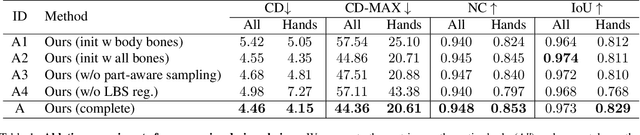
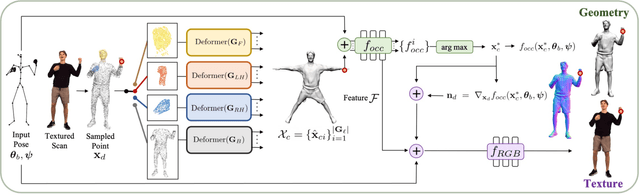
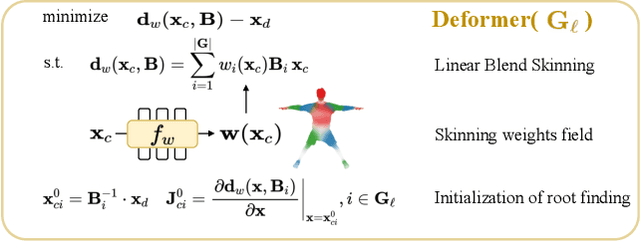
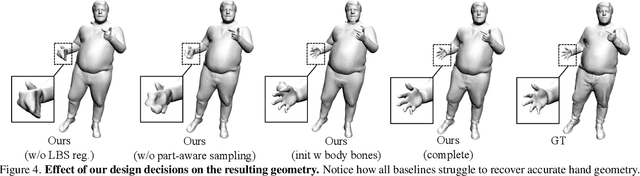
We present X-Avatar, a novel avatar model that captures the full expressiveness of digital humans to bring about life-like experiences in telepresence, AR/VR and beyond. Our method models bodies, hands, facial expressions and appearance in a holistic fashion and can be learned from either full 3D scans or RGB-D data. To achieve this, we propose a part-aware learned forward skinning module that can be driven by the parameter space of SMPL-X, allowing for expressive animation of X-Avatars. To efficiently learn the neural shape and deformation fields, we propose novel part-aware sampling and initialization strategies. This leads to higher fidelity results, especially for smaller body parts while maintaining efficient training despite increased number of articulated bones. To capture the appearance of the avatar with high-frequency details, we extend the geometry and deformation fields with a texture network that is conditioned on pose, facial expression, geometry and the normals of the deformed surface. We show experimentally that our method outperforms strong baselines in both data domains both quantitatively and qualitatively on the animation task. To facilitate future research on expressive avatars we contribute a new dataset, called X-Humans, containing 233 sequences of high-quality textured scans from 20 participants, totalling 35,500 data frames.