 Add to Chrome
 Add to Firefox
 Add to Edge
BayesContact: Uncertain Pose Estimation via Visuo-Tactile Proposals and Simulation-based Inference
Jul 17, 2026
Contact-rich manipulation requires pose estimates that are often more accurate than what depth-only sensing provides. Existing methods, relying on vision and contact, employ costly offline training procedures that need to be retrained for new environments and geometries. We propose BayesContact, a Simulation-Based Inference framework for visuo-tactile pose estimation in peg-in-hole insertion. BayesContact maintains a particle belief over object pose and fuses depth observations with force/torque-derived contact evidence. We employ simulation based forward models to approximate these observation likelihoods. For each pose hypothesis, a renderer predicts depth measurements and a physics simulator predicts contact outcomes under guarded probing actions; both are scored against real observations to update the belief. The resulting multimodal belief also enables information-gain-based probing for active disambiguation. Across simulated geometries and real-robot experiments, BayesContact improves pose observability and insertion success over vision-only inference by 30%

Optimal Transport Q-Learning for Flow Policy Steering and Acceleration
Jul 07, 2026Diffusion and flow policies have recently demonstrated remarkable performance in robotic applications by accurately capturing multimodal robot trajectory distributions, especially in the context of vision language action (VLA) models. However, high quality policy performance also requires fast inference and high quality demonstrations, which are often hard to get. Lack of these leads to suboptimal policy behaviors and failure under distribution shifts. In this work we address the problem of fine-tuning and accelerating suboptimal flow-based policies using the robot's experience through RL post-training. We introduce Optimal Transport Q-Learning (OTQL), a new method for finetuning flow policies using advantage weighted conditional optimal transport flow matching. OTQL can finetune and accelerate flows with an interaction budget of 50-60 episodes while avoiding computationally expensive distillation in simulation and real-world robot tasks. Our results show that OTQL post-trains flow policies using the robot's own experience, increasing average success percentage of single-task policies from 36% to 86% and of a pre-trained VLA from 38% to 76% while reducing the number of inference steps per action generation by 70%.
roto 2.0: The Robot Tactile Olympiad
May 20, 2026Tactile-based reinforcement learning (RL) is currently hindered by fragmented research and a focus on over-saturated orientation tasks. We introduce v2 of the Robot Tactile Olympiad (\texttt{roto 2.0}), a GPU-parallelised benchmark designed to standardise tactile-based RL across four distinct robotic morphologies (16-DOF to 24-DOF). Unlike prior benchmarks, roto focuses on end-to-end "blind" manipulation, utilising only proprioception and tactile sensing without state information or distillation. We demonstrate a significant performance leap, with our blind agents achieving 13 Baoding ball rotations in 10 seconds, an order of magnitude faster than current state-of-the-art speeds. By open-sourcing our environments and robustly tuned baselines, we reduce the barrier to entry and enable researchers to prioritise fundamental algorithmic challenges over tedious RL tuning. Website: https://elle-miller.github.io/roto/
Online Estimation and Manipulation of Articulated Objects
Jan 04, 2026From refrigerators to kitchen drawers, humans interact with articulated objects effortlessly every day while completing household chores. For automating these tasks, service robots must be capable of manipulating arbitrary articulated objects. Recent deep learning methods have been shown to predict valuable priors on the affordance of articulated objects from vision. In contrast, many other works estimate object articulations by observing the articulation motion, but this requires the robot to already be capable of manipulating the object. In this article, we propose a novel approach combining these methods by using a factor graph for online estimation of articulation which fuses learned visual priors and proprioceptive sensing during interaction into an analytical model of articulation based on Screw Theory. With our method, a robotic system makes an initial prediction of articulation from vision before touching the object, and then quickly updates the estimate from kinematic and force sensing during manipulation. We evaluate our method extensively in both simulations and real-world robotic manipulation experiments. We demonstrate several closed-loop estimation and manipulation experiments in which the robot was capable of opening previously unseen drawers. In real hardware experiments, the robot achieved a 75% success rate for autonomous opening of unknown articulated objects.
Attentive Feature Aggregation or: How Policies Learn to Stop Worrying about Robustness and Attend to Task-Relevant Visual Cues
Nov 13, 2025The adoption of pre-trained visual representations (PVRs), leveraging features from large-scale vision models, has become a popular paradigm for training visuomotor policies. However, these powerful representations can encode a broad range of task-irrelevant scene information, making the resulting trained policies vulnerable to out-of-domain visual changes and distractors. In this work we address visuomotor policy feature pooling as a solution to the observed lack of robustness in perturbed scenes. We achieve this via Attentive Feature Aggregation (AFA), a lightweight, trainable pooling mechanism that learns to naturally attend to task-relevant visual cues, ignoring even semantically rich scene distractors. Through extensive experiments in both simulation and the real world, we demonstrate that policies trained with AFA significantly outperform standard pooling approaches in the presence of visual perturbations, without requiring expensive dataset augmentation or fine-tuning of the PVR. Our findings show that ignoring extraneous visual information is a crucial step towards deploying robust and generalisable visuomotor policies. Project Page: tsagkas.github.io/afa
Enhancing Tactile-based Reinforcement Learning for Robotic Control
Oct 24, 2025Achieving safe, reliable real-world robotic manipulation requires agents to evolve beyond vision and incorporate tactile sensing to overcome sensory deficits and reliance on idealised state information. Despite its potential, the efficacy of tactile sensing in reinforcement learning (RL) remains inconsistent. We address this by developing self-supervised learning (SSL) methodologies to more effectively harness tactile observations, focusing on a scalable setup of proprioception and sparse binary contacts. We empirically demonstrate that sparse binary tactile signals are critical for dexterity, particularly for interactions that proprioceptive control errors do not register, such as decoupled robot-object motions. Our agents achieve superhuman dexterity in complex contact tasks (ball bouncing and Baoding ball rotation). Furthermore, we find that decoupling the SSL memory from the on-policy memory can improve performance. We release the Robot Tactile Olympiad (RoTO) benchmark to standardise and promote future research in tactile-based manipulation. Project page: https://elle-miller.github.io/tactile_rl
Few-shot transfer of tool-use skills using human demonstrations with proximity and tactile sensing
Jul 17, 2025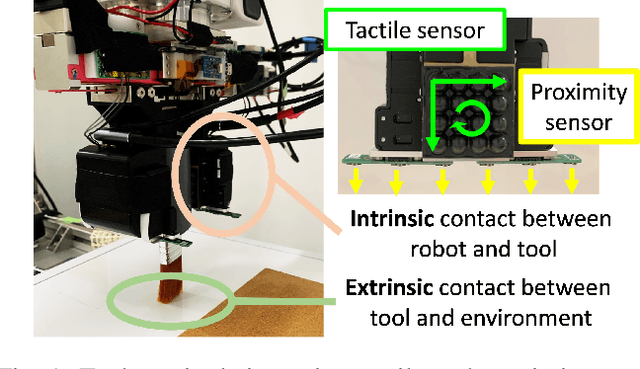
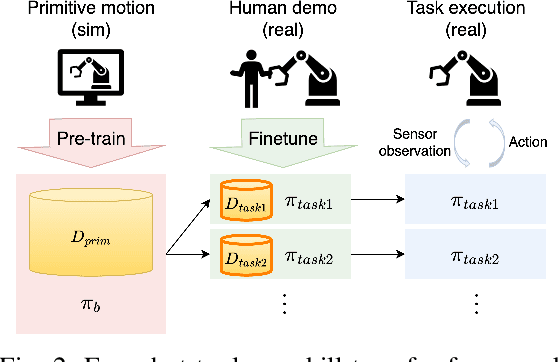
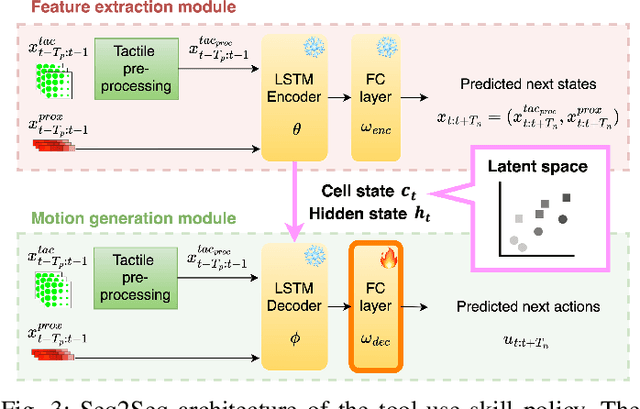
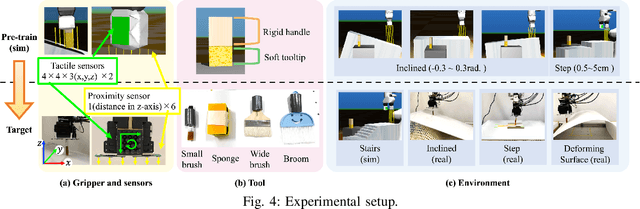
Tools extend the manipulation abilities of robots, much like they do for humans. Despite human expertise in tool manipulation, teaching robots these skills faces challenges. The complexity arises from the interplay of two simultaneous points of contact: one between the robot and the tool, and another between the tool and the environment. Tactile and proximity sensors play a crucial role in identifying these complex contacts. However, learning tool manipulation using these sensors remains challenging due to limited real-world data and the large sim-to-real gap. To address this, we propose a few-shot tool-use skill transfer framework using multimodal sensing. The framework involves pre-training the base policy to capture contact states common in tool-use skills in simulation and fine-tuning it with human demonstrations collected in the real-world target domain to bridge the domain gap. We validate that this framework enables teaching surface-following tasks using tools with diverse physical and geometric properties with a small number of demonstrations on the Franka Emika robot arm. Our analysis suggests that the robot acquires new tool-use skills by transferring the ability to recognise tool-environment contact relationships from pre-trained to fine-tuned policies. Additionally, combining proximity and tactile sensors enhances the identification of contact states and environmental geometry.
Fast Flow-based Visuomotor Policies via Conditional Optimal Transport Couplings
May 02, 2025Diffusion and flow matching policies have recently demonstrated remarkable performance in robotic applications by accurately capturing multimodal robot trajectory distributions. However, their computationally expensive inference, due to the numerical integration of an ODE or SDE, limits their applicability as real-time controllers for robots. We introduce a methodology that utilizes conditional Optimal Transport couplings between noise and samples to enforce straight solutions in the flow ODE for robot action generation tasks. We show that naively coupling noise and samples fails in conditional tasks and propose incorporating condition variables into the coupling process to improve few-step performance. The proposed few-step policy achieves a 4% higher success rate with a 10x speed-up compared to Diffusion Policy on a diverse set of simulation tasks. Moreover, it produces high-quality and diverse action trajectories within 1-2 steps on a set of real-world robot tasks. Our method also retains the same training complexity as Diffusion Policy and vanilla Flow Matching, in contrast to distillation-based approaches.
ContactFusion: Stochastic Poisson Surface Maps from Visual and Contact Sensing
Mar 20, 2025Robust and precise robotic assembly entails insertion of constituent components. Insertion success is hindered when noise in scene understanding exceeds tolerance limits, especially when fabricated with tight tolerances. In this work, we propose ContactFusion which combines global mapping with local contact information, fusing point clouds with force sensing. Our method entails a Rejection Sampling based contact occupancy sensing procedure which estimates contact locations on the end-effector from Force/Torque sensing at the wrist. We demonstrate how to fuse contact with visual information into a Stochastic Poisson Surface Map (SPSMap) - a map representation that can be updated with the Stochastic Poisson Surface Reconstruction (SPSR) algorithm. We first validate the contact occupancy sensor in simulation and show its ability to detect the contact location on the robot from force sensing information. Then, we evaluate our method in a peg-in-hole task, demonstrating an improvement in the hole pose estimate with the fusion of the contact information with the SPSMap.
Learning Visuotactile Estimation and Control for Non-prehensile Manipulation under Occlusions
Dec 17, 2024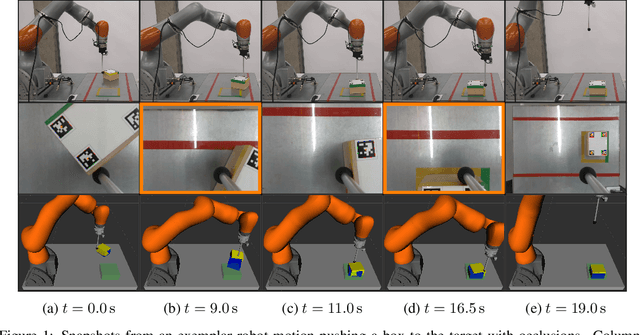
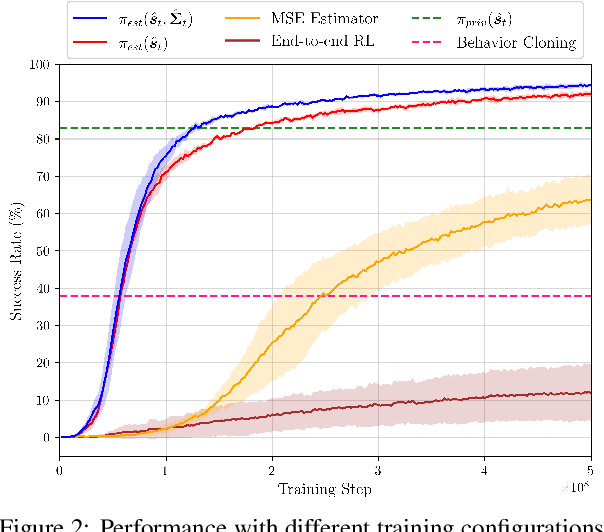
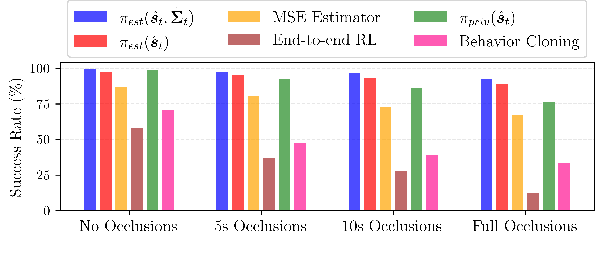
Manipulation without grasping, known as non-prehensile manipulation, is essential for dexterous robots in contact-rich environments, but presents many challenges relating with underactuation, hybrid-dynamics, and frictional uncertainty. Additionally, object occlusions in a scenario of contact uncertainty and where the motion of the object evolves independently from the robot becomes a critical problem, which previous literature fails to address. We present a method for learning visuotactile state estimators and uncertainty-aware control policies for non-prehensile manipulation under occlusions, by leveraging diverse interaction data from privileged policies trained in simulation. We formulate the estimator within a Bayesian deep learning framework, to model its uncertainty, and then train uncertainty-aware control policies by incorporating the pre-learned estimator into the reinforcement learning (RL) loop, both of which lead to significantly improved estimator and policy performance. Therefore, unlike prior non-prehensile research that relies on complex external perception set-ups, our method successfully handles occlusions after sim-to-real transfer to robotic hardware with a simple onboard camera. See our video: https://youtu.be/hW-C8i_HWgs.