 Add to Chrome
 Add to Firefox
 Add to Edge
Amortising Trajectory Optimisation for Residual MPC via Implicit Contact Differentiation
Jul 27, 2026
Differentiable simulation can accelerate contact-rich trajectory optimisation by exposing local sensitivities of task outcomes to controls. Existing approaches either use finite differences, which are expensive and step-size sensitive; differentiate iterative contact solvers by unrolling automatic differentiation (AD), which stores a growing computation trace; or require intricate, solver-specific KKT sensitivity derivations. We introduce an AD-assisted implicit derivative for regularised smooth contacts and apply it to Mujoco MJX, based on the Implicit Function Theorem (IFT). The method differentiates the stationarity residual at the tolerance-converged solution, avoiding both solver unrolling and hand-assembled KKT systems. IFT keeps compiled temporary memory nearly constant with solver effort, changing by less than 4$\%$ from one to ten iterations versus 10.6$\times$ growth for unrolled AD. IFT memory grows slower with active contacts and model dimension, using 20$\times$ less memory at 256 contacts and 6$\times$ less at 16 contacts and 96 DoF. We further introduce optimiser distillation for residual MPC, amortising batched full-horizon iLQR into a policy that guides short-horizon residual iLQR. Across Finger, Franka, and Unitree, this raises six-step success by 28-98 percentage points over standard iLQR.

Perceptive Locomotion through Whole-Body MPC and Optimal Region Selection
May 15, 2023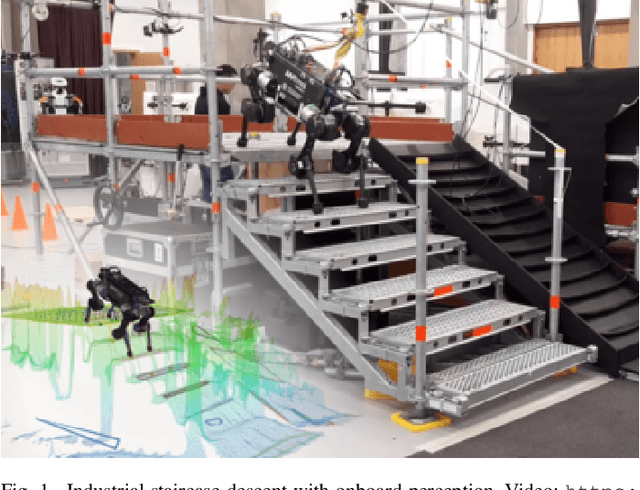
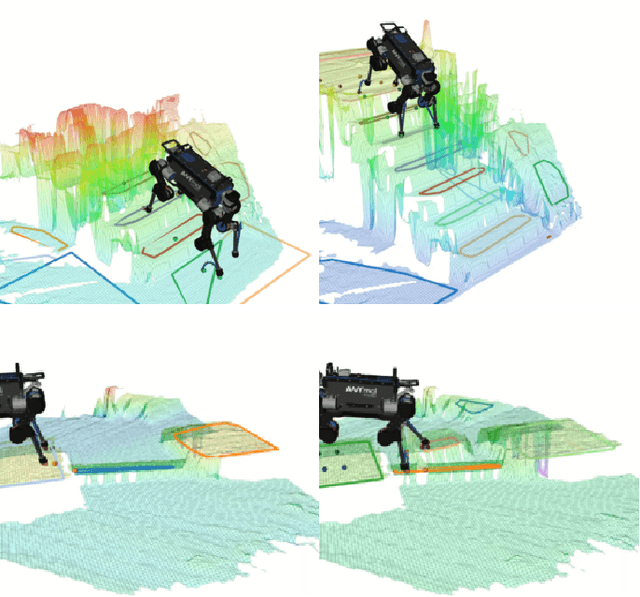

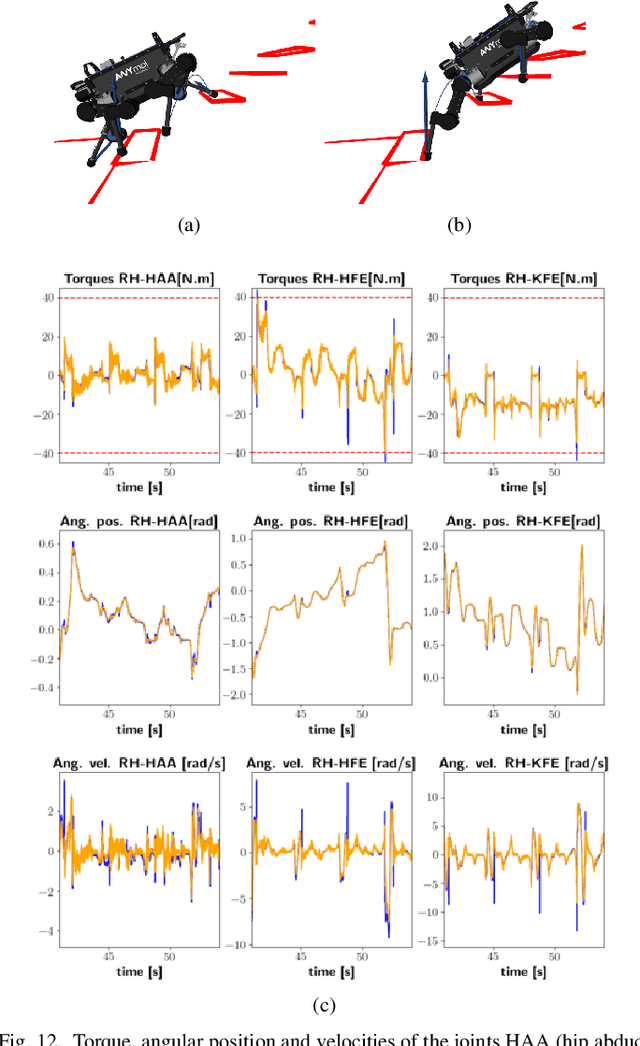
Real-time synthesis of legged locomotion maneuvers in challenging industrial settings is still an open problem, requiring simultaneous determination of footsteps locations several steps ahead while generating whole-body motions close to the robot's limits. State estimation and perception errors impose the practical constraint of fast re-planning motions in a model predictive control (MPC) framework. We first observe that the computational limitation of perceptive locomotion pipelines lies in the combinatorics of contact surface selection. Re-planning contact locations on selected surfaces can be accomplished at MPC frequencies (50-100 Hz). Then, whole-body motion generation typically follows a reference trajectory for the robot base to facilitate convergence. We propose removing this constraint to robustly address unforeseen events such as contact slipping, by leveraging a state-of-the-art whole-body MPC (Croccodyl). Our contributions are integrated into a complete framework for perceptive locomotion, validated under diverse terrain conditions, and demonstrated in challenging trials that push the robot's actuation limits, as well as in the ICRA 2023 quadruped challenge simulation.
Topology-Based MPC for Automatic Footstep Placement and Contact Surface Selection
Mar 24, 2023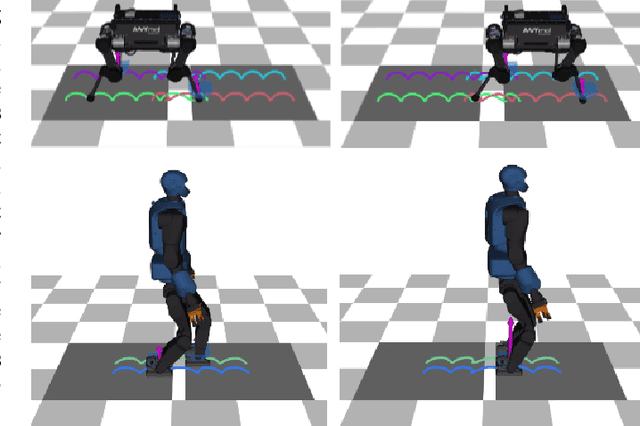
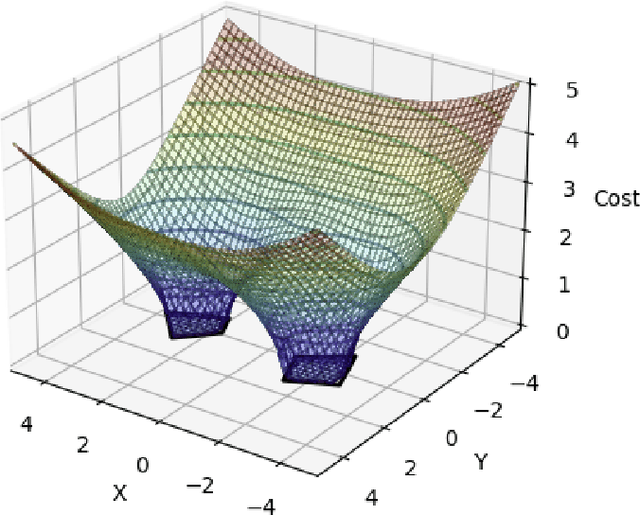
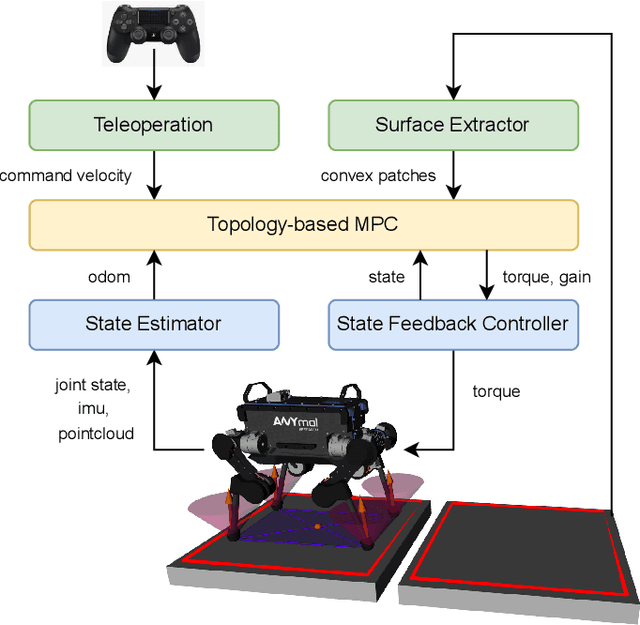
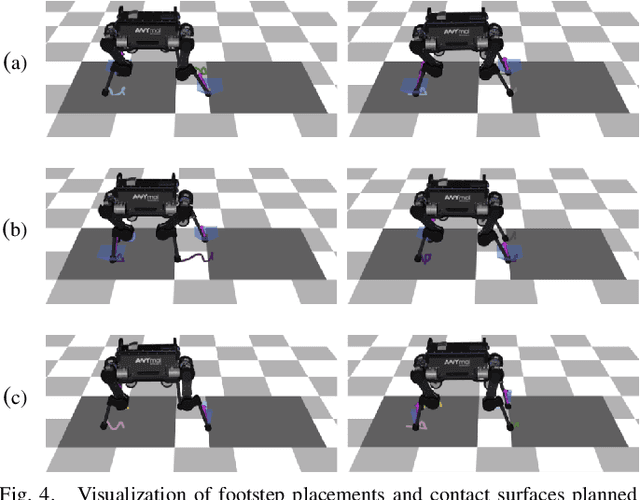
State-of-the-art approaches to footstep planning assume reduced-order dynamics when solving the combinatorial problem of selecting contact surfaces in real time. However, in exchange for computational efficiency, these approaches ignore joint torque limits and limb dynamics. In this work, we address these limitations by presenting a topology-based approach that enables~\gls{mpc} to simultaneously plan full-body motions, torque commands, footstep placements, and contact surfaces in real time. To determine if a robot's foot is inside a contact surface, we borrow the winding number concept from topology. We then use this winding number and potential field to create a contact-surface penalty function. By using this penalty function,~\gls{mpc} can select a contact surface from all candidate surfaces in the vicinity and determine footstep placements within it. We demonstrate the benefits of our approach by showing the impact of considering full-body dynamics, which includes joint torque limits and limb dynamics, on the selection of footstep placements and contact surfaces. Furthermore, we validate the feasibility of deploying our topology-based approach in an~\gls{mpc} scheme and explore its potential capabilities through a series of experimental and simulation trials.
* 7 pages, 6 figures
Inverse-Dynamics MPC via Nullspace Resolution
Sep 12, 2022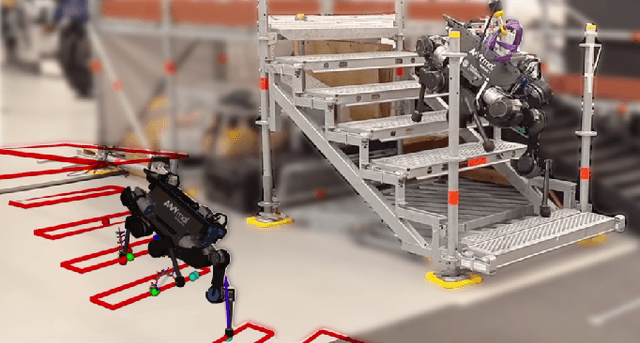
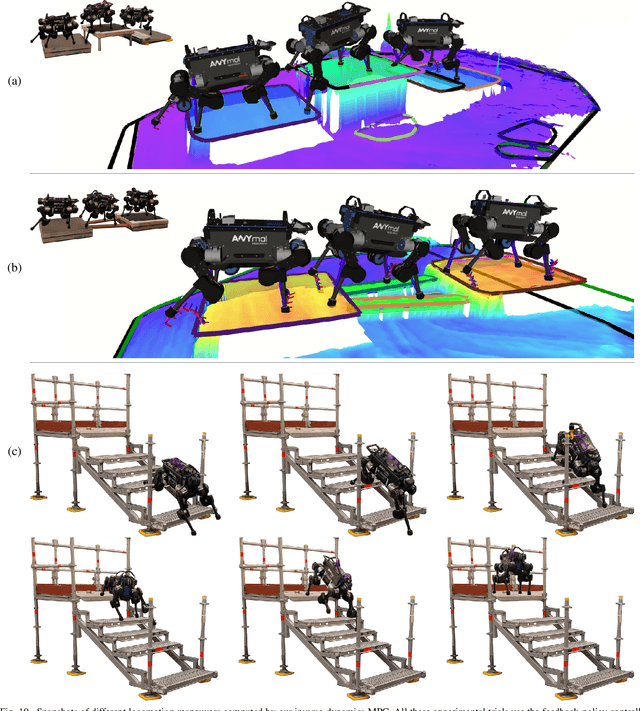
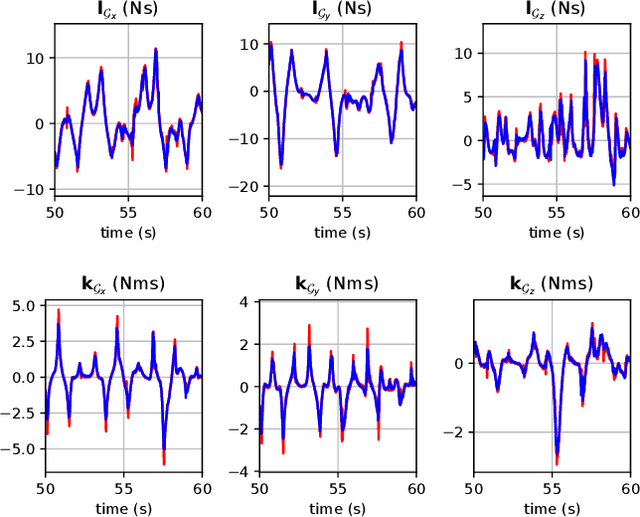
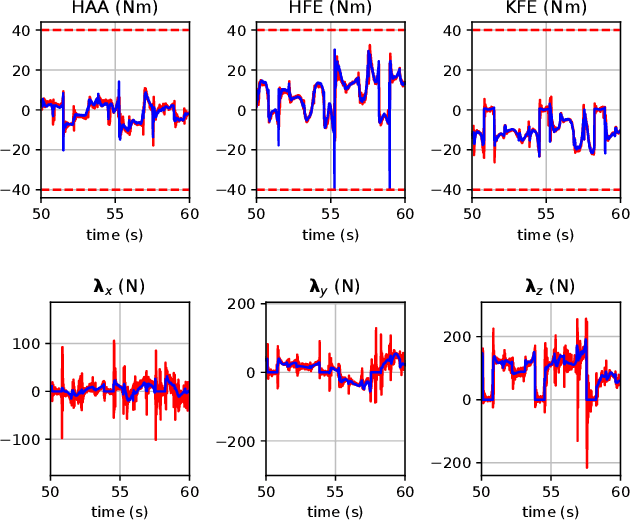
Optimal control (OC) using inverse dynamics provides numerical benefits such as coarse optimization, cheaper computation of derivatives, and a high convergence rate. However, in order to take advantage of these benefits in model predictive control (MPC) for legged robots, it is crucial to handle its large number of equality constraints efficiently. To accomplish this, we first (i) propose a novel approach to handle equality constraints based on nullspace parametrization. Our approach balances optimality, and both dynamics and equality-constraint feasibility appropriately, which increases the basin of attraction to good local minima. To do so, we then (ii) adapt our feasibility-driven search by incorporating a merit function. Furthermore, we introduce (iii) a condensed formulation of the inverse dynamics that considers arbitrary actuator models. We also develop (iv) a novel MPC based on inverse dynamics within a perception locomotion framework. Finally, we present (v) a theoretical comparison of optimal control with the forward and inverse dynamics, and evaluate both numerically. Our approach enables the first application of inverse-dynamics MPC on hardware, resulting in state-of-the-art dynamic climbing on the ANYmal robot. We benchmark it over a wide range of robotics problems and generate agile and complex maneuvers. We show the computational reduction of our nullspace resolution and condensed formulation (up to 47.3%). We provide evidence of the benefits of our approach by solving coarse optimization problems with a high convergence rate (up to 10 Hz of discretization). Our algorithm is publicly available inside CROCODDYL.