 Add to Chrome
 Add to Firefox
 Add to Edge
COSMIK-MPPI: Scaling Constrained Model Predictive Control to Collision Avoidance in Close-Proximity Dynamic Human Environments
Apr 11, 2026
Ensuring safe physical interaction between torque-controlled manipulators and humans is essential for deploying robots in everyday environments. Model Predictive Control (MPC) has emerged as a suitable framework thanks to its capacity to handle hard constraints, provide strong guarantees and zero-shot adaptability through predictive reasoning. However, Gradient-Based MPC (GB-MPC) solvers have demonstrated limited performance for collision avoidance in complex environments. Sampling-based approaches such as Model Predictive Path Integral (MPPI) control offer an alternative via stochastic rollouts, but enforcing safety via additive penalties is inherently fragile, as it provides no formal constraint satisfaction guarantees. We propose a collision avoidance framework called COSMIK-MPPI combining MPPI with the toolbox for human motion estimation RT-COSMIK and the Constraints-as-Terminations transcription, which enforces safety by treating constraint violations as terminal events, without relying on large penalty terms or explicit human motion prediction. The proposed approach is evaluated against state-of-the-art GB-MPC and vanilla MPPI in simulation and on a real manipulator arm. Results show that COSMIK-MPPI achieves a 100% task success rate with a constant computation time (22 ms), largely outperforming GB-MPC. In simulated infeasible scenarios, COSMIK-MPPI consistently generates collision-free trajectories, contrary to vanilla MPPI. These properties enabled safe execution of complex real-world human-robot interaction tasks in shared workspaces using an affordable markerless human motion estimator, demonstrating a robust, compliant, and practical solution for predictive collision avoidance (cf. results showcased at https://exquisite-parfait-ffa925.netlify.app)

Learning-Guided Force-Feedback Model Predictive Control with Obstacle Avoidance for Robotic Deburring
Apr 07, 2026Model Predictive Control (MPC) is widely used for torque-controlled robots, but classical formulations often neglect real-time force feedback and struggle with contact-rich industrial tasks under collision constraints. Deburring in particular requires precise tool insertion, stable force regulation, and collision-free circular motions in challenging configurations, which exceeds the capability of standard MPC pipelines. We propose a framework that integrates force-feedback MPC with diffusion-based motion priors to address these challenges. The diffusion model serves as a memory of motion strategies, providing robust initialization and adaptation across multiple task instances, while MPC ensures safe execution with explicit force tracking, torque feasibility, and collision avoidance. We validate our approach on a torque-controlled manipulator performing industrial deburring tasks. Experiments demonstrate reliable tool insertion, accurate normal force tracking, and circular deburring motions even in hard-to-reach configurations and under obstacle constraints. To our knowledge, this is the first integration of diffusion motion priors with force-feedback MPC for collision-aware, contact-rich industrial tasks.
Warm-Starting Collision-Free Model Predictive Control With Object-Centric Diffusion
Jan 06, 2026Acting in cluttered environments requires predicting and avoiding collisions while still achieving precise control. Conventional optimization-based controllers can enforce physical constraints, but they struggle to produce feasible solutions quickly when many obstacles are present. Diffusion models can generate diverse trajectories around obstacles, yet prior approaches lacked a general and efficient way to condition them on scene structure. In this paper, we show that combining diffusion-based warm-starting conditioned with a latent object-centric representation of the scene and with a collision-aware model predictive controller (MPC) yields reliable and efficient motion generation under strict time limits. Our approach conditions a diffusion transformer on the system state, task, and surroundings, using an object-centric slot attention mechanism to provide a compact obstacle representation suitable for control. The sampled trajectories are refined by an optimal control problem that enforces rigid-body dynamics and signed-distance collision constraints, producing feasible motions in real time. On benchmark tasks, this hybrid method achieved markedly higher success rates and lower latency than sampling-based planners or either component alone. Real-robot experiments with a torque-controlled Panda confirm reliable and safe execution with MPC.
Infinite-Horizon Value Function Approximation for Model Predictive Control
Feb 10, 2025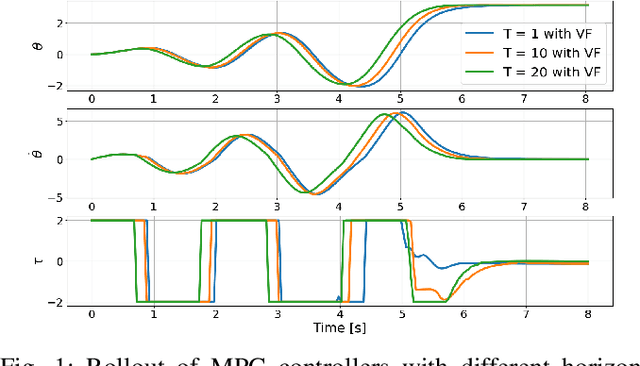
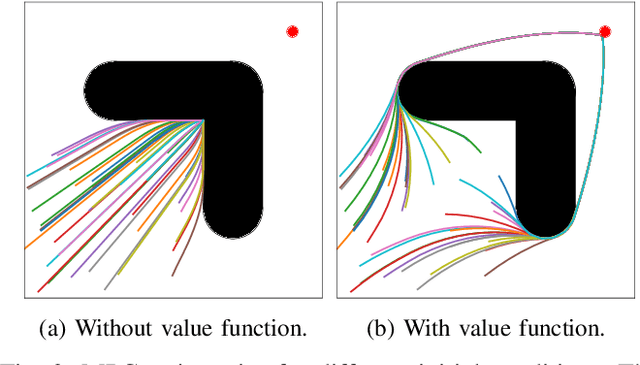
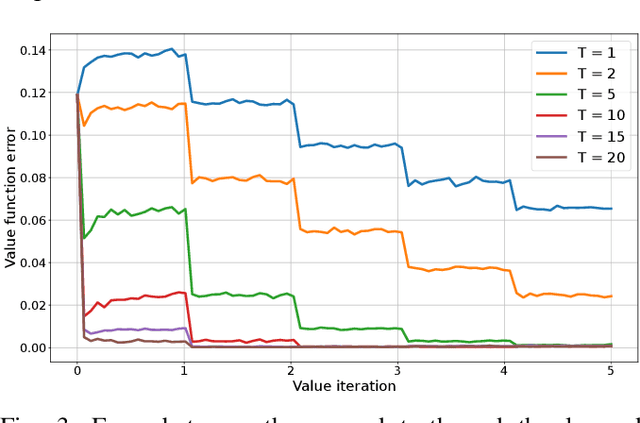
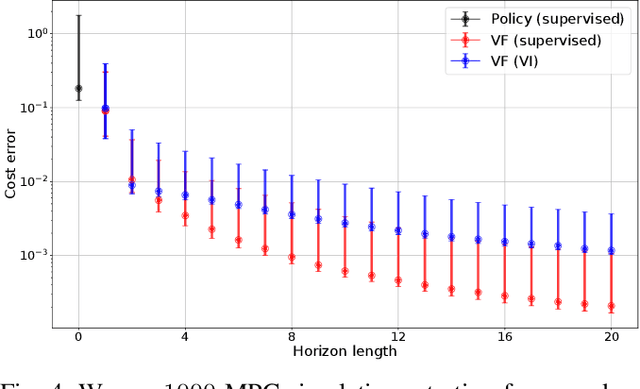
Model Predictive Control has emerged as a popular tool for robots to generate complex motions. However, the real-time requirement has limited the use of hard constraints and large preview horizons, which are necessary to ensure safety and stability. In practice, practitioners have to carefully design cost functions that can imitate an infinite horizon formulation, which is tedious and often results in local minima. In this work, we study how to approximate the infinite horizon value function of constrained optimal control problems with neural networks using value iteration and trajectory optimization. Furthermore, we demonstrate how using this value function approximation as a terminal cost provides global stability to the model predictive controller. The approach is validated on two toy problems and a real-world scenario with online obstacle avoidance on an industrial manipulator where the value function is conditioned to the goal and obstacle.