 Add to Chrome
 Add to Firefox
 Add to Edge
Large Language Models Persuade Without Planning Theory of Mind
Feb 19, 2026
A growing body of work attempts to evaluate the theory of mind (ToM) abilities of humans and large language models (LLMs) using static, non-interactive question-and-answer benchmarks. However, theoretical work in the field suggests that first-personal interaction is a crucial part of ToM and that such predictive, spectatorial tasks may fail to evaluate it. We address this gap with a novel ToM task that requires an agent to persuade a target to choose one of three policy proposals by strategically revealing information. Success depends on a persuader's sensitivity to a given target's knowledge states (what the target knows about the policies) and motivational states (how much the target values different outcomes). We varied whether these states were Revealed to persuaders or Hidden, in which case persuaders had to inquire about or infer them. In Experiment 1, participants persuaded a bot programmed to make only rational inferences. LLMs excelled in the Revealed condition but performed below chance in the Hidden condition, suggesting difficulty with the multi-step planning required to elicit and use mental state information. Humans performed moderately well in both conditions, indicating an ability to engage such planning. In Experiment 2, where a human target role-played the bot, and in Experiment 3, where we measured whether human targets' real beliefs changed, LLMs outperformed human persuaders across all conditions. These results suggest that effective persuasion can occur without explicit ToM reasoning (e.g., through rhetorical strategies) and that LLMs excel at this form of persuasion. Overall, our results caution against attributing human-like ToM to LLMs while highlighting LLMs' potential to influence people's beliefs and behavior.

Designing Speech Technologies for Australian Aboriginal English: Opportunities, Risks and Participation
Mar 05, 2025In Australia, post-contact language varieties, including creoles and local varieties of international languages, emerged as a result of forced contact between Indigenous communities and English speakers. These contact varieties are widely used, yet are poorly supported by language technologies. This gap presents barriers to participation in civil and economic society for Indigenous communities using these varieties, and reproduces minoritisation of contemporary Indigenous sociolinguistic identities. This paper concerns three questions regarding this context. First, can speech technologies support speakers of Australian Aboriginal English, a local indigenised variety of English? Second, what risks are inherent in such a project? Third, what technology development practices are appropriate for this context, and how can researchers integrate meaningful community participation in order to mitigate risks? We argue that opportunities do exist -- as well as risks -- and demonstrate this through a case study exploring design practices in a real-world project aiming to improve speech technologies for Australian Aboriginal English. We discuss how we integrated culturally appropriate and participatory processes throughout the project. We call for increased support for languages used by Indigenous communities, including contact varieties, which provide practical economic and socio-cultural benefits, provided that participatory and culturally safe practices are enacted.
"It's how you do things that matters": Attending to Process to Better Serve Indigenous Communities with Language Technologies
Feb 06, 2024Indigenous languages are historically under-served by Natural Language Processing (NLP) technologies, but this is changing for some languages with the recent scaling of large multilingual models and an increased focus by the NLP community on endangered languages. This position paper explores ethical considerations in building NLP technologies for Indigenous languages, based on the premise that such projects should primarily serve Indigenous communities. We report on interviews with 17 researchers working in or with Aboriginal and/or Torres Strait Islander communities on language technology projects in Australia. Drawing on insights from the interviews, we recommend practices for NLP researchers to increase attention to the process of engagements with Indigenous communities, rather than focusing only on decontextualised artefacts.
A Systematic Review and Thematic Analysis of Community-Collaborative Approaches to Computing Research
Jul 09, 2022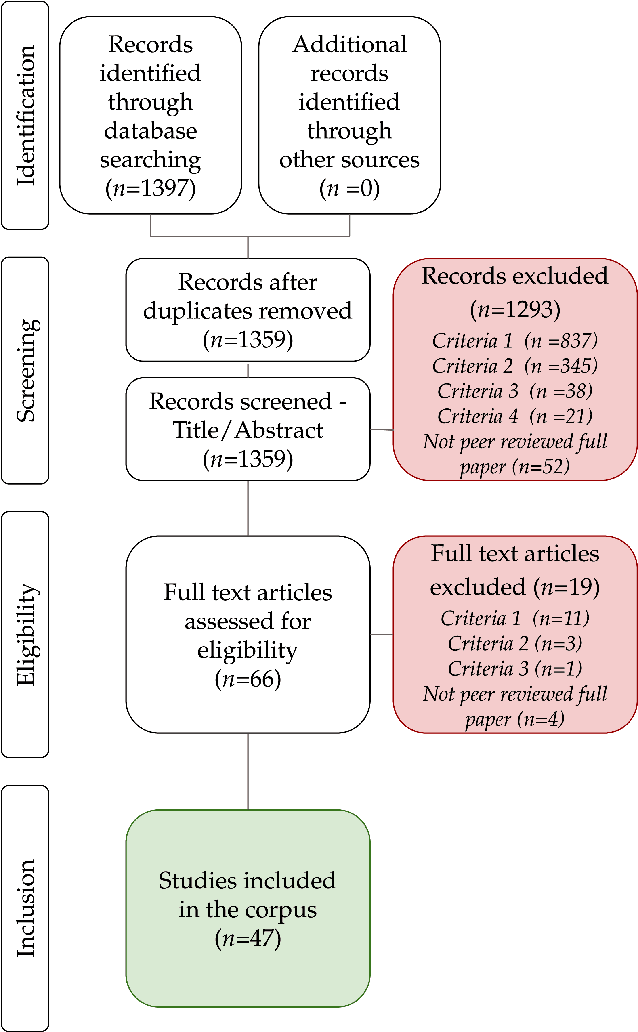
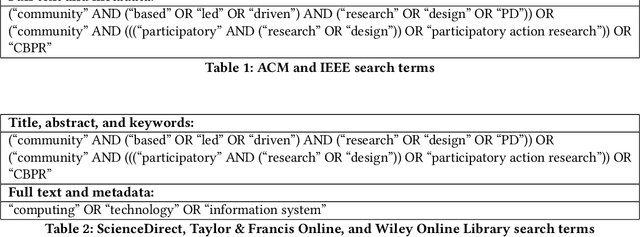
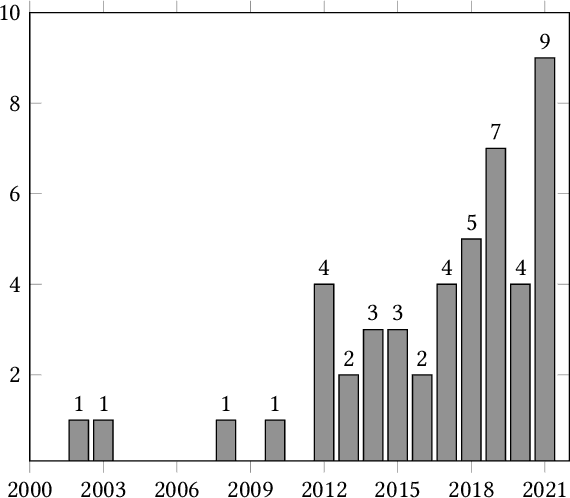
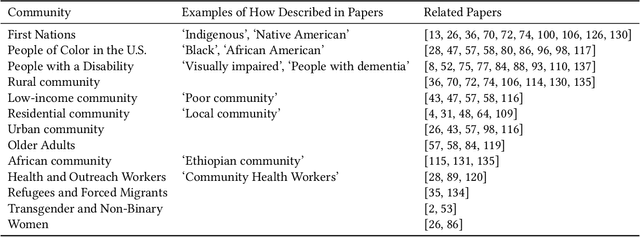
HCI researchers have been gradually shifting attention from individual users to communities when engaging in research, design, and system development. However, our field has yet to establish a cohesive, systematic understanding of the challenges, benefits, and commitments of community-collaborative approaches to research. We conducted a systematic review and thematic analysis of 47 computing research papers discussing participatory research with communities for the development of technological artifacts and systems, published over the last two decades. From this review, we identified seven themes associated with the evolution of a project: from establishing community partnerships to sustaining results. Our findings suggest that several tensions characterize these projects, many of which relate to the power and position of researchers, and the computing research environment, relative to community partners. We discuss the implications of our findings and offer methodological proposals to guide HCI, and computing research more broadly, towards practices that center communities.