 Add to Chrome
 Add to Firefox
 Add to Edge
Near-Field Wideband Channel Estimation for XL-MIMO Systems via Denoising Diffusion Model
Apr 22, 2026
Extremely large-scale multiple-input multiple-output (XL-MIMO) is a key enabling technology for sixth-generation (6G) communication systems. Nevertheless, the increase in array aperture and signal bandwidth brings new challenges to wideband channel estimation in XL-MIMO systems. Motivated by recent advances in deep generative modeling, we propose a diffusion model-based method for near-field wideband channel estimation in XL-MIMO systems. We first analyze the statistical correlation of wideband channel and show that near-field wideband channel exhibits both spatial non-stationarity and beam split effects. Based on these observations, the channel estimation problem is formulated as a Bayesian posterior inference task, in which a diffusion model is employed to learn the prior distribution of the channel. To further enhance the representation of complex spatial-frequency channel structures, we design a denoising network with a multi-scale attention mechanism. In particular, the network extracts multi-scale spatial-frequency features via parallel convolutional branches with different receptive fields, and combines feature attention and spatial attention modules to adaptively emphasize critical channel features. This design enables more accurate modeling of near-field wideband channel distributions and consequently improves channel estimation performance. Experimental results demonstrate that the proposed method exhibits superior robustness to existing baseline schemes for XL-MIMO wideband channel estimation under different experimental settings.

Adaptive Structured Sparse Bayesian Learning for Near-Field Non-Stationary Channel Estimation in XL-MIMO Systems
Apr 13, 2026Extremely large-scale multiple-input multiple-output (XL-MIMO) is a key enabler for sixth-generation (6G) communications. However, near-field channel estimation is particularly challenging due to spherical-wave propagation and spatial non-stationarity. To tackle this challenge, we propose a structured sparse Bayesian learning framework with adaptive dictionary updating for near-field non-stationary channel estimation. Specifically, the proposed method iteratively updates the distance parameters within an adaptive dictionary, thereby enhancing the representation capability without increasing the dictionary size. Moreover, we develop a hierarchical prior model that jointly captures polar-domain sparsity and structured dependency, enabling efficient Bayesian inference. Simulation results demonstrate that the proposed approach outperforms existing polar-domain dictionary-based methods while achieving low dictionary overhead.
Pilot Allocation for Multi-Hop Over-the-Air Neural Inference under Imperfect CSI
Apr 08, 2026A multi-hop amplify-and-forward (AF) relay network can emulate a fully connected (FC) neural network layer via over-the-air (OTA) computation. However, achieving high emulation accuracy requires accurate channel state information (CSI) across all links in the multi-hop network. In this work, we investigate the impact of CSI errors on classification performance. We propose five heuristic schemes for allocating the total channel training time (pilots) across hops and compare their effectiveness. Numerical results reveal a clear trade-off between channel training overhead and classification accuracy. In particular, with sufficient pilot power and balanced allocation of channel training resources, the system can achieve classification accuracy close to that of the digital baseline.
Relay-Assisted Activation-Integrated SIM for Wireless Physical Neural Networks
Apr 05, 2026Wireless physical neural networks (WPNNs) have emerged as a promising paradigm for performing neural computation directly in the physical layer of wireless systems, offering low latency and high energy efficiency. However, most existing WPNN implementations primarily rely on linear physical transformations, which fundamentally limits their expressiveness. In this work, we propose a relay-assisted WPNN architecture based on activation-integrated stacked intelligent metasurfaces (AI-SIMs), where each passive metasurface layer enabling linear wave manipulation is cascaded with an activation metasurface layer that realizes nonlinear processing in the analog domain. By deliberately structuring multi-hop wireless propagation, the relay amplification matrix and the metasurface phase-shift matrices jointly act as trainable network weights, while hardware-implemented activation functions provide essential nonlinearity. Simulation results demonstrate that the proposed architecture achieves high classification accuracy, and that incorporating hardware-based activation functions significantly improves representational capability and performance compared with purely linear physical implementations.
Realization of a Fully Connected Neural Layer Over-the-Air through Multi-hop Amplify-and-Forward Relays
Mar 20, 2026We study the problem of implementing a fully-connected layer of a neural network using wireless over-the-air computing. We assume a multi hop system with a multi-antenna transmitter and receiver, along with a number of multi-hop amplify-and-forward relay devices in between. We formulate an optimization problem that optimizes the transmitter precoder, receiver combiner and amplify-and-forward gains, subject to relay device power constraint and transmitter power constraint. We propose an alternating optimization framework that optimizes the imitation accuracy. Simulation study results reveal that multi-hop relaying achieves an almost perfect classification accuracy when used in a neural network.
Wireless Physical Neural Networks (WPNNs): Opportunities and Challenges
Feb 15, 2026Wireless communication systems exhibit structural and functional similarities to neural networks: signals propagate through cascaded elements, interact with the environment, and undergo transformations. Building upon this perspective, we introduce a unified paradigm, termed \textit{wireless physical neural networks (WPNNs)}, in which components of a wireless network, such as transceivers, relays, backscatter, and intelligent surfaces, are interpreted as computational layers within a learning architecture. By treating the wireless propagation environment and network elements as differentiable operators, new opportunities arise for joint communication-computation designs, where system optimization can be achieved through learning-based methods applied directly to the physical network. This approach may operate independently of, or in conjunction with, conventional digital neural layers, enabling hybrid communication learning pipelines. In the article, we outline representative architectures that embody this viewpoint and discuss the algorithmic and training considerations required to leverage the wireless medium as a computational resource. Through numerical examples, we highlight the potential performance gains in processing, adaptability, efficiency, and end-to-end optimization, demonstrating the promise of reconfiguring wireless systems as learning networks in next-generation communication frameworks.
Secure Transmission for Cell-Free Symbiotic Radio Communications with Movable Antenna: Continuous and Discrete Positioning Designs
Aug 09, 2025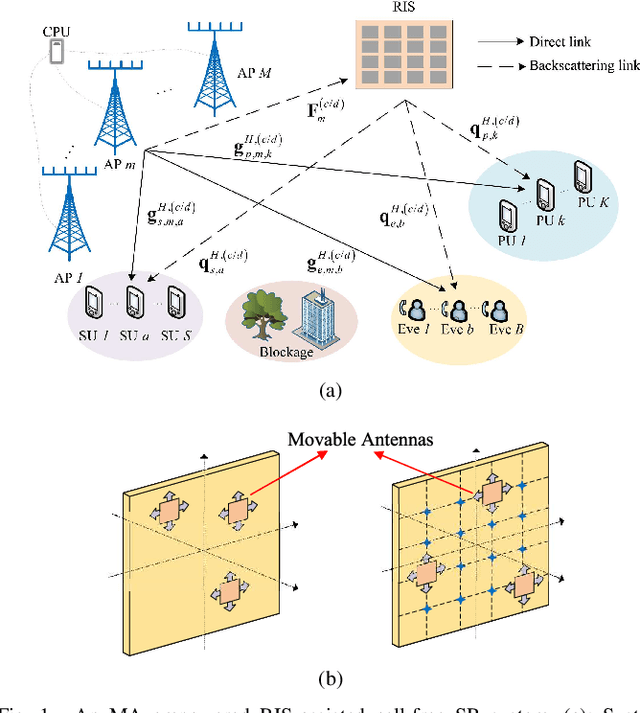
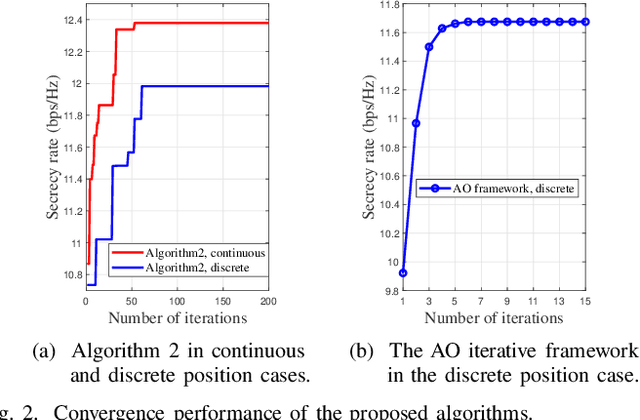
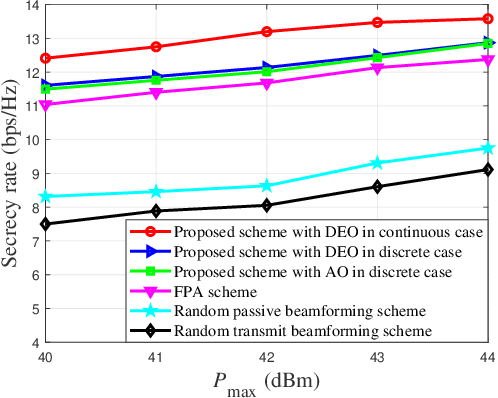
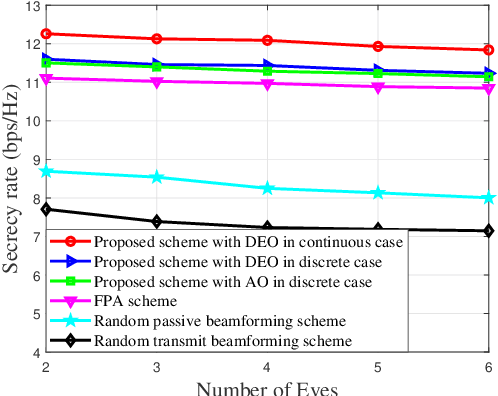
In this paper, we study a movable antenna (MA) empowered secure transmission scheme for reconfigurable intelligent surface (RIS) aided cell-free symbiotic radio (SR) system. Specifically, the MAs deployed at distributed access points (APs) work collaboratively with the RIS to establish high-quality propagation links for both primary and secondary transmissions, as well as suppressing the risk of eavesdropping on confidential primary information. We consider both continuous and discrete MA position cases and maximize the secrecy rate of primary transmission under the secondary transmission constraints, respectively. For the continuous position case, we propose a two-layer iterative optimization method based on differential evolution with one-in-one representation (DEO), to find a high-quality solution with relatively moderate computational complexity. For the discrete position case, we first extend the DEO based iterative framework by introducing the mapping and determination operations to handle the characteristic of discrete MA positions. To further reduce the computational complexity, we then design an alternating optimization (AO) iterative framework to solve all variables within a single layer. In particular, we develop an efficient strategy to derive the sub-optimal solution for the discrete MA positions, superseding the DEO-based method. Numerical results validate the effectiveness of the proposed MA empowered secure transmission scheme along with its optimization algorithms.
Intelligent Metasurface-Enabled Integrated Sensing and Communication: Unified Framework and Key Technologies
Jun 16, 2025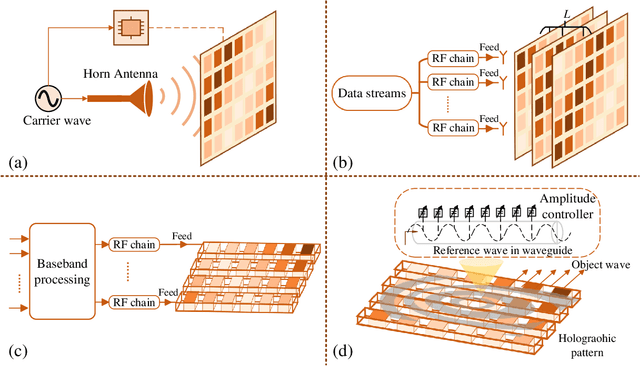
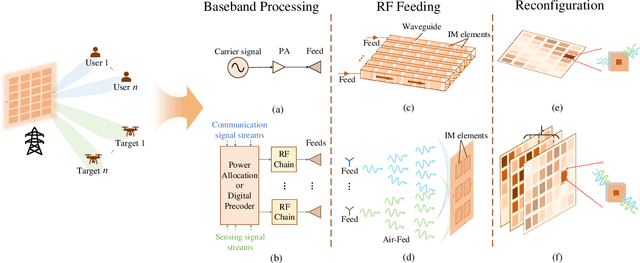
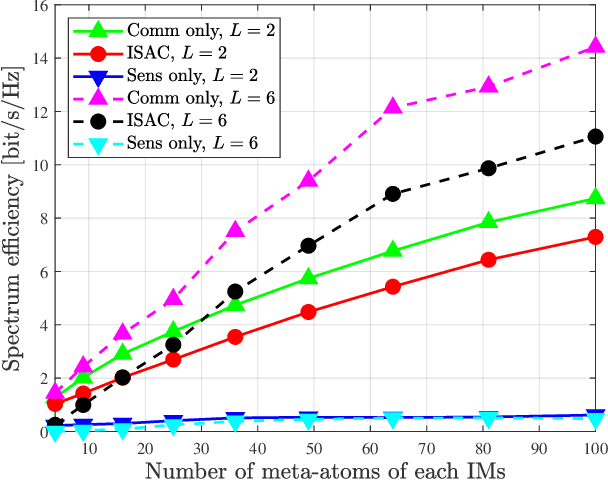
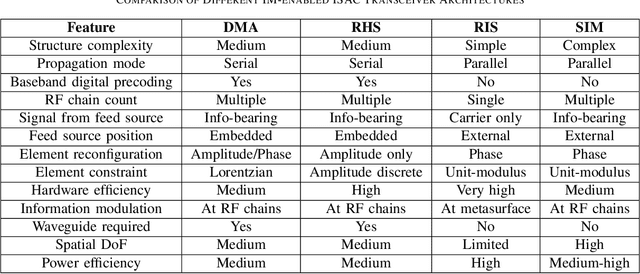
As the demand for ubiquitous connectivity and high-precision environmental awareness grows, integrated sensing and communication (ISAC) has emerged as a key technology for sixth-generation (6G) wireless networks. Intelligent metasurfaces (IMs) have also been widely adopted in ISAC scenarios due to their efficient, programmable control over electromagnetic waves. This provides a versatile solution that meets the dual-function requirements of next-generation networks. Although reconfigurable intelligent surfaces (RISs) have been extensively studied for manipulating the propagation channel between base and mobile stations, the full potential of IMs in ISAC transceiver design remains under-explored. Against this backdrop, this article explores emerging IM-enabled transceiver designs for ISAC systems. It begins with an overview of representative IM architectures, their unique principles, and their inherent advantages in EM wave manipulation. Next, a unified ISAC framework is established to systematically model the design and derivation of diverse IM-enabled transceiver structures. This lays the foundation for performance optimization, trade-offs, and analysis. The paper then discusses several critical technologies for IM-enabled ISAC transceivers, including dedicated channel modeling, effective channel estimation, tailored beamforming strategies, and dual-functional waveform design.
Realizing Fully-Connected Layers Over the Air via Reconfigurable Intelligent Surfaces
May 02, 2025By leveraging the waveform superposition property of the multiple access channel, over-the-air computation (AirComp) enables the execution of digital computations through analog means in the wireless domain, leading to faster processing and reduced latency. In this paper, we propose a novel approach to implement a neural network (NN) consisting of digital fully connected (FC) layers using physically reconfigurable hardware. Specifically, we investigate reconfigurable intelligent surfaces (RISs)-assisted multiple-input multiple-output (MIMO) systems to emulate the functionality of a NN for over-the-air inference. In this setup, both the RIS and the transceiver are jointly configured to manipulate the ambient wireless propagation environment, effectively reproducing the adjustable weights of a digital FC layer. We refer to this new computational paradigm as \textit{AirFC}. We formulate an imitation error minimization problem between the effective channel created by RIS and a target FC layer by jointly optimizing over-the-air parameters. To solve this non-convex optimization problem, an extremely low-complexity alternating optimization algorithm is proposed, where semi-closed-form/closed-form solutions for all optimization variables are derived. Simulation results show that the RIS-assisted MIMO-based AirFC can achieve competitive classification accuracy. Furthermore, it is also shown that a multi-RIS configuration significantly outperforms a single-RIS setup, particularly in line-of-sight (LoS)-dominated channels.
Over-the-Air Inference over Multi-hop MIMO Networks
May 01, 2025A novel over-the-air machine learning framework over multi-hop multiple-input and multiple-output (MIMO) networks is proposed. The core idea is to imitate fully connected (FC) neural network layers using multiple MIMO channels by carefully designing the precoding matrices at the transmitting nodes. A neural network dubbed PrototypeNet is employed consisting of multiple FC layers, with the number of neurons of each layer equal to the number of antennas of the corresponding terminal. To achieve satisfactory performance, we train PrototypeNet based on a customized loss function consisting of classification error and the power of latent vectors to satisfy transmit power constraints, with noise injection during training. Precoding matrices for each hop are then obtained by solving an optimization problem. We also propose a multiple-block extension when the number of antennas is limited. Numerical results verify that the proposed over-the-air transmission scheme can achieve satisfactory classification accuracy under a power constraint. The results also show that higher classification accuracy can be achieved with an increasing number of hops at a modest signal-to-noise ratio (SNR).