 Add to Chrome
 Add to Firefox
 Add to Edge
Pilot Allocation for Multi-Hop Over-the-Air Neural Inference under Imperfect CSI
Apr 08, 2026
A multi-hop amplify-and-forward (AF) relay network can emulate a fully connected (FC) neural network layer via over-the-air (OTA) computation. However, achieving high emulation accuracy requires accurate channel state information (CSI) across all links in the multi-hop network. In this work, we investigate the impact of CSI errors on classification performance. We propose five heuristic schemes for allocating the total channel training time (pilots) across hops and compare their effectiveness. Numerical results reveal a clear trade-off between channel training overhead and classification accuracy. In particular, with sufficient pilot power and balanced allocation of channel training resources, the system can achieve classification accuracy close to that of the digital baseline.

Realization of a Fully Connected Neural Layer Over-the-Air through Multi-hop Amplify-and-Forward Relays
Mar 20, 2026We study the problem of implementing a fully-connected layer of a neural network using wireless over-the-air computing. We assume a multi hop system with a multi-antenna transmitter and receiver, along with a number of multi-hop amplify-and-forward relay devices in between. We formulate an optimization problem that optimizes the transmitter precoder, receiver combiner and amplify-and-forward gains, subject to relay device power constraint and transmitter power constraint. We propose an alternating optimization framework that optimizes the imitation accuracy. Simulation study results reveal that multi-hop relaying achieves an almost perfect classification accuracy when used in a neural network.
Wireless Physical Neural Networks (WPNNs): Opportunities and Challenges
Feb 15, 2026Wireless communication systems exhibit structural and functional similarities to neural networks: signals propagate through cascaded elements, interact with the environment, and undergo transformations. Building upon this perspective, we introduce a unified paradigm, termed \textit{wireless physical neural networks (WPNNs)}, in which components of a wireless network, such as transceivers, relays, backscatter, and intelligent surfaces, are interpreted as computational layers within a learning architecture. By treating the wireless propagation environment and network elements as differentiable operators, new opportunities arise for joint communication-computation designs, where system optimization can be achieved through learning-based methods applied directly to the physical network. This approach may operate independently of, or in conjunction with, conventional digital neural layers, enabling hybrid communication learning pipelines. In the article, we outline representative architectures that embody this viewpoint and discuss the algorithmic and training considerations required to leverage the wireless medium as a computational resource. Through numerical examples, we highlight the potential performance gains in processing, adaptability, efficiency, and end-to-end optimization, demonstrating the promise of reconfiguring wireless systems as learning networks in next-generation communication frameworks.
Predictive Beamforming with Distributed MIMO
Jan 29, 2025


In vehicle-to-everything (V2X) applications, roadside units (RSUs) can be tasked with both sensing and communication functions to enable sensing-assisted communications. Recent studies have demonstrated that distance, angle, and velocity information obtained through sensing can be leveraged to reduce the overhead associated with communication beam tracking. In this work, we extend this concept to scenarios involving multiple distributed RSUs and distributed MIMO (multiple-input multiple-output) systems. We derive the state evolution model, formulate the extended Kalman-filter equations, and implement predictive beamforming for distributed MIMO. Simulation results indicate that, when compared with a co-located massive MIMO antenna array, distributed antennas lead to more uniform and robust sensing performance, coverage, and data rates, while the vehicular user is in motion.
Inter-Numerology Interference Pre-Equalization for 5G Mixed-Numerology Communications
Jan 26, 2022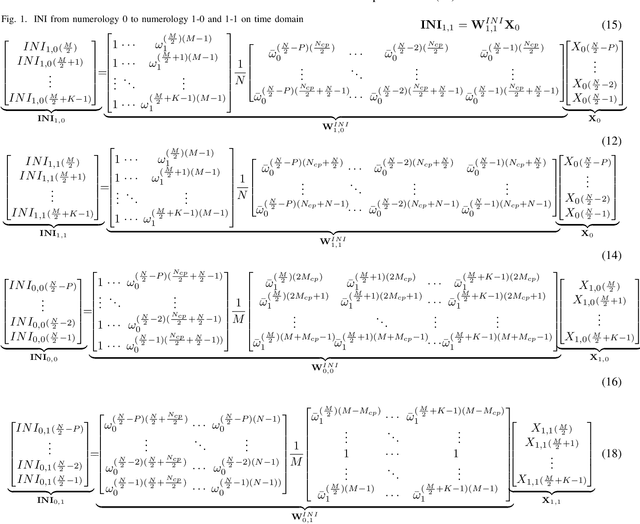
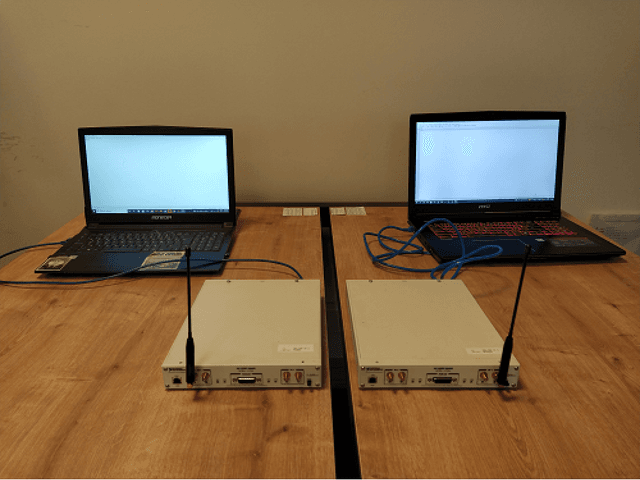
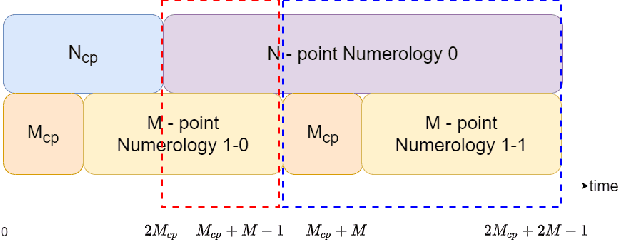
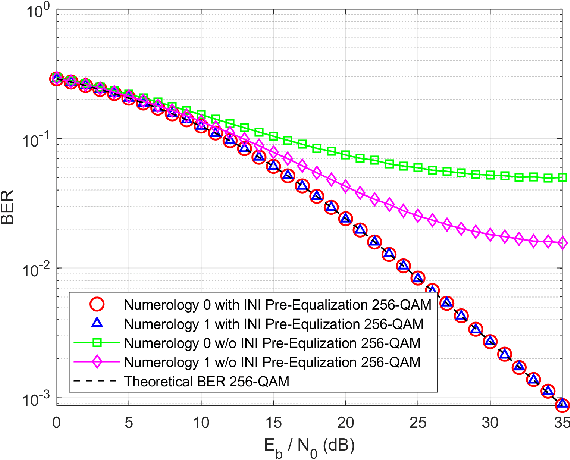
This article proposes a pre-equalization method to remove inter-numerology interference (INI) that occurs in multi-numerology OFDM frame structures of fifth-generation New Radio (5G-NR) and beyond on the transmitter side. In the literature, guard bands, filters and interference cancellation methods are used to reduce the INI. In this work, we mathematically model how the INI is generated and how it can be removed completely for multi-numerology systems on the transmitter side.