 Add to Chrome
 Add to Firefox
 Add to Edge
BioDCASE 2026 Challenge Baseline for Cross-Domain Mosquito Species Classification
Mar 20, 2026
Mosquito-borne diseases affect more than one billion people each year and cause close to one million deaths. Traditional surveillance methods rely on traps and manual identification that are slow, labor-intensive, and difficult to scale. Audio-based mosquito monitoring offers a non-destructive, lower-cost, and more scalable complement to trap-based surveillance, but reliable species classification remains difficult under real-world recording conditions. Mosquito flight tones are narrow-band, often low in signal-to-noise ratio, and easily masked by background noise, and recordings for several epidemiologically relevant species remain limited, creating pronounced class imbalance. Variation across devices, environments, and collection protocols further increases the difficulty of robust classification. Such variation can cause models to rely on domain-specific recording artefacts rather than species-relevant acoustic cues, which makes transfer to new acquisition settings difficult. The BioDCASE 2026 Cross-Domain Mosquito Species Classification (CD-MSC) challenge is designed around this deployment problem by evaluating performance on both seen and unseen domains. This paper presents the official baseline system and evaluation pipeline as a simple, fully reproducible reference for the CD-MSC challenge task. The baseline uses log-mel features and a multitemporal resolution convolutional neural network (MTRCNN) with species and auxiliary domain outputs, together with complete training and test scripts. The baseline system performs strongly on seen domains but degrades markedly on unseen domains, showing that cross-domain generalisation, rather than within-domain recognition, is the central challenge for practical mosquito species classification from multi-source bioacoustic recordings.

Cost-sensitive detection with variational autoencoders for environmental acoustic sensing
Dec 07, 2017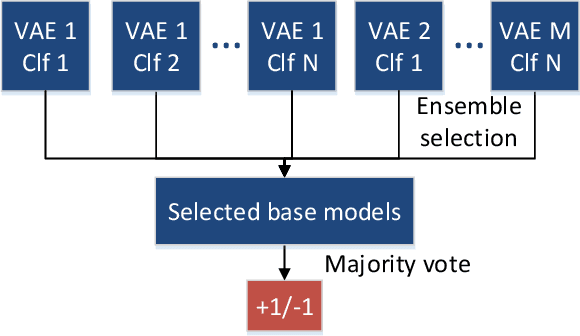
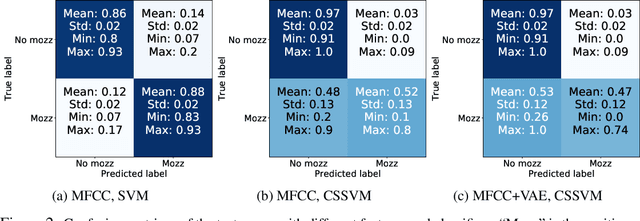
Environmental acoustic sensing involves the retrieval and processing of audio signals to better understand our surroundings. While large-scale acoustic data make manual analysis infeasible, they provide a suitable playground for machine learning approaches. Most existing machine learning techniques developed for environmental acoustic sensing do not provide flexible control of the trade-off between the false positive rate and the false negative rate. This paper presents a cost-sensitive classification paradigm, in which the hyper-parameters of classifiers and the structure of variational autoencoders are selected in a principled Neyman-Pearson framework. We examine the performance of the proposed approach using a dataset from the HumBug project which aims to detect the presence of mosquitoes using sound collected by simple embedded devices.
Mosquito detection with low-cost smartphones: data acquisition for malaria research
Dec 06, 2017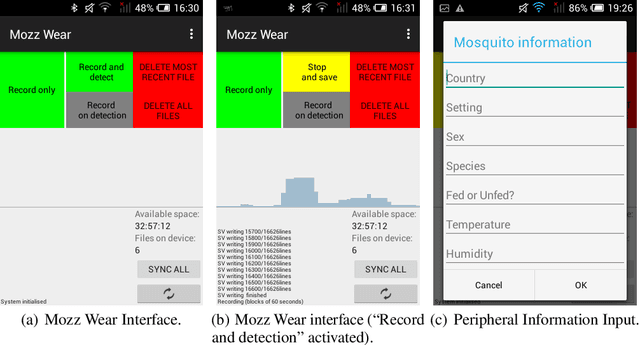
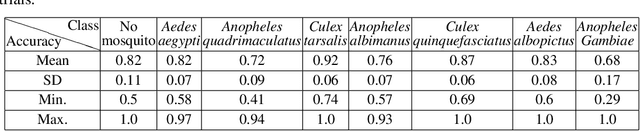
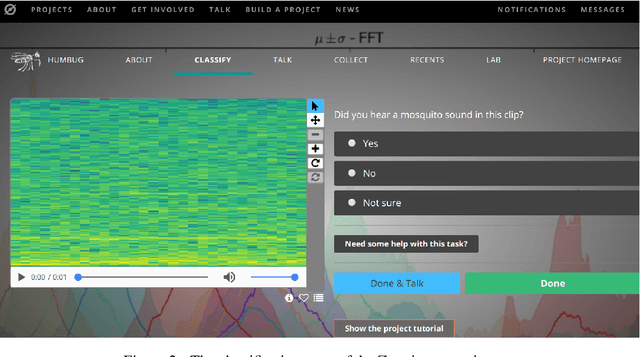
Mosquitoes are a major vector for malaria, causing hundreds of thousands of deaths in the developing world each year. Not only is the prevention of mosquito bites of paramount importance to the reduction of malaria transmission cases, but understanding in more forensic detail the interplay between malaria, mosquito vectors, vegetation, standing water and human populations is crucial to the deployment of more effective interventions. Typically the presence and detection of malaria-vectoring mosquitoes is only quantified by hand-operated insect traps or signified by the diagnosis of malaria. If we are to gather timely, large-scale data to improve this situation, we need to automate the process of mosquito detection and classification as much as possible. In this paper, we present a candidate mobile sensing system that acts as both a portable early warning device and an automatic acoustic data acquisition pipeline to help fuel scientific inquiry and policy. The machine learning algorithm that powers the mobile system achieves excellent off-line multi-species detection performance while remaining computationally efficient. Further, we have conducted preliminary live mosquito detection tests using low-cost mobile phones and achieved promising results. The deployment of this system for field usage in Southeast Asia and Africa is planned in the near future. In order to accelerate processing of field recordings and labelling of collected data, we employ a citizen science platform in conjunction with automated methods, the former implemented using the Zooniverse platform, allowing crowdsourcing on a grand scale.
Mosquito Detection with Neural Networks: The Buzz of Deep Learning
May 15, 2017
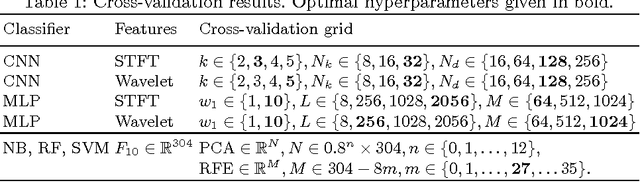
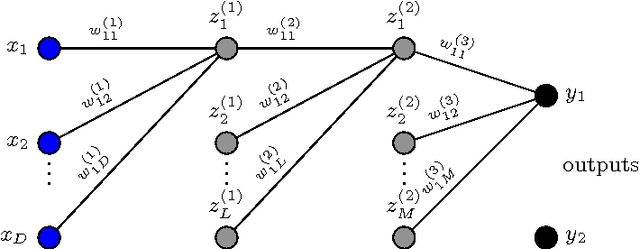
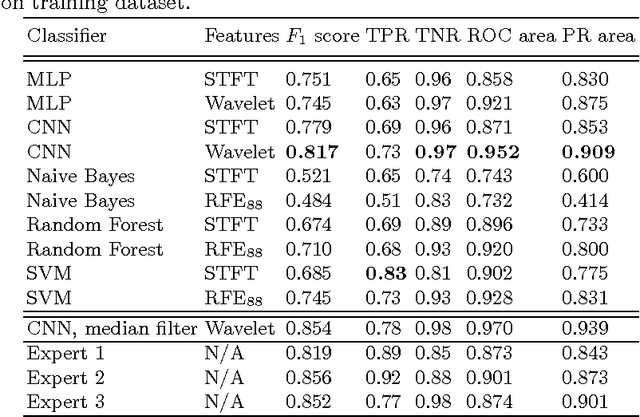
Many real-world time-series analysis problems are characterised by scarce data. Solutions typically rely on hand-crafted features extracted from the time or frequency domain allied with classification or regression engines which condition on this (often low-dimensional) feature vector. The huge advances enjoyed by many application domains in recent years have been fuelled by the use of deep learning architectures trained on large data sets. This paper presents an application of deep learning for acoustic event detection in a challenging, data-scarce, real-world problem. Our candidate challenge is to accurately detect the presence of a mosquito from its acoustic signature. We develop convolutional neural networks (CNNs) operating on wavelet transformations of audio recordings. Furthermore, we interrogate the network's predictive power by visualising statistics of network-excitatory samples. These visualisations offer a deep insight into the relative informativeness of components in the detection problem. We include comparisons with conventional classifiers, conditioned on both hand-tuned and generic features, to stress the strength of automatic deep feature learning. Detection is achieved with performance metrics significantly surpassing those of existing algorithmic methods, as well as marginally exceeding those attained by individual human experts.
Detecting bird sound in unknown acoustic background using crowdsourced training data
May 24, 2015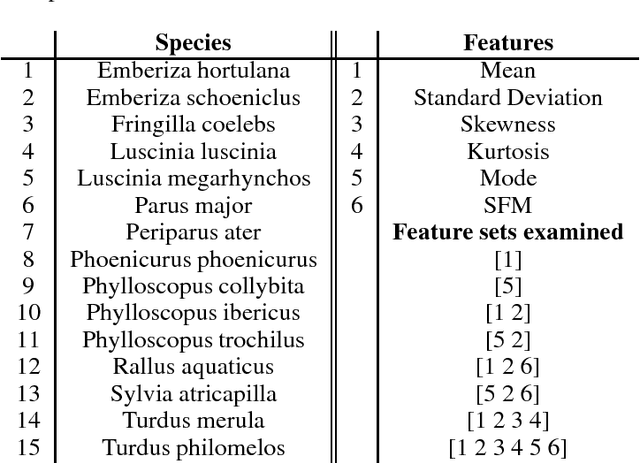
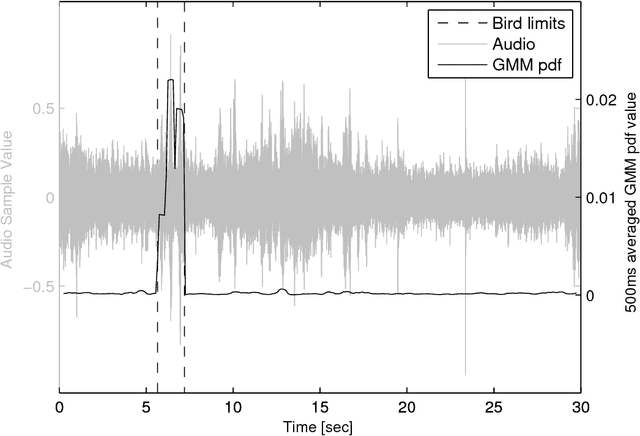
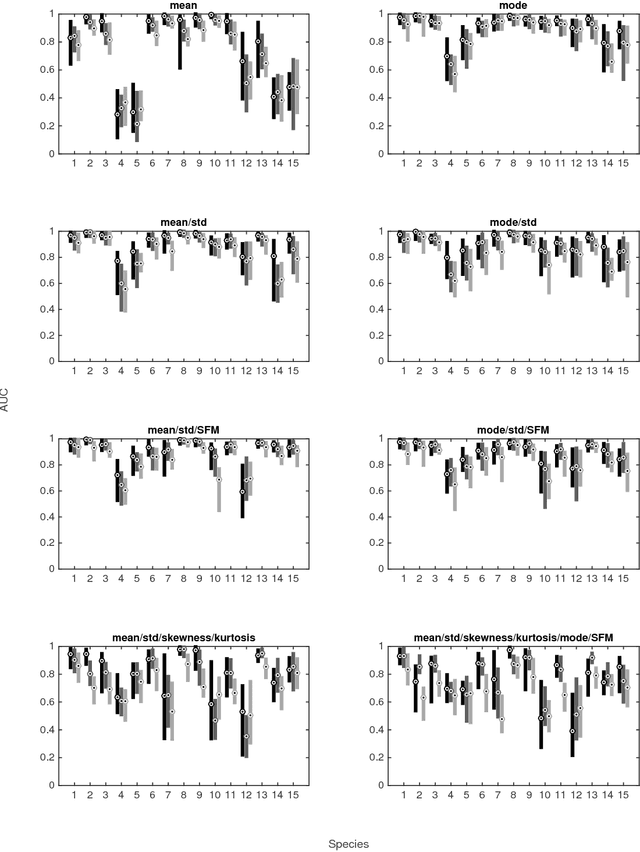
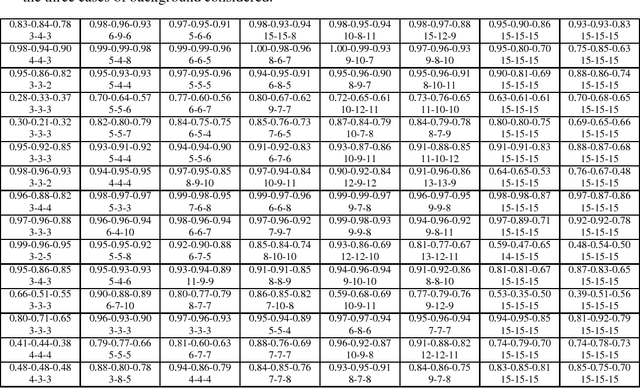
Biodiversity monitoring using audio recordings is achievable at a truly global scale via large-scale deployment of inexpensive, unattended recording stations or by large-scale crowdsourcing using recording and species recognition on mobile devices. The ability, however, to reliably identify vocalising animal species is limited by the fact that acoustic signatures of interest in such recordings are typically embedded in a diverse and complex acoustic background. To avoid the problems associated with modelling such backgrounds, we build generative models of bird sounds and use the concept of novelty detection to screen recordings to detect sections of data which are likely bird vocalisations. We present detection results against various acoustic environments and different signal-to-noise ratios. We discuss the issues related to selecting the cost function and setting detection thresholds in such algorithms. Our methods are designed to be scalable and automatically applicable to arbitrary selections of species depending on the specific geographic region and time period of deployment.