 Add to Chrome
 Add to Firefox
 Add to Edge
Explainable AI in Speaker Recognition -- Attention Map Visualisation and Evaluation
Jun 22, 2026
Explaining and understanding the decision-making process of artificial intelligence (AI) systems, particularly those implemented by neural networks, falls within the field of explainable AI (XAI). Analogous to the human attention mechanism, neural networks are assumed to possess their own attention mechanisms that selectively process information during decision-making. This work proposes to study one XAI topic: analysing and visualising the attention mechanisms of neural networks. Our experiments are performed on speaker recognition neural networks that are trained to identify speaker identity from a given utterance. Previous studies have widely used class activation map (CAM)-based methods to analyse and visualise the attention mechanisms of neural networks. Each of these methods produces an attention map for each network input, highlighting which input regions are selectively processed when the speaker recognition network makes decisions. However, the evaluation of attention maps produced by these methods remains largely underexplored. This work systematically reviews an existing attention map evaluation algorithm, establishing key concepts and identifying its shortcomings. On the basis of this existing evaluation algorithm, a new version is then proposed to address the identified shortcomings, called the Modified Randomised Input Sampling for Explanation - Evaluation algorithm (Modified RISE-eval). Using Modified RISE-eval, we evaluate the attention maps produced by two representative CAM-based methods, GradCAM and LayerCAM, applied to a certain speaker recognition network. The evaluation results demonstrate that GradCAM and LayerCAM each exhibit distinct advantages when applied under different experimental conditions in the speaker recognition task.

Explainable AI in Speaker Recognition -- Making Latent Representations Understandable
Apr 25, 2026Neural networks can be trained to learn task-relevant representations from data. Understanding how these networks make decisions falls within the Explainable AI (XAI) domain. This paper proposes to study an XAI topic: uncovering unknown organisational patterns in network representations, particularly those representations learned by the speaker recognition network that recognises the speaker identity of utterances. Past studies employed algorithms (e.g. t-distributed Stochastic Neighbour Embedding and K-means) to analyse and visualise how network representations form independent clusters, indicating the presence of flat clustering phenomena within the space defined by these representations. In contrast, this work applies two algorithms -- Single-Linkage Clustering (SLINK) and Hierarchical Density-Based Spatial Clustering of Applications with Noise (HDBSCAN) -- to analyse how representations form clusters with hierarchical relationships rather than being independent, thereby demonstrating the existence of hierarchical clustering phenomena within the network representation space. To semantically understand the above hierarchical clustering phenomena, a new algorithm, termed Hierarchical Cluster-Class Matching (HCCM), is designed to perform one-to-one matching between predefined semantic classes and hierarchical representation clusters (i.e. those produced by SLINK or HDBSCAN). Some hierarchical clusters are successfully matched to individual semantic classes (e.g. male, UK), while others to conjunctions of semantic classes (e.g. male and UK, female and Ireland). A new metric, Liebig's score, is proposed to quantify the performance of each matching behaviour, allowing us to diagnose the factor that most strongly limits matching performance.
Lightweight Dual-channel Target Speaker Separation for Mobile Voice Communication
Jun 05, 2021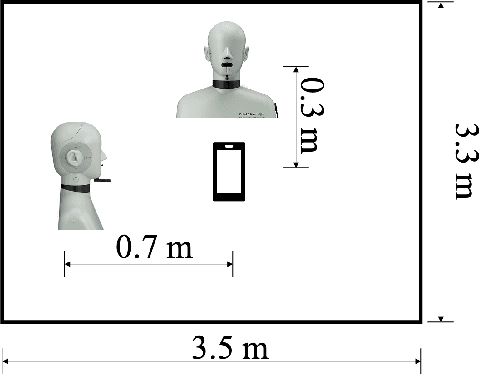
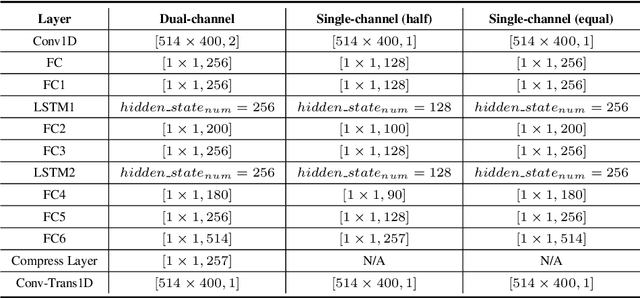
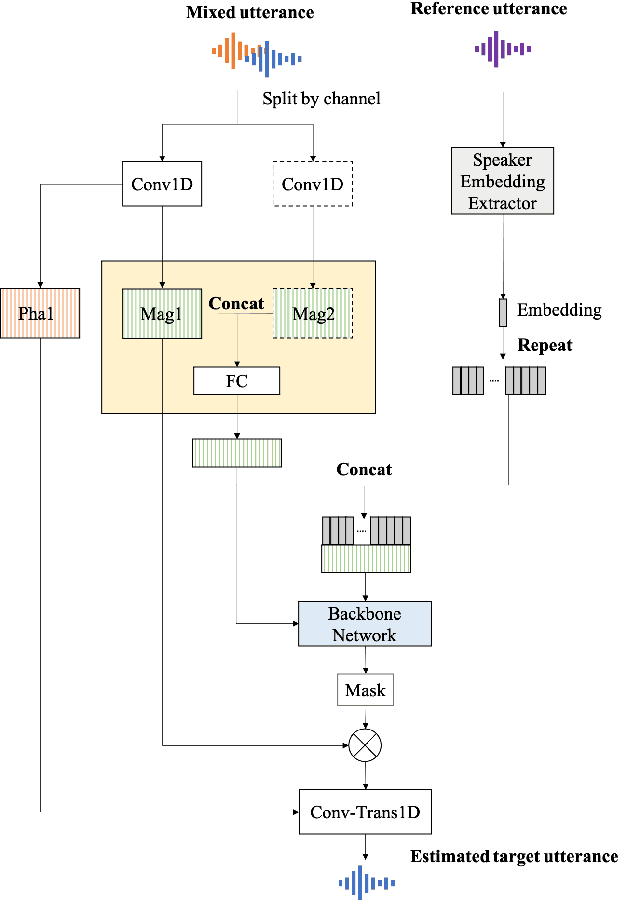
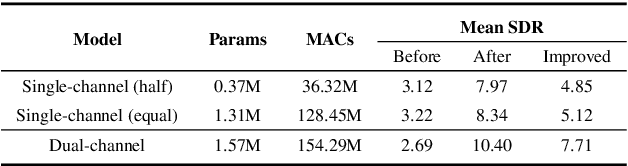
Nowadays, there is a strong need to deploy the target speaker separation (TSS) model on mobile devices with a limitation of the model size and computational complexity. To better perform TSS for mobile voice communication, we first make a dual-channel dataset based on a specific scenario, LibriPhone. Specifically, to better mimic the real-case scenario, instead of simulating from the single-channel dataset, LibriPhone is made by simultaneously replaying pairs of utterances from LibriSpeech by two professional artificial heads and recording by two built-in microphones of the mobile. Then, we propose a lightweight time-frequency domain separation model, LSTM-Former, which is based on the LSTM framework with source-to-noise ratio (SI-SNR) loss. For the experiments on Libri-Phone, we explore the dual-channel LSTMFormer model and a single-channel version by a random single channel of Libri-Phone. Experimental result shows that the dual-channel LSTM-Former outperforms the single-channel LSTMFormer with relative 25% improvement. This work provides a feasible solution for the TSS task on mobile devices, playing back and recording multiple data sources in real application scenarios for getting dual-channel real data can assist the lightweight model to achieve higher performance.
Detecting Escalation Level from Speech with Transfer Learning and Acoustic-Lexical Information Fusion
Apr 13, 2021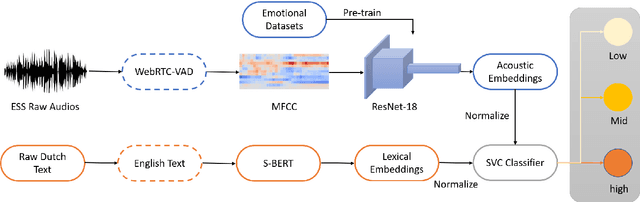
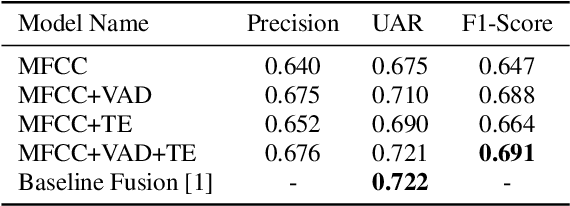
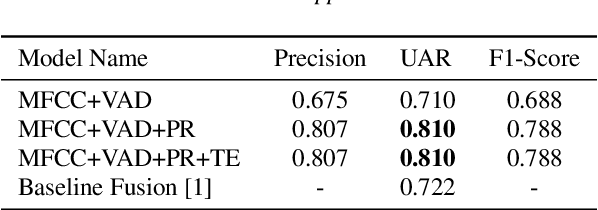
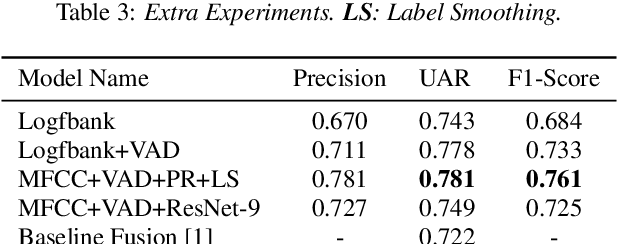
Textual escalation detection has been widely applied to e-commerce companies' customer service systems to pre-alert and prevent potential conflicts. Similarly, in public areas such as airports and train stations, where many impersonal conversations frequently take place, acoustic-based escalation detection systems are also useful to enhance passengers' safety and maintain public order. To this end, we introduce a system based on acoustic-lexical features to detect escalation from speech, Voice Activity Detection (VAD) and label smoothing are adopted to further enhance the performance in our experiments. Considering a small set of training and development data, we also employ transfer learning on several well-known emotional detection datasets, i.e. RAVDESS, CREMA-D, to learn advanced emotional representations that can be applied to the escalation detection task. On the development set, our proposed system achieves 81.5% unweighted average recall (UAR) which significantly outperforms the baseline with 72.2% UAR.