 Add to Chrome
 Add to Firefox
 Add to Edge
SIMPL: A Simple and Efficient Multi-agent Motion Prediction Baseline for Autonomous Driving
Feb 04, 2024
This paper presents a Simple and effIcient Motion Prediction baseLine (SIMPL) for autonomous vehicles. Unlike conventional agent-centric methods with high accuracy but repetitive computations and scene-centric methods with compromised accuracy and generalizability, SIMPL delivers real-time, accurate motion predictions for all relevant traffic participants. To achieve improvements in both accuracy and inference speed, we propose a compact and efficient global feature fusion module that performs directed message passing in a symmetric manner, enabling the network to forecast future motion for all road users in a single feed-forward pass and mitigating accuracy loss caused by viewpoint shifting. Additionally, we investigate the continuous trajectory parameterization using Bernstein basis polynomials in trajectory decoding, allowing evaluations of states and their higher-order derivatives at any desired time point, which is valuable for downstream planning tasks. As a strong baseline, SIMPL exhibits highly competitive performance on Argoverse 1 & 2 motion forecasting benchmarks compared with other state-of-the-art methods. Furthermore, its lightweight design and low inference latency make SIMPL highly extensible and promising for real-world onboard deployment. We open-source the code at https://github.com/HKUST-Aerial-Robotics/SIMPL.

Long-Term Fair Decision Making through Deep Generative Models
Jan 20, 2024This paper studies long-term fair machine learning which aims to mitigate group disparity over the long term in sequential decision-making systems. To define long-term fairness, we leverage the temporal causal graph and use the 1-Wasserstein distance between the interventional distributions of different demographic groups at a sufficiently large time step as the quantitative metric. Then, we propose a three-phase learning framework where the decision model is trained on high-fidelity data generated by a deep generative model. We formulate the optimization problem as a performative risk minimization and adopt the repeated gradient descent algorithm for learning. The empirical evaluation shows the efficacy of the proposed method using both synthetic and semi-synthetic datasets.
Striking a Balance in Fairness for Dynamic Systems Through Reinforcement Learning
Jan 12, 2024While significant advancements have been made in the field of fair machine learning, the majority of studies focus on scenarios where the decision model operates on a static population. In this paper, we study fairness in dynamic systems where sequential decisions are made. Each decision may shift the underlying distribution of features or user behavior. We model the dynamic system through a Markov Decision Process (MDP). By acknowledging that traditional fairness notions and long-term fairness are distinct requirements that may not necessarily align with one another, we propose an algorithmic framework to integrate various fairness considerations with reinforcement learning using both pre-processing and in-processing approaches. Three case studies show that our method can strike a balance between traditional fairness notions, long-term fairness, and utility.
Scene 3-D Reconstruction System in Scattering Medium
Dec 14, 2023The research on neural radiance fields for new view synthesis has experienced explosive growth with the development of new models and extensions. The NERF algorithm, suitable for underwater scenes or scattering media, is also evolving. Existing underwater 3D reconstruction systems still face challenges such as extensive training time and low rendering efficiency. This paper proposes an improved underwater 3D reconstruction system to address these issues and achieve rapid, high-quality 3D reconstruction.To begin with, we enhance underwater videos captured by a monocular camera to correct the poor image quality caused by the physical properties of the water medium while ensuring consistency in enhancement across adjacent frames. Subsequently, we perform keyframe selection on the video frames to optimize resource utilization and eliminate the impact of dynamic objects on the reconstruction results. The selected keyframes, after pose estimation using COLMAP, undergo a three-dimensional reconstruction improvement process using neural radiance fields based on multi-resolution hash coding for model construction and rendering.
Long-Range Neural Atom Learning for Molecular Graphs
Nov 02, 2023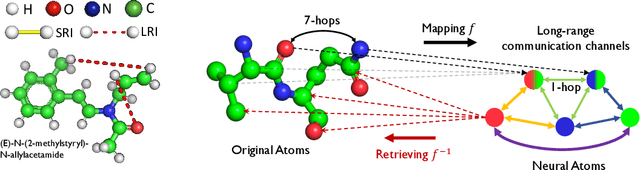
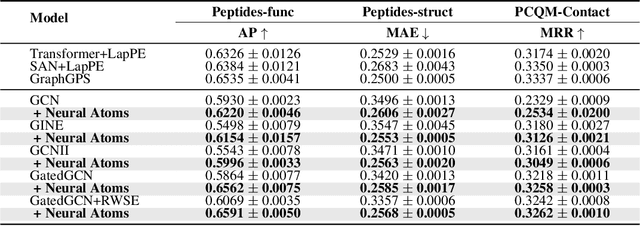
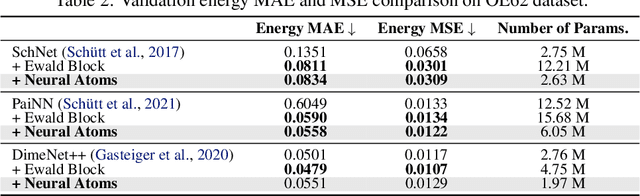
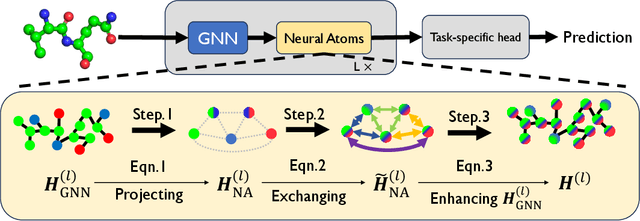
Graph Neural Networks (GNNs) have been widely adopted for drug discovery with molecular graphs. Nevertheless, current GNNs are mainly good at leveraging short-range interactions (SRI) but struggle to capture long-range interactions (LRI), both of which are crucial for determining molecular properties. To tackle this issue, we propose a method that implicitly projects all original atoms into a few Neural Atoms, which abstracts the collective information of atomic groups within a molecule. Specifically, we explicitly exchange the information among neural atoms and project them back to the atoms' representations as an enhancement. With this mechanism, neural atoms establish the communication channels among distant nodes, effectively reducing the interaction scope of arbitrary node pairs into a single hop. To provide an inspection of our method from a physical perspective, we reveal its connection with the traditional LRI calculation method, Ewald Summation. We conduct extensive experiments on three long-range graph benchmarks, covering both graph-level and link-level tasks on molecular graphs. We empirically justify that our method can be equipped with an arbitrary GNN and help to capture LRI.
Video Frame Interpolation with Many-to-many Splatting and Spatial Selective Refinement
Oct 29, 2023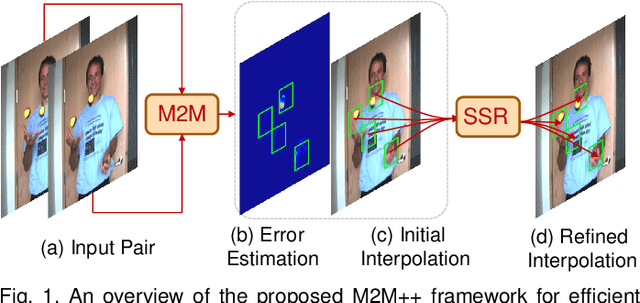
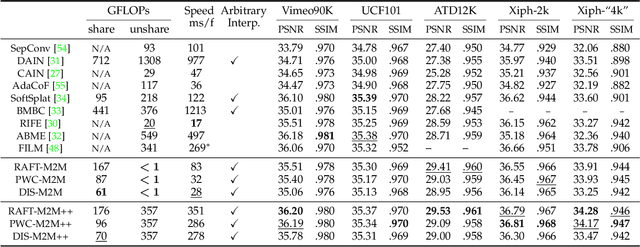
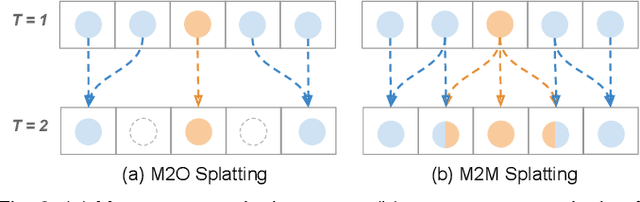
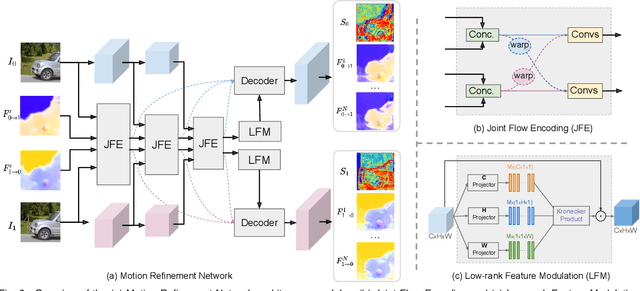
In this work, we first propose a fully differentiable Many-to-Many (M2M) splatting framework to interpolate frames efficiently. Given a frame pair, we estimate multiple bidirectional flows to directly forward warp the pixels to the desired time step before fusing overlapping pixels. In doing so, each source pixel renders multiple target pixels and each target pixel can be synthesized from a larger area of visual context, establishing a many-to-many splatting scheme with robustness to undesirable artifacts. For each input frame pair, M2M has a minuscule computational overhead when interpolating an arbitrary number of in-between frames, hence achieving fast multi-frame interpolation. However, directly warping and fusing pixels in the intensity domain is sensitive to the quality of motion estimation and may suffer from less effective representation capacity. To improve interpolation accuracy, we further extend an M2M++ framework by introducing a flexible Spatial Selective Refinement (SSR) component, which allows for trading computational efficiency for interpolation quality and vice versa. Instead of refining the entire interpolated frame, SSR only processes difficult regions selected under the guidance of an estimated error map, thereby avoiding redundant computation. Evaluation on multiple benchmark datasets shows that our method is able to improve the efficiency while maintaining competitive video interpolation quality, and it can be adjusted to use more or less compute as needed.
PathRL: An End-to-End Path Generation Method for Collision Avoidance via Deep Reinforcement Learning
Oct 20, 2023Robot navigation using deep reinforcement learning (DRL) has shown great potential in improving the performance of mobile robots. Nevertheless, most existing DRL-based navigation methods primarily focus on training a policy that directly commands the robot with low-level controls, like linear and angular velocities, which leads to unstable speeds and unsmooth trajectories of the robot during the long-term execution. An alternative method is to train a DRL policy that outputs the navigation path directly. However, two roadblocks arise for training a DRL policy that outputs paths: (1) The action space for potential paths often involves higher dimensions comparing to low-level commands, which increases the difficulties of training; (2) It takes multiple time steps to track a path instead of a single time step, which requires the path to predicate the interactions of the robot w.r.t. the dynamic environment in multiple time steps. This, in turn, amplifies the challenges associated with training. In response to these challenges, we propose PathRL, a novel DRL method that trains the policy to generate the navigation path for the robot. Specifically, we employ specific action space discretization techniques and tailored state space representation methods to address the associated challenges. In our experiments, PathRL achieves better success rates and reduces angular rotation variability compared to other DRL navigation methods, facilitating stable and smooth robot movement. We demonstrate the competitive edge of PathRL in both real-world scenarios and multiple challenging simulation environments.
ChatRadio-Valuer: A Chat Large Language Model for Generalizable Radiology Report Generation Based on Multi-institution and Multi-system Data
Oct 10, 2023


Radiology report generation, as a key step in medical image analysis, is critical to the quantitative analysis of clinically informed decision-making levels. However, complex and diverse radiology reports with cross-source heterogeneity pose a huge generalizability challenge to the current methods under massive data volume, mainly because the style and normativity of radiology reports are obviously distinctive among institutions, body regions inspected and radiologists. Recently, the advent of large language models (LLM) offers great potential for recognizing signs of health conditions. To resolve the above problem, we collaborate with the Second Xiangya Hospital in China and propose ChatRadio-Valuer based on the LLM, a tailored model for automatic radiology report generation that learns generalizable representations and provides a basis pattern for model adaptation in sophisticated analysts' cases. Specifically, ChatRadio-Valuer is trained based on the radiology reports from a single institution by means of supervised fine-tuning, and then adapted to disease diagnosis tasks for human multi-system evaluation (i.e., chest, abdomen, muscle-skeleton, head, and maxillofacial $\&$ neck) from six different institutions in clinical-level events. The clinical dataset utilized in this study encompasses a remarkable total of \textbf{332,673} observations. From the comprehensive results on engineering indicators, clinical efficacy and deployment cost metrics, it can be shown that ChatRadio-Valuer consistently outperforms state-of-the-art models, especially ChatGPT (GPT-3.5-Turbo) and GPT-4 et al., in terms of the diseases diagnosis from radiology reports. ChatRadio-Valuer provides an effective avenue to boost model generalization performance and alleviate the annotation workload of experts to enable the promotion of clinical AI applications in radiology reports.
Magicremover: Tuning-free Text-guided Image inpainting with Diffusion Models
Oct 04, 2023Image inpainting aims to fill in the missing pixels with visually coherent and semantically plausible content. Despite the great progress brought from deep generative models, this task still suffers from i. the difficulties in large-scale realistic data collection and costly model training; and ii. the intrinsic limitations in the traditionally user-defined binary masks on objects with unclear boundaries or transparent texture. In this paper, we propose MagicRemover, a tuning-free method that leverages the powerful diffusion models for text-guided image inpainting. We introduce an attention guidance strategy to constrain the sampling process of diffusion models, enabling the erasing of instructed areas and the restoration of occluded content. We further propose a classifier optimization algorithm to facilitate the denoising stability within less sampling steps. Extensive comparisons are conducted among our MagicRemover and state-of-the-art methods including quantitative evaluation and user study, demonstrating the significant improvement of MagicRemover on high-quality image inpainting. We will release our code at https://github.com/exisas/Magicremover.
Algorithmic Recourse for Anomaly Detection in Multivariate Time Series
Sep 28, 2023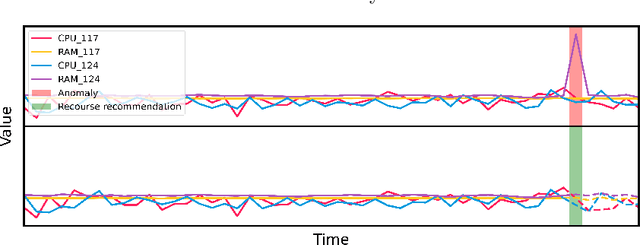

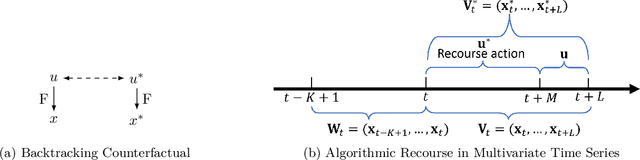
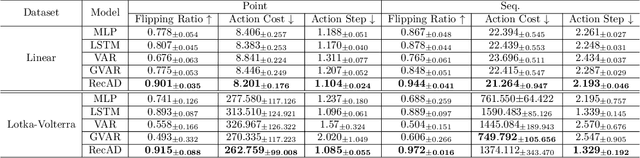
Anomaly detection in multivariate time series has received extensive study due to the wide spectrum of applications. An anomaly in multivariate time series usually indicates a critical event, such as a system fault or an external attack. Therefore, besides being effective in anomaly detection, recommending anomaly mitigation actions is also important in practice yet under-investigated. In this work, we focus on algorithmic recourse in time series anomaly detection, which is to recommend fixing actions on abnormal time series with a minimum cost so that domain experts can understand how to fix the abnormal behavior. To this end, we propose an algorithmic recourse framework, called RecAD, which can recommend recourse actions to flip the abnormal time steps. Experiments on two synthetic and one real-world datasets show the effectiveness of our framework.