 Add to Chrome
 Add to Firefox
 Add to Edge
Content Depth Matters in Short-Video Recommendation: Rethinking the Attention Economy
Aug 14, 2026
Driven by the attention economy, short-video Recommender Systems (RSs) are primarily optimized to maximize user engagement by promoting videos that capture attention within seconds. These systems inherently favor shallow-content videos that are effective at attracting immediate attention. However, growing evidence suggests that prolonged exposure to such content may negatively affect users' cognitive engagement and mental well-being, raising concerns about the long-term societal impact of the short-video platform. To tackle this challenge, this paper introduces a new metric, the \textbf{Content Depth Score (CDS)}, to quantify the content depth of short videos. CDS measures the extent to which a video is expected to stimulate higher-order cognitive processes, using a seven-level scale grounded in established theories of cognitive psychology and learning. As an initial step toward this vision, we present \textbf{SCOPE-Bench}, the first benchmark for content-depth evaluation in short-video recommendation. Built upon a large-scale open-source short-video dataset, SCOPE-Bench provides CDS annotations for 150K videos, enabling systematic evaluation of RSs from a cognitive-content perspective. Leveraging SCOPE-Bench, we evaluate 13 representative RSs and reveal a consistent preference for shallow-content videos. Moreover, we find that these algorithms recommending cognitively deep content are only marginally better than random selection, highlighting a previously overlooked limitation of existing recommendation objectives. Our code and datasets are available at https://liweidengdavid.github.io/SCOPE-Bench/.

Using Lower-Bound Representations for Trajectory Similarity Learning
Aug 02, 2026Trajectory similarity learning is fundamental to efficient trajectory retrieval under complex distance measures. Existing learning-based methods typically rely on embeddings trained to approximate trajectory distances or rankings, but they often lack guarantees with respect to the original distances, exhibit unstable performance across distance measures, and incur substantial training costs. We revisit trajectory similarity learning from a lower-bound representation perspective and propose LB-TrajRep, a unified lower-bound representation framework independent of deep neural embeddings. This framework constructs single-vector representations from a set of lower-bound components, enabling admissible and interpretable lower bounds for multiple classical trajectory distances, including Dynamic Time Warping (DTW), Hausdorff distance, and Discrete Fréchet Distance (DFD). Within this framework, we instantiate point-pivot components, which naturally support both metric and non-metric distances and remain compatible with standard vector-based retrieval pipelines. To improve ranking quality, we develop two data-driven pivot selection strategies that explicitly optimize lower-bound tightness and prioritize hard near-neighbor trajectory pairs, respectively. Extensive experiments on real-world trajectory datasets show that the proposed lower-bound representations are able to consistently outperform state-of-the-art neural trajectory embeddings across diverse distance measures, improving top-$k$ ranking accuracy by up to 20\%--60\% on the Hausdorff distance and DFD and by 15\%--40\% on DTW.
Discrete Prototypical Memories for Federated Time Series Foundation Models
Apr 06, 2026Leveraging Large Language Models (LLMs) as federated learning (FL)-based time series foundation models offers a promising way to transfer the generalization capabilities of LLMs to time series data while preserving access to private data. However, the semantic misalignment between time-series data and the text-centric latent space of existing LLMs often leads to degraded performance. Meanwhile, the parameter-sharing mechanism in existing FL methods model heterogeneous cross-domain time-series data into a unified continuous latent space, which contradicts the fact that time-series semantics frequently manifest as discrete and recurring regimes. To address these limitations, we propose \textsc{FeDPM}, a federated framework for time-series foundation models based on discrete prototypical memories. Specifically, we learn local prototypical memory priors for intra-domain time-series data. We then align cross-domain memories to promote a unified discrete latent space and introduce a domain-specific memory update mechanism to balance shared and personalized prototypical knowledge. Extensive experiments demonstrate the efficiency and effectiveness of \textsc{FeDPM}. The code is publicly available at https://anonymous.4open.science/r/FedUnit-64D1.
LIRA: A Learning-based Query-aware Partition Framework for Large-scale ANN Search
Mar 30, 2025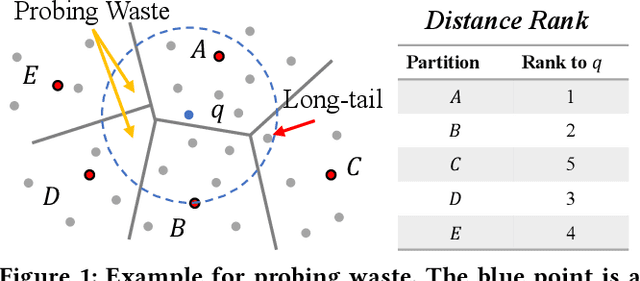
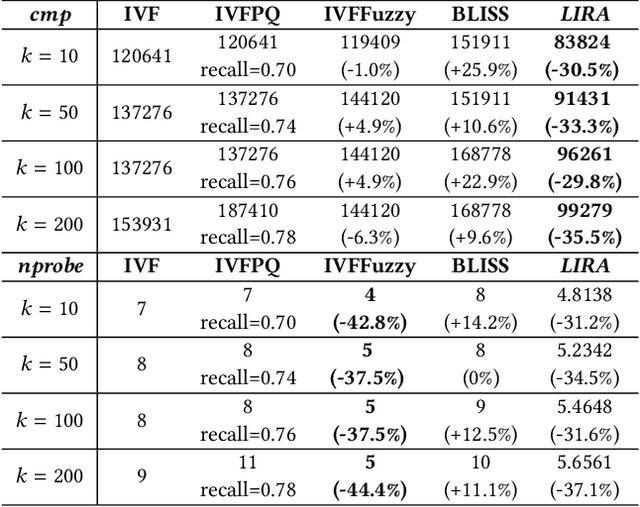
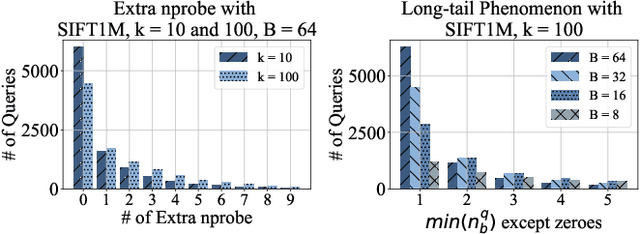
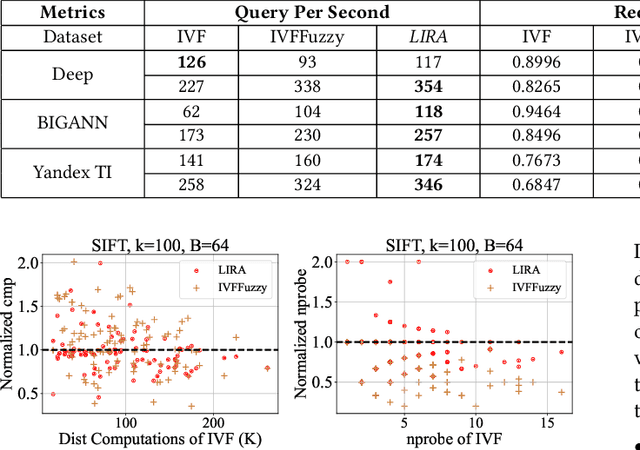
Approximate nearest neighbor search is fundamental in information retrieval. Previous partition-based methods enhance search efficiency by probing partial partitions, yet they face two common issues. In the query phase, a common strategy is to probe partitions based on the distance ranks of a query to partition centroids, which inevitably probes irrelevant partitions as it ignores data distribution. In the partition construction phase, all partition-based methods face the boundary problem that separates a query's nearest neighbors to multiple partitions, resulting in a long-tailed kNN distribution and degrading the optimal nprobe (i.e., the number of probing partitions). To address this gap, we propose LIRA, a LearnIng-based queRy-aware pArtition framework. Specifically, we propose a probing model to directly probe the partitions containing the kNN of a query, which can reduce probing waste and allow for query-aware probing with nprobe individually. Moreover, we incorporate the probing model into a learning-based redundancy strategy to mitigate the adverse impact of the long-tailed kNN distribution on search efficiency. Extensive experiments on real-world vector datasets demonstrate the superiority of LIRA in the trade-off among accuracy, latency, and query fan-out. The codes are available at https://github.com/SimoneZeng/LIRA-ANN-search.
Efficient Large-Scale Traffic Forecasting with Transformers: A Spatial Data Management Perspective
Dec 13, 2024Road traffic forecasting is crucial in real-world intelligent transportation scenarios like traffic dispatching and path planning in city management and personal traveling. Spatio-temporal graph neural networks (STGNNs) stand out as the mainstream solution in this task. Nevertheless, the quadratic complexity of remarkable dynamic spatial modeling-based STGNNs has become the bottleneck over large-scale traffic data. From the spatial data management perspective, we present a novel Transformer framework called PatchSTG to efficiently and dynamically model spatial dependencies for large-scale traffic forecasting with interpretability and fidelity. Specifically, we design a novel irregular spatial patching to reduce the number of points involved in the dynamic calculation of Transformer. The irregular spatial patching first utilizes the leaf K-dimensional tree (KDTree) to recursively partition irregularly distributed traffic points into leaf nodes with a small capacity, and then merges leaf nodes belonging to the same subtree into occupancy-equaled and non-overlapped patches through padding and backtracking. Based on the patched data, depth and breadth attention are used interchangeably in the encoder to dynamically learn local and global spatial knowledge from points in a patch and points with the same index of patches. Experimental results on four real world large-scale traffic datasets show that our PatchSTG achieves train speed and memory utilization improvements up to $10\times$ and $4\times$ with the state-of-the-art performance.
MILLION: A General Multi-Objective Framework with Controllable Risk for Portfolio Management
Dec 04, 2024
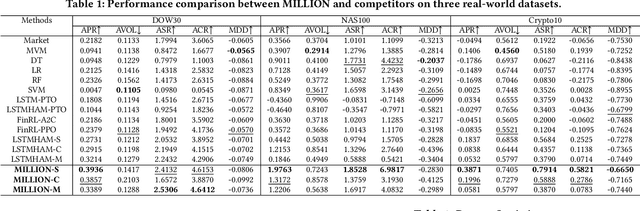

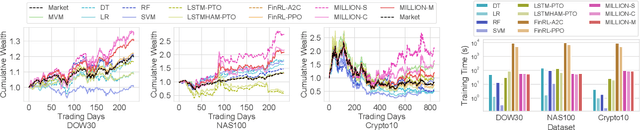
Portfolio management is an important yet challenging task in AI for FinTech, which aims to allocate investors' budgets among different assets to balance the risk and return of an investment. In this study, we propose a general Multi-objectIve framework with controLLable rIsk for pOrtfolio maNagement (MILLION), which consists of two main phases, i.e., return-related maximization and risk control. Specifically, in the return-related maximization phase, we introduce two auxiliary objectives, i.e., return rate prediction, and return rate ranking, combined with portfolio optimization to remit the overfitting problem and improve the generalization of the trained model to future markets. Subsequently, in the risk control phase, we propose two methods, i.e., portfolio interpolation and portfolio improvement, to achieve fine-grained risk control and fast risk adaption to a user-specified risk level. For the portfolio interpolation method, we theoretically prove that the risk can be perfectly controlled if the to-be-set risk level is in a proper interval. In addition, we also show that the return rate of the adjusted portfolio after portfolio interpolation is no less than that of the min-variance optimization, as long as the model in the reward maximization phase is effective. Furthermore, the portfolio improvement method can achieve greater return rates while keeping the same risk level compared to portfolio interpolation. Extensive experiments are conducted on three real-world datasets. The results demonstrate the effectiveness and efficiency of the proposed framework.
Efficient Data-aware Distance Comparison Operations for High-Dimensional Approximate Nearest Neighbor Search
Nov 26, 2024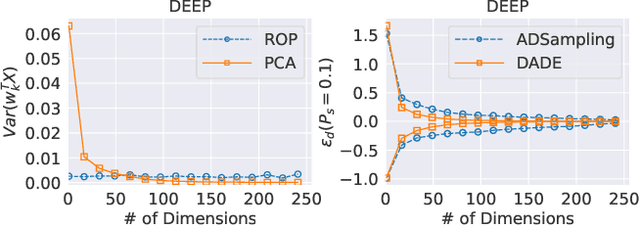
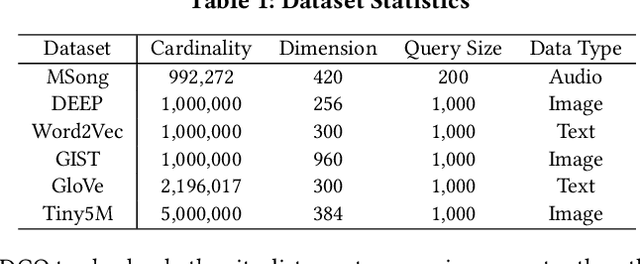
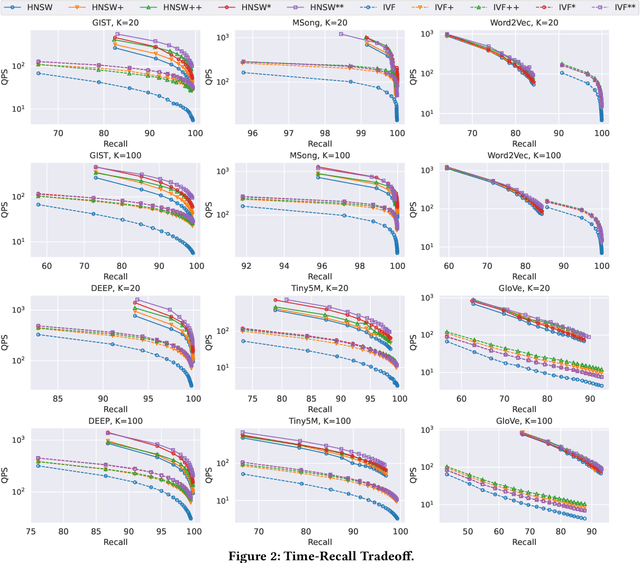
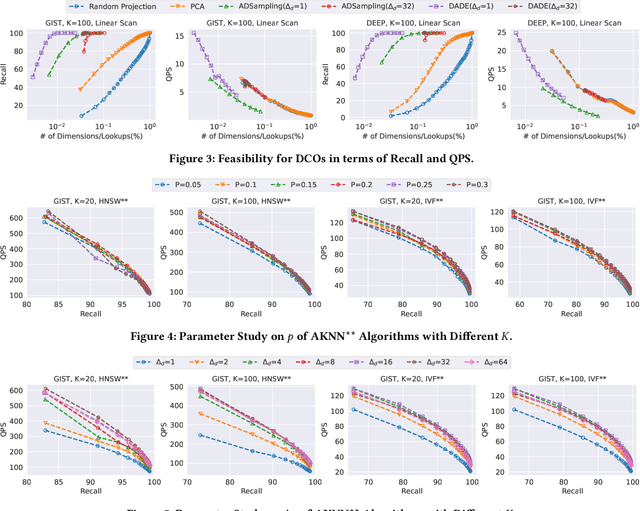
High-dimensional approximate $K$ nearest neighbor search (AKNN) is a fundamental task for various applications, including information retrieval. Most existing algorithms for AKNN can be decomposed into two main components, i.e., candidate generation and distance comparison operations (DCOs). While different methods have unique ways of generating candidates, they all share the same DCO process. In this study, we focus on accelerating the process of DCOs that dominates the time cost in most existing AKNN algorithms. To achieve this, we propose an \underline{D}ata-\underline{A}ware \underline{D}istance \underline{E}stimation approach, called \emph{DADE}, which approximates the \emph{exact} distance in a lower-dimensional space. We theoretically prove that the distance estimation in \emph{DADE} is \emph{unbiased} in terms of data distribution. Furthermore, we propose an optimized estimation based on the unbiased distance estimation formulation. In addition, we propose a hypothesis testing approach to adaptively determine the number of dimensions needed to estimate the \emph{exact} distance with sufficient confidence. We integrate \emph{DADE} into widely-used AKNN search algorithms, e.g., \emph{IVF} and \emph{HNSW}, and conduct extensive experiments to demonstrate the superiority.
D2Vformer: A Flexible Time Series Prediction Model Based on Time Position Embedding
Sep 17, 2024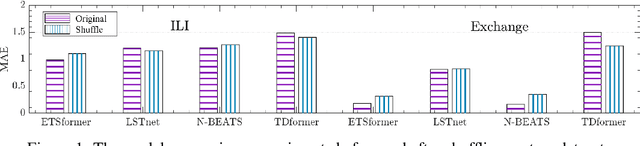


Time position embeddings capture the positional information of time steps, often serving as auxiliary inputs to enhance the predictive capabilities of time series models. However, existing models exhibit limitations in capturing intricate time positional information and effectively utilizing these embeddings. To address these limitations, this paper proposes a novel model called D2Vformer. Unlike typical prediction methods that rely on RNNs or Transformers, this approach can directly handle scenarios where the predicted sequence is not adjacent to the input sequence or where its length dynamically changes. In comparison to conventional methods, D2Vformer undoubtedly saves a significant amount of training resources. In D2Vformer, the Date2Vec module uses the timestamp information and feature sequences to generate time position embeddings. Afterward, D2Vformer introduces a new fusion block that utilizes an attention mechanism to explore the similarity in time positions between the embeddings of the input sequence and the predicted sequence, thereby generating predictions based on this similarity. Through extensive experiments on six datasets, we demonstrate that Date2Vec outperforms other time position embedding methods, and D2Vformer surpasses state-of-the-art methods in both fixed-length and variable-length prediction tasks.
Parameterized Decision-making with Multi-modal Perception for Autonomous Driving
Dec 19, 2023


Autonomous driving is an emerging technology that has advanced rapidly over the last decade. Modern transportation is expected to benefit greatly from a wise decision-making framework of autonomous vehicles, including the improvement of mobility and the minimization of risks and travel time. However, existing methods either ignore the complexity of environments only fitting straight roads, or ignore the impact on surrounding vehicles during optimization phases, leading to weak environmental adaptability and incomplete optimization objectives. To address these limitations, we propose a parameterized decision-making framework with multi-modal perception based on deep reinforcement learning, called AUTO. We conduct a comprehensive perception to capture the state features of various traffic participants around the autonomous vehicle, based on which we design a graph-based model to learn a state representation of the multi-modal semantic features. To distinguish between lane-following and lane-changing, we decompose an action of the autonomous vehicle into a parameterized action structure that first decides whether to change lanes and then computes an exact action to execute. A hybrid reward function takes into account aspects of safety, traffic efficiency, passenger comfort, and impact to guide the framework to generate optimal actions. In addition, we design a regularization term and a multi-worker paradigm to enhance the training. Extensive experiments offer evidence that AUTO can advance state-of-the-art in terms of both macroscopic and microscopic effectiveness.
History Semantic Graph Enhanced Conversational KBQA with Temporal Information Modeling
Jun 12, 2023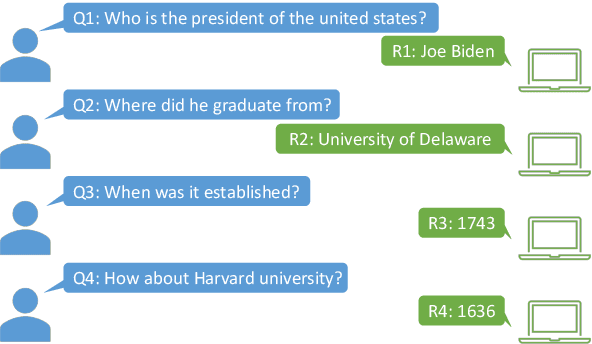


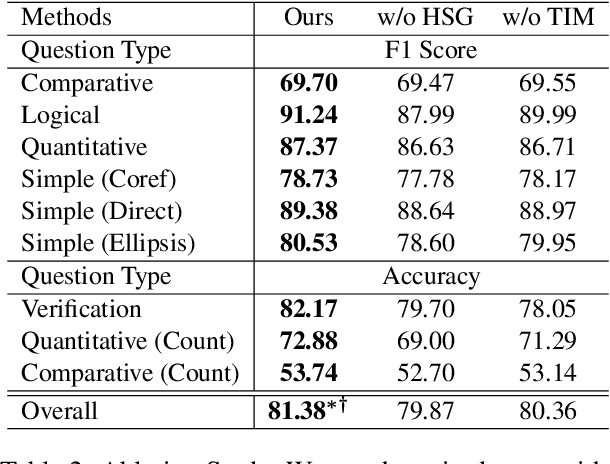
Context information modeling is an important task in conversational KBQA. However, existing methods usually assume the independence of utterances and model them in isolation. In this paper, we propose a History Semantic Graph Enhanced KBQA model (HSGE) that is able to effectively model long-range semantic dependencies in conversation history while maintaining low computational cost. The framework incorporates a context-aware encoder, which employs a dynamic memory decay mechanism and models context at different levels of granularity. We evaluate HSGE on a widely used benchmark dataset for complex sequential question answering. Experimental results demonstrate that it outperforms existing baselines averaged on all question types.