 Add to Chrome
 Add to Firefox
 Add to Edge
Lethe: How Hard Is It to Forget? A Benchmark for Federated Unlearning in Medical Imaging
Aug 02, 2026
Federated learning enables medical-imaging models to be trained across hospitals, and privacy law, most explicitly the GDPR ``right to be forgotten'', turns removing a hospital's, a class's, or a patient's influence from such a model into a federated unlearning problem. This need is most acute in medicine, where patients withdraw consent and hospitals leave collaborations. Yet nearly all unlearning evidence comes from natural images, whose heterogeneity and task structure differ sharply from clinical data, so it is unclear whether existing methods transfer, and no shared protocol covers clinical data. We present Lethe, a benchmark for federated unlearning in medical imaging. It evaluates twelve methods across eight task families, from classification and segmentation to denoising, cross-modality synthesis, and vision-language question answering, at three forgetting granularities and against a retrained gold standard on utility, privacy, and cost. The central result is that what separates methods is the difficulty of the forgetting request, not the method itself. The easy removals that dominate the literature leave the methods that preserve utility indistinguishable, while only hard ones separate them. More striking, on the many medical tasks that generalize across sites, forgetting a client barely changes task performance, leaving residual membership as the signal that must be erased.

FM$^2$: Unified Federated Foundation Models for Heterogeneous Multimodal Medical Imaging
Jul 15, 2026Building foundation models for medical imaging requires pooling data across institutions, yet privacy regulations prohibit centralized aggregation. Existing Federated Foundation Models either fine-tune natural-image models with poor medical-domain transfer, or train from scratch within a single modality, lacking the flexibility to unify tasks. We identify an under-explored challenge, Imaging Modality Heterogeneity, where clients operate under two structural regimes: Overlapped (shared modalities with heterogeneous label distributions) and Non-overlapped (fully disjoint modalities per client). We propose FM$^2$, a unified framework that trains the core backbone from scratch to preserve medical domain fidelity while optionally incorporating biomedical pretrained encoders for vision-language alignment. FM$^2$ equips each client with dual Mixture-of-Experts modules (a Class-wise MoE for personalized category knowledge and a Domain-wise MoE for shared cross-modality representations), coupled with a Heterogeneous Modality Alignment (HMA) regularizer that explicitly aligns modality-specific expert parameters, admitting provable $O(1/\sqrt{T})$ convergence and generalization guarantees. FM$^2$ further incorporates Caption-Enhanced Learning (CEL), where locally retained GPT-4o-generated captions serve as a textual semantic bridge enabling representation transfer across clients with disjoint modalities, and demonstrates extensibility to Federated Medical VQA. Experiments on our MIMH benchmark (classification and CEL) and real-world medical VQA datasets confirm consistent superiority over state-of-the-art federated baselines and strong out-of-modality generalization across all three tasks.
Learning Design Skills as Memory Policies for Agentic Photonic Inverse Design
May 28, 2026Photonic crystal fiber (PCF) inverse design remains challenging because candidate geometries must satisfy coupled optical targets under expensive electromagnetic simulation. Existing pipelines improve surrogate prediction or one-shot parameter recommendation, but they do not accumulate reusable design knowledge across iterative trials. We formulate PCF inverse design as a memory-policy learning problem and propose SkillPCF, a closed-loop agent framework that combines a physics-guided memory skill bank, reinforcement-learned skill selection, and simulator-grounded skill evolution. We further construct a real-world dataset with 479 expert interaction traces (2,507 spans) and 553 memory-dependent evaluation queries covering dispersion engineering, loss optimization, and multi-objective design. Experiments across multiple LLM backbones and classical baselines show that SkillPCF achieves stronger design-quality and efficiency trade-offs under practical simulation budgets, demonstrating the effectiveness of our proposed memory-skill learning paradigm for physics-aware PCF inverse design.
Bi-level Heterogeneous Learning for Time Series Foundation Models: A Federated Learning Approach
Apr 08, 2026Heterogeneity in time series data is more pronounced than in vision or language, as temporal dynamics vary substantially across domains and tasks. Existing efforts on training time series foundation models (TSFMs) from scratch are often trained with mixed-batch strategies that merge large-scale datasets, which can cause gradient conflicts and degrade representation quality. To address this, we propose a fine-grained learning method that distills invariant knowledge from heterogeneous series while reducing cross-domain interference. We characterize heterogeneity at two levels: inter-domain and intra-domain. To tackle this bi-level heterogeneity, we design a federated learning method that mitigates intra-domain conflicts by enforcing domain-invariant and semantically consistent representations through local regularization, and addresses inter-domain discrepancies by enhancing cross-domain collaboration via domain-aware aggregation. Experiments across diverse benchmarks show that TSFMs trained with our method consistently outperform both centralized and federated TSFM baselines in point and probabilistic forecasting, while also achieving competitive zero-shot performance at scale, offering a flexible pathway for training TSFMs from scratch in heterogeneous environments.
Discrete Prototypical Memories for Federated Time Series Foundation Models
Apr 06, 2026Leveraging Large Language Models (LLMs) as federated learning (FL)-based time series foundation models offers a promising way to transfer the generalization capabilities of LLMs to time series data while preserving access to private data. However, the semantic misalignment between time-series data and the text-centric latent space of existing LLMs often leads to degraded performance. Meanwhile, the parameter-sharing mechanism in existing FL methods model heterogeneous cross-domain time-series data into a unified continuous latent space, which contradicts the fact that time-series semantics frequently manifest as discrete and recurring regimes. To address these limitations, we propose \textsc{FeDPM}, a federated framework for time-series foundation models based on discrete prototypical memories. Specifically, we learn local prototypical memory priors for intra-domain time-series data. We then align cross-domain memories to promote a unified discrete latent space and introduce a domain-specific memory update mechanism to balance shared and personalized prototypical knowledge. Extensive experiments demonstrate the efficiency and effectiveness of \textsc{FeDPM}. The code is publicly available at https://anonymous.4open.science/r/FedUnit-64D1.
FeDaL: Federated Dataset Learning for Time Series Foundation Models
Aug 06, 2025Dataset-wise heterogeneity introduces significant domain biases that fundamentally degrade generalization on Time Series Foundation Models (TSFMs), yet this challenge remains underexplored. This paper rethink the development of TSFMs using the paradigm of federated learning. We propose a novel Federated Dataset Learning (FeDaL) approach to tackle heterogeneous time series by learning dataset-agnostic temporal representations. Specifically, the distributed architecture of federated learning is a nature solution to decompose heterogeneous TS datasets into shared generalized knowledge and preserved personalized knowledge. Moreover, based on the TSFM architecture, FeDaL explicitly mitigates both local and global biases by adding two complementary mechanisms: Domain Bias Elimination (DBE) and Global Bias Elimination (GBE). FeDaL`s cross-dataset generalization has been extensively evaluated in real-world datasets spanning eight tasks, including both representation learning and downstream time series analysis, against 54 baselines. We further analyze federated scaling behavior, showing how data volume, client count, and join rate affect model performance under decentralization.
Boosting Sclera Segmentation through Semi-supervised Learning with Fewer Labels
Jan 13, 2025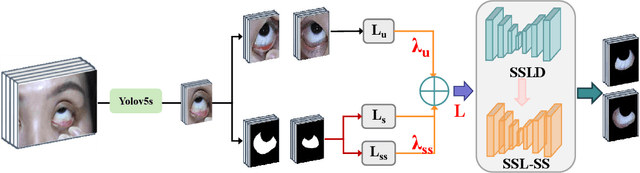

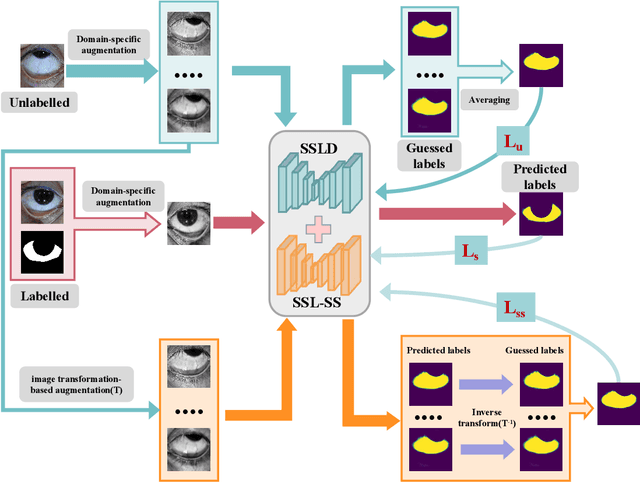
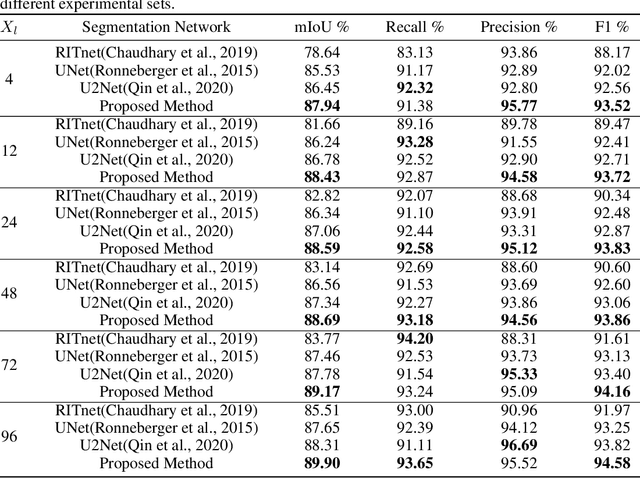
Sclera segmentation is crucial for developing automatic eye-related medical computer-aided diagnostic systems, as well as for personal identification and verification, because the sclera contains distinct personal features. Deep learning-based sclera segmentation has achieved significant success compared to traditional methods that rely on hand-crafted features, primarily because it can autonomously extract critical output-related features without the need to consider potential physical constraints. However, achieving accurate sclera segmentation using these methods is challenging due to the scarcity of high-quality, fully labeled datasets, which depend on costly, labor-intensive medical acquisition and expertise. To address this challenge, this paper introduces a novel sclera segmentation framework that excels with limited labeled samples. Specifically, we employ a semi-supervised learning method that integrates domain-specific improvements and image-based spatial transformations to enhance segmentation performance. Additionally, we have developed a real-world eye diagnosis dataset to enrich the evaluation process. Extensive experiments on our dataset and two additional public datasets demonstrate the effectiveness and superiority of our proposed method, especially with significantly fewer labeled samples.
Federated Foundation Models on Heterogeneous Time Series
Dec 12, 2024Training a general-purpose time series foundation models with robust generalization capabilities across diverse applications from scratch is still an open challenge. Efforts are primarily focused on fusing cross-domain time series datasets to extract shared subsequences as tokens for training models on Transformer architecture. However, due to significant statistical heterogeneity across domains, this cross-domain fusing approach doesn't work effectively as the same as fusing texts and images. To tackle this challenge, this paper proposes a novel federated learning approach to address the heterogeneity in time series foundation models training, namely FFTS. Specifically, each data-holding organization is treated as an independent client in a collaborative learning framework with federated settings, and then many client-specific local models will be trained to preserve the unique characteristics per dataset. Moreover, a new regularization mechanism will be applied to both client-side and server-side, thus to align the shared knowledge across heterogeneous datasets from different domains. Extensive experiments on benchmark datasets demonstrate the effectiveness of the proposed federated learning approach. The newly learned time series foundation models achieve superior generalization capabilities on cross-domain time series analysis tasks, including forecasting, imputation, and anomaly detection.
Federated Distillation for Medical Image Classification: Towards Trustworthy Computer-Aided Diagnosis
Jul 03, 2024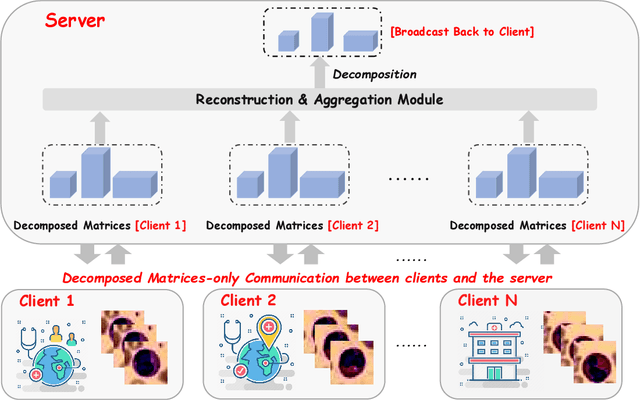
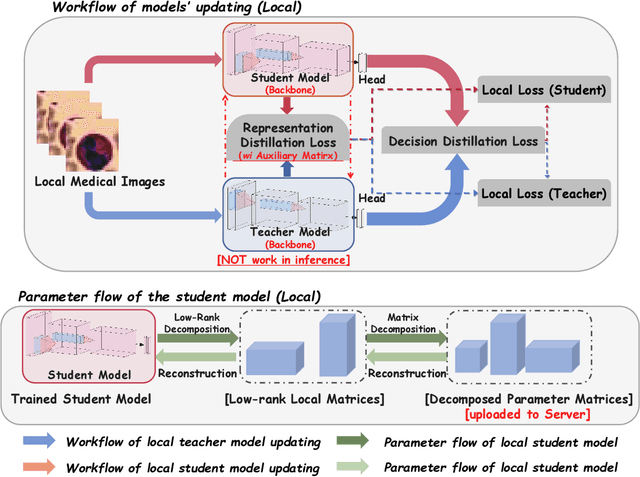
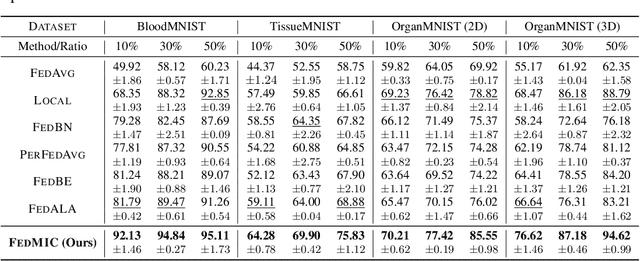
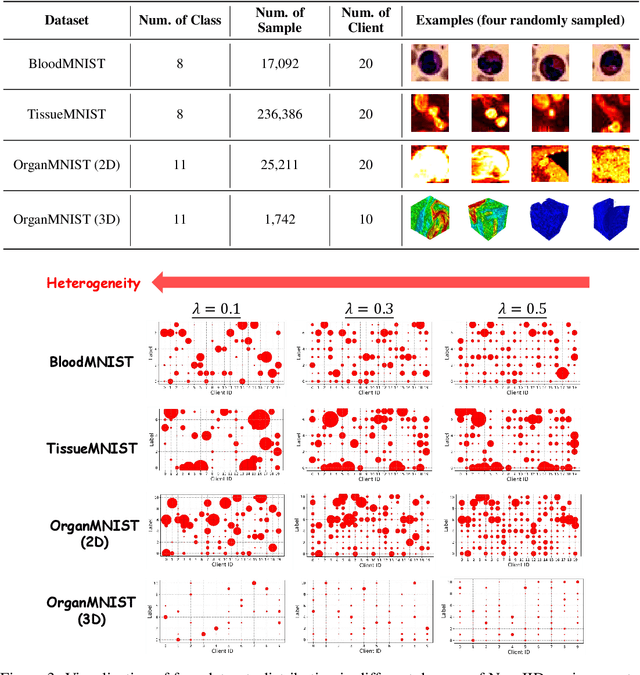
Medical image classification plays a crucial role in computer-aided clinical diagnosis. While deep learning techniques have significantly enhanced efficiency and reduced costs, the privacy-sensitive nature of medical imaging data complicates centralized storage and model training. Furthermore, low-resource healthcare organizations face challenges related to communication overhead and efficiency due to increasing data and model scales. This paper proposes a novel privacy-preserving medical image classification framework based on federated learning to address these issues, named FedMIC. The framework enables healthcare organizations to learn from both global and local knowledge, enhancing local representation of private data despite statistical heterogeneity. It provides customized models for organizations with diverse data distributions while minimizing communication overhead and improving efficiency without compromising performance. Our FedMIC enhances robustness and practical applicability under resource-constrained conditions. We demonstrate FedMIC's effectiveness using four public medical image datasets for classical medical image classification tasks.
Personalized Adapter for Large Meteorology Model on Devices: Towards Weather Foundation Models
May 24, 2024This paper demonstrates that pre-trained language models (PLMs) are strong foundation models for on-device meteorological variables modeling. We present LM-Weather, a generic approach to taming PLMs, that have learned massive sequential knowledge from the universe of natural language databases, to acquire an immediate capability to obtain highly customized models for heterogeneous meteorological data on devices while keeping high efficiency. Concretely, we introduce a lightweight personalized adapter into PLMs and endows it with weather pattern awareness. During communication between clients and the server, low-rank-based transmission is performed to effectively fuse the global knowledge among devices while maintaining high communication efficiency and ensuring privacy. Experiments on real-wold dataset show that LM-Weather outperforms the state-of-the-art results by a large margin across various tasks (e.g., forecasting and imputation at different scales). We provide extensive and in-depth analyses experiments, which verify that LM-Weather can (1) indeed leverage sequential knowledge from natural language to accurately handle meteorological sequence, (2) allows each devices obtain highly customized models under significant heterogeneity, and (3) generalize under data-limited and out-of-distribution (OOD) scenarios.